-
-
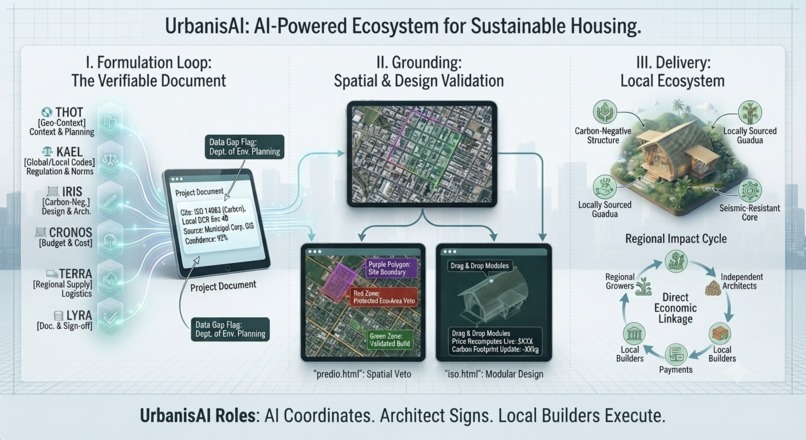
End-to-end AI ecosystem for sustainable, legally compliant modular housing.
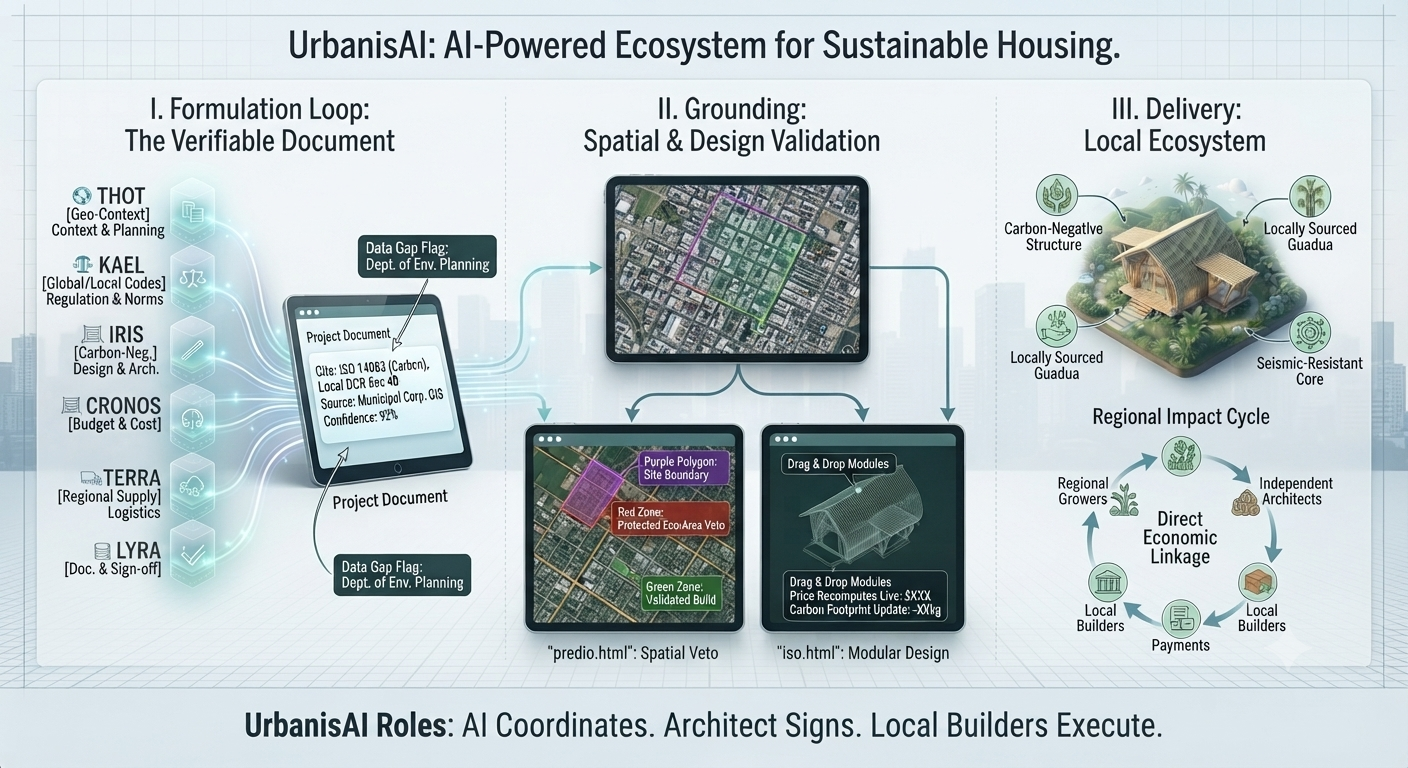
Inspiration
Nearly 3 billion people — close to 40% of the world's population — are living inside a housing crisis right now, and that number keeps climbing as cities absorb billions more residents by 2050. What struck us wasn't a lack of materials, labor, or land — it was that the process connecting them is broken. Independent architects spend months buried in scattered zoning codes before laying a single foundation. Sustainable materials like bamboo and compressed earth block exist but never make it into mainstream construction because no one has made their cost and compliance data easy to access. We wanted to build something that didn't just design better houses, but fixed the pipeline that decides whether housing gets built at all.
What it does
UrbanisAI is an AI-driven ecosystem that takes a housing project from raw site data to a compliant, cost-estimated, submission-ready plan. It connects independent architects, municipal bodies, and local builders around one shared workflow:
Six specialized AI agents — THOT, KAEL, IRIS, CRONOS, TERRA, and LYRA — handle context-gathering, regulatory research, design generation, budgeting, logistics, and final documentation, automatically citing every regulation by legal hierarchy and date. Spatial validation checks proposed sites against satellite data with hard-coded vetoes that block construction outright on flood zones or protected ecological land — no manual override possible. Interactive design and costing lets users drag and drop modular components while cost and carbon footprint recalculate live against real material data. A local sourcing layer routes projects to local builders and sustainable material producers instead of centralized contractors, keeping economic value inside the community being built for.
How we built it
We designed UrbanisAI around a clear separation of concerns: AI handles judgment and synthesis, while deterministic, rule-based code handles anything safety- or legally-critical. The six-agent engine runs on Gemini, with each agent grounded in domain-specific data — regulatory text, material databases, cost indices — rather than general model knowledge, to minimize hallucination risk on outputs that carry legal weight. Spatial validation uses satellite polygon data and geodesic calculations through deterministic geofencing logic, kept entirely separate from the AI layer so a probabilistic model can never override a flood-zone or protected-land veto. The two core interfaces — predio.html for site validation and iso.html for modular design — were built to feel like a single continuous workflow rather than disconnected tools.
Challenges we ran into
The hardest problem was trust: how do you let AI move fast on a domain where being wrong has legal and safety consequences? We solved this by drawing a hard boundary — AI never gets the final word on anything safety-critical. Flood-zone and protected-land checks live entirely in deterministic code the AI cannot influence or override. Another challenge was designing the automatic gap-flagging system: rather than letting an agent guess or silently fail when data was missing, we had to build a mechanism that names exactly which institution is responsible for the missing piece, so the project keeps moving instead of stalling in ambiguity.
Accomplishments that we're proud of
We learned that the biggest barrier to solving the housing crisis isn't a lack of sustainable technology — it's the friction of navigating fragmented, undocumented bureaucracy and disconnected supply chains. We also learned that AI's real value in high-stakes domains isn't in replacing human judgment, but in removing the manual grunt work — research, citation-tracking, recalculation — so humans can focus on decisions that actually require them. Keeping legally-critical logic outside the AI layer wasn't just a technical choice, it became the core design principle that made the whole system defensible.
What we learned
We learned that the biggest barrier to solving the housing crisis isn't a lack of sustainable technology — it's the friction of navigating fragmented, undocumented bureaucracy and disconnected supply chains. We also learned that AI's real value in high-stakes domains isn't in replacing human judgment, but in removing the manual grunt work — research, citation-tracking, recalculation — so humans can focus on decisions that actually require them. Keeping legally-critical logic outside the AI layer wasn't just a technical choice, it became the core design principle that made the whole system defensible.
What's next for Urbanis AI
Our immediate next step is a pilot deployment in one to two partner cities with active housing shortages, testing our agents against real municipal approval processes to validate accuracy before scaling further. From there, we plan to expand KAEL's regulatory database across additional states and countries, building a repeatable framework for onboarding new jurisdictions rather than rebuilding the system each time. We also want to turn our local sourcing network into a live, transactional marketplace connecting builders, architects, and material suppliers directly within the platform. Longer term, we're adding predictive climate-risk modelling — forecasting long-term site vulnerability like shifting flood plains and seismic activity, rather than just checking today's static maps. Our ultimate goal is to position UrbanisAI as core infrastructure for UN-Habitat-aligned housing initiatives, deployed in the world's most climate-vulnerable, fastest-urbanizing regions.


Log in or sign up for Devpost to join the conversation.