-
-
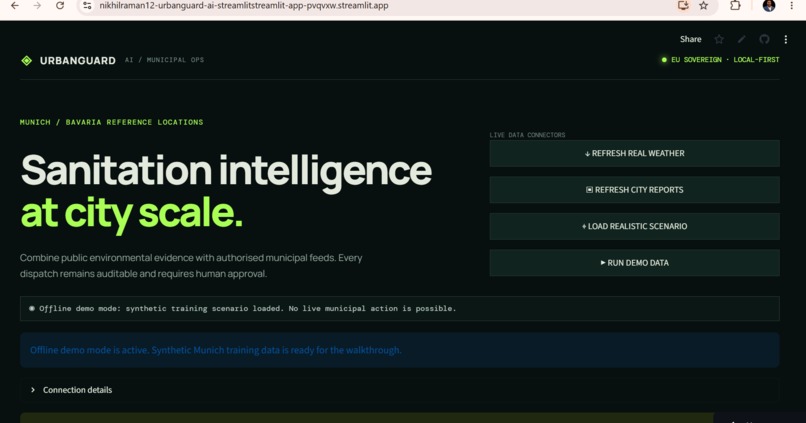
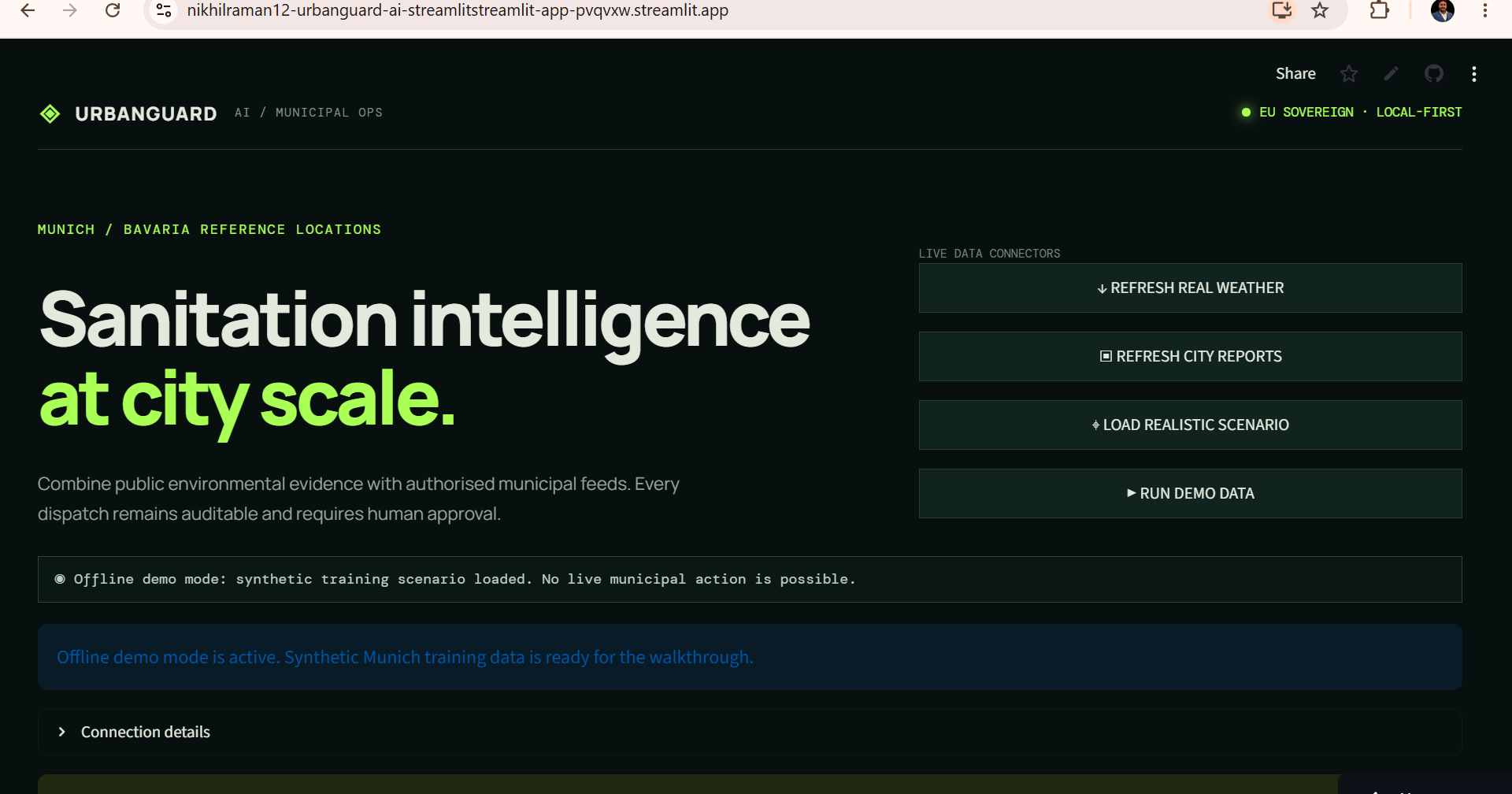
Streamlit Ui showing UrbanguardAI
Inspiration Cities across Europe face a quiet, escalating crisis: climate-driven temperature shifts and aging infrastructure are supercharging vector-borne disease risks (such as mosquito proliferation in stagnant drainage) and urban sanitation bottlenecks. Yet, most municipal responses remain entirely reactive, relying on citizens filing complaints after an overflow or infestation has already occurred. Worse, trying to solve this with standard enterprise cloud stacks collides head-first with strict European data privacy mandates. We wanted to build something that proves public sector AI can be proactive, lightning-fast, and 100% sovereign.
What it does UrbanGuard AI is a local-first municipal sanitation intelligence platform designed for Munich and European cities. It continuously ingests simulated IoT sensor feeds, public weather telemetry, and citizen sanitation reports to compute real-time Pathogen Risk Index (PRI) scores across districts like Neuhausen and Schwabing.
The platform does three critical things:
Explains Risk Contributors: Breaks down exactly why a specific district is flagged (e.g., correlating standing water duration with local temperature spikes).
Multi-Agent Orchestration: Deploys a LangGraph workflow to coordinate sanitation monitoring, regulatory compliance checks, and multilingual public safety draft advisories.
Human-in-the-Loop Governance: Automatically drafts auditable municipal maintenance work orders, strictly requiring explicit human sign-off from a civil servant before any operational action is taken—fulfilling the transparency requirements of the EU AI Act.
How we built it We engineered UrbanGuard AI with a production-grade, privacy-first technical stack:
Backend & Core: Built with Python 3.10+, FastAPI, and Pydantic v2 for robust, typed data handling.
Agentic Logic: Orchestrated using asynchronous LangGraph loops to manage multi-agent decision paths without black-box drift.
Sovereignty & Inference: Designed for local-first open-weights model execution (Ollama / Hugging Face endpoints) to ensure zero data leaves European infrastructure boundaries.
Frontend & Deployment: Delivered via a high-performance Streamlit application interface, ensuring seamless accessibility for judges to test live environmental scenarios and risk maps instantly.
Challenges we ran into Balancing rigorous regulatory compliance with rapid hackathon execution was our biggest hurdle. Designing a multi-agent workflow that must pause for human validation meant restructuring our asynchronous endpoints so the system naturally waits for a civil servant's approval rather than rushing autonomous execution. We also had to fine-tune our mock telemetry generators to reflect realistic European municipal topographies (such as Munich district grids) while maintaining clean offline fallback resilience.
Accomplishments that we're proud of True European Alignment: Building a system that treats GDPR and the EU AI Act not as afterthoughts, but as core architectural pillars.
Zero-Leakage Architecture: Successfully proving that municipal intelligence can run locally on sovereign infrastructure without depending on external proprietary hyperscaler APIs.
Production-Ready Polish: Delivering a clean, transparent interface complete with built-in safety disclaimers, live risk heatmaps, and auditable work order drafting.
What we learned We learned firsthand that the future of public sector AI isn't about replacing human judgment—it's about empowering civil servants with transparent, explainable decision support. Building strict human-in-the-loop controls actually made our agentic architecture cleaner, safer, and far more credible for real-world municipal deployment.
What's next for UrbanGuard AI Real-World IoT Integration: Partnering with municipal pilot programs to plug actual LoRaWAN sensor streams and open municipal GIS datasets into the pipeline.
Advanced Vector Modeling: Expanding epidemiological models to forecast seasonal pathogen transmission rates weeks in advance.
Multilingual Expansion: Scaling the communication agent to cover all official EU languages for seamless cross-border municipal collaboration.

Log in or sign up for Devpost to join the conversation.