-
-
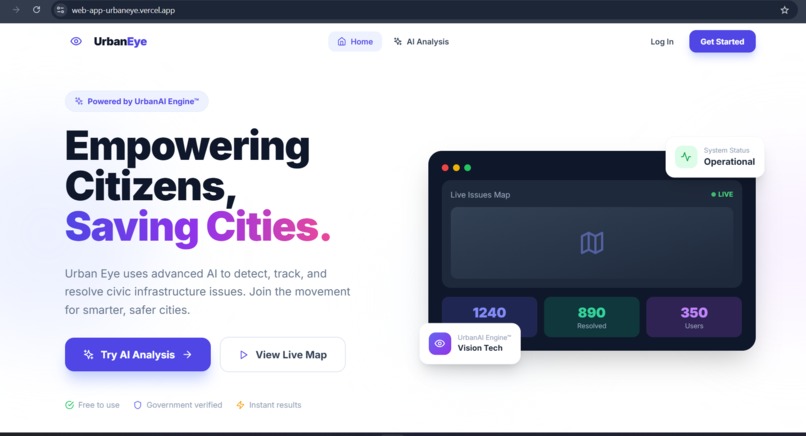
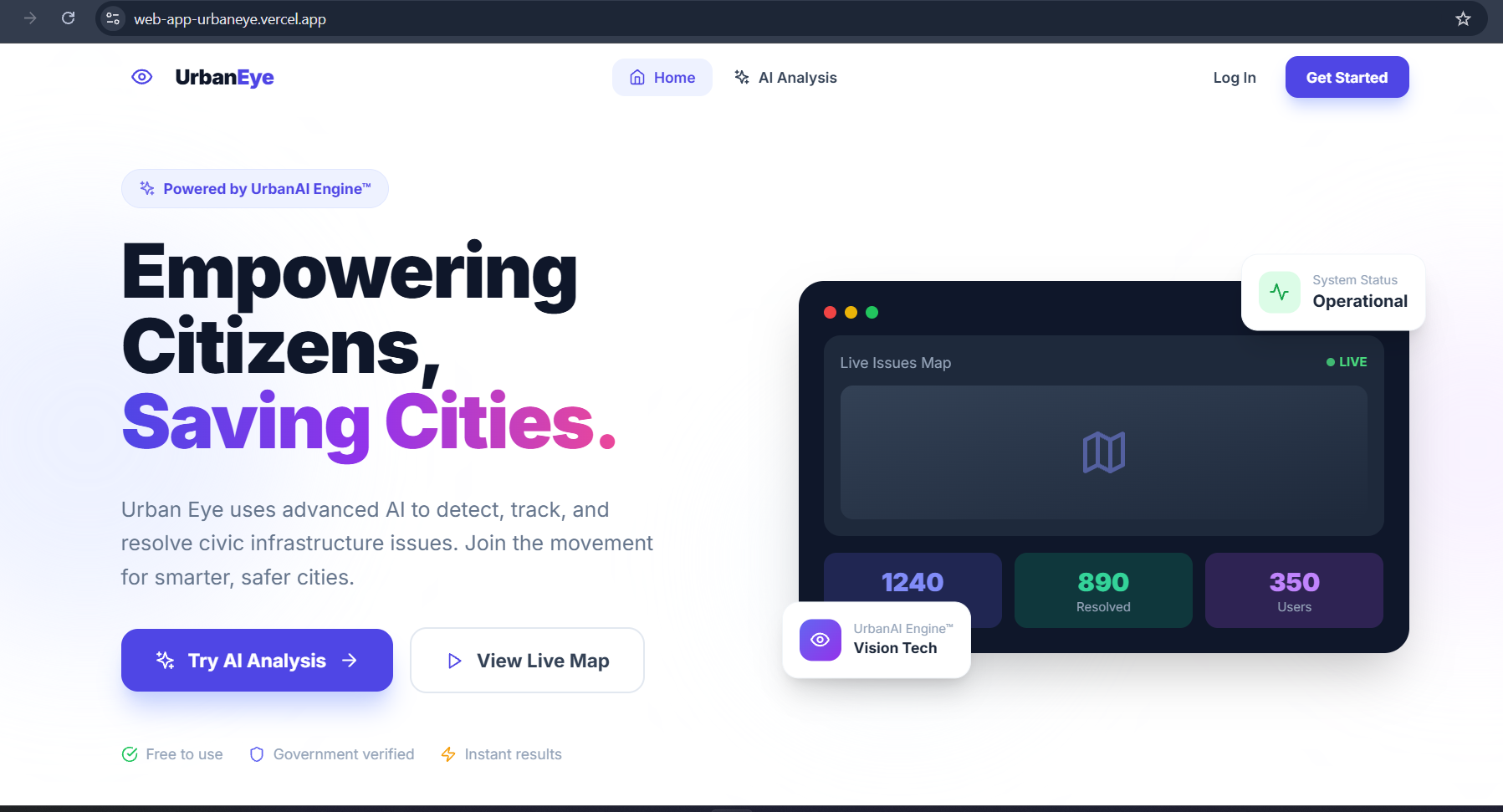
Landing Page of the application.
-
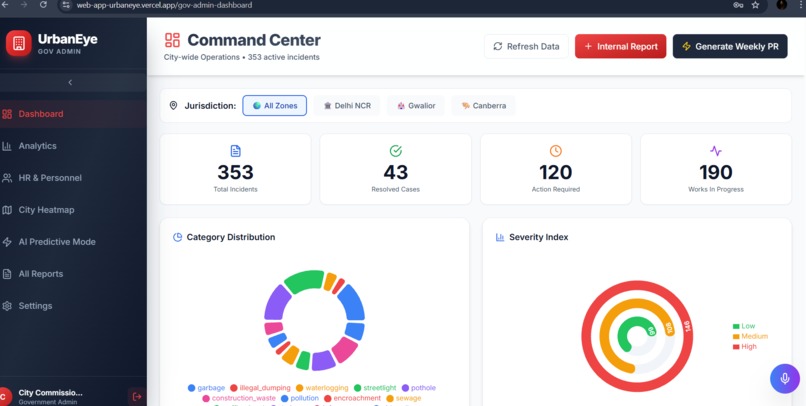
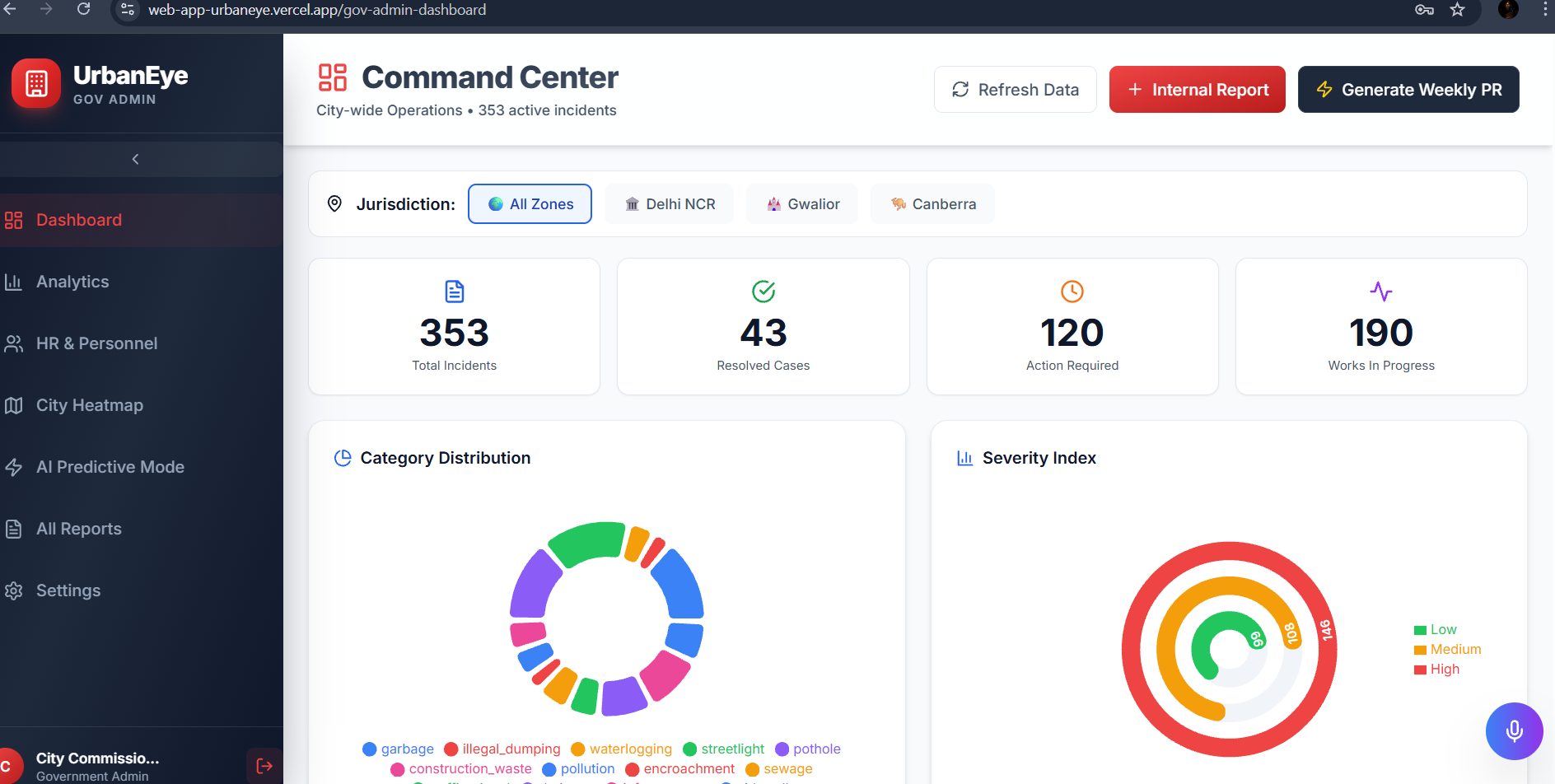
Government admin landing page
UrbanEye – AI-Powered Civic Accountability Platform
Inspiration
In today’s cities, everyday civic issues like potholes, garbage accumulation, sewage overflow, and electrical faults are everywhere. However, the process of reporting and resolving them is often:
- Slow
- Disconnected
- Non-transparent
- Demotivating for citizens
There is no unified system that connects citizens, government bodies, NGOs, and private maintenance workers on a single collaborative platform. We asked ourselves: "What if reporting a civic issue was as simple as posting on social media — but led to real, trackable action?" That question led to UrbanEye.
What UrbanEye Does ??
UrbanEye is an AI-powered civic issue reporting and resolution platform designed to significantly improve the efficiency, transparency, and accountability of urban governance systems. The platform enables citizens to report civic issues such as potholes, garbage accumulation, sewage overflows, and electrical faults through a minimal image-based workflow, reducing report submission time compared to traditional manual complaint systems. At the core of UrbanEye is an AI-driven visual intelligence engine that analyzes uploaded images to automatically classify issue type, assess severity, and route complaints to the appropriate department or service provider. This automation eliminates manual categorization and accelerates issue handling, achieving 95%+ accuracy in issue classification across 8+ civic issues categories. UrbanEye operates as a unified ecosystem connecting citizens, field workers, government officials, department heads, and system administrators through role-based access control. The platform supports 7 distinct user roles, each with a dedicated interface tailored to their responsibilities, ensuring clear accountability and streamlined coordination.
Key Features & Functionalities:
1. AI-Based Issue Classification & Prioritization : Automatically identifies issue type and severity from images, reducing errors and manual verification effort.
2. Flexible Resolution Pathways : Routes issues to government departments based on urgency and availability.
3. Dedicated Role-Based Panels : Separate dashboards for citizens, government employees, service providers, and administrators to support real-world governance workflows.
4. Social-Civic Engagement Mechanisms : Issue tracking, resolution ratings, badges, and leaderboards to recognize citizen contributions and drive sustained participation.
5. Scalable & Government-Compatible Architecture : Built using open standards, secure APIs, and modular components to support multi-city deployment and future service expansion.
6. Data-Driven Insights & Future Predictive Capability : Aggregated issue data enables identification of high-risk zones and supports long-term urban planning and proactive maintenance.
7. Multilingual & Inclusive Interface : Supports multiple regional languages with a guided, intuitive UI, ensuring accessibility for users across diverse linguistic backgrounds, literacy levels, and age groups.
8. Optimized Data Retention & Storage Management : Uploaded images are securely stored only for a defined verification and audit period and are automatically archived or discarded thereafter, reducing server load while maintaining privacy and system efficiency.
9. Open-Source & Vendor-Neutral Platform : Built on a 100% open-source technology stack, ensuring zero licensing costs, long-term sustainability, vendor independence, and easy adoption by government bodies and smart city initiatives.
10. Enterprise-Grade Security & Data Protection : Implements secure authentication, encrypted data storage, and role-based access control in compliance with national cybersecurity guidelines and the Digital Personal Data Protection (DPDP) Act, ensuring citizen data safety and system integrity.
11. Offline-First & Resilient Architecture : Designed to function in low or intermittent connectivity environments by enabling offline issue capture and queued synchronization, ensuring uninterrupted service availability in underserved or high-traffic urban areas.
How We Built It :
Tools & Frameworks Used:
Frontend:
- React.js: Open-source, component based, responsive
- Tailwind CSS: Utility-first, low bundle size, accessible
- Framer Motion: Smooth animations for touch interactions
Backend:
- Python: Government-preferred, extensive libraries
- Flask: Lightweight, easy to deploy, well-documented
- Flask-RESTx: Auto Swagger docs, validation
- Gunicorn: Production WSGI server
Database:
- PostgreSQL: Government-standard, ACID compliant, free
- Redis: Session management, caching
Authentication:
- JWT: Stateless, scalable authentication
- OAuth2: Standard protocol for third party auth
Security:
- TLS: Encrypted communications
- bcrypt: Password hashing
- AES-256: Data encryption at rest
AI/ML:
- UrbanAI Engine: Proprietary computer vision & NLP
Payment:
- Razorpay/PayU: UPI, cards, net banking
Challenges We Faced :
Designing a Multi-Stakeholder Model Balancing the needs of: Citizens, Government bodies, NGOs and Private workers was complex. Each required a dedicated panel and workflow.
Building Reliable Issue Classification Ensuring the AI could correctly identify civic problems required careful dataset handling and tuning.
Maintaining Transparency We had to design a system where issue tracking remains visible, fair, and tamper-resistant.
Time Constraints As a hackathon project, building frontend, backend, AI integration, and deployment within limited time was challenging.
What We Learned :
Building scalable civic tech requires both technical and social thinking. AI is powerful only when integrated into a real workflow. Transparency and gamification increase user engagement dramatically. Collaboration is the key to sustainable urban development.
What's next for UrbenEye??
Future Improvements & Scalability: UrbanEye is built on a future-ready, cloud-native architecture, allowing it to scale seamlessly from local pilots to national and global deployments while continuously evolving with urban needs.
Future Enhancements:
Advanced AI Verification to detect fake, duplicate, or misleading reports using metadata, context, and historical analysis.
Voice AI Support for hands-free reporting and accessibility.
Expanded Gamification & Incentives, including tier-based rankings, community challenges, and reward partnerships.
Regional Customization, supporting local languages, workflows, and administrative rules.
Scalability & Growth Roadmap
Short-Term (6–12 months): Pilot deployments with 2–3 municipalities, offline support, ERP integration, multilingual rollout, and 10,000+ users.
Medium-Term (1–2 years): Expansion to 50+ cities, IoT sensor integration (smart bins, water monitors), predictive maintenance models, and an open API ecosystem.
Long-Term (3–5 years):International expansion, white-label deployments, open urban data platforms, and positioning UrbanEye as a global civic-tech standard.


Log in or sign up for Devpost to join the conversation.