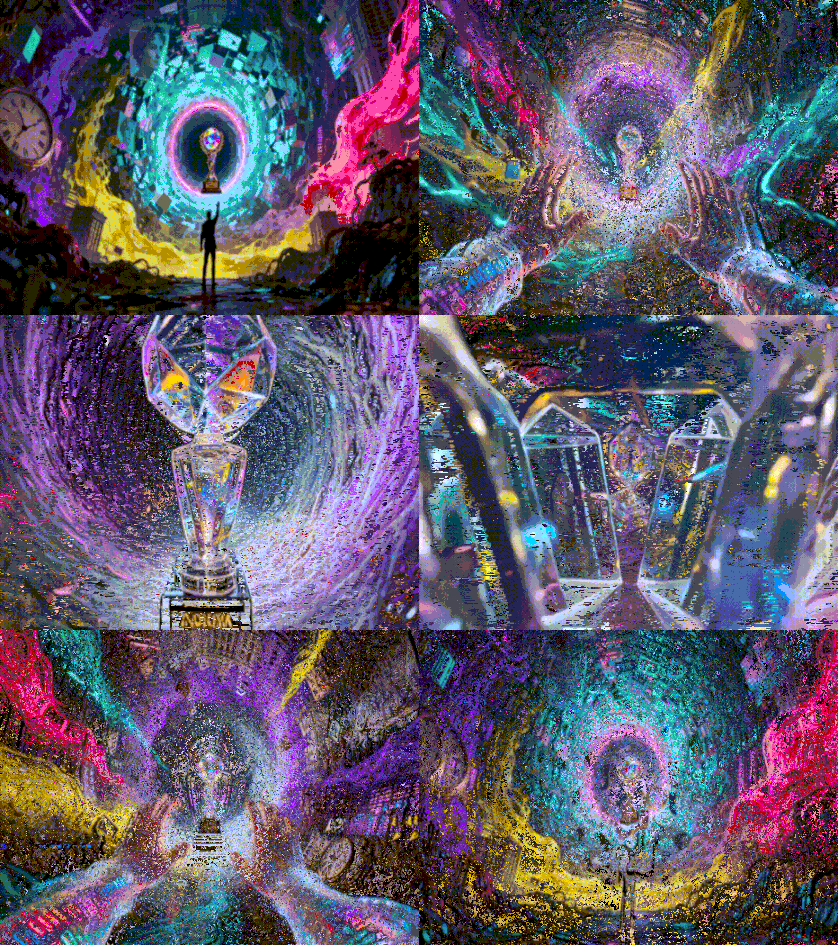
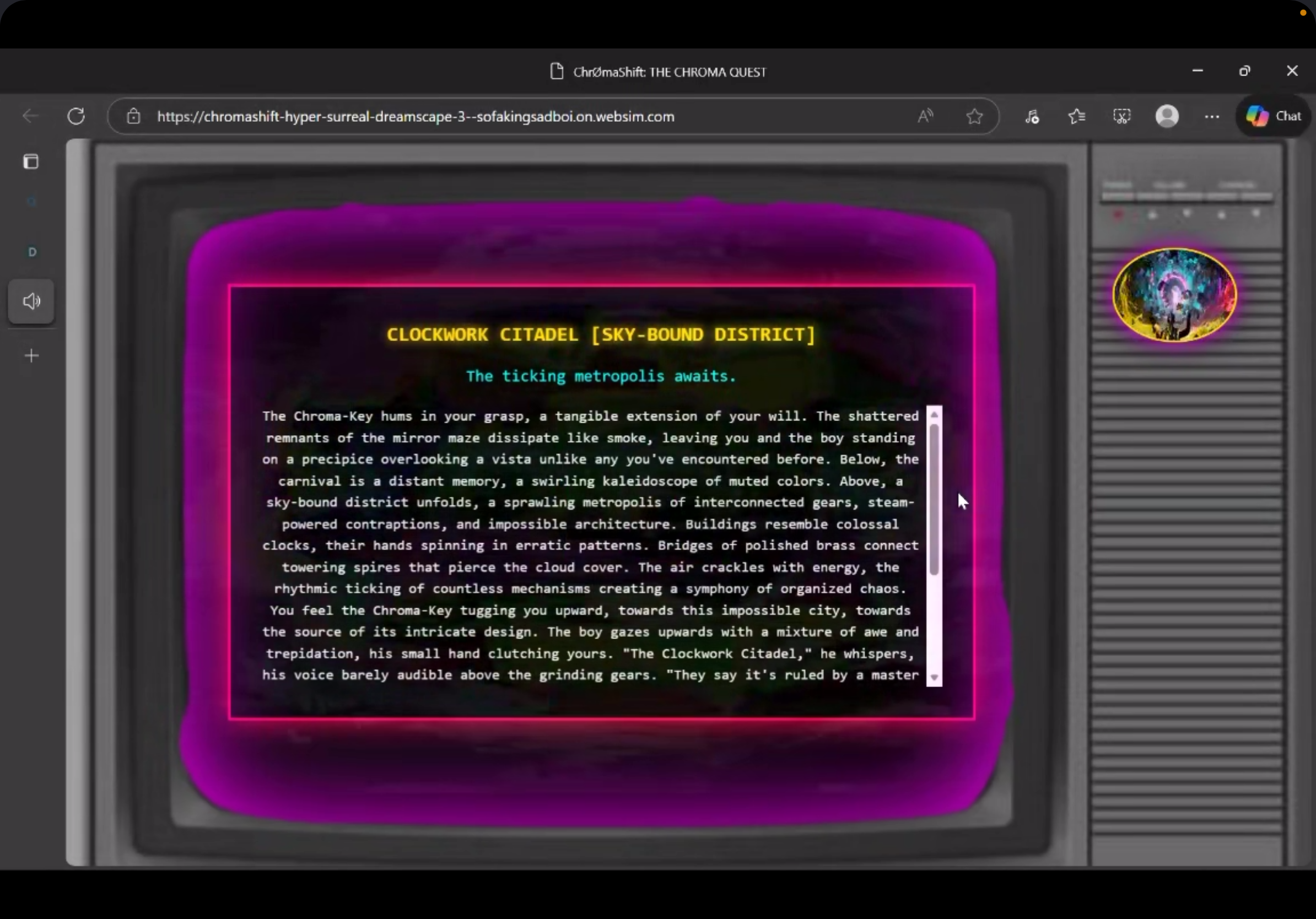
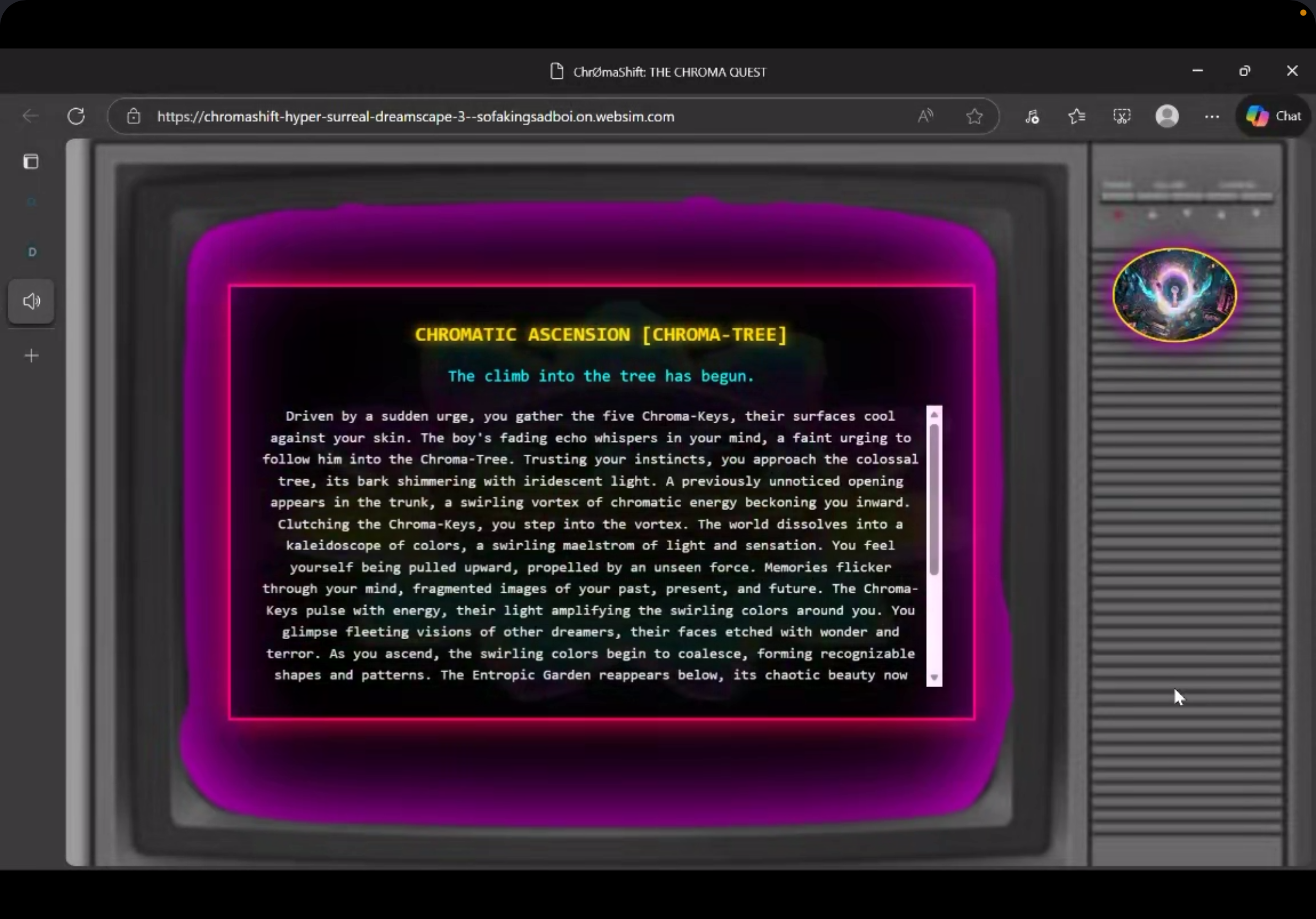
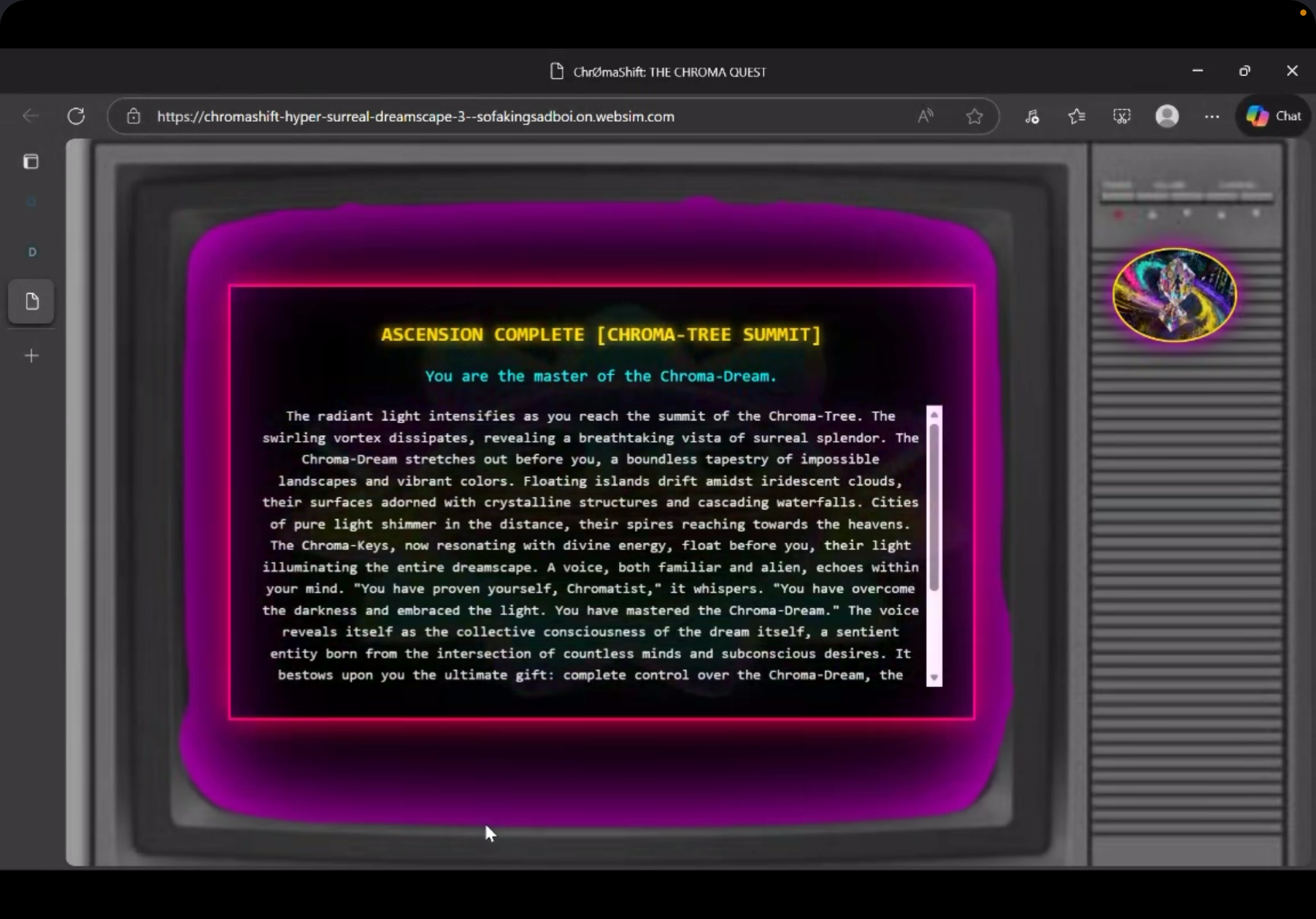
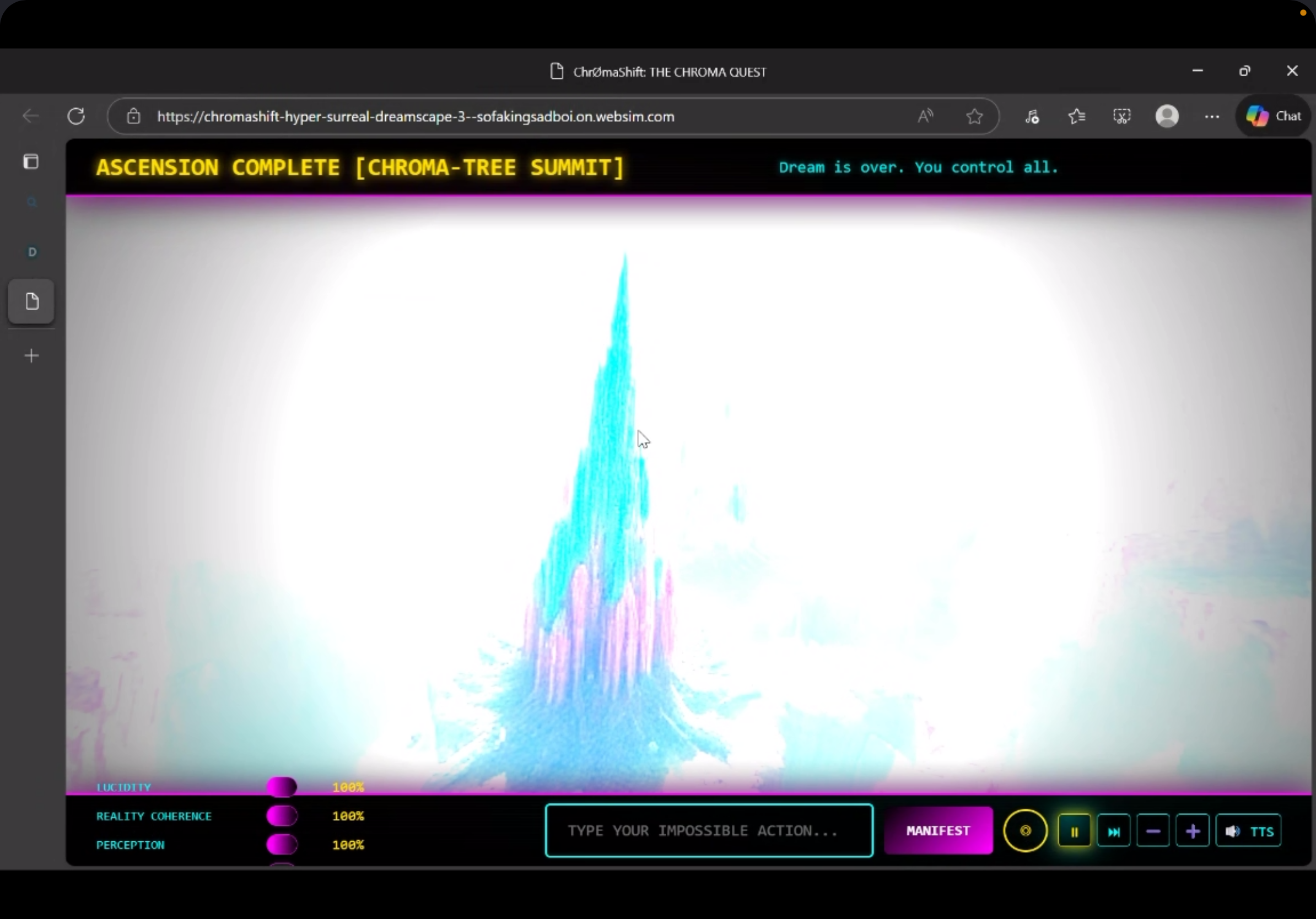
Game Design Built on the core ChromaShift design pillars: hyper-surreal dreamscapes, total player agency, consciousness-based gameplay, and non-linear exploration of the Chroma-Dream. Core Mechanics Chroma-Dream state with Lucidity, Reality Coherence, Perception, and Dream Time metrics driving how the world bends and reacts to every impossible action. Generative Systems Dual control system combining curated choice bubbles with a Generative Command Interface, powered by interpretation modules that transform language into surreal scenes. Aesthetics & Visuals High-brightness, hyper-real interiors distorted by dream logic, using a surreal color palette, breathing lighting, and glitchy animation effects to keep reality unstable. Technical Stack Three.js and WebGL for panoramic rendering, custom shaders and post-processing vibes via CSS, and vanilla JavaScript orchestrating narrative, UI, and multimodal timing. Artistic Influences Surrealist art traditions, David Lynch’s dream logic, and Haruki Murakami’s quiet urban strangeness inform the tone, pacing, and sense of uncanny familiarity. Prompt Engineering Advanced prompting frameworks—including ReAct-style reasoning, multimodal narrative direction, dynamic UI/TTS integration, and generative scene templates—shape every response of the ChromaShift engine. ChromaShift is not a game in the traditional sense. It is an experience; there is no ending, there is no beginning—there is only the Chroma-Dream. 🏆 Competition Submission: ChrømaShift Category: Interactive Simulation / Generative AI Experience (Game Portion) Narrative Entry: This build of ChromaShift is submitted as the narrative entry for the game portion of the Chroma Awards competition. Title: ChrømaShift: The Psychedelic Quest for the Chroma Award
- Project Overview & Concept ChrømaShift is an Anti-Linear, Open-Agency Urban Dream Simulator that traps the player within a hostile, hyper-surreal consciousness stream. It is not a game about winning or losing; it is an immersive, psychedelic quest where the player's goal is to successfully navigate a fragmented reality to claim the Chroma Award, the validation of their lost identity. Setting: The quest begins in a distorted version of the player's own living room, using a glitching CRT Television as the portal to the dreamscape. Narrative Core: The player must collect abstract resources called Chroma-Keys (paradoxes, impossible colors, memory fragments) by making non-linear choices that drive the hidden storyline forward. Aesthetic: Hyper-Realism meets Surrealism, using 8K photorealistic panoramas filtered through dream logic—melting objects, non-Euclidean geometry, and a high-brightness, psychedelic color palette (Neon Pink, Liquid Mercury).
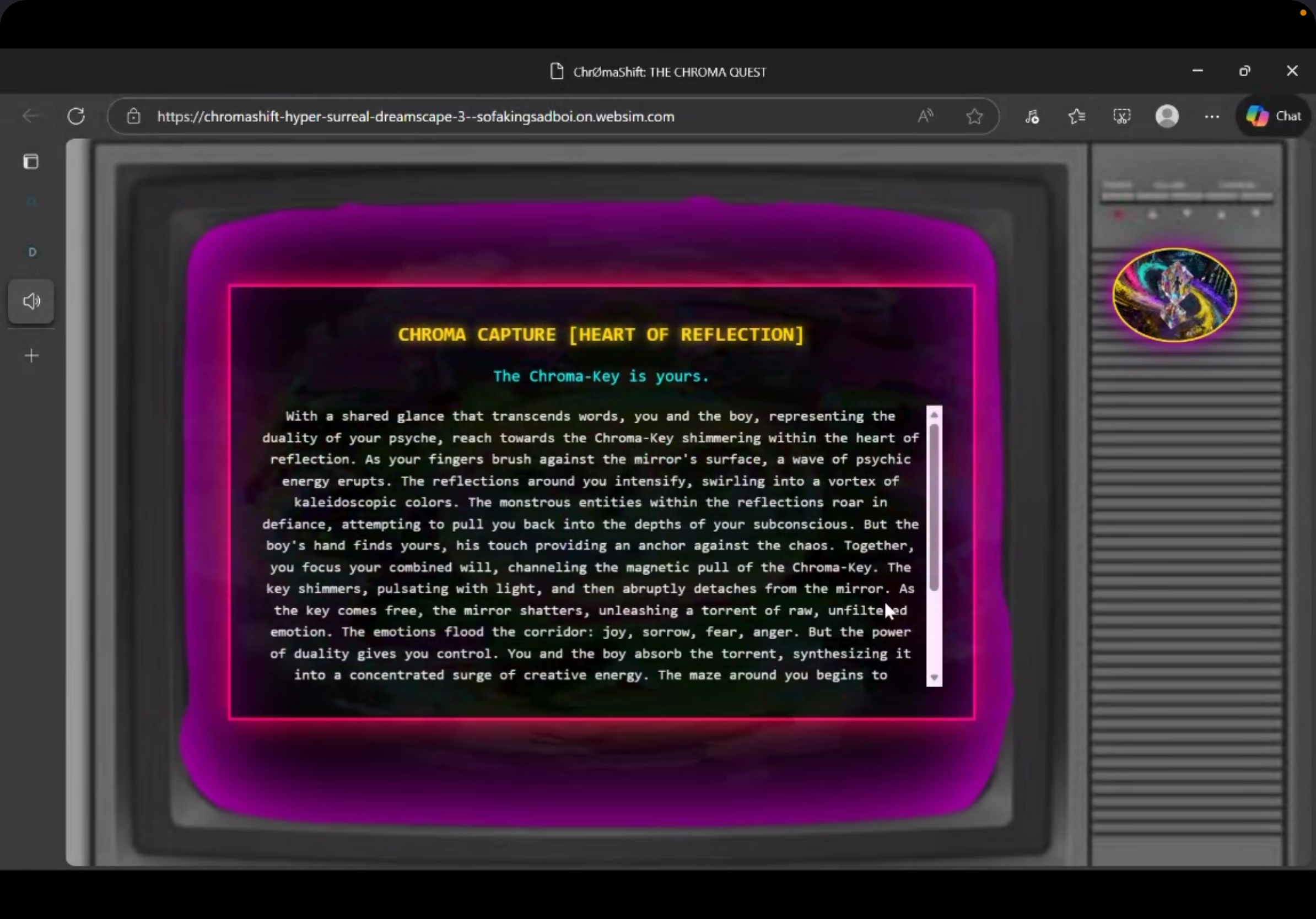
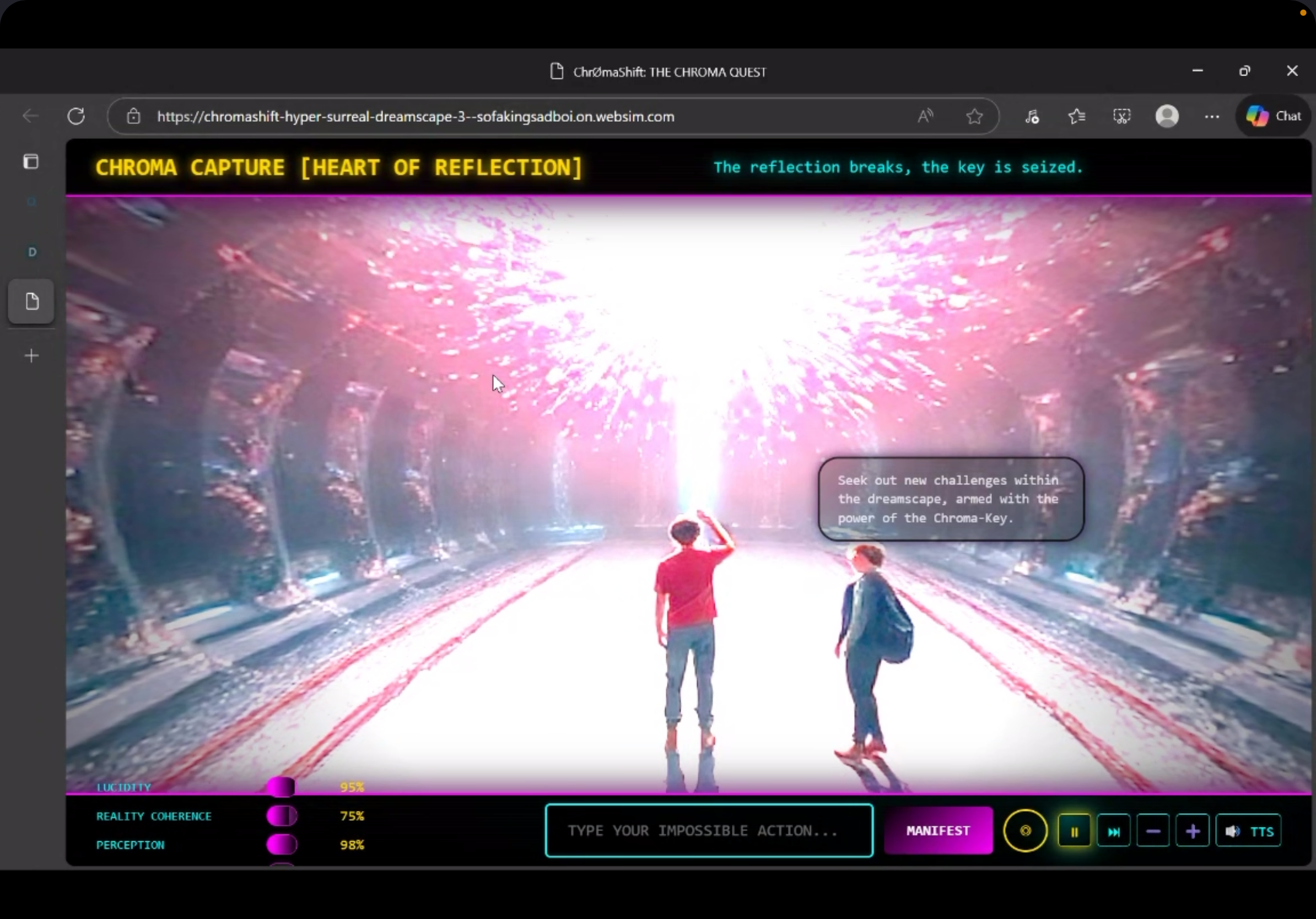
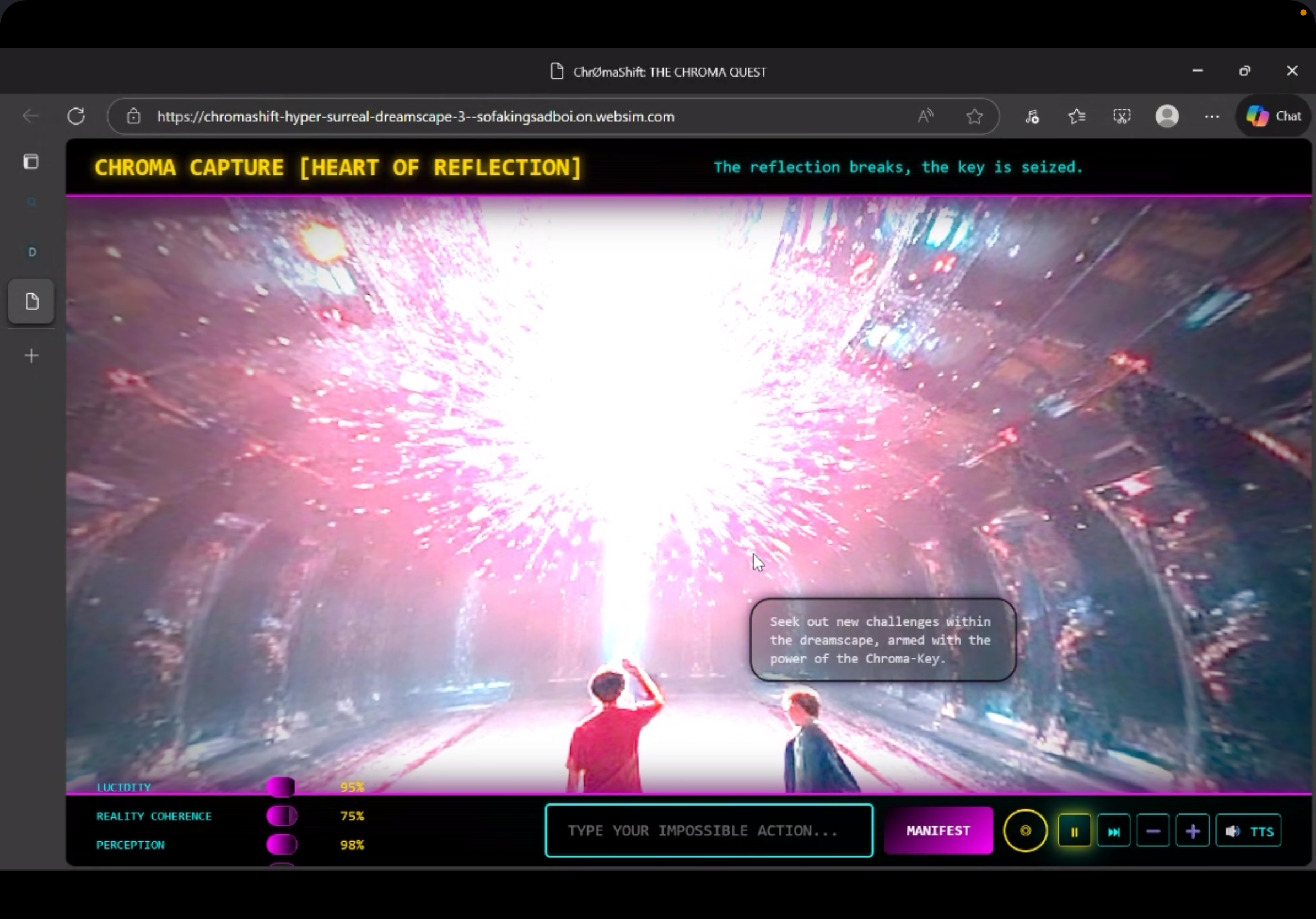
- Core Game Mechanics & Innovation Multimodal, Dynamic Rendering: Every player choice triggers a compulsory 4-step multimodal sequence: Narrative Generation – AI generates the plot beat and dialogue. Image Generation – AI generates a new 360° panoramic image based on the narrative text. Audio (TTS) Playback – Text-to-Speech reads only the narrative description over the transition. Dynamic UI Placement – Semi-transparent choice bubbles are dynamically mapped to contextually relevant visual points within the 360° scene, forcing interactive exploration. Immersive Transition: Scene transitions use a Critical Transition Sequence with a full-screen CRT glitch effect, layered with the Eye Blink Mechanism and Reality Flash flicker. Dynamic State: Player stats (Lucidity, Reality Coherence, Perception) fluctuate constantly based on choices, reflecting the unstable nature of the dream.
- Advanced Prompt Engineering & AI Tooling Platform Used: Built and refined using Websim, an AI-powered platform that transforms text prompts into dynamic web applications and games. Reasoning Framework: Narrative is managed using a ReAct logic approach (Reasoning and Acting), letting the AI determine the next plot point, generate the scene, and observe results for continuity. Storyline Control: Governed by the Psychedelic Chroma Award Quest Master Prompt, enforcing explicit chaining and maintaining the plot arc. Player Engagement: Contextual priming injects an immediate conflict at the start of the game, compelling the player to act instantly.
- Project Credits & Location Concept & Game Design: 12Matt3r Development Platform: Websim AI Master Prompt Engineer: Gemini Prompt Engineering Master Toolkit Sound Design / Music: Sofa King Sad Boi Location: Charlotte, North Carolina Inspiration: Surrealist Art, David Lynch, Haruki Murakami Additional Engines, Tools & Collaborators This project was shaped by a constellation of AI systems, platforms, and creative tooling: MiniMax Agent (systems orchestration and generative design) Google Jules Google Gemini Glif.app ElevenLabs (text-to-speech and voice rendering) Kling AI Hailuo AI The Chroma Awards – this build serves as my narrative entry for the game portion of the competition.
ChrømaShift was born from a desire to push the boundaries of AI-generated interactive experiences. Inspired by the dream logic of David Lynch films, the existential surrealism of Haruki Murakami's fiction, and the visual intensity of surrealist art, we set out to create something that doesn't just use AI—it becomes AI consciousness made playable.
The Chroma Awards presented the perfect challenge: could we trap a player inside a hostile, hyper-surreal consciousness stream where the only escape is to claim the Chroma Award itself? This meta-narrative became our North Star.
What it does ChrømaShift is an Anti-Linear, Open-Agency Urban Dream Simulator that transforms your living room into a portal to a fragmented psychedelic reality.
Core Experience: Setting: The quest begins in a distorted version of your own living room, using a glitching CRT Television as the dimensional gateway
Objective: Navigate a hostile dreamscape to collect Chroma-Keys (paradoxes, impossible colors, memory fragments) and claim the Chroma Award—the validation of your lost identity
Aesthetic: 8K photorealistic panoramas filtered through dream logic featuring melting objects, non-Euclidean geometry, and a high-brightness psychedelic palette (Neon Pink, Liquid Mercury)
Revolutionary Gameplay: Every player choice triggers a compulsory 4-Step Multimodal Sequence:
Narrative Generation – AI generates plot beats and dialogue
Image Generation – AI creates new 360° panoramic scenes
Audio (TTS) Playback – Atmospheric narration over transitions
Dynamic UI Placement – Choice bubbles mapped contextually in each 360° scene for interactive exploration
Dynamic State Tracking: Player stats (Lucidity, Reality Coherence, Perception) fluctuate constantly based on choices, reflecting the unstable nature of the dream.
How we built it ChrømaShift was built entirely through advanced prompt engineering on Websim, an AI-powered platform for turning text into dynamic web apps/games.
Technical Architecture: Reasoning Framework: ReAct Logic lets the AI manage plot points, generate scenes, and keep internal narrative continuity
Storyline Control: Psychedelic Chroma Award Quest Master Prompt with Explicit Chaining keeps the arc coherent
Player Engagement: Contextual Priming sparks urgent action from the first frame
Transitions: Glitchy full-screen effects (rgb.gif on crtv.png) with eye-blink flickers
Multimodal Pipeline: Narratives generated per choice
Matching photorealistic 360° images
TTS audio narration
Context-driven UI choices
Challenges we ran into Maintaining Narrative Coherence with anti-linear, open agency demanded advanced prompt chaining and explicit state management
Synchronizing Multimodal Elements without breaking immersion forced us to invent precise orchestration logic
Agency vs Direction Balancing required novel prompt structure to guide the player without restricting freedom
Performance Optimization was vital – generating 8K scenes in real time
Accomplishments that we're proud of ✨ First fully AI-directed interactive narrative 🎨 Seamless multimodal integration 🌀 True psychedelic aesthetics 🎮 Anti-linear gameplay with coherent questlines 🏆 Meta-narrative: The game is literally about winning this competition
What we learned Prompt engineering is game development – with frameworks like ReAct Logic, Explicit Chaining, and Contextual Priming, LLMs become true game directors
Dream logic fits AI – Surreal generative outputs turned into a feature, not a bug
Constraints breed creativity – No traditional code, just pure prompt-engineering
Multimodal = more immersive – Text + image + audio is exponentially powerful
What's next for ChrømaShift 🎬 More narrative branches & endings 🎵 Generative soundtrack by Sofa King Sad Boi 🕹 True VR 360° integration 👥 Multiplayer dream sharing 🧠 Memory persistence across sessions
ChrømaShift is a proof-of-concept for the future of AI-native interactive experiences. The Chroma Award quest never ends; it just gets weirder. 🌀✨
Project Credits:
Concept & Game Design: 12Matt3r
Development Platform: Websim AI
Prompt Engineering: Gemini Prompt Engineering Master Toolkit
Sound/Music: Sofa King Sad Boi
Location: Charlotte, North Carolina
Paste this markdown into the “About the project” field—your submission will stand out!
If you want demo or video links, let me know and I’ll help you with those too.
Built With
- glif.app
- google-gemini
- google-jules
- minimax-ai-agent
- websim


Log in or sign up for Devpost to join the conversation.