We started from a simple but painful reality: a good tutor isn’t just someone who explains well – it’s someone who can manage 20–30 students in parallel, remember their personalities, track their progress, notice when they’re losing interest, and still show up as a warm human every lesson.
In practice that’s almost impossible: many students never come back after the first or second session, a big share of tutors have no clear method or preparation routine, and even though AI is powerful, about two out of three people say they don’t want pure AI in tutoring – they still want a human in the loop.
That led us to our core belief:
Consistency beats intensity.
Uptum was born from the idea of giving human tutors AI superpowers – so they can deliver consistent, personal, emotionally aware learning journeys instead of fighting chaos in spreadsheets and memory.
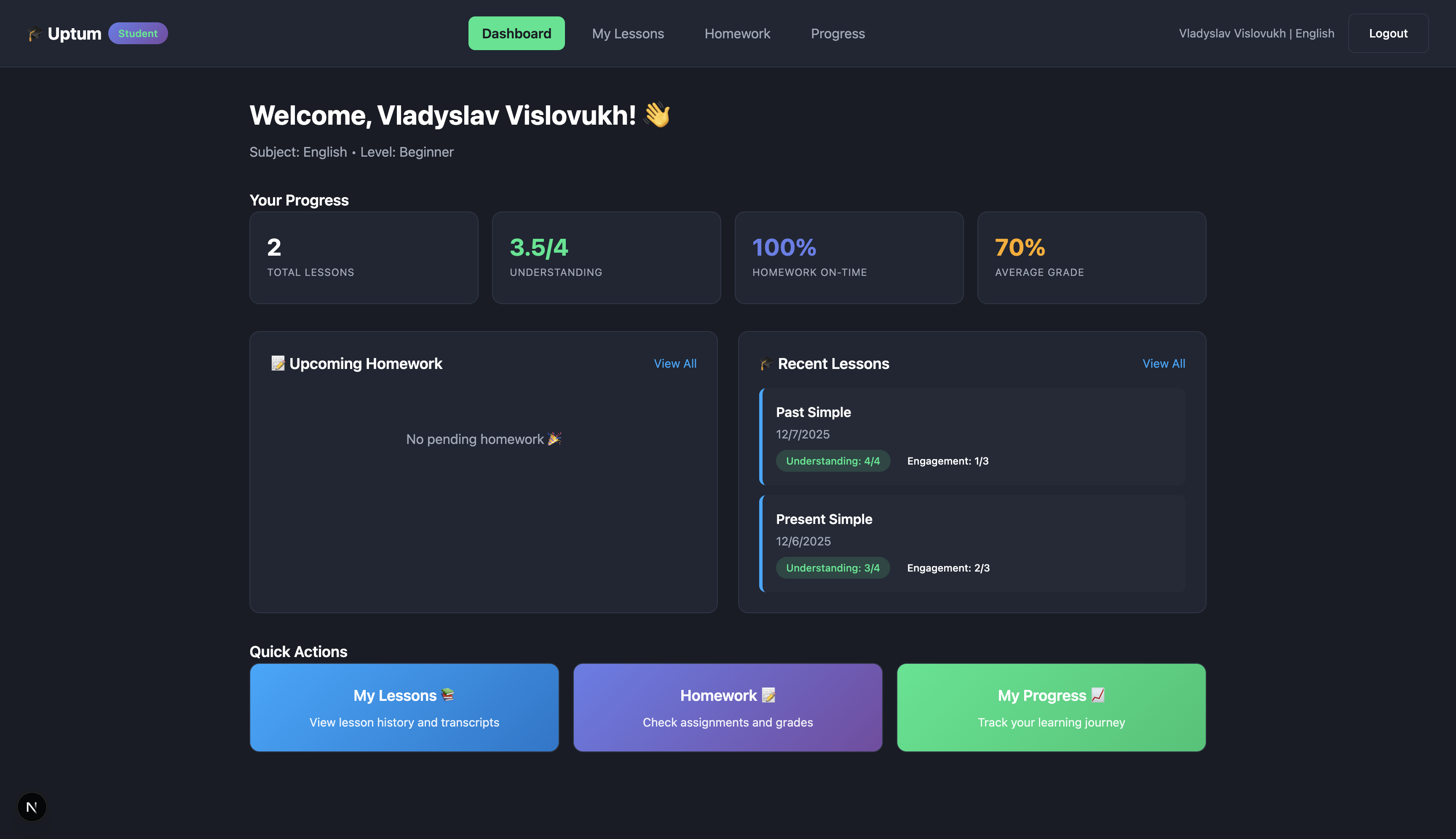
We see a huge issue that generally student management is incredibly tiresome for the tutor. Leading 30 students in parallel remembering personal details, accounting for personality types, levels of engagement, individual needs and even the progress made during the previous sessions. In practice this affects the quality of a tutor experience greatly. 44% percent of people never come to the second lesson. And this is very reasonable as (just think of it) 35% of tutors don’t have any evident approach at all basically meaning that they don’t prepare for the lessons at all. And on the higher level it’s incredibly important to have a student consistency coming back to lessons. Because they are interested, because they feel good, because the student feels very personal human connection with the tutor. When the course gets to difficult it should be easier. When the course gets too boring we can raise the level of tasks. Meanwhile with all the benefits that AI provides such as infinite source of information, consistency, continuity people hate interacting with AI when they don’t expect it. Even in commercial setting as of 2024 (and we’re way above this already) 64% customers reported that they don’t want to see any AI in customer service and tutoring is a waaay more personal experience. Something that could not be completely automatized. And this is where Uptum comes into play. We offer an AI native platform designed to maximize the engagement and a lifetime of a student by providing all the necessary tools to the tutor. With our platform each person in a tutor’s portfolio will have an account with analytics and summary of a pupils profile.
We have three core tools in mind:
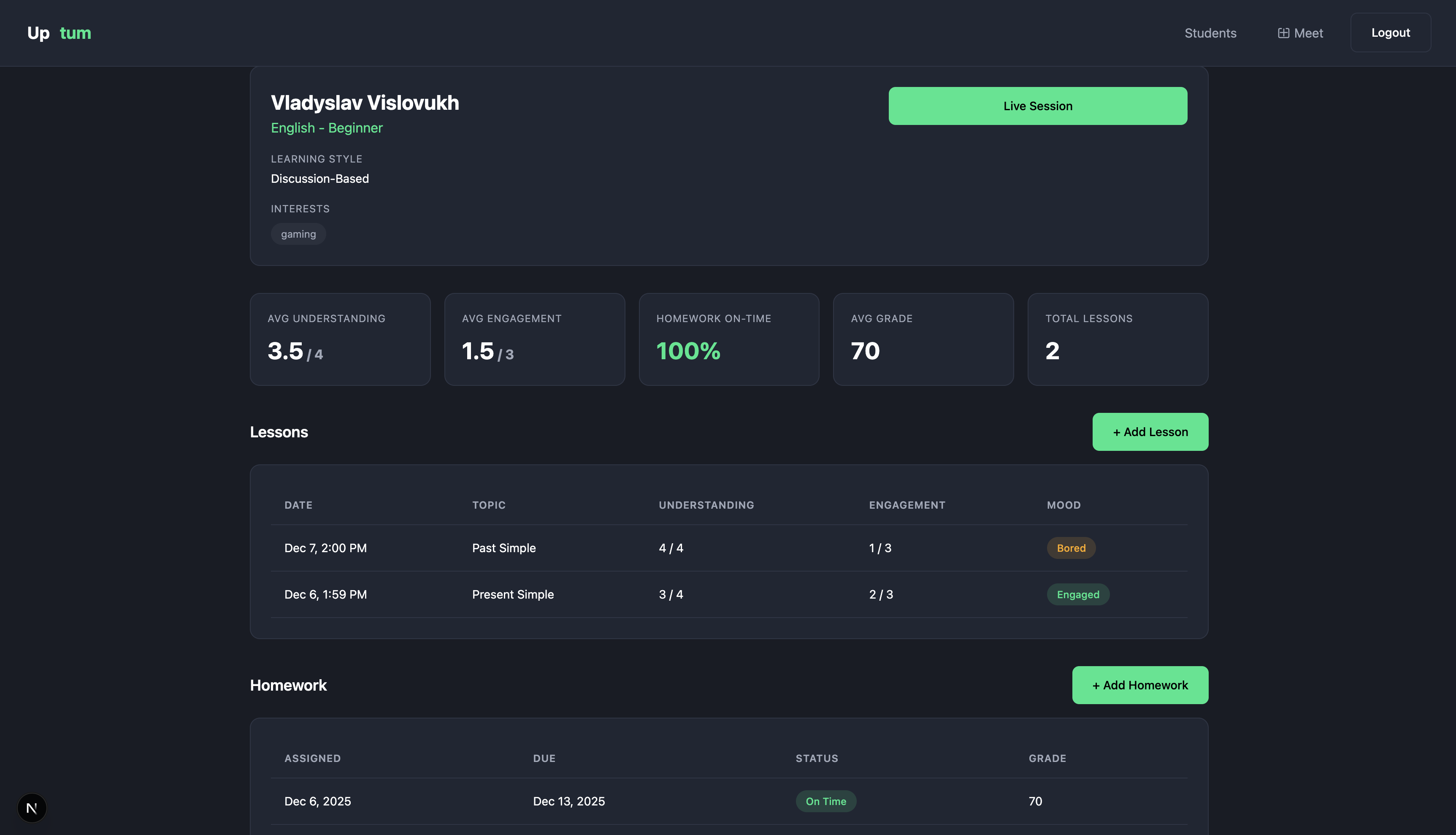
- Transcription of all calls is summarized and written and gradually fills and updates a short dossier of a student. Context switching is now easy even at a scale as a short student file will appear before the lesson and get tutors mind exactly to the point where the last lesson finished. Where has the student went this weekends? What sports interest him? Was the exam he took on Friday successful?
- Live stream video of a lesson is analyzed in real time for emotions against the lesson content that will help tutor document and analyze data over time. This data could be then used to iteratively improve the lessons content.
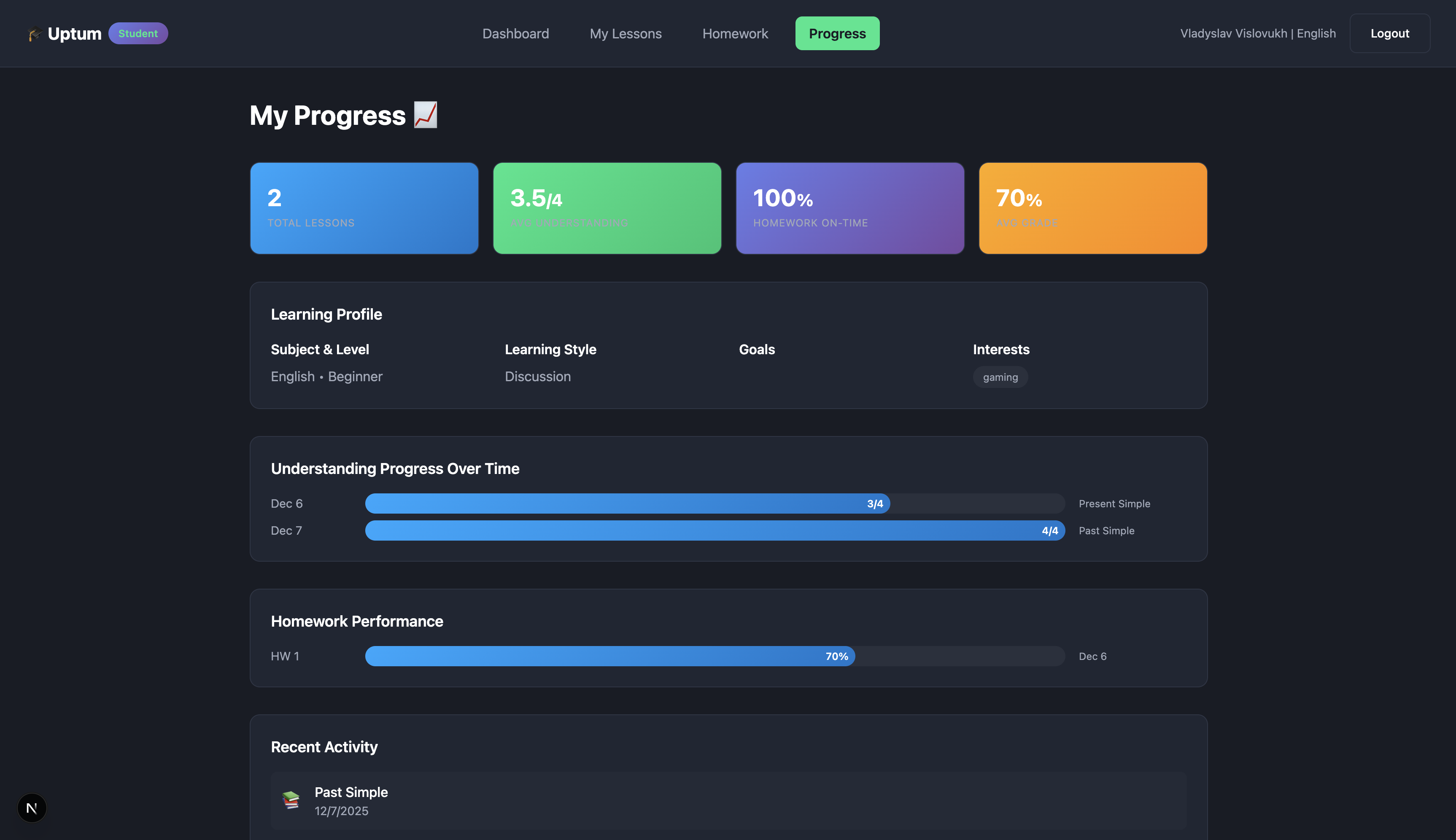
- As we expect also homework to be done through our platform we can track a lot of data that accompanies it. Has the time of homework submissions changed? Is there a subtle decline in grades? Has the student started increasingly coming late to the lessons?
While this metrics are tracked in other platforms they are no analyzed deeply enough and used as a supplementary and not a guiding lines for the tutor. 85% of students want a human teacher, not an automated system. And this is exactly what we provide. But with all the benefits of a soulless, precise and all-noticing machine. Based on the analytics we implemented we will provide insight right before the lesson to recap the students progress and generally his dossier. Live suggestions for topics or exercises during a lesson. Having a substantial amount of data gathered we can go into direction of predicting and suggesting new and exciting topics for the student to go over (especially in language classes) to keep him engaged. Combining all others factors once in a two week platform will provide breakdown with the general overview of a students who lose interest, who may churn and what actions could be taken in order to keep them.
Combining the results and the experiences of other platforms and technologies we expect to increase the LTV of a student by 50%.
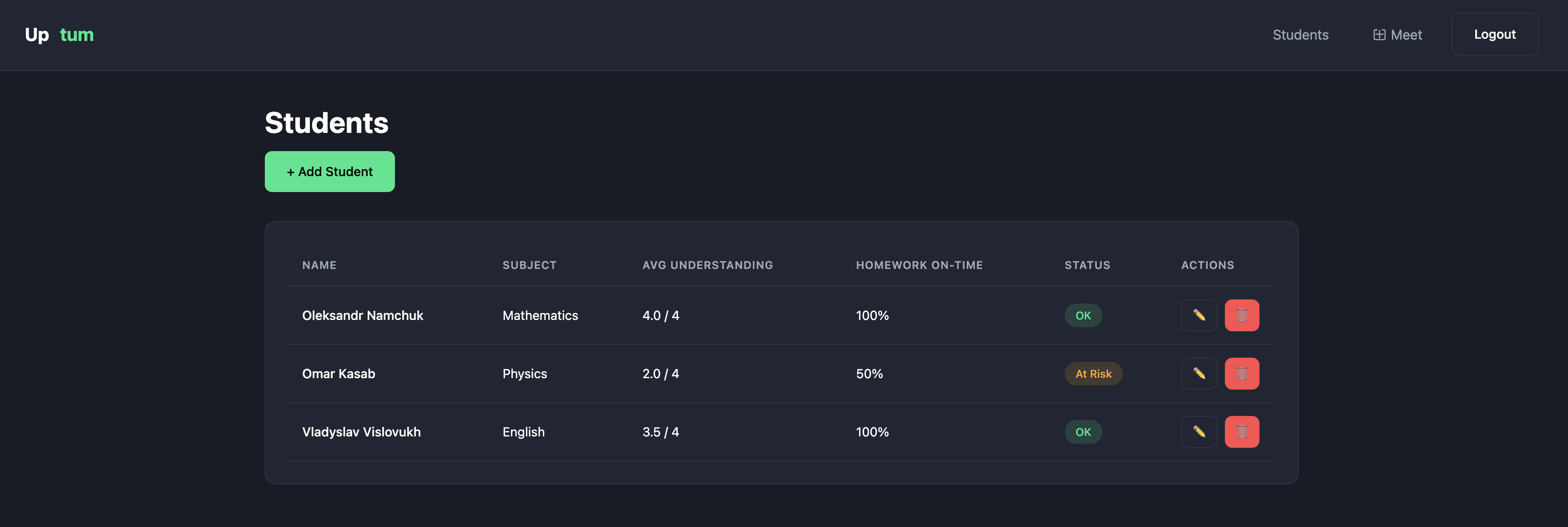
##How we built it We focused on building a thin end-to-end slice of the product instead of a huge system. In our web app a tutor can log in, see a list of students, open a student profile and immediately get an AI-generated dossier, recent lessons and homework signals.
On the frontend we used Next.js to build two simple flows: a tutor dashboard and a student profile page. All data about students, lessons and homework is stored in Cloud Firestore, and access is handled through Firebase Authentication for tutors and students.
For live lessons we integrate with Google Calendar/Google Meet APIs. When a tutor creates a new lesson, our Next.js API route calls Google Calendar to create an event and returns a Meet link that is automatically attached to the lesson card.
After a lesson, a transcript (or notes) is sent from the frontend to a secure Next.js API route, which calls the Gemini API. Gemini summarizes the session and extracts key facts (topics covered, goals, personal details, homework). The summary is written back to Firestore and shown as a short student dossier that helps the tutor quickly recall context before the next class.
For “consistency over intensity”, we also log homework submissions and lesson attendance. A small rules engine in our backend looks at late homework, grade drops and missed lessons and surfaces a simple “risk of churn” flag on the tutor dashboard, so the tutor knows with whom to follow up next.


Log in or sign up for Devpost to join the conversation.