Inspiration
Nowadays, because of COVID-19, college students around the country are being overwhelmed by the stresses of school work and student life more than ever before. In addition, the new generation of young people are increasingly spending their time on the internet and social media platforms. Studies have shown that social media has negative effects on the mental well-being of users, namely in the form of depression and loneliness. Many close friends around us have suffered from depression, and this has made us realize that depression is a very real issue. We hope to be able to gauge the mental state of people on these social media platforms through their posts/tweets and use this information to offer them some uplifting words or advice that they may need to hear.
What it does
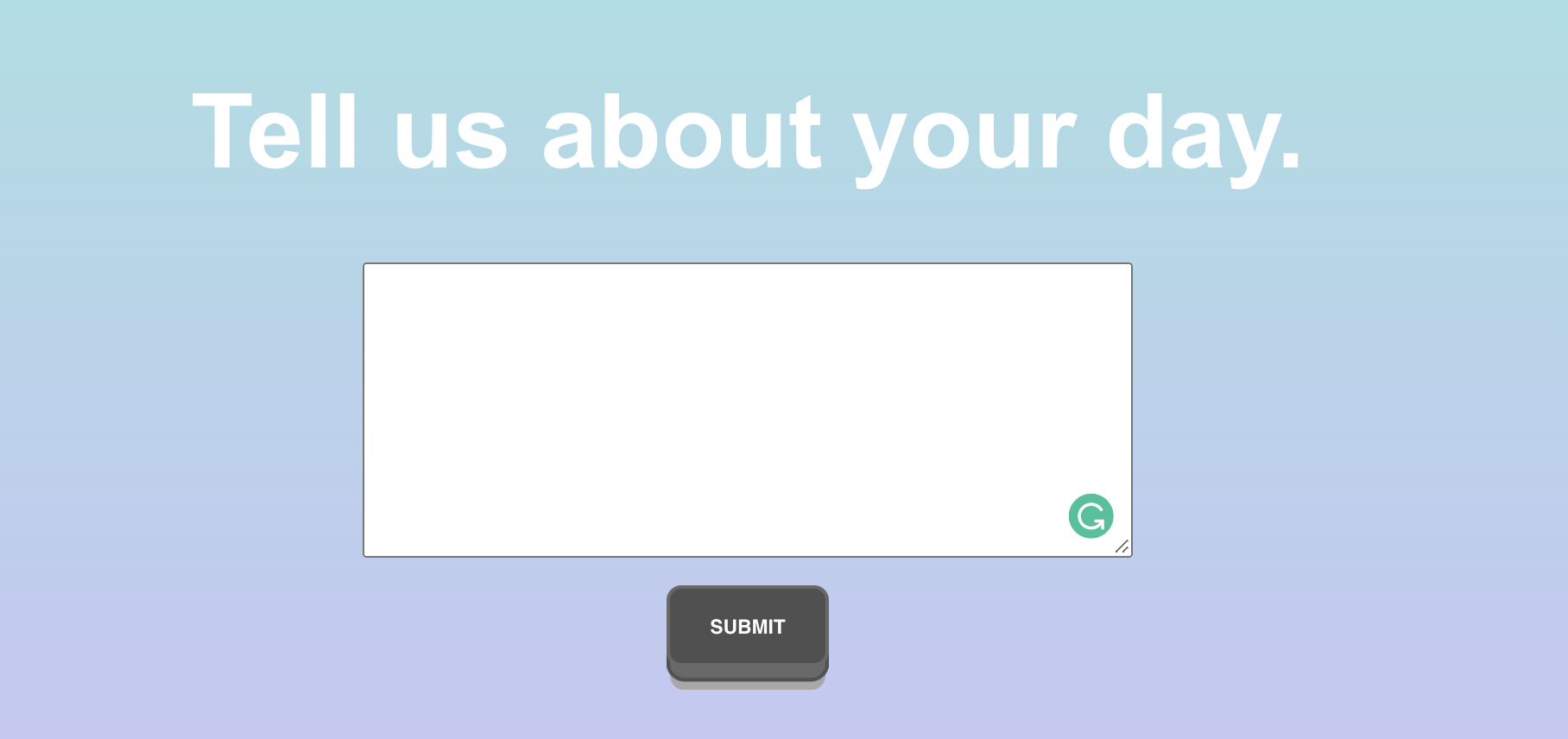
Our web app takes in a sentence or body of text and runs it through our machine learning model to detect the likely mood or state of mind of the user. We have categorized the moods into 3 main possibilities--happy, sad/depressed, and suicidal. Our program then generates an appropriate message to return to the user based on how they’re feeling--whether that be a message of encouragement or a helpful number to call for further advice and care.
How I built it
Our project is based on machine learning to detect happiness, depression, and suicidal thoughts. We have used twitter and sentences that convey depression and suicidal thoughts to train our machine learning model. The model we used is a Seq2Seq natural language processing model. It first determines whether a given sentence’s mood is happy or sad. Once this has been done, the model analyzes the input further to determine whether it is suggestive of depression or suicidal thoughts.
Challenges I ran into
One difficulty we ran into was finding appropriate datasets to use to train our model. We discovered that there were actually very few datasets out there that was aimed at detecting depression and other mental health issues from social media. Another difficulty was that most of our team members have never worked on frontend before this project and had to learn React through a lot of trial-and-error and googling.
Accomplishments that I'm proud of
We are very proud of the accuracy of our model. Currently our model has about 80 percent accurately when evaluated with the test dataset. We have also evaluated manually by trying out the demo, and we got very promising results.
What I learned
As we were looking for the training dataset for the model, we were surprised to find that there is a limited amount of publicly available dataset related to mental health. It is understandable, since preparing dataset for supervised learning of natural language processing models takes a lot of human effort. However, as the importance of mental health problem is increasing daily, we found it necessary to have a more accessible mental health dataset so that it is easier to develop open source programs to help people overcome mental illnesses. Also, most of our teammates were new to frontend design, and so we had to learn how to use React. It was an enriching and meaningful time learning how to design the frontend while working on a real project.
What's next for Uptimism
Our current website provides quotes, but in the future we want to provide a paragraph explaining potential mental health issues based on the result, as well as links to the various websites that are aimed at helping people overcome such conditions. Also, right now, users have to type in their mood of the day in order to determine their mental condition. However, social media platforms can integrate our system in order to detect tweets or posts that convey depression or suicidal thoughts. Based on the result, if the social media platforms provide guidance for the mental illness or ads related to organizations for mental health, we can help people deal with mental health issues even for those who do not realize their mental condition and do not have accessible mental support. Because with these, we can automatically detect the mental health issues of the users and make helpful resources more readily available, we would be able to improve the mental health of the general public greatly, even during this difficult time of pandemic.

Log in or sign up for Devpost to join the conversation.