-
-
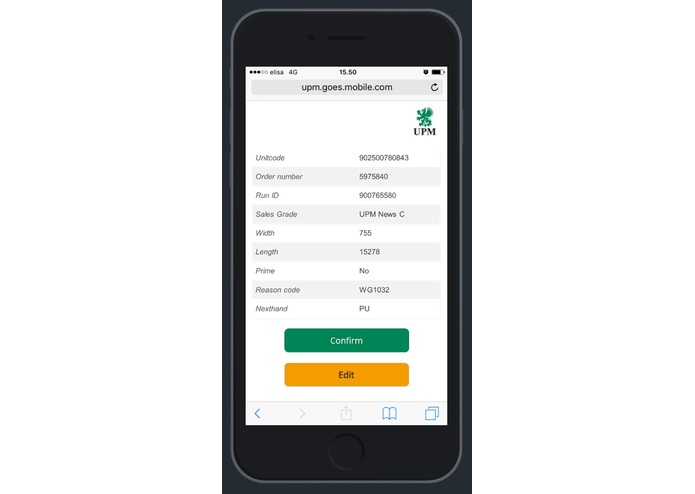
Screen shot of mobile app
Inspiration
The use case immediately sparked ideas in our process minded heads in how we could improve the process of obtaining information about the reels and production, and reduce the time used and possible errors made in this process. After discussing the use cases more with UPM we also discovered that our solution could be useful for also other areas of the supply chain, e.g. technical sales, logistics and even customers.
What it does
At the moment UPM factory floor supervisors have to manually analyse the paper reels taken aside in production. This involves getting a bar code from the reel, walking to the office, inputting data to the production system and making decisions on what to do with the reels taken aside.
By introducing QR codes to paper reels and shipping manifests, and providing the UPM factory floor supervisors with an web based application to read these codes, we make it possible:
- For the UPM factory floor supervisors to analyze reels in situation, without the need to walk to the control room and manually enter information.
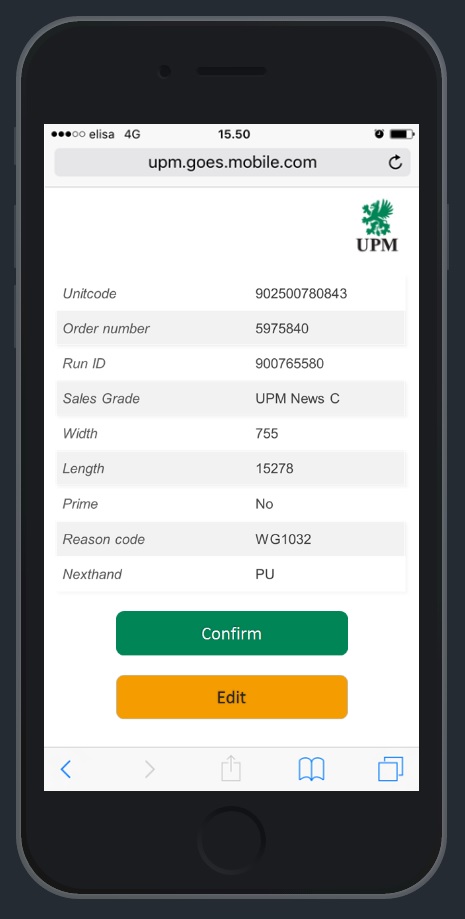
- Supervisor to get a simple view – only the decision making critical information is shown. No overloading with information.
- Give supervisor the ability to decide if they want to change e.g. prime, reason code or nexthand directly in the mobile app for the right reel while standing right next to the reel.
The application removes possibility for human error as no information is inputted manually - which in turn reduces the issues down the line in packaging and all the way in customer satisfaction. This will have positive financial impact. Future proof solution. QR codes can include all sorts of data that can add value to the supply chain. Once the QR codes are part of infrastructure, additional solutions that make use of the QR code can add value for sales, logistics and customer. It reduces the time supervisors need to spend on the process of going through the paper reels which allows them to focus on more useful work. The QR code directs the user into UPM’s system. In order to access the information, the system will require an authentication. When someone is not logged in and he can't access QR code data as he lacks authentication into the system. So this new system won’t change the current security that UPM already has. QR codes are as secure as UPM’s own systems.
How we built it
We wanted to know 1st the business needs before we went into more detail on the technical implementation. As we've seen before, understanding the business issues and needs are always the key to solving any process issues. After understanding the need we built a NodeJS based web application to demonstrate the feasibility of providing a simple application to workers on the factory floor. In addition we mocked up what a fully developed version could look like.
Challenges we ran into:
Project initially wouldn't deploy to Bluemix. Started with only about 7 days of development experience with any of the platforms/frameworks used.
Accomplishments that we're proud of:
Pretty much all code, since this is our first real NodeJS project. We're also proud of the solution we thought of as it is easy to deploy, has a great business case, and has potential to improve work for many different departments at UPM.
What we learned:
On the coding side NodeJS, Express, Pug/Jade, Bluemix, DashDB, bootstrap. On business side we learned how paper mills function, what issues they can have, and what issues paper business has in general.
What's next for Factory floor goes Mobile:
Greatness! Integration to factory systems would be a logical step - and finding more use cases with small changes to the basic concept.
For trying out the solution you need valid UICs or Unit Codes. You can use any one from the database, but here are a few examples just in case: UIC: 25007808440290, 23002327040290, 26002583630284 Unit code: 902500780849, 902500780853,902500768160
Built With
- atomic.io
- bluemix
- bootstrap
- cloud-foundry
- dashdb
- express.js
- jade
- node.js

Log in or sign up for Devpost to join the conversation.