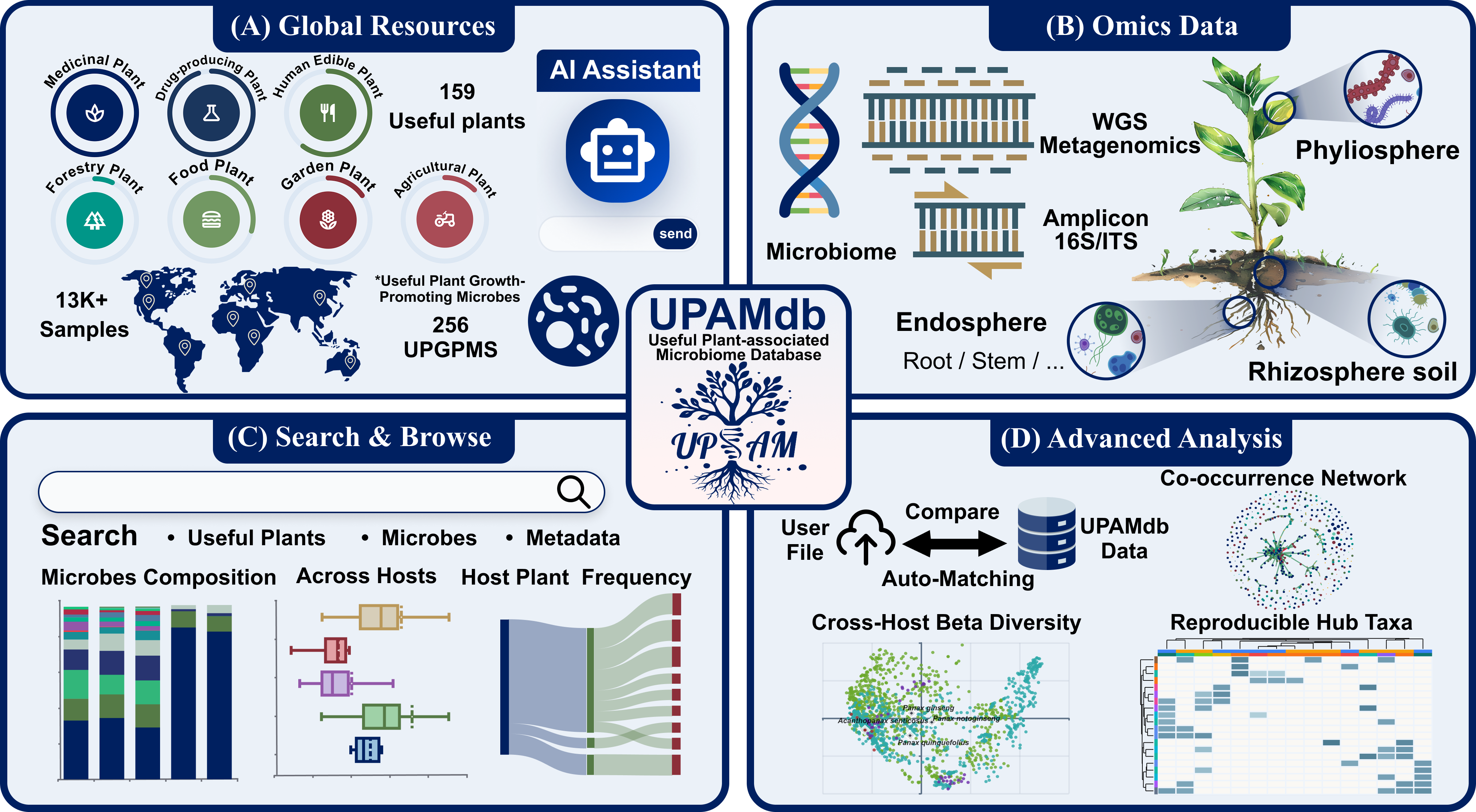
Inspiration
Scientific datasets are often difficult to use even when the data is already available. Researchers have to move between database tables, CSV files, taxonomy records, charts, and analysis scripts before they can answer a simple question.
We built UPAMdb Research Copilot to reduce that friction. The challenge was to make natural-language exploration useful without hiding the underlying evidence. A response should lead a researcher back to the studies, filters, and records that produced it.
The project started as a medicinal plant microbiome database and evolved into a research workspace that combines structured search, interactive analysis, and grounded AI assistance.
What it does
- Searches medicinal plant and microbiome study metadata.
- Converts natural-language research questions into structured retrieval tasks.
- Maps plant names, taxonomy, hosts, plant parts, and study entities.
- Retrieves matching records from MySQL.
- Uses GPT-5.6 to summarize retrieved results.
- Keeps study IDs and query metadata available for inspection.
- Displays microbial abundance, diversity, network, geographic, and taxonomy views.
- Supports pharmacopoeia and medicinal plant reference data.
How we built it
The application uses a PHP API layer backed by MySQL, with a browser frontend built from HTML, CSS, JavaScript, Bootstrap, ECharts, and Plotly.
The retrieval pipeline contains a query analyzer, plant-name mapper, SQL generator, retrieval engine, and context formatter. The AI layer receives retrieved database context rather than the entire database, which helps keep responses focused and auditable.
During the OpenAI Build Week submission period, Codex was used to inspect the existing data flow, design the AI integration boundary, implement and debug the GPT-5.6 research workflow, improve error handling, and prepare the runnable repository and documentation.
GPT-5.6 is used to interpret the researcher’s question and produce a grounded explanation from the records returned by the database retrieval layer.
Challenges we ran into
The main challenge was working with a large legacy scientific schema containing inconsistent field names, multiple data formats, and both database-backed and file-backed data paths.
We also had to prevent the language model from answering from unsupported assumptions. The retrieval pipeline therefore separates question analysis, database retrieval, context construction, and final response generation.
Another challenge was keeping the interface useful for both quick lookup and deeper analysis. Users should be able to ask a question quickly, but also inspect the records and visualizations behind the answer.
Accomplishments that we're proud of
- Built an end-to-end research workflow instead of a standalone chatbot.
- Connected natural-language questions to structured database retrieval.
- Preserved access to study IDs, filters, tables, and visual evidence.
- Integrated microbiome browsing and analysis into the same workspace.
- Added a practical AI layer to an existing scientific data resource.
- Used Codex to accelerate work across API integration, debugging, and documentation. ## What we learned We learned that a useful scientific AI interface needs more than a model call. The quality of the final answer depends on entity mapping, query constraints, database performance, context selection, and clear links back to source records.
We also learned that legacy scientific data should not be discarded simply because its schema is imperfect. A carefully designed retrieval layer can make existing data more accessible while preserving the original records and analysis workflow.
What's next for UPAMdb
Next, we plan to add stronger query validation, more transparent source citations, database-side pagination, precomputed analysis results, and Redis-based caching for frequently used queries.
We also plan to migrate the API incrementally to a typed service layer while keeping the existing data model stable. Future versions could support dataset versioning, collaborative annotations, and richer semantic search across studies and microbial taxa.

Log in or sign up for Devpost to join the conversation.