-
-
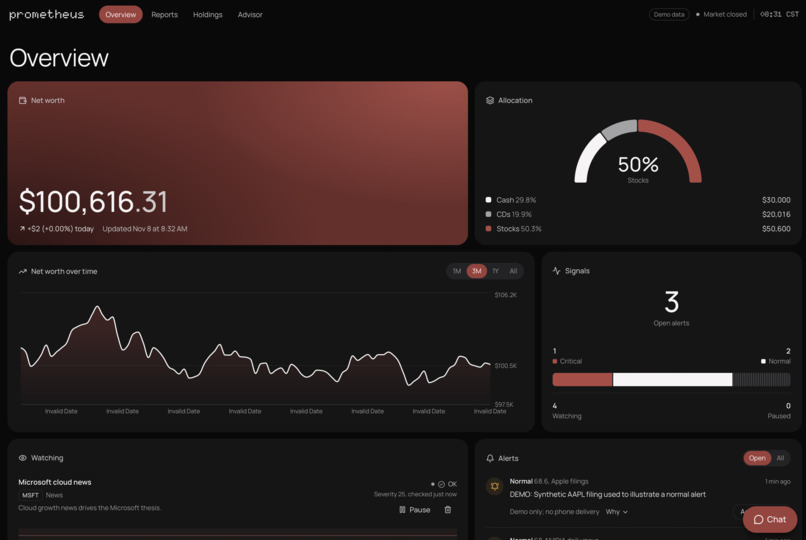
Dashboard
Inspiration:
Oftentimes, new investors tend to rely heavily on unverified sources such as public speculation or the opinions of public figures when making investment decisions. Rather than do their own research, they may act on this misleading information. We decided to build Prometheus, a financial advising app to help users better understand their financial situation and the factors that may influence their investment decisions.
Prometheus cannot independently approve its own triggers or override escalation rules. All of its answers must be linked to a real source, and in case of a real incident critical alerts are communicated via phone call for quickest response. Timing makes a significant difference in the market, and even a few minutes of awareness can have a huge impact.
What it does:
Prometheus is a personalized financial advising program that allows for users to connect their own brokerage accounts for recommendations suited to their financial situation. It provides a dashboard that shows vital financial information such as net worth, allocation, and alerts based on predefined signals.
In the advisor chat, all one needs to do is ask a casual question and they will get a response with cited references. They can inquire about market opportunities or questions with their own portfolio. If this information is insufficient, it may also invoke the research agent to find verifiable sources to investigate potential market opportunities.
Finally, Prometheus includes the alert feed, providing the evidence behind each notification, ensuring the user knows why the AI is flagging these events. It continuously evaluates user-approved triggers against recent news, assigning a severity score that determines its response. The system may just send a text, or for critical events it may escalate to a phone call to ensure user response. Rather than simply telling the user their course of action, Prometheus makes the reasoning why transparent, letting users make informed financial decisions.
How we did it:
To create the foundation for our project, we spent a significant amount of our time at the beginning of the hackathon thoroughly designing and specifying exactly what we wanted to see out of our program. With two adept coders on the team, it was possible to produce a large amount of the codebase with the limited amount of time left for the actual creation of the project.
Because we also had team members who had experience planning and orchestrating videos and skits, we could create a demo video that was more special than a simple mundane description and walkthrough of the program.
Our challenges:
One of the biggest challenges we faced as a team was group coordination. Because our group was formed the day of the hackathon, we didn’t get much time to discuss our roles and identify who would do what. This led to a lot of confusion around who needed to do what and led to some wasted time.
We were also set back by a technical malfunction with GoDaddy while attempting to redeem the “prometheus.cooking” domain, as we had dedicated a significant portion of our time to attempting to publicly host the application. However, without a domain, it would be less beneficial to publicly host the app, as we would have to share the IP address instead.
The many wonderful events at HackUTD also distracted us from our work. While some of these distractions were positive, like attending the Smash Bros event or meeting with the engineers at the sponsor booths, the lengthy food lines didn’t help our time crunch. Our accomplishments: WIth a team consisting of 2 first-time hackers, 1 product designer, and a (grumpy) coder, we managed to ship a product that we can all feel proud about, especially our UI. When we had first started it just felt like a mobile app was trying to dress up as a website, but after many iterations we were able to land on an interface that we all found pleasing.
Integrating Photon and the VPS hosted on NVIDIA Brev were two of the most challenging steps of our project. So much so that we caught our grumpy coder smiling after we had fully integrated the two to properly identify triggers and send the appropriate form of alerts. The research bot was also something that proved a little difficult: Early in the project we struggled with some heavy latency, but we were able to fix this by using partial streaming of the LLM’s response so that the user is aware that the system is processing the request rather than being left in the dark.
Our greatest accomplishment of all is that we were able to finish with more than ten minutes to spare, unlike previous hackathons.
What we learned:
Because of the difficulties we faced in group coordination, it’s clear that moving forward we need to more rigorously plan and divide our tasks, while also being more capable of assisting teammates who may be facing difficulties with their tasks. This lesson was learned manifold because of the distractions during the hackathon, which further desynchronized our already disjointed workflow.
For the first-time hackers, there was a lot to learn about project development, especially in a team. Particularly, Github, Devpost, project presentation, and system design were all critical skills that the veterans needed to teach the new hackers in a short amount of time.
In terms of technologies, we learned how to use NVIDIA Brev for specialized cloud inference, Nemotron for general agent workflows, Photon and Kokoro TTS for text and call alerts, and TigerDB to store our user data & vector embeddings.
What’s next:
Some things we would like to build on with more time is to integrate authentication for multiple users. Currently, we didn’t add authentication, as it simply got added to the backlog as our technical issues mounted. It would be a relatively straightforward addition that would make our product feel more real. Another addition that could potentially save costs once our free credits run out is to implement RLCD models to save costs on classification tasks. In a similar vein, using these models could also allow us to have more specific trigger types rather than just number amounts & binary choices, allowing further avenues for performance & cost optimization.
Built With
- brev
- kokoro
- langgraph
- nemotron
- photon
- python
- tigerdb


