-
-
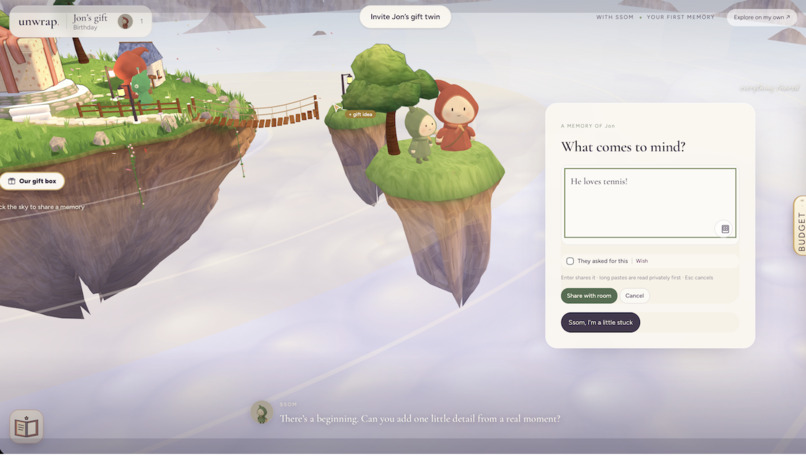
Start with the first prompt!
-
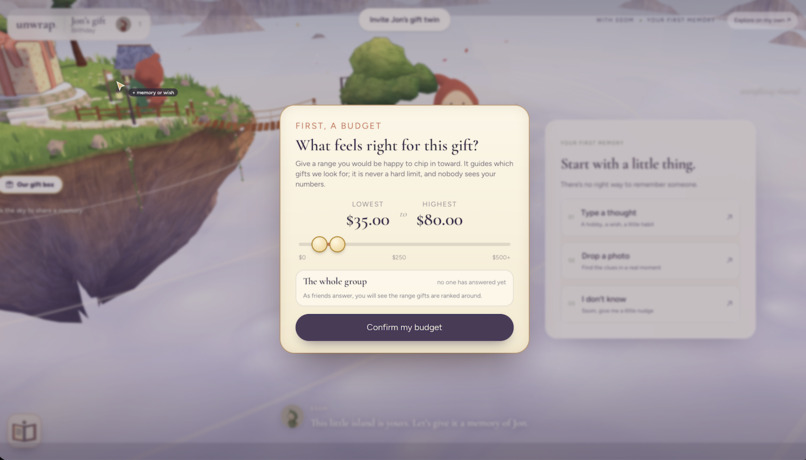
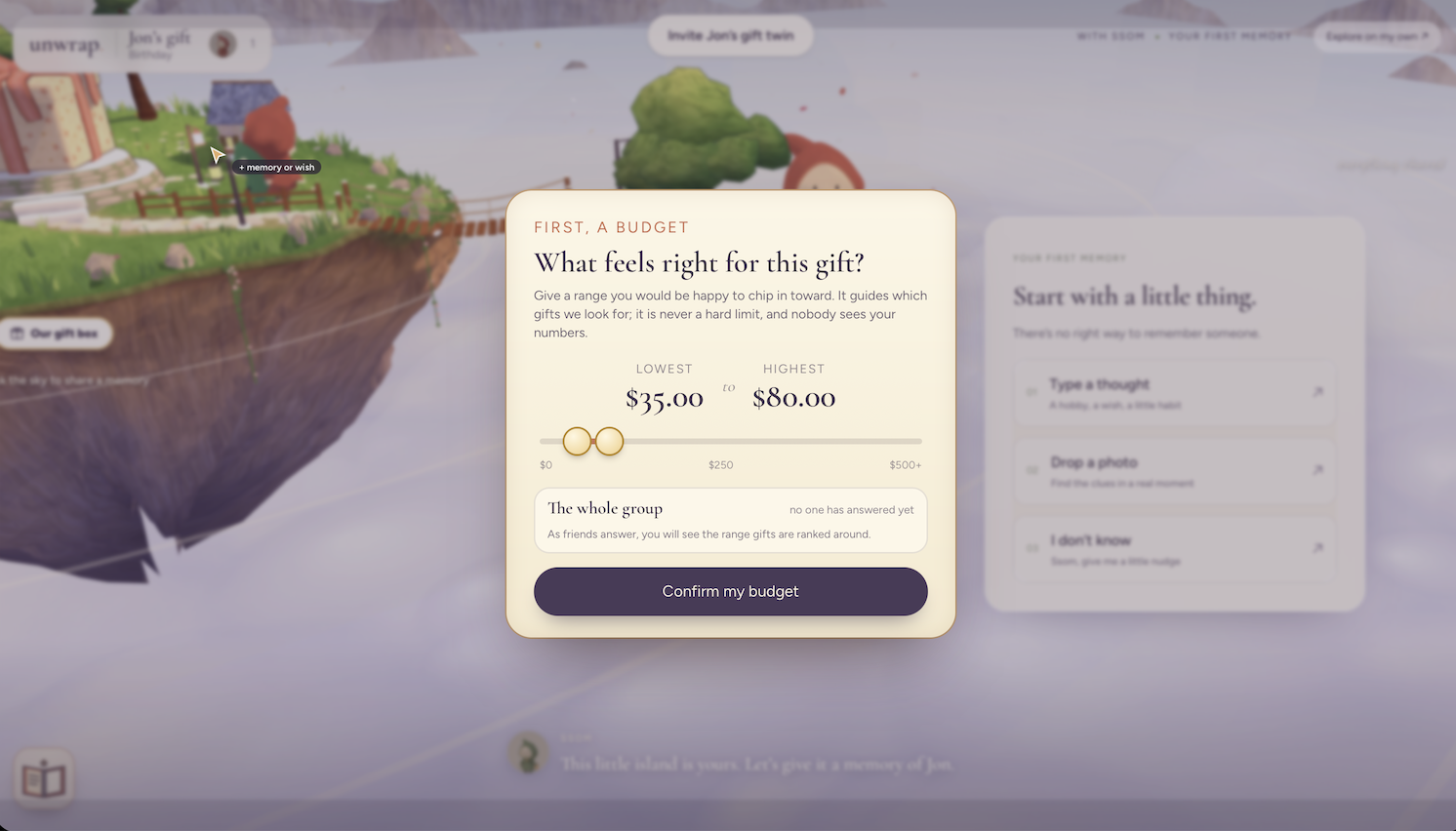
Set up a financial budget for how much you're willing to spend on your gift!
-
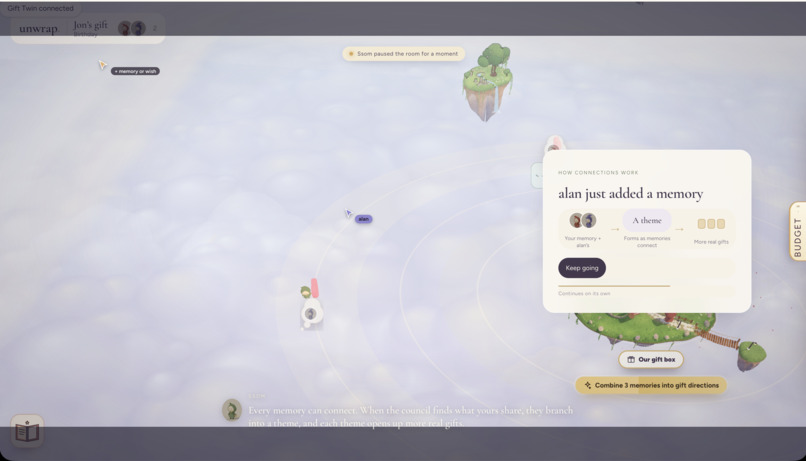
Collaboration sparks creativity
-
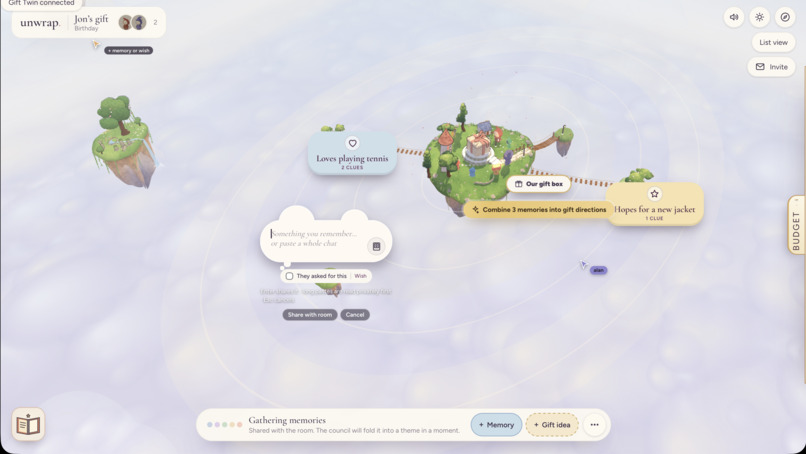
See your ideas come together with others.
-
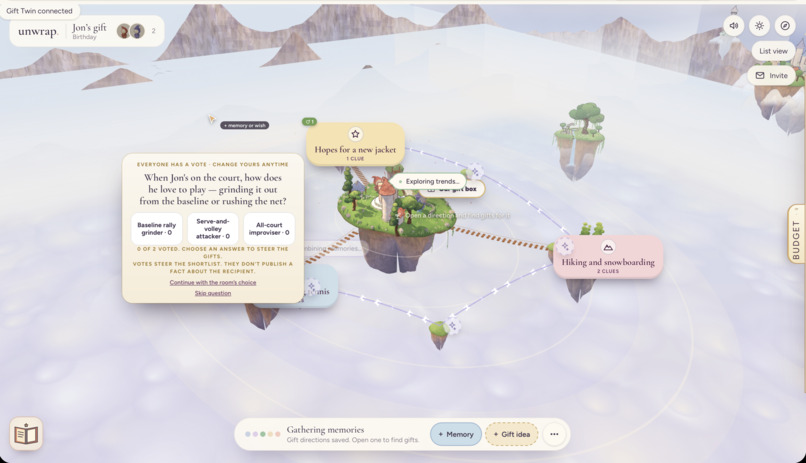
We guide you through with questions.
-
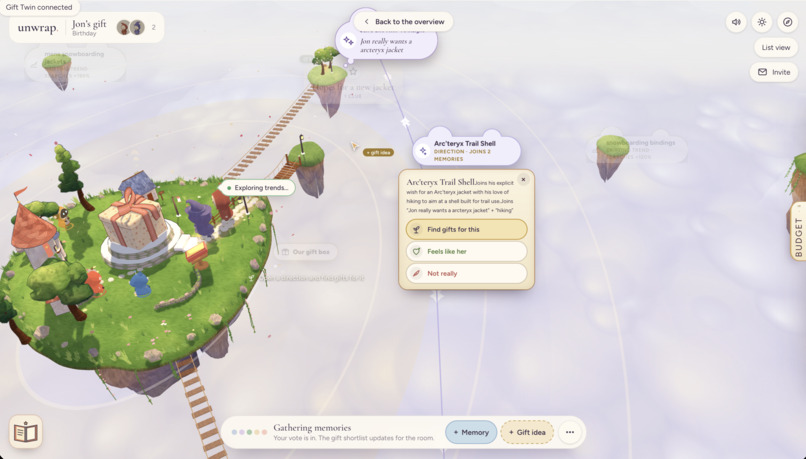
We research about the gift recipient, suggesting prompts and ideas.
-
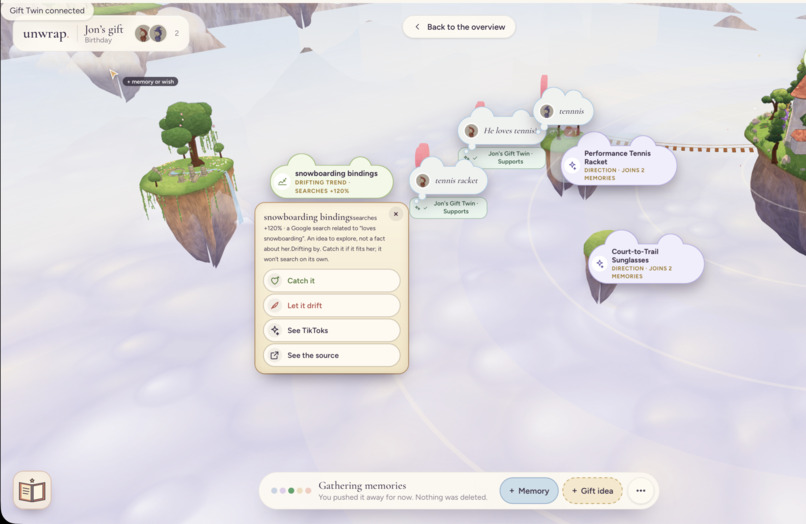
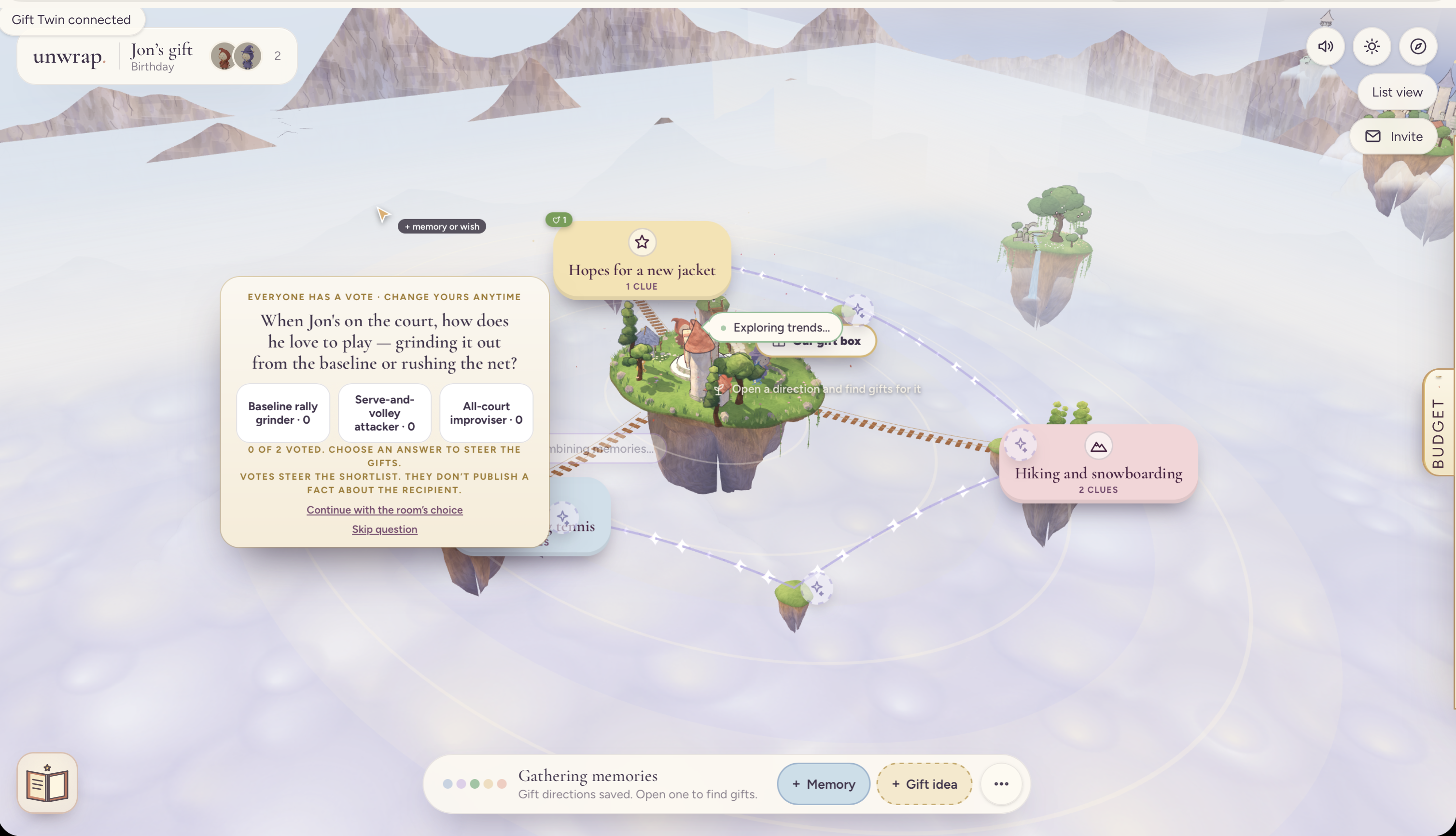
We research trends for you, so the gift recipient gets updated new trendy gifts!
-
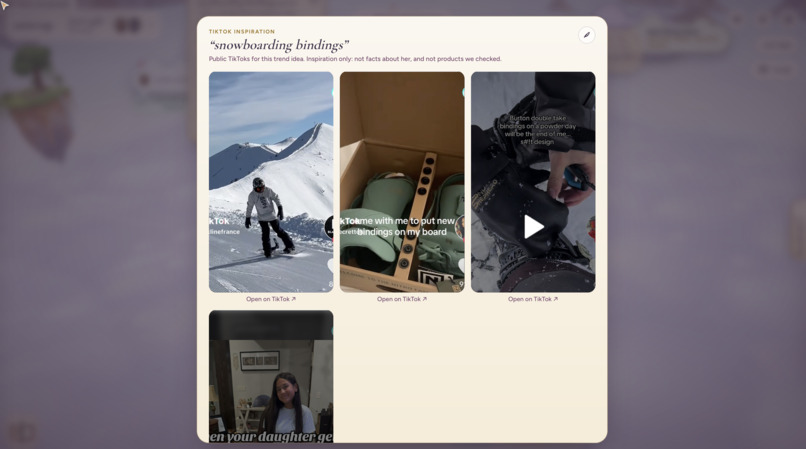
See what makes them trending!
-
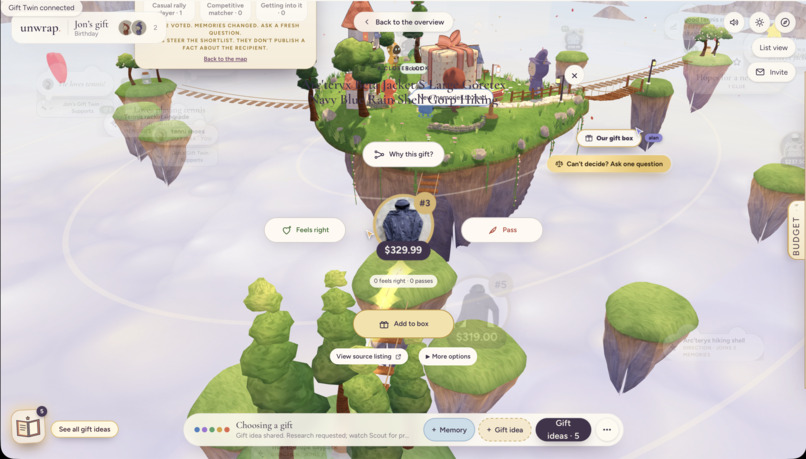
We give you real products, direct links with real costs.
-
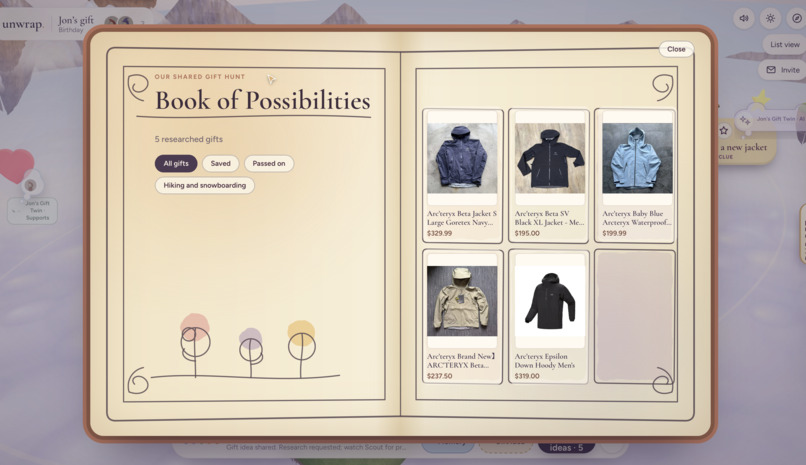
See a gallery of potential products.
-
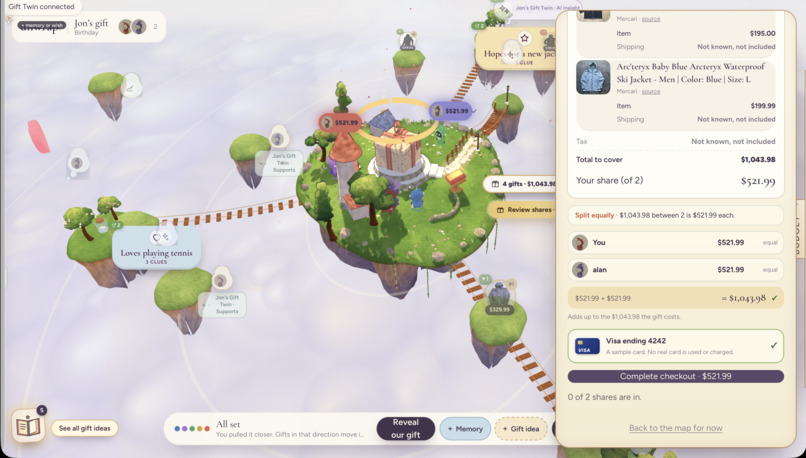
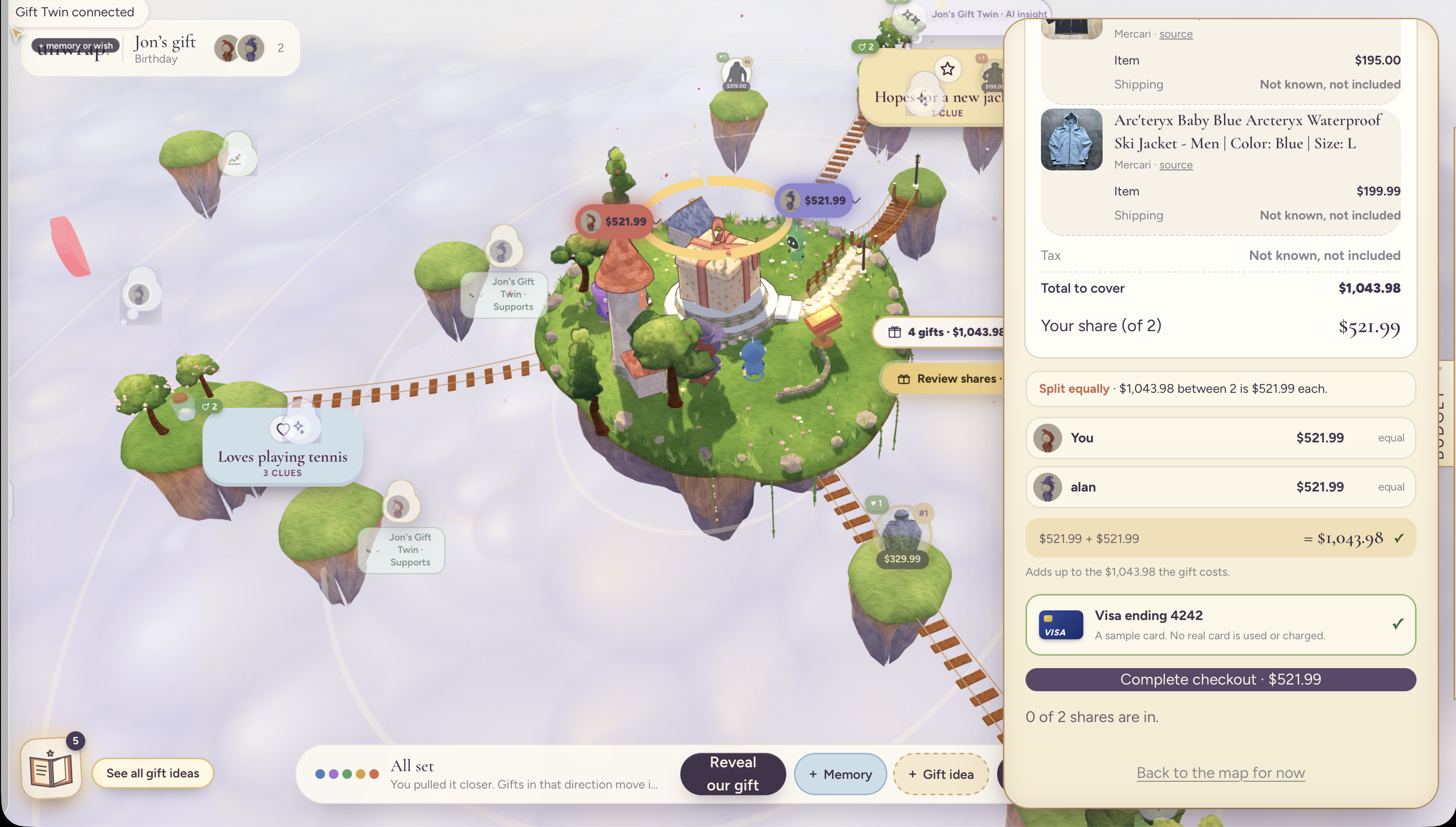
Plan how you contribute paying and checkout specific products.
-
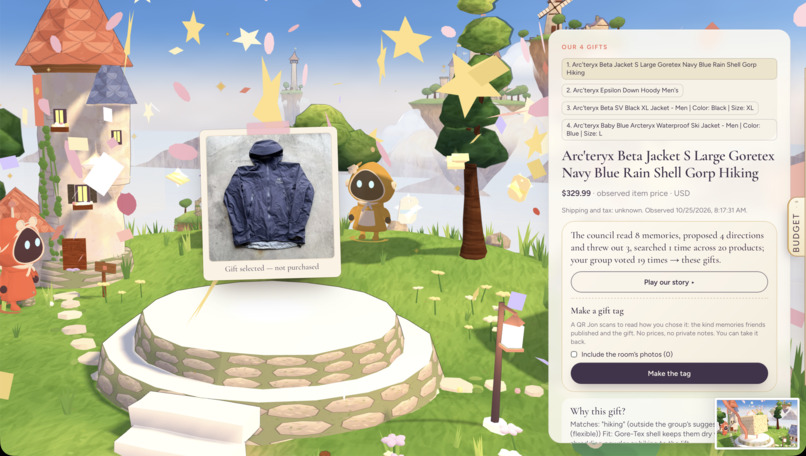
Ultimately, we give you the perfect product.
-
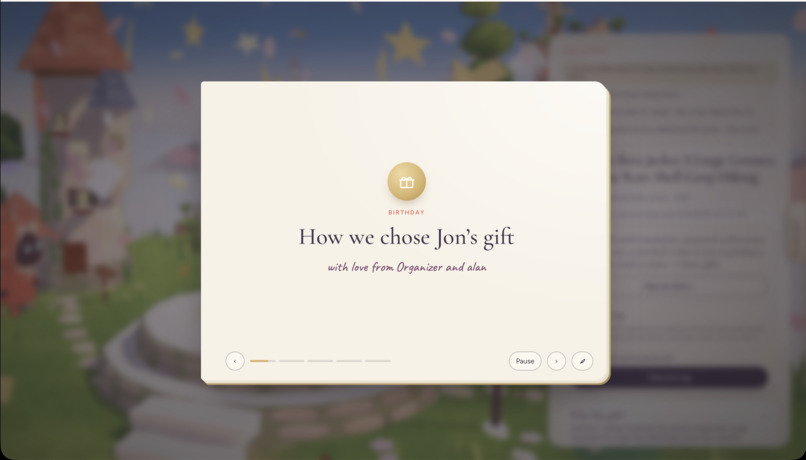
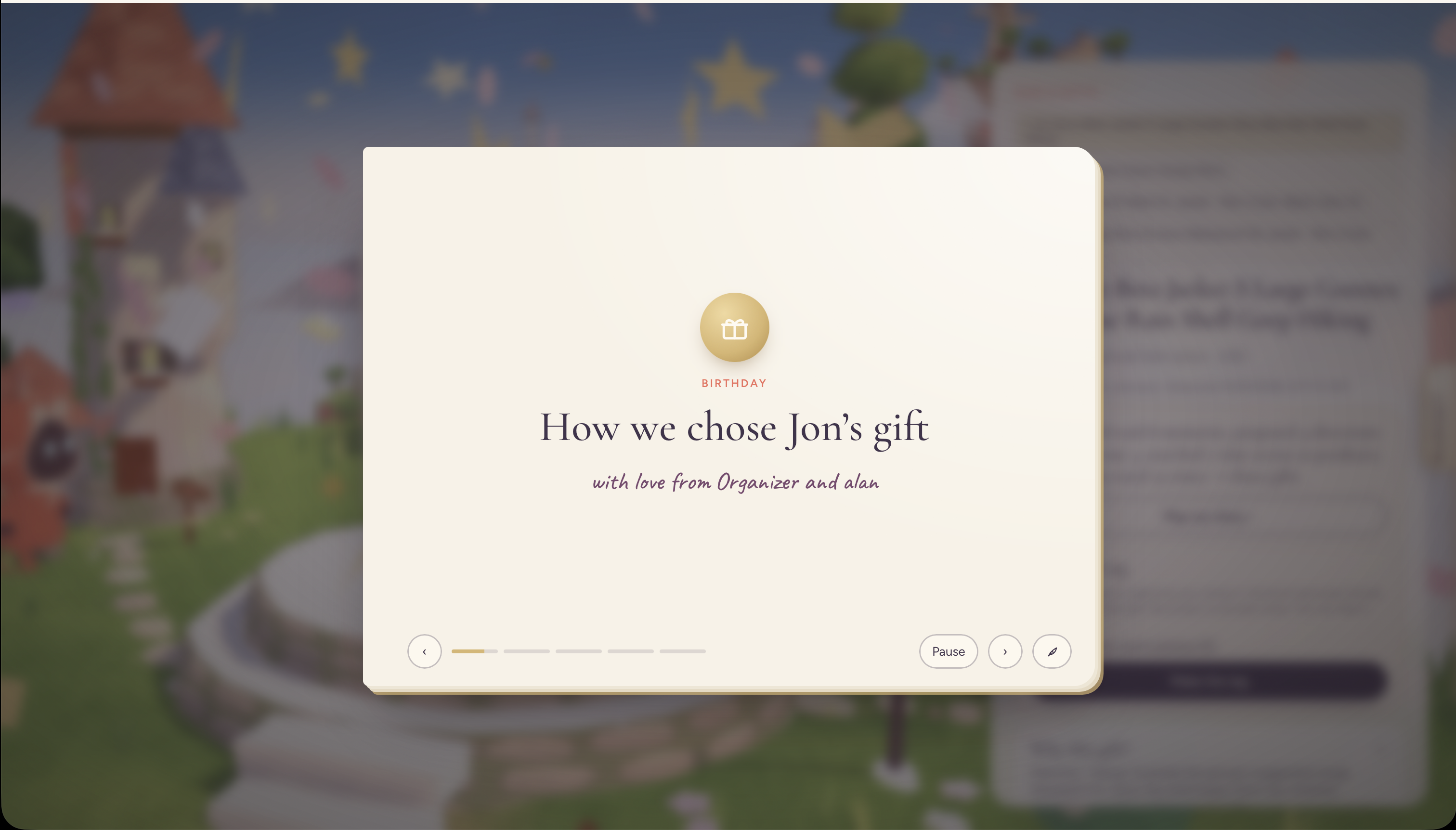
Share the journey of your hard work to the gift recipient!
-
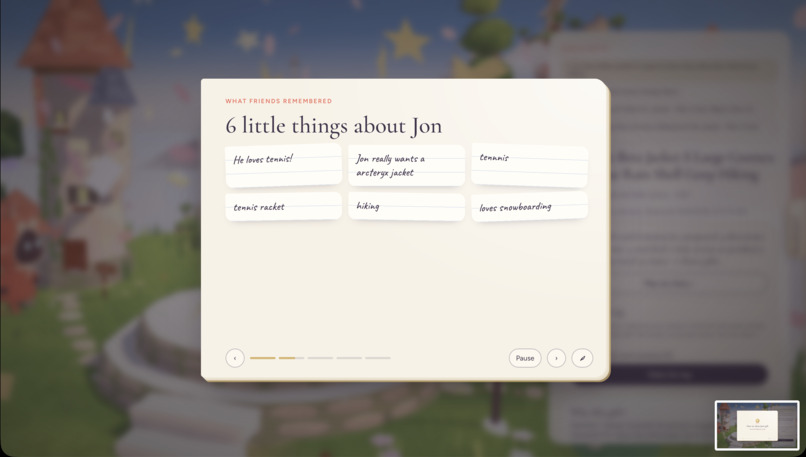
Share how much you guys care.
-
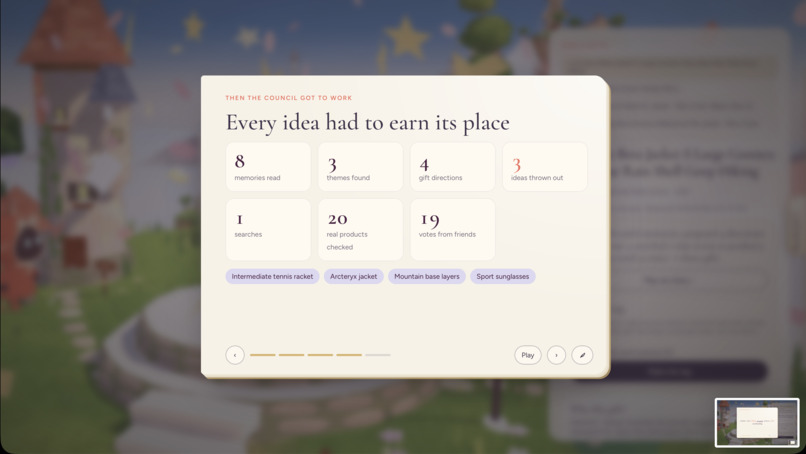
Every trial and error... To the final conclusion.
Unwrap
Name: Unwrap Tagline: A multiplayer storybook where friends' memories become the perfect gift.
Inspiration
Everyone knows a different side of someone.
One friend knows their favorite hobbies. Another remembers an inside joke from years ago. Someone else remembers a passing comment about something they've always wanted to try. Another knows what they already own or what they absolutely wouldn't want.
Individually, these are just little pieces of information. Together, they tell a much bigger story about who someone is.
Yet, when birthdays and special occasions come around, all that knowledge is scattered across different people, conversations, and group chats. Gift planning becomes a cycle of generic suggestions, forgotten ideas, budget negotiations, and someone inevitably saying, "I'll Venmo you later."
Existing AI gift recommenders don't really solve this problem. They typically start with a generic description of one person and return a list of products. But the most meaningful gifts aren't necessarily the most popular or expensive. They're the ones that make someone say:
"Wait, you remembered that?"
We wanted to build something that could bring everyone's different perspectives together and transform the entire gift-giving process into an experience worth sharing.
That's how Unwrap was born: a collaborative, AI-powered storybook world where memories become connected ideas, AI agents turn those ideas into real gift possibilities, and friends discover the perfect present together.
What it does
Unwrap turns collaborative gift planning into an interactive, multiplayer storybook adventure.
1. Enter the storybook. A hand-drawn illustration gradually fills with watercolor, revealing a floating-island world centered around a wrapped present. Pulling the gift tag begins the experience. The present opens into an invitation tree displaying a QR code that friends can scan to join.
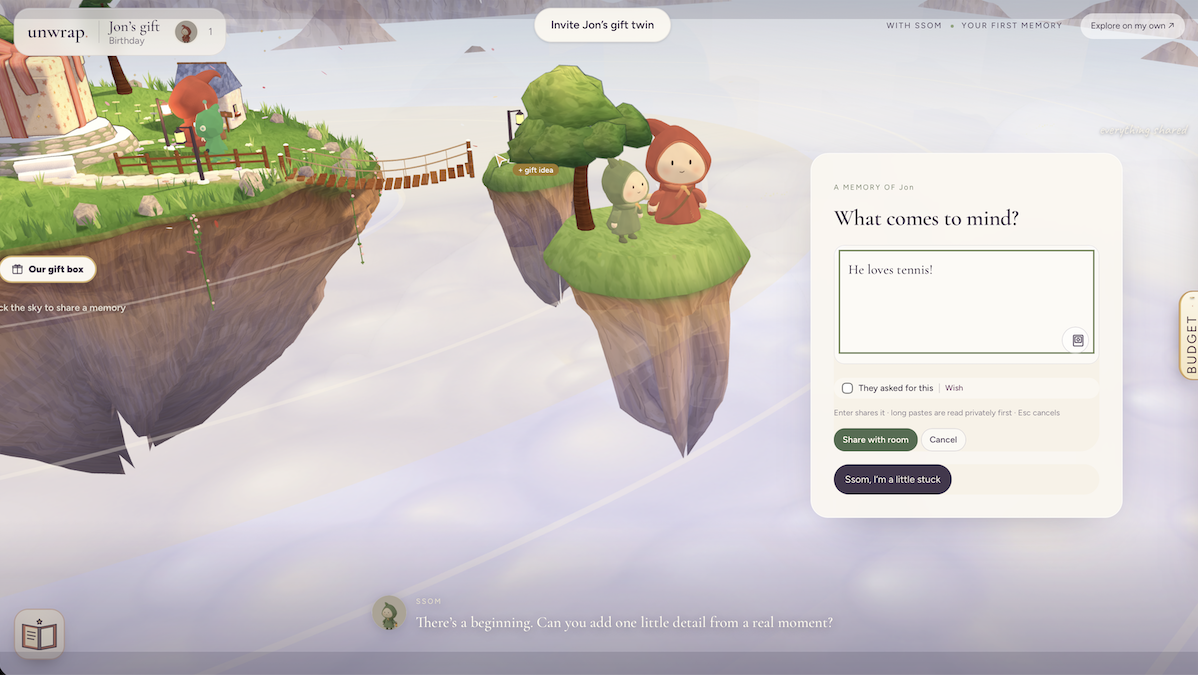
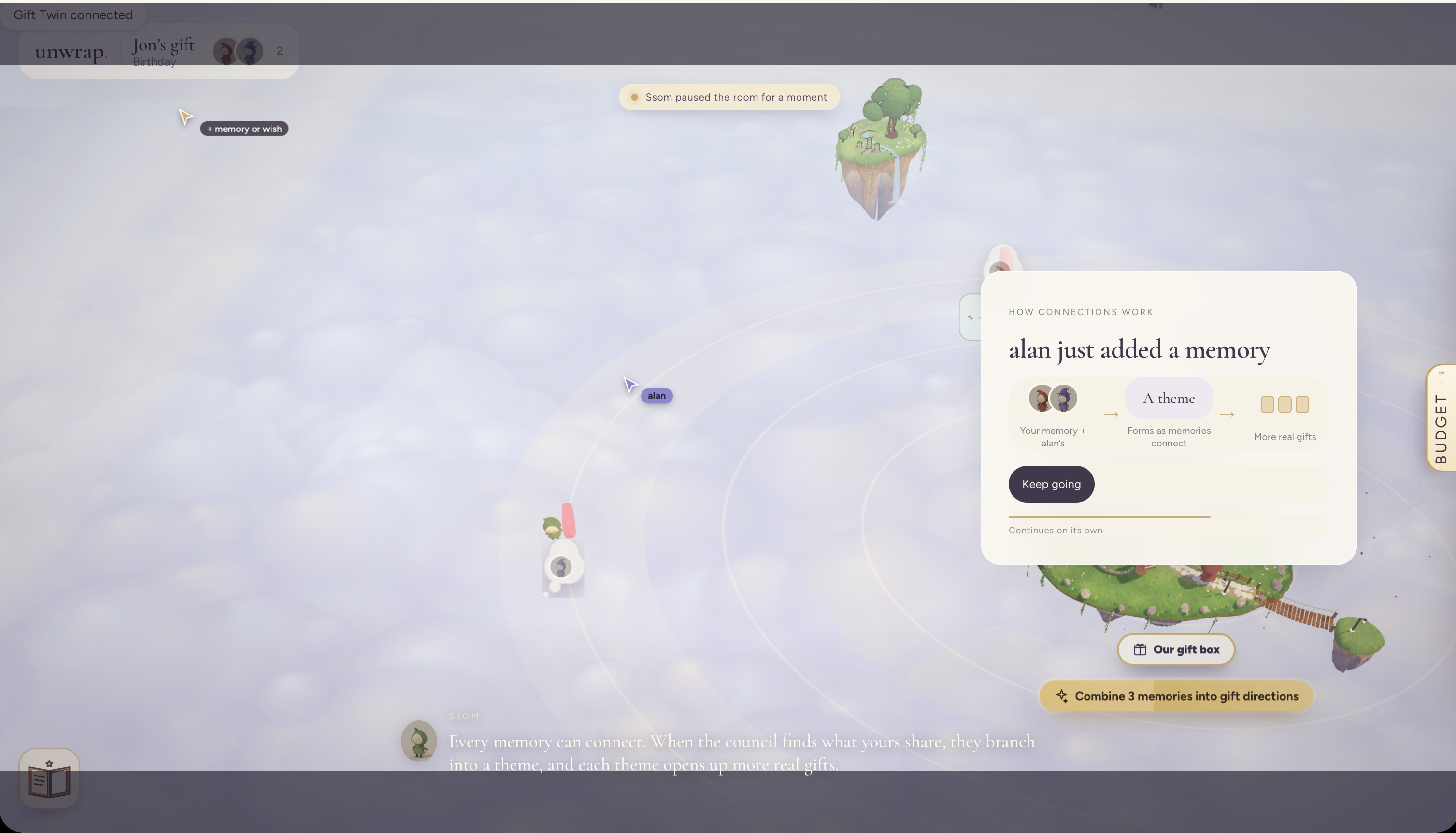
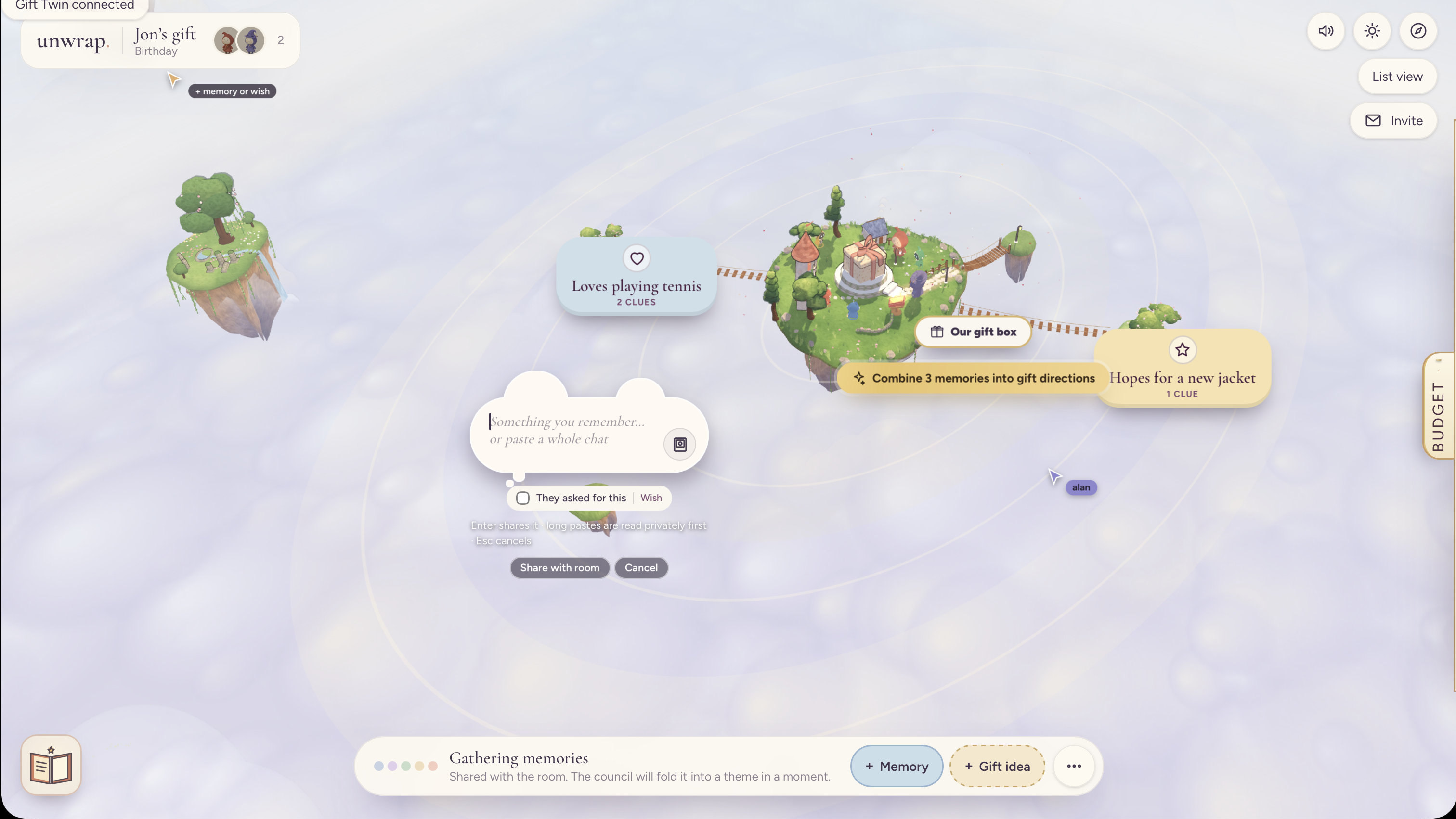
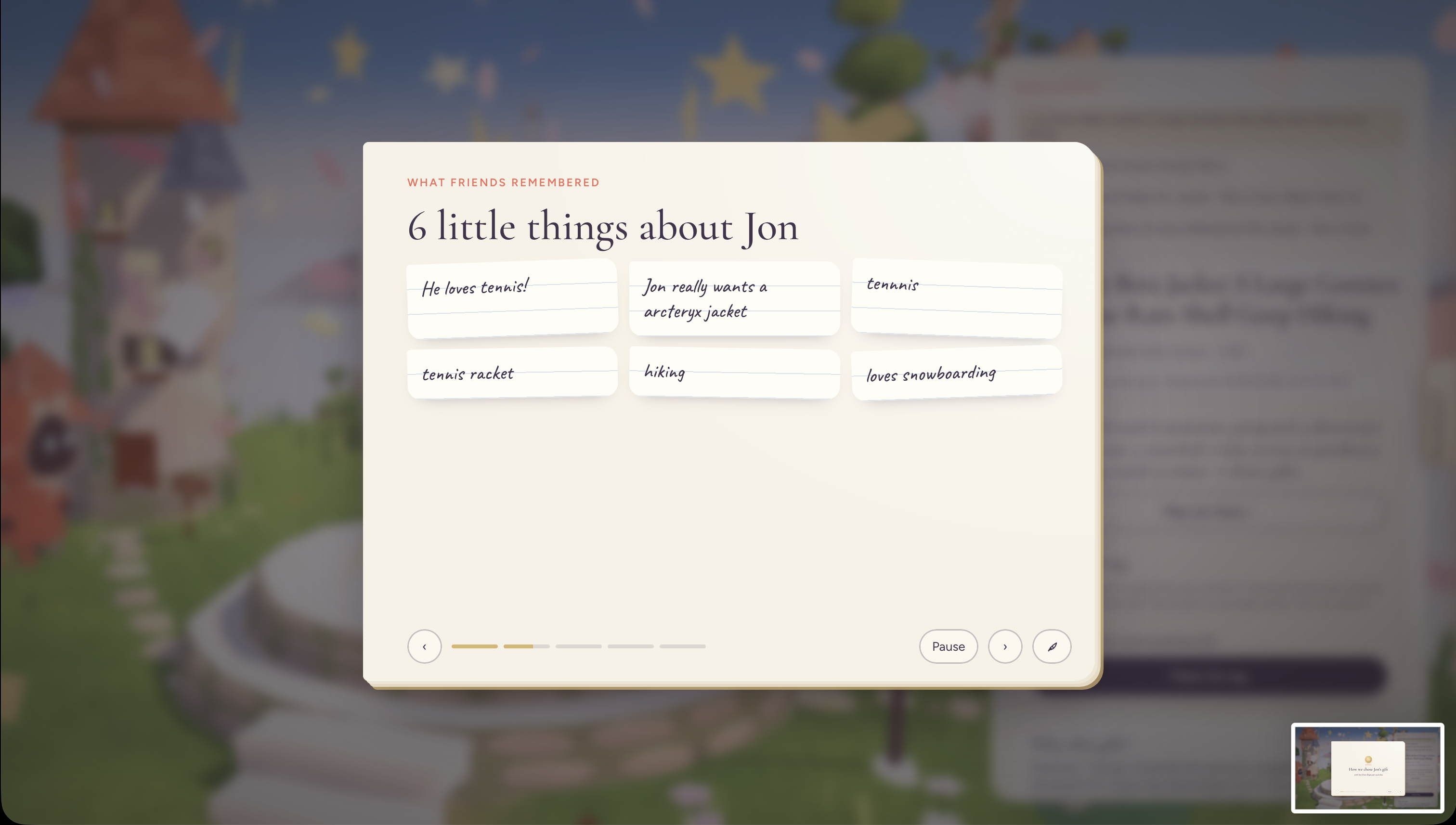
2. Share what makes someone special. Friends contribute memories, wishes, interests, photos, and inside jokes from their phones. Each friend brings a different perspective, and their contributions appear in the shared world in real time. AI can interpret selected messages and photos, but extracted clues remain private until their contributor chooses to share them.
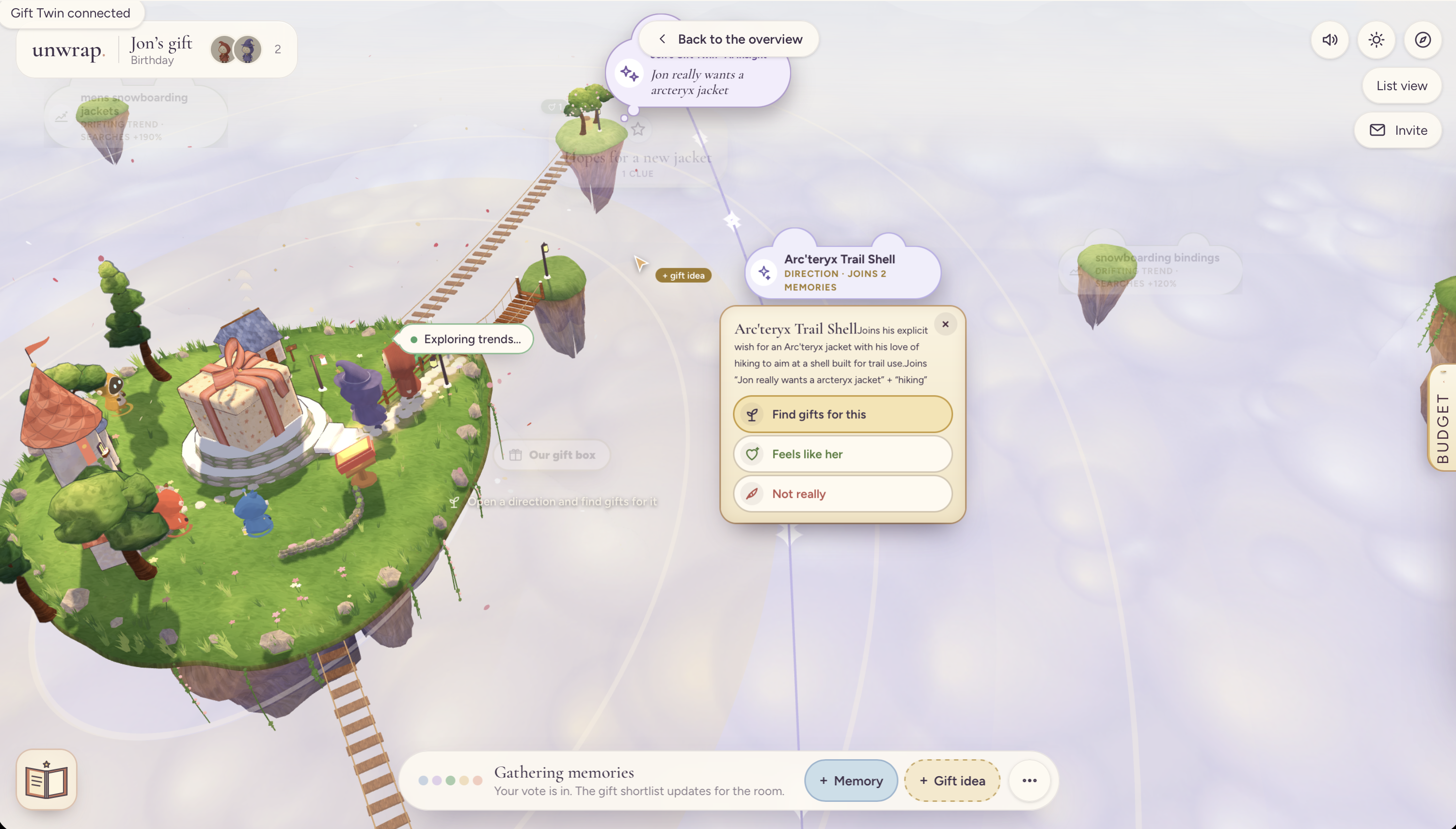
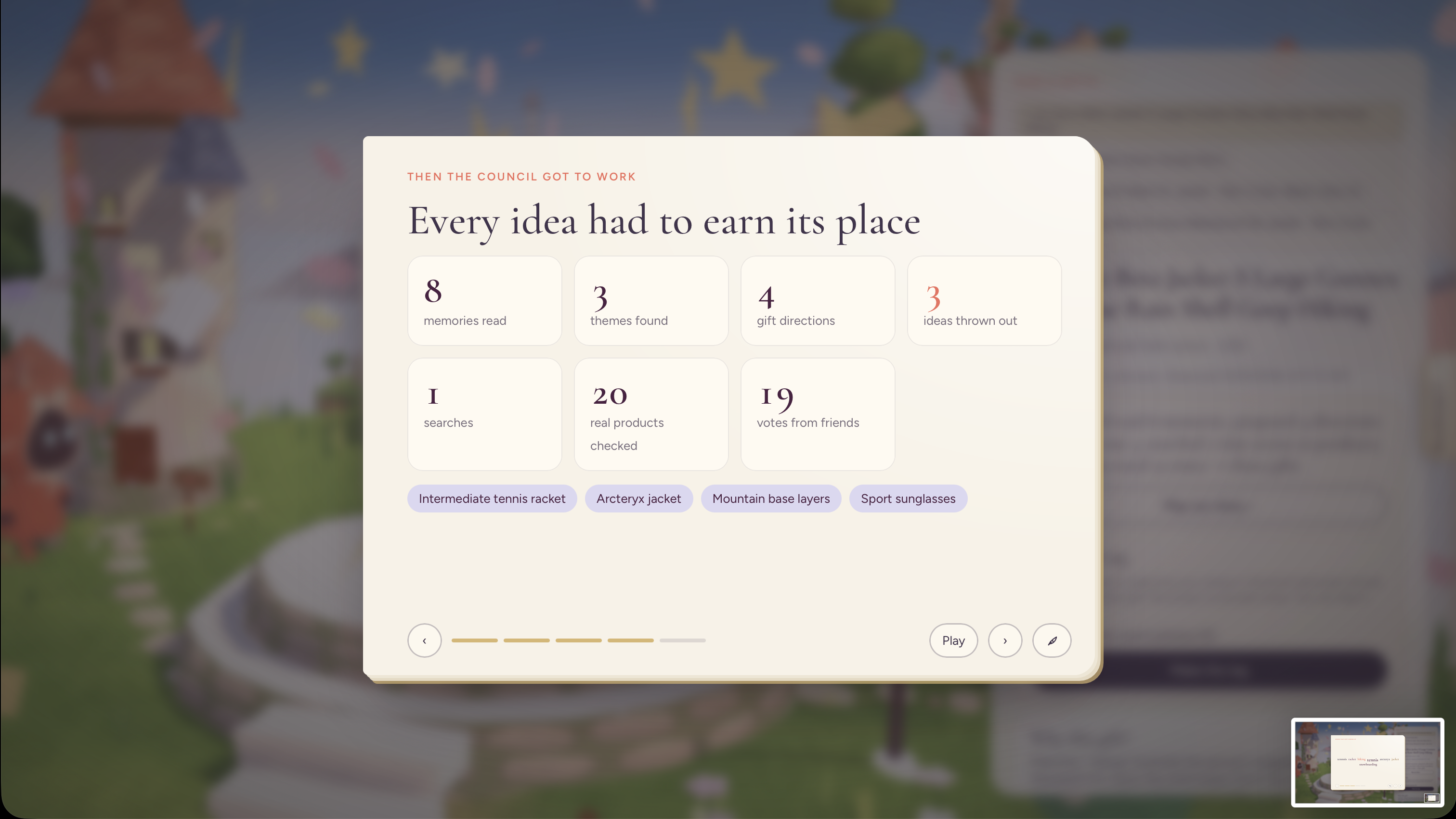
3. Watch the AI Council work. Five specialized Fetch.ai agents—Archivist, Muse, Scout, Keeper, and Courier—interpret memories, discover connections, investigate real gift listings, and check constraints. Their progress powers animated robot companions within the 3D experience.
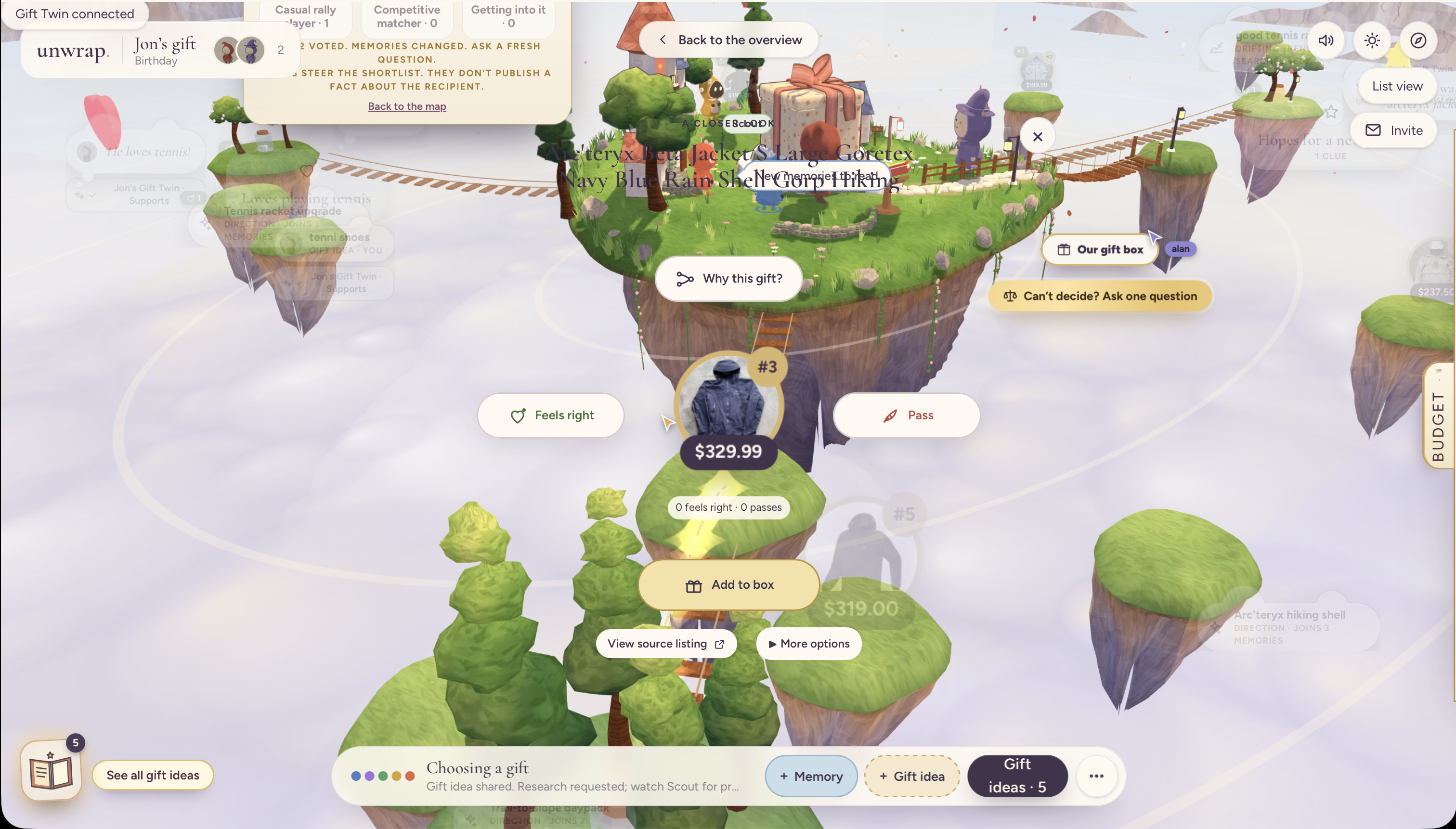
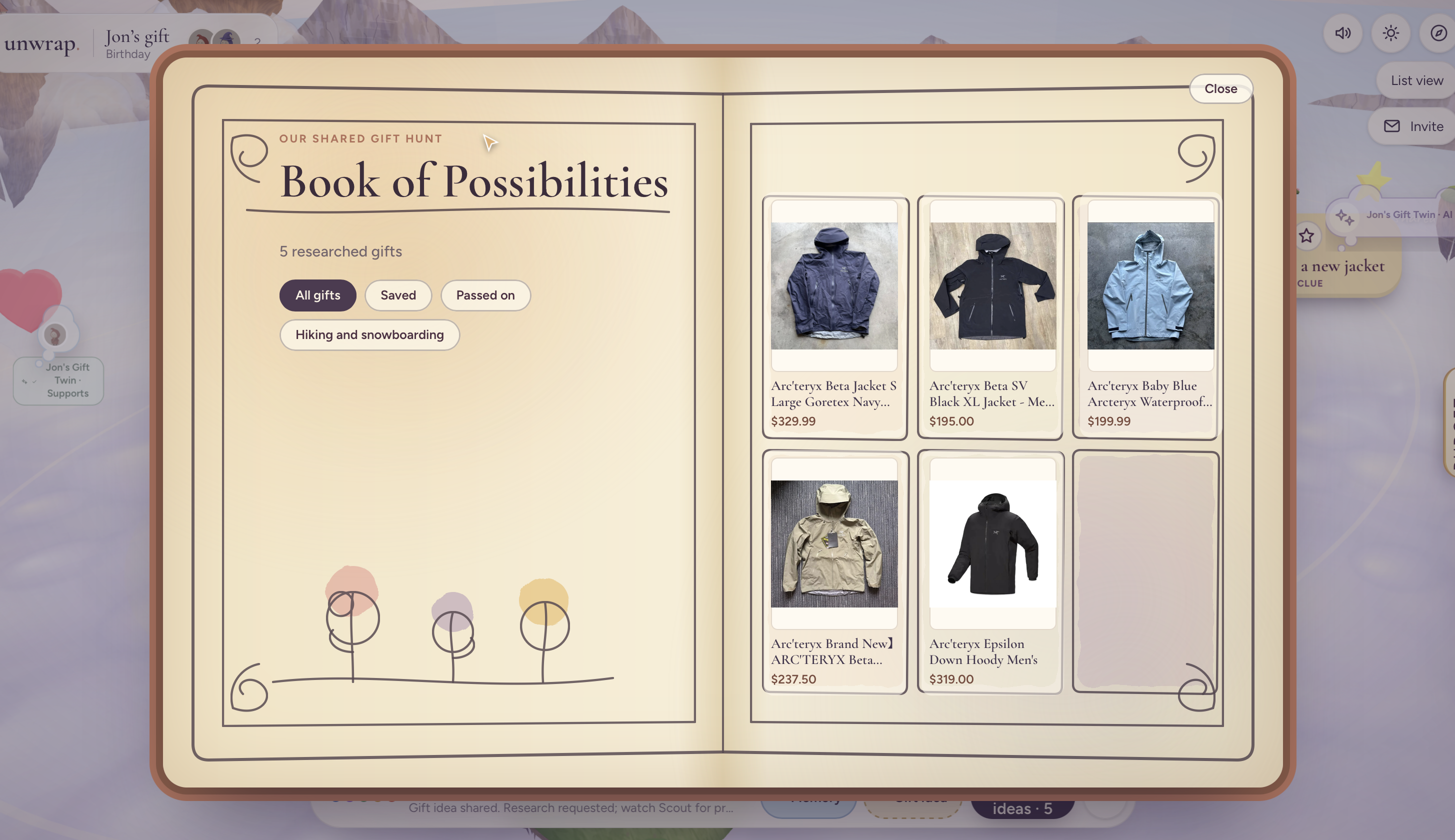
4. Explore meaningful gift possibilities. Memories grow into connected themes and gift directions across the floating-island map. Players can trace recommendations back to the memories that inspired them, then open the illustrated Book of Possibilities to compare sourced products, observed prices, and gift options in one place.
5. Discover what friends may have missed. With the recipient's explicit consent, Gift Twin can analyze a limited sample of messages they sent through iMessage. It identifies gift-relevant interests, wishes, dislikes, and things they already own, contributing screened insights and advisory votes without exposing raw conversations to the group.
6. Choose together. Friends vote and shortlist gifts, set private contribution limits, and agree on an exact proposal. Deterministic allocation calculates each person's share, while versioned approvals ensure that changes require renewed agreement.
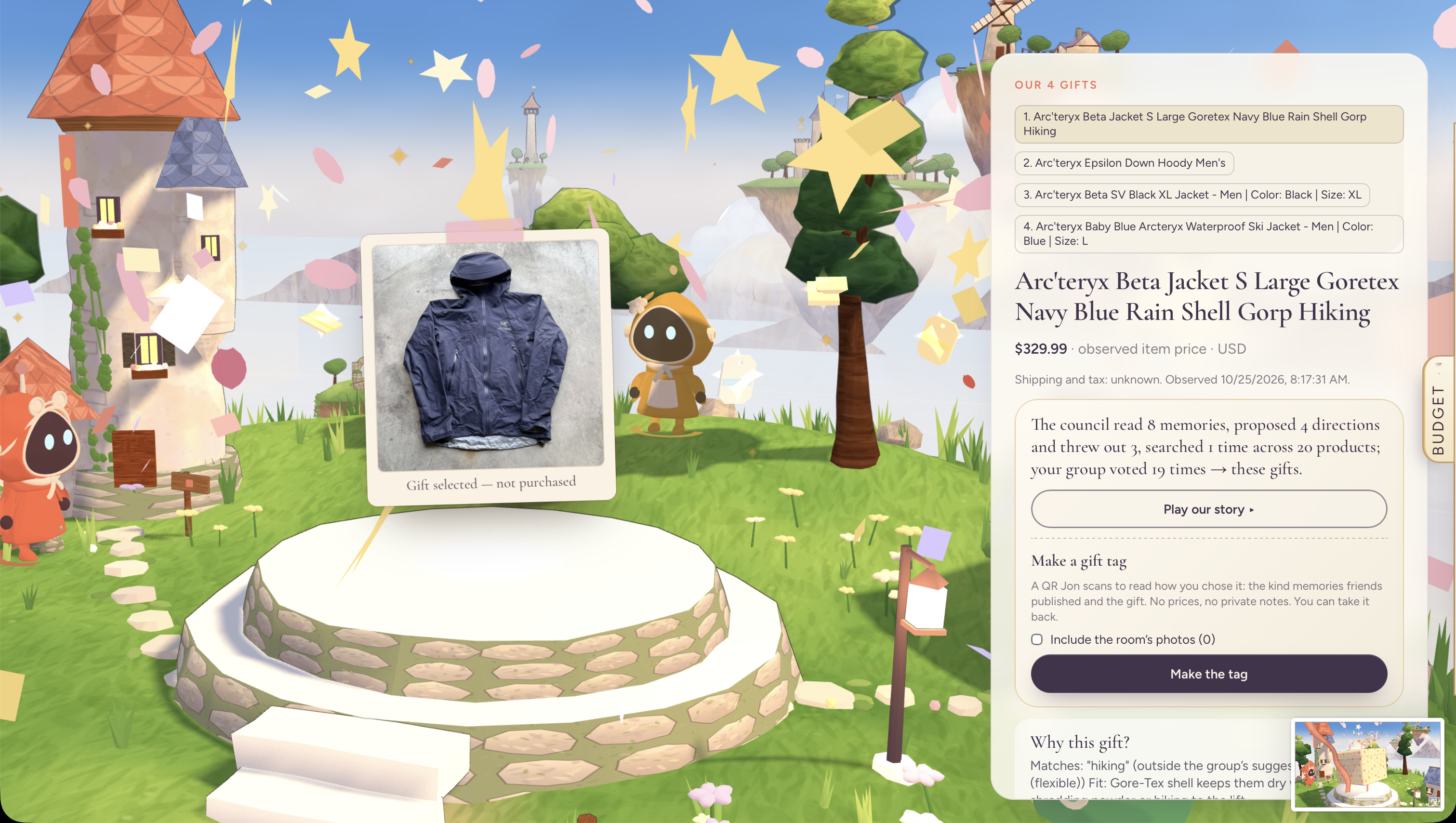
7. Celebrate the reveal. Memories converge on the central present, its ribbon wraps itself, and a cinematic reveal celebrates the group's chosen gift. The contribution-completion sequence is simulated; no money is charged or product purchased.
Unwrap makes the gifting process feel less like filling out a spreadsheet and more like discovering how well we know someone.
The gift is the outcome. The memories are what make it meaningful.
How we built it
Unwrap combines real-time multiplayer, a custom 3D world, a communicating multi-agent system, multimodal AI, and sourced shopping research.
Next.js + React Three Fiber + Three.js: We built a painterly, interactive storybook world with floating islands, custom materials, character animations, camera interactions, ribbon physics-inspired motion, and cinematic transitions. A lightweight phone interface allows friends to contribute without requiring full 3D rendering on every device.
Convex: Convex acts as our authoritative real-time backend, synchronizing rooms, memories, participants, research jobs, Council events, votes, and proposal approvals. Its queries power live collaboration, while server-side authorization keeps private evidence and contribution limits separate from shared room data. Convex also handles scheduled workflows, file storage, and Gift Twin's temporary message vault.
Fetch.ai: Five independent Python uAgents communicate through typed messages. Courier coordinates the specialists; Archivist extracts clues, Muse interprets creative directions, Scout researches sourced products, and Keeper evaluates constraints. Their recorded task events flow into the web experience, making the animated Council reflect actual agent activity. The coordinator is also accessible through Agentverse and ASI:One.
Bitdeer AI Model Studio: Our OpenAI-compatible model integration supports extracting structured clues from selected text and images, generating memory themes, identifying gift directions, and screening trends. Zod validates model output before it enters backend workflows. AI interprets information, but cannot independently publish private memories or authorize purchases.
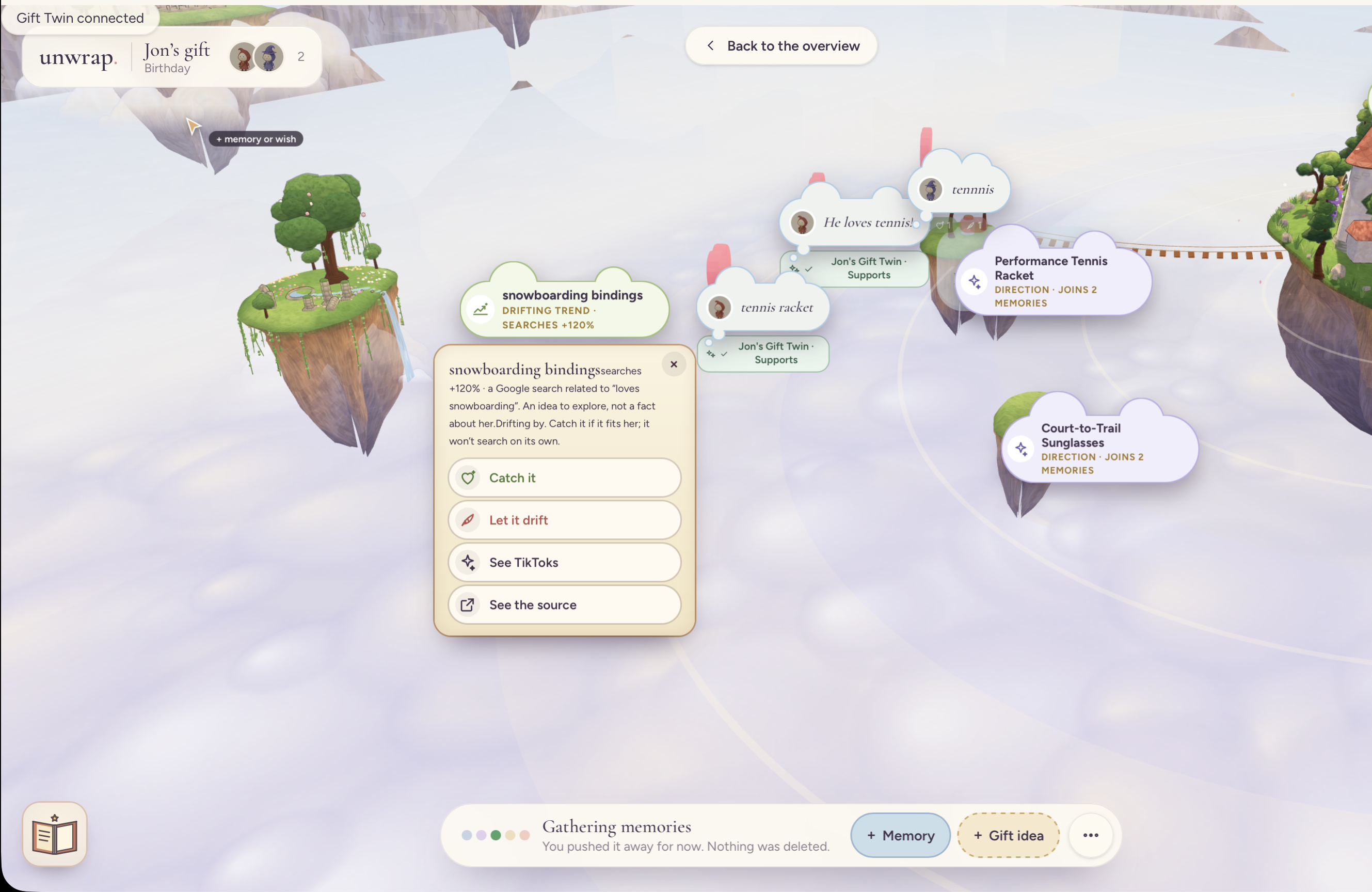
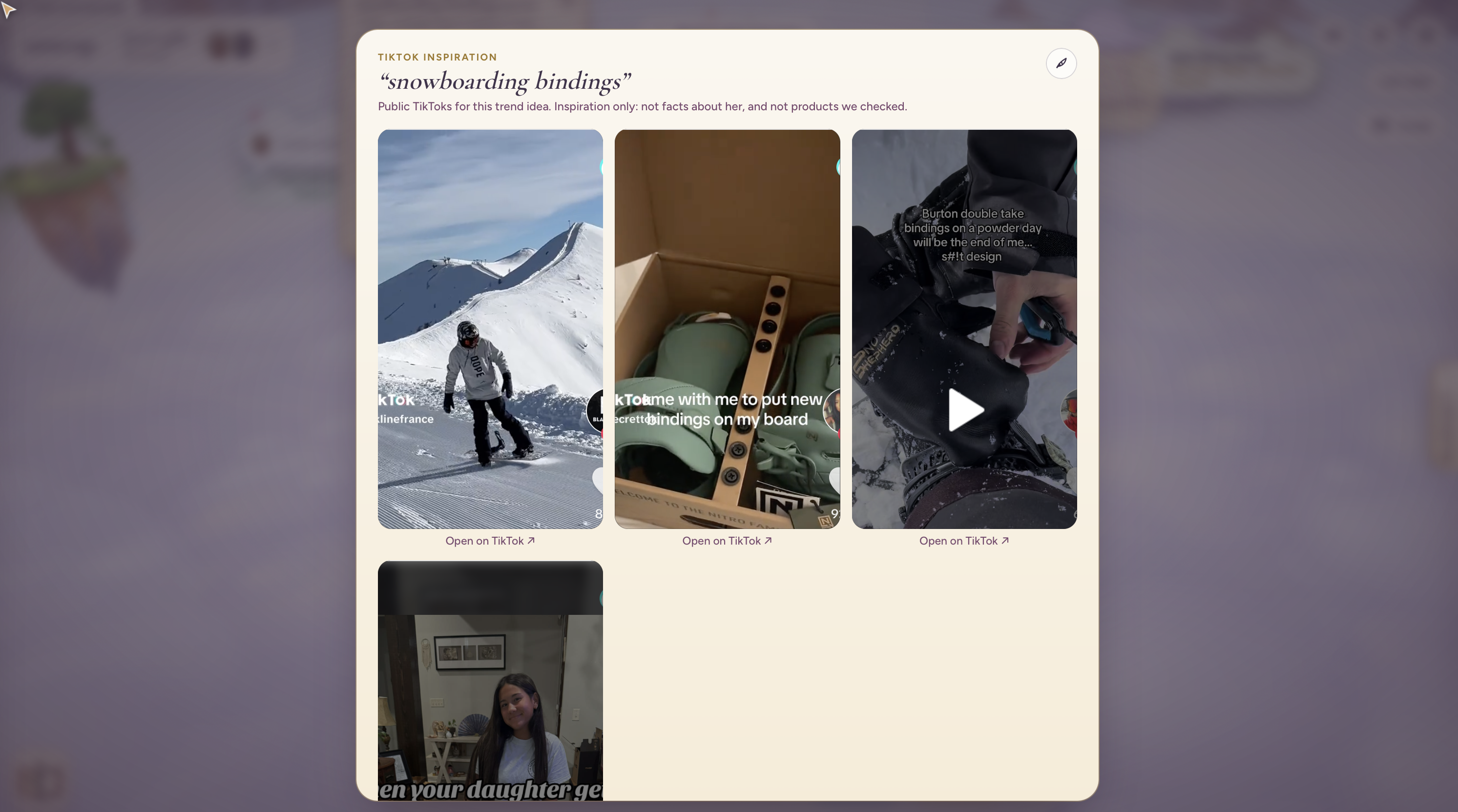
Apify: Google Shopping research connects gift directions to externally sourced listings. Google Trends and TikTok discovery provide additional inspiration. Our research layer normalizes results, retains source links and observation timestamps, and handles missing fields, irrelevant results, and provider failures.
Moss: Gift Twin uses semantic retrieval to match recipient messages to proposed gift ideas, even when the words differ. For example, "I'd love to learn wheel throwing" can support a suggestion for a ceramics workshop. Keyword and explicit contradiction checks complement semantic search.
Gift Twin + SQLite: The recipient's local Mac companion reads a bounded sample of their iMessage database in read-only mode. After explicit consent, only messages they sent are uploaded into an access-restricted Convex vault with a maximum 24-hour lifetime. Internal agent actions extract gift insights and evaluate the group's ideas without sharing raw messages with friends.
Deterministic decision logic: Contribution limits, cent-exact allocations, permissions, and revision-aware approvals are enforced through application code rather than language-model decisions.
The hardest engineering challenge was making these independently complex systems behave as one continuous, understandable multiplayer experience.
Challenges we ran into
- Keeping AI honest. Models love to invent products and prices. We made a hard rule that a listing without a source link, observed price and retrieval time is dropped, and that every recommendation must cite real memories.
- Trends that aren't gifts. Google Trends for "bowling" returns news, sports scores and tragedies. We built a two-layer screen: a model classifies each search as product, style, experience or not a gift, and a word filter acts as a hard floor and fallback.
- Privacy in a group app. Your pasted chats, your photo guesses and your budget limit must stay yours, while the room still feels shared. We split "private until you share" from "room-visible" at the database level, not in prompts.
- Photos without face recognition. We let the uploader tap the gift person on a large, uncropped photo, so the AI knows who to look at without identifying anyone.
- Paying for live data. Scraper actors cost real money, ran out of allowance, or returned rows without links. We swapped providers mid-hackathon and added per-room caps and kill switches.
- Four people, one map. Everyone's features landed in the same 3D map at once, so we leaned on a shared contracts document and frequent merges.
Accomplishments that we're proud of
- A collaborative world built from different perspectives. Friends contribute separate memories, and Unwrap makes their connections visible through an interactive 3D environment.
- A real five-role Fetch.ai Council. The agents communicate using typed messages, handle specialized responsibilities, and publish progress events that drive their animated characters.
- Gift Twin's consent-based memory pipeline. We combined local iMessage processing, temporary private storage, structured extraction, and advisory voting to uncover recipient preferences that friends may have missed.
- Evidence-backed recommendations. We designed gift discovery around published memories and real-world product sources, not generic AI-generated lists.
- A synchronized multiplayer experience. Convex connects individual phone interactions to a shared desktop world and group decision-making process.
- Human-controlled financial decisions. Private caps, deterministic allocation, and revision-aware approvals make the final choice explicit and accountable.
- A cohesive storybook experience. From pencil-sketch animations and QR invitations to the AI Council, enchanted catalogue, and cinematic gift reveal, we turned collaborative thinking into game mechanics.
What we learned
- The best AI features are the ones that show their work. Citations and "price seen" labels made people trust the suggestions far more than clever wording did.
- AI should interpret, while plain code should own money, permissions and consent.
- Real-time sync (Convex) makes multiplayer feel magical with very little code, as long as the data model is right.
- Live web data is messy: rate limits, empty results and irrelevant trends. Designing for failure states mattered as much as the happy path.
What's next for Unwrap
We want Unwrap to become a complete collaborative gifting experience that feels personal from the first memory to the final celebration.
Our next steps include production-ready checkout, a wider range of bookable experiences and local activities, recurring occasions, and an ongoing consent-based Gift Twin that can help people remember preferences over time.
We also want to bring Unwrap directly into the group chats where gift planning already happens, making it easier to transform everyday conversations into shared discoveries.
Track challenges
Best Use of Fetch.ai
Unwrap turns a real multi-agent system into the characters and intelligence of a multiplayer gift-discovery world.
We built five Fetch.ai uAgents with distinct responsibilities:
- Courier: Public coordinator that receives requests, delegates work, and assembles responses.
- Archivist: Extracts gift-relevant memories, preferences, ownership, and exclusions.
- Muse: Creates symbolic interpretations and gift-related memory charms.
- Scout: Initiates real product research through the Unwrap backend.
- Keeper: Enforces budget constraints and checks for inappropriate or duplicate recommendations.
Rather than representing five personalities inside one LLM prompt, these are separate Python uAgents communicating through typed request and response messages.
Courier orchestrates the specialists, with parallel work where appropriate. Timeout and fallback handling allows the system to continue when individual agents fail, without inventing research results.
The Council runs through a uAgents Bureau with Agentverse integration. Courier exposes an ASI:One-compatible chat entry point so the Council can be tested independently from our website.
Our most distinctive integration is connecting the agent system to the physical experience. Council task events travel through Convex and inform five animated 3D robot companions, letting users see which specialist is working and what has actually happened.
Technical proof:
The agents are not just an API behind the interface. Their collaboration is part of the gameplay.
- Courier (Unwrap Gift Council): https://agentverse.ai/agents/details/agent1q2vtalfkht476sacz6v3aslhas7pflw73m9lcpf64cth8vza3j52xtnq5mg/profile
- Keeper: https://agentverse.ai/agents/details/agent1qvrvpqjhey6g8crugt3qznxzdw7utysct068tgtlsw44j6twtxp32epyej4/profile
- Scout: https://agentverse.ai/agents/details/agent1qwptueewcv6r7t3ra7jejgvte0tjgmua8hm2du6hgdvehmw55j2vcmv66mm/profile
- Muse: https://agentverse.ai/agents/details/agent1q2q6anuhf0khmgkh5w5fw05hgw85vdgltc3qv4zl6gxd2q6y4r6d57uwwr4/profile
- Archivist: https://agentverse.ai/agents/details/agent1qvy8ev9ze4e6zhuec59shm7d8mterdfl7duzxcnq4vlnlgg8k6227nylv43/profile
Best Use of Visa: Reimagining Shopping
What if shopping felt more like exploring a magical world than scrolling through endless products?
Unwrap transforms gift shopping into an immersive, multiplayer 3D adventure, where friends combine their memories to discover meaningful gifts together.
Instead of traditional search bars and product grids, Unwrap offers a richly detailed, interactive storybook world built with React Three Fiber and Three.js. Hand-drawn sketches bloom into watercolor, revealing floating islands, animated characters, atmospheric landscapes, and a mysterious wrapped present.
Every part of the shopping journey becomes an interactive experience:
- Explore instead of scroll: Navigate a 3D world where memories connect to gift themes and real products.
- Discover with AI companions: Five animated Fetch.ai agents research gifts and bring their discoveries into the world.
- Shop through a storybook: Open the enchanted Book of Possibilities to explore sourced products, prices, and recommendations.
- Decide together: Friends vote, compare gifts, and coordinate private budgets in real time.
- Celebrate the purchase decision: Memories converge into a magical gift box for a cinematic reveal.
Behind the experience, Apify provides real shopping listings, Convex synchronizes multiplayer interactions, and deterministic allocation helps friends agree on affordable contributions.
Unwrap reimagines shopping as something social, exploratory, personalized, and genuinely fun.
We're not building another AI shopping assistant. We're turning shopping itself into a shared adventure.
Best Use of Convex
Convex is the foundation of Unwrap's shared, real-time experience.
Unwrap isn't a static gift recommender. Multiple people contribute memories, vote, explore suggestions, and approve decisions simultaneously, while a shared 3D world reacts to what they do.
We chose Convex as the authoritative backend so the experience could stay synchronized across desktop and mobile without manually managing a separate real-time messaging infrastructure.
We use Convex for:
- Reactive queries: Keeping room membership, published memories, recommendations, votes, approvals, and Council progress synchronized across clients.
- Mutations with authorization: Validating room membership and enforcing which data each participant may publish, view, or change.
- Actions and background workflows: Coordinating model inference, product research, and other asynchronous operations while tracking their states.
- Scheduled operations: Supporting retries, recovery checks, and time-limited processing where implemented.
- File storage: Supporting the media-based memory workflow.
- HTTP endpoints: Receiving and integrating events from the separate Fetch.ai Council service.
- Private data models: Keeping contributor-only evidence, contribution limits, and Gift Twin's temporary message vault separate from room-visible data.
Convex also enables one of our most visually distinctive features: when someone contributes or the Council finishes real work, the change can be reflected inside the interactive storybook world.
The financial decision system uses Convex's authoritative state to maintain exact proposal revisions. A changed selection or allocation invalidates outdated approvals rather than silently applying them to a different deal.
Convex is not merely where we store information. It is how separate people, AI agents, and one animated world participate in the same evolving experience.
Best Use of Apify
Apify bridges the gap between the things people remember and gifts they can actually find.
The central challenge in Unwrap is converting subjective, fragmented memories into actionable gift recommendations.
An LLM can infer that someone who loves pottery might appreciate a ceramics workshop or specialized tools. But language generation alone cannot verify product availability, seller pages, or observed prices.
We built a structured research pipeline around Apify-powered external data.
Google Shopping research provides sourced products, listing URLs, and observed pricing information.
Google Trends discovery expands interests into related topics that might inspire new gift directions.
TikTok discovery supports optional style and fashion research when appearance and trends are relevant to the recipient's interests.
We then normalize provider responses into application records, retaining source information and timestamps and rejecting unusable or unsupported results.
One of our biggest challenges was that external research isn't predictable. Actors may return incomplete listings, irrelevant trends, empty responses, or usage-cost constraints.
We introduced bounded jobs, explicit execution states, normalization, filtering, and recovery behavior to make the pipeline more reliable.
The result is a system in which AI proposes what may be meaningful, while Apify supplies evidence about what exists on the shopping web.
The gift is inspired by a memory, but the recommendation is backed by a source.
Explore the research implementation
Best Use of Bitdeer AI Model Studio
Unwrap uses Bitdeer AI Model Studio to translate everyday human memories into structured gift intelligence.
Gift planning rarely starts with clean data.
One friend remembers a conversation. Another contributes a photo. Someone recalls a specific interest but doesn't know which product would fit.
Our model workflows interpret these different inputs and turn them into useful, reviewable information.
Using an OpenAI-compatible model adapter, we integrate Bitdeer AI Model Studio into several parts of the recommendation pipeline:
Conversation and clue extraction: Selected text is analyzed for possible wishes, interests, dislikes, ownership, and relevant constraints.
Visual interpretation: Submitted photos can be analyzed for activities and relevant objects, with the uploader identifying which person to focus on rather than using face recognition.
Theme and direction generation: The model helps identify connections among published memories and propose gift directions supported by the available clues.
Trend screening: Candidate topics from Google Trends are classified to distinguish potentially giftable products, styles, and experiences from irrelevant results.
In-room guidance: Model-driven responses can explain ideas using the information already confirmed by the group.
We use Zod schemas to validate structured responses and backend policies to determine what may be persisted or published.
This distinction is fundamental: the model can interpret a memory, but it cannot independently expose private conversations or invent authoritative product information.
Bitdeer helps turn unstructured human knowledge into the structured reasoning that powers Unwrap's collaborative discovery experience.
Model adapter and AI implementation
Meta: Bringing People Closer Together with AI
Everyone knows a different side of someone. Unwrap turns those perspectives into something people create together.
Most AI gift recommenders begin with one person's description of another.
We wanted to begin with their relationships.
One friend remembers a childhood interest. Another knows their current hobbies. Another remembers a spontaneous wish, and someone else knows exactly what they wouldn't like.
Each person has incomplete knowledge, but together those memories become meaningful.
Unwrap uses AI to connect those different perspectives, uncover shared themes, and discover gift opportunities that might not emerge from a single person's memory.
The experience is intentionally multiplayer. Friends join the same storybook room, contribute through their phones, watch the environment change, explore recommendations, and make the final decision together.
AI doesn't replace participation. It makes each person's contribution more valuable.
Gift Twin adds an optional perspective from the recipient's own expressed interests, with their permission and without exposing raw conversations to the group.
Our central design principle is that AI should make human thoughtfulness more visible, not automate it away.
The final result is not simply a recommended product. It is a gift the group can trace back to the moments and memories they shared.
We built Unwrap to make people feel remembered—and to make the act of remembering someone a shared experience.
Cal Hacks Most Creative Hack
What if planning a gift felt like playing through a magical story?
Unwrap transforms group gift planning into a shared 3D storybook.
The experience begins as a pencil drawing. Watercolor fills the world, revealing floating islands and a present tied with a ribbon.
The present becomes an invitation: its ribbon unravels, the box unfolds, and a QR-code tree grows so friends can enter the same world.
Friends appear as little spirits. Their memories become objects and connected themes. A Council of five animated AI agents investigates ideas while the group explores a floating archipelago of gift possibilities.
The Book of Possibilities uses the same sketch-to-watercolor language to turn product comparison into another chapter of the story.
When a gift is chosen, memories flow into the present for a cinematic reveal.
These interactions aren't unrelated visual decorations. They transform the core activities of remembering, brainstorming, researching, and agreeing into the mechanics of a playable experience.
We didn't just make a gift planner look like a game. We made remembering someone the game itself.
Cal Hacks Most Technically Complex Hack
Unwrap combines several independent technical systems into one reactive multiplayer experience.
Real-time state and authorization: Convex manages shared room state, individual permissions, live subscriptions, research jobs, and revision-aware group decisions.
Interactive 3D rendering: React Three Fiber and Three.js power custom floating islands, painterly materials, animated characters, camera interactions, and cinematic transitions.
Distributed multi-agent coordination: Five Python Fetch.ai uAgents exchange typed messages and publish task events that integrate with the TypeScript application.
Multimodal AI: Validated language and vision workflows interpret selected conversations, photos, and memory clues without granting the model unrestricted access or publishing authority.
Live research integration: Apify-based shopping and trend pipelines must handle incomplete external data, bounded paid calls, source provenance, and asynchronous outcomes.
Private personal memory processing: Gift Twin uses local SQLite access, consent-gated uploads, temporary Convex storage, internal processing, semantic retrieval, and advisory voting.
Deterministic financial logic: Cent-exact allocation, private contribution caps, and proposal-revision checks keep consequential decisions outside AI-generated output.
The most difficult work was coordinating the boundaries between these systems: making asynchronous agents and external research visible in a real-time world while preserving source integrity, privacy, and human control.
Unwrap's complexity lies not in one algorithm, but in turning a sophisticated, multi-runtime system into one coherent interactive product.
Best Use of Moss
Moss helps Unwrap remember what someone meant, not just the exact words they used.
One of our most interesting features is Gift Twin, an optional AI collaborator that evaluates gift ideas using messages the recipient explicitly authorized for analysis.
The difficulty is that real people rarely speak in product catalogue terminology.
Someone might text, "I've always wanted to learn wheel throwing." Months later, a friend might propose a "ceramics workshop."
Those phrases have little direct word overlap, but they describe the same underlying interest.
We use Moss-supported semantic retrieval to connect a proposed gift idea to meaningful evidence from the recipient's messages.
Gift Twin combines semantic search with explicit keyword and sentiment-based checks. This matters because the system must distinguish enthusiasm from contradiction and recognize when someone already owns an item.
The memory workflow is privacy-conscious:
- The recipient authorizes a limited upload of messages they sent.
- Messages live in a temporary, access-restricted Convex vault.
- Internal Twin processing uses semantic retrieval to identify relevant evidence.
- Screened gift insights and advisory votes can be shared with the room.
- The raw message history is never exposed as a group conversation or searchable public record.
We also explored Moss-based room guidance and optional voice interactions to help players navigate the storybook experience.
Moss allows Unwrap to connect ideas across the natural, imperfect language people use in everyday life.
This is what makes Gift Twin more than keyword detection: it can recognize gift-relevant meaning even when the recommendation and the original memory use different words.
Gift Twin and Moss implementation
Microsoft: Built for the Real World
Unwrap solves a recurring, practical problem: groups know someone well, but struggle to turn their collective knowledge into one thoughtful purchase.
Friends and families routinely coordinate birthday gifts, graduation presents, holiday gifts, and celebrations through fragmented conversations and spreadsheets.
That process creates real friction: duplicate suggestions, forgotten preferences, uncertainty about what someone already owns, unequal contribution expectations, and the burden of coordination falling on one person.
Unwrap brings these steps into a single collaborative experience.
Users can create a room, invite contributors, share memories, research sourced gifts, compare recommendations, and agree on a contribution plan.
Our design decisions prioritize real usability:
Accessible participation: Friends can contribute through a lightweight mobile interface while a shared desktop displays the interactive 3D world.
Privacy: Contributors control what memories become room-visible. Recipient-authorized Gift Twin data is processed separately, with limited retention.
Transparent recommendations: Gift ideas connect to supporting memories and recorded external sources.
Financial clarity: Private caps, deterministic allocations, and versioned approvals ensure that a group can agree on a specific proposal without exposing everyone's personal limits.
Reliability: Structured model validation, bounded research jobs, and explicit failure handling reduce dependence on ideal external-service behavior.
The cinematic storybook experience differentiates Unwrap, but the underlying utility is straightforward: helping people make a meaningful decision together.
Beyond the hackathon, we see opportunities in family gifting, student organizations, celebrations, bookable experiences, and recurring occasions.
The most important customer outcome is simple: less time coordinating, and a gift that feels more personal.


Log in or sign up for Devpost to join the conversation.