Inspiration
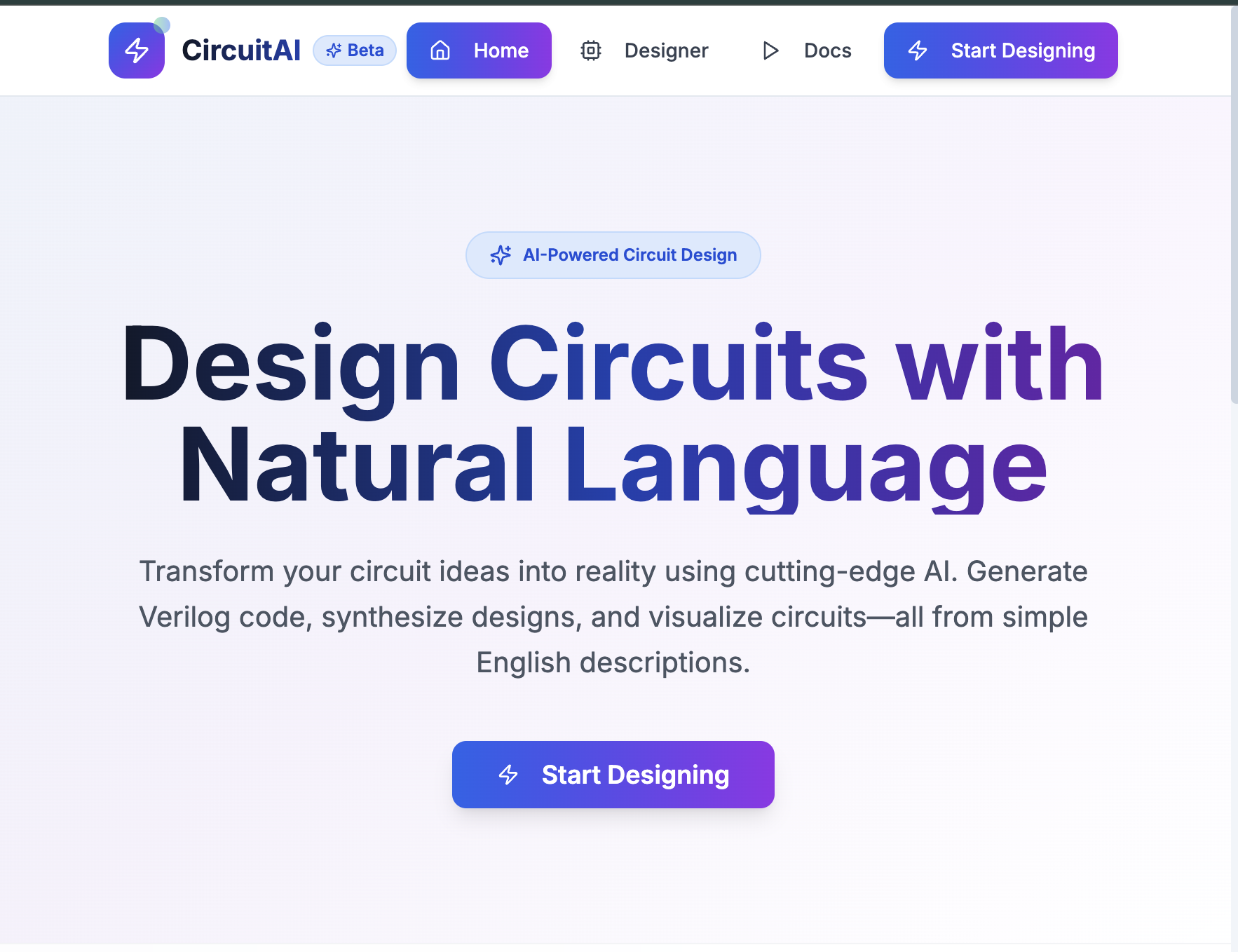
We were inspired by the challenge of bridging the gap between human intuition and hardware design. Many students and engineers struggle to translate ideas or hand-drawn schematics into working Verilog code. We wanted to make digital design as easy as describing your idea or uploading a circuit diagram. Circuits can quickly scale in complexity - a huge technical challenge (or opportunity) exists in being able to use AI to design chips - our eventual vision is to be able to use this tool as both an open-source tool for curious individuals to design their own schematics, as well as be able to take on more complex projects such as CPU or GPU architecture design eventually.
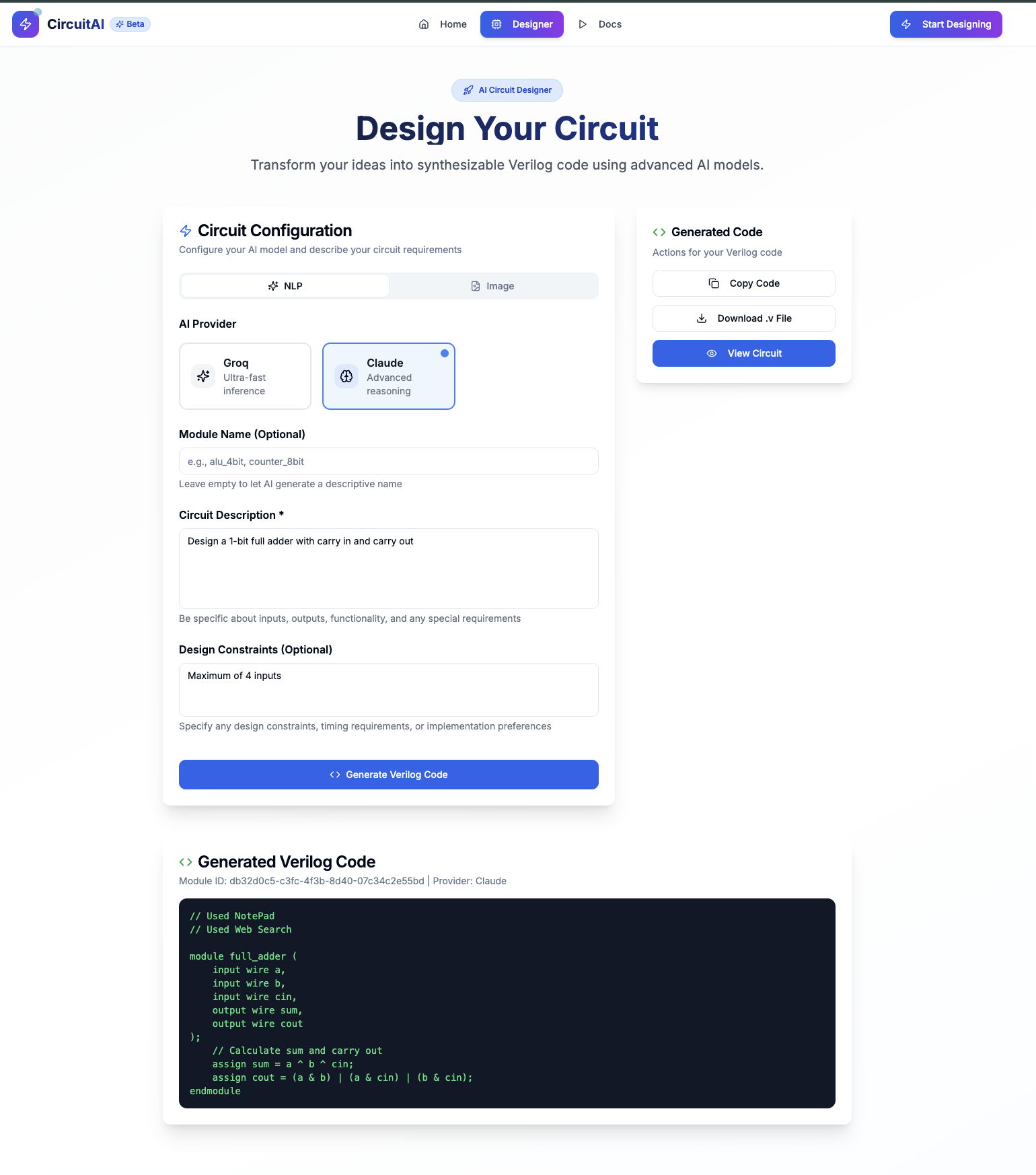
CircuitAI lets users:
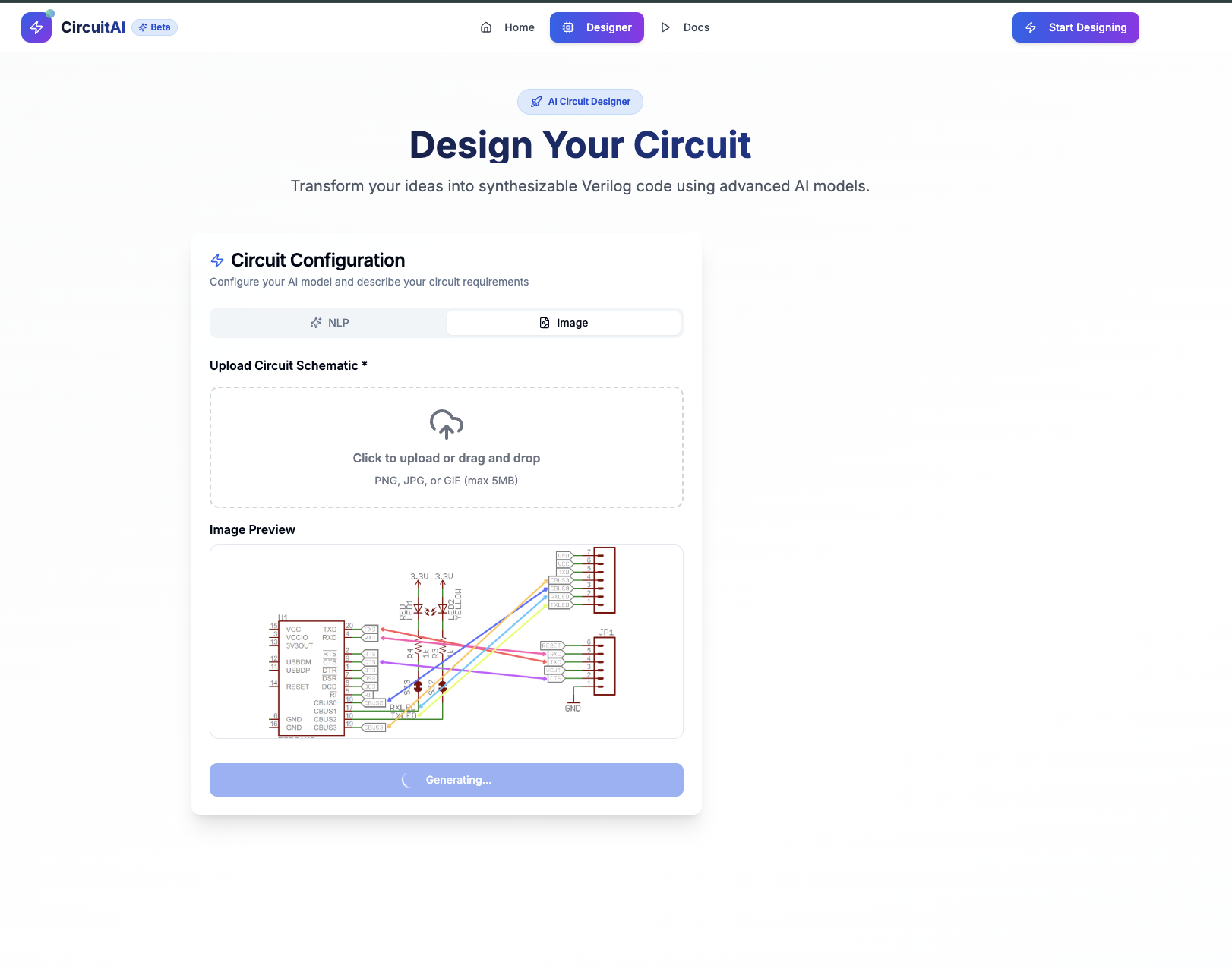
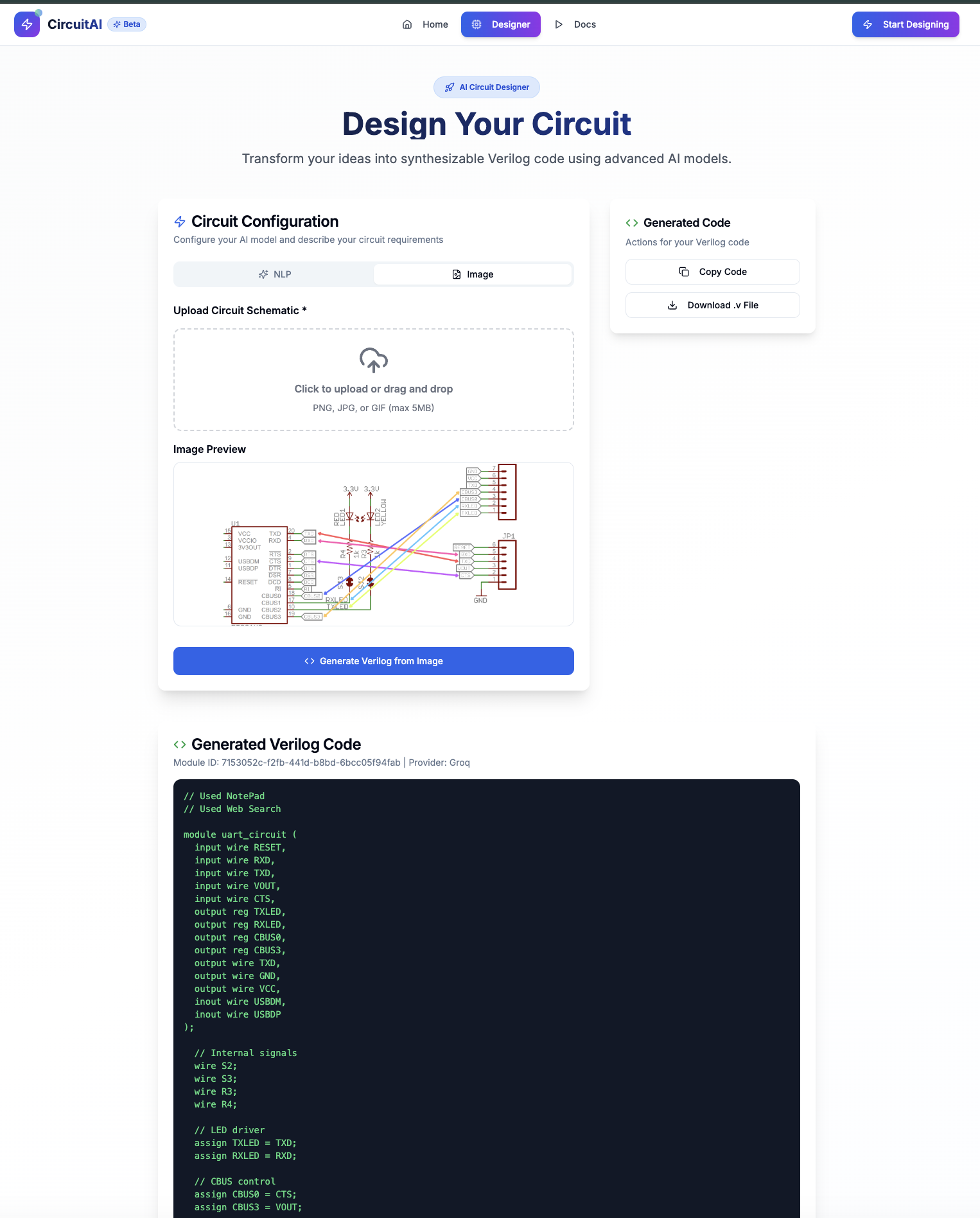
- Describe a digital circuit in plain English (NLP), or upload a schematic image.
- Instantly generate clean, synthesizable Verilog code.
- Visualize and interact with the generated schematic.
- Ensure the generated code matches the original intent and abstraction level, using a double-pass AI review for accuracy.
How we built it
- Frontend: Next.js/React with a modern, responsive UI and tabbed workflow for NLP and image input.
- Backend: FastAPI Python server orchestrating the pipeline. AI/LLM: Anthropic Claude for vision (image-to-text) and code review & Groq for ultra-fast, deterministic Verilog code generation.
- Double-pass logic: After initial code generation, the model reviews and revises the output to ensure functional and abstraction-level accuracy.
- LLM Tools: Claude's capabilities are boosted by access to Web Search, Code Execution, and a custom Notepad tool.
- Other tools: Filetype for robust image handling, and custom prompt engineering for determinism.
Challenges we ran into
- Ensuring the generated Verilog is not just plausible, but functionally equivalent to the input schematic or description.
- Maintaining the correct abstraction level (gate-level vs. behavioral) in the output.
- Integrating vision models and text models in a seamless pipeline.
- Handling ambiguous or incomplete schematics.
Accomplishments that we're proud of
- Building a pipeline that can take both text and image inputs and produce high-quality Verilog.
- Designing and implementing a custom notepad tool for Claude
- Implementing a double-pass AI review for improved accuracy and reliability.
- Creating an interactive, user-friendly frontend for both students and engineers.
What we learned
- Multi-pass (generate + review) workflows significantly improve LLM output quality.
- Integrating vision and text models opens up new possibilities for hardware design automation.
- Prompt engineering can be used to direct code generation. Utilizing groq enabled us to critically integrate deterministic outputs into our outputs, and the speed of groq enabled us to utilize that latency budget to integrate checks within our circuit generation.
What's next for CircuitAI?
- Voice debugging walk through with VAPI
- Add support for more complex, multi-module schematics. Add support for multiple levels of complexity, layers of PCB design, and different HDLs.
- Integrate simulation and waveform visualization directly in the browser.
- Expand to support VHDL and SystemVerilog.
- Open-source the project and invite contributions from the hardware and AI communities.


Log in or sign up for Devpost to join the conversation.