Inspiration
Five friends on a couch, a game on the TV, and not a single person actually watching it. Watching sports with friends is meant to be social and fun, but these days everyone ends up on their own phone, scrolling and texting. At the same time, betting and prediction markets are all the rage, but the major apps make the experience a solo one rather than something you share. We wanted one solution for both problems.
What it does
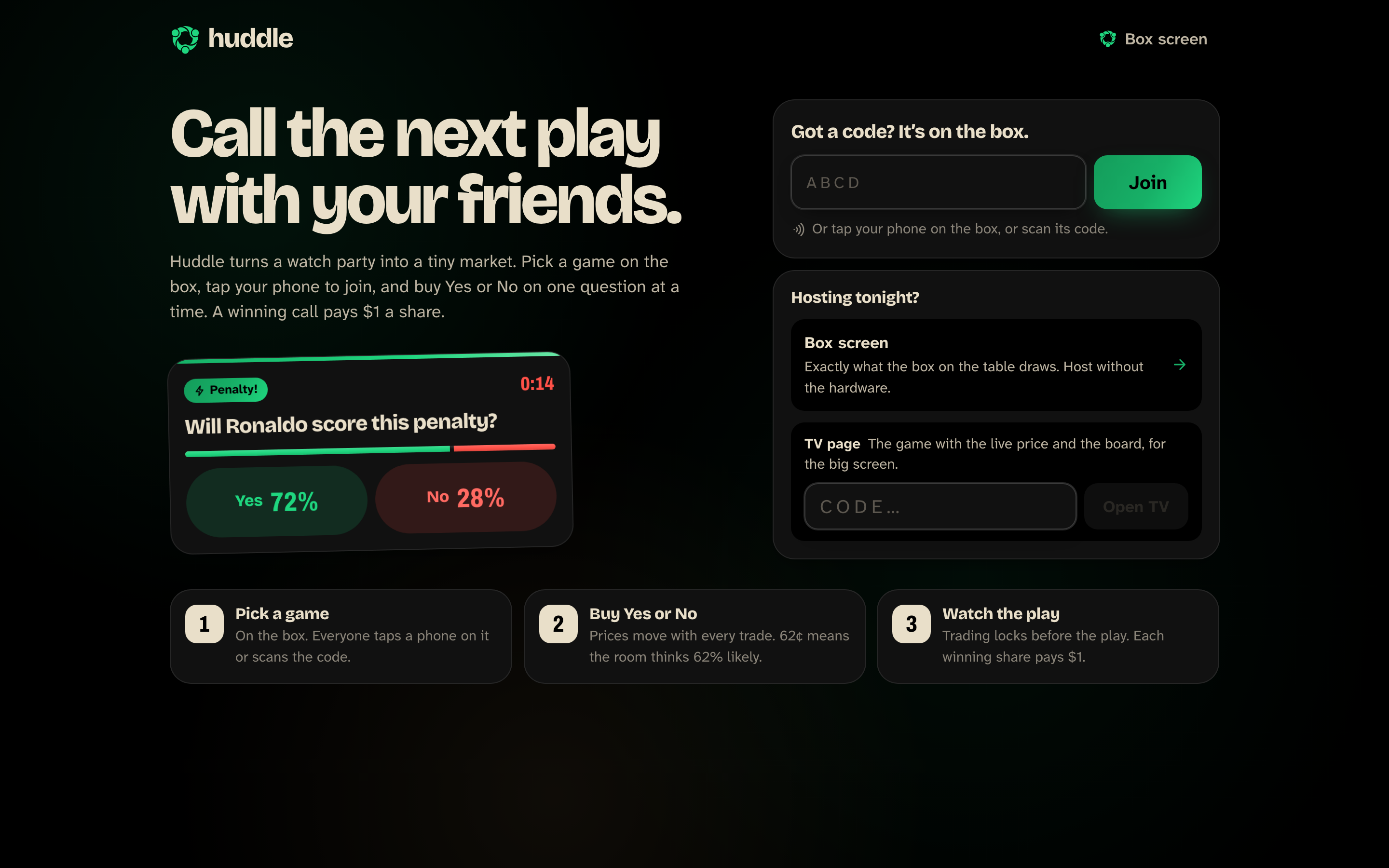
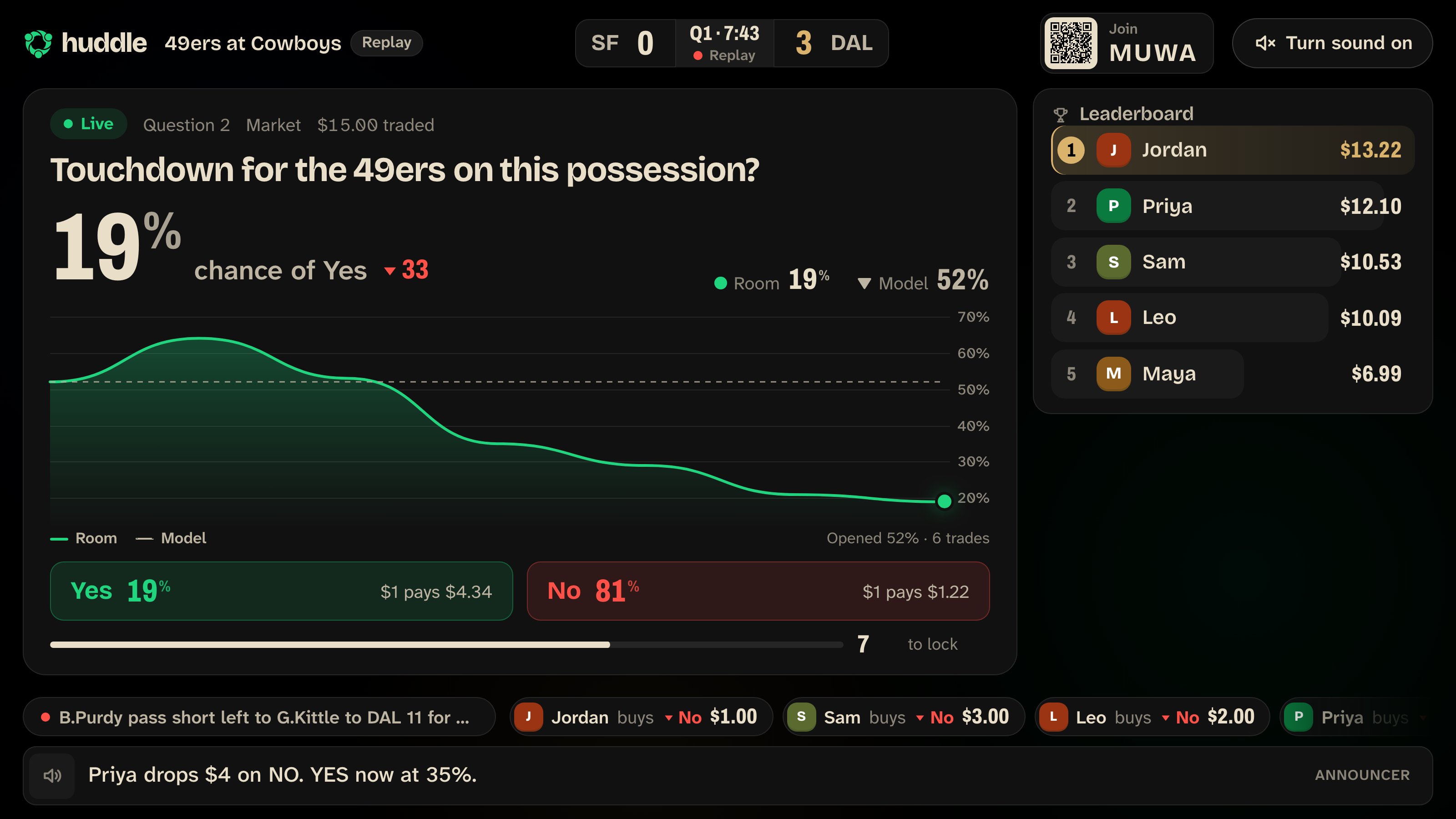
Huddle creates a prediction market for the room you're already in. It gives friend groups something to stay connected over and brings back the yelling and trash talk that make watch parties fun. After all, you're bound to pay attention when you've got money on the line.
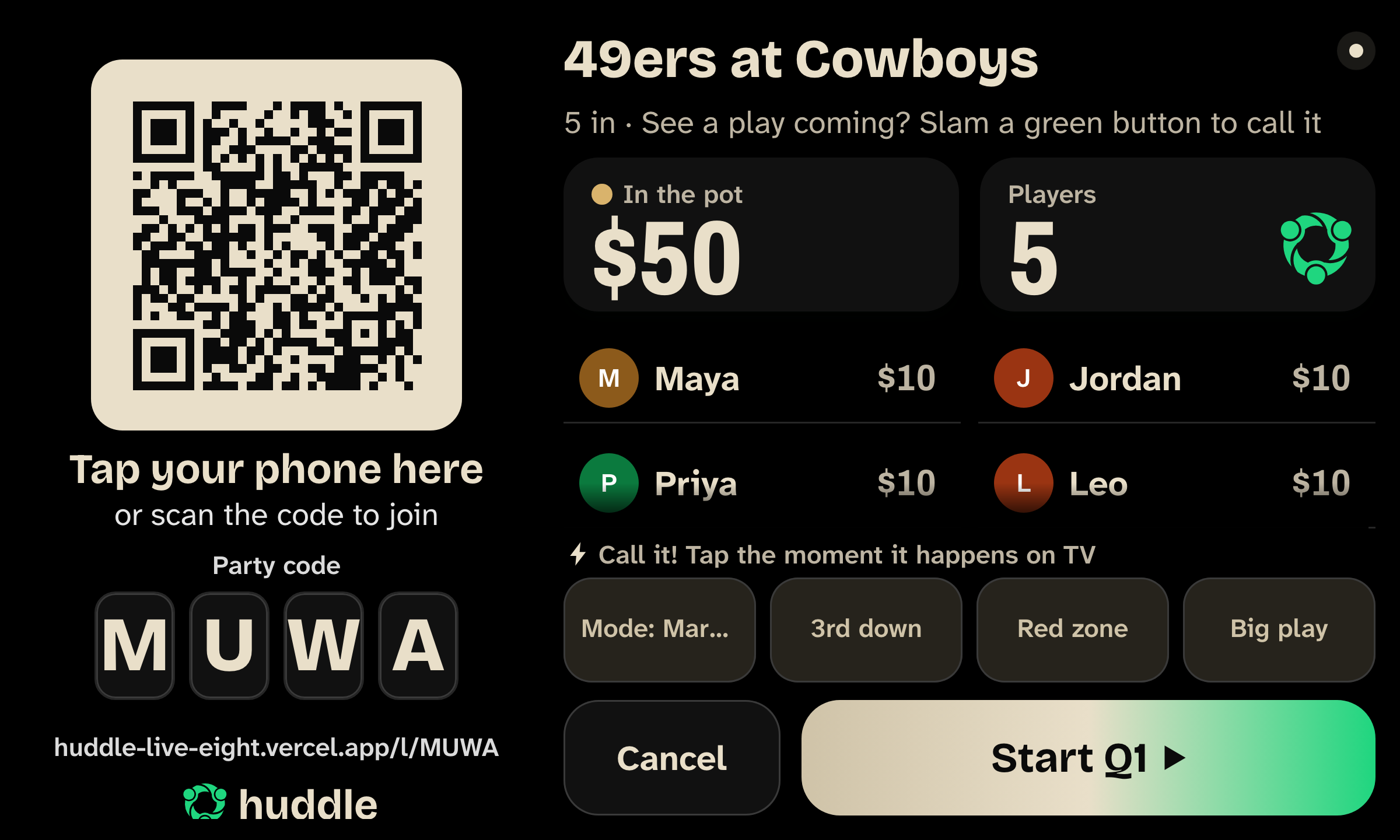
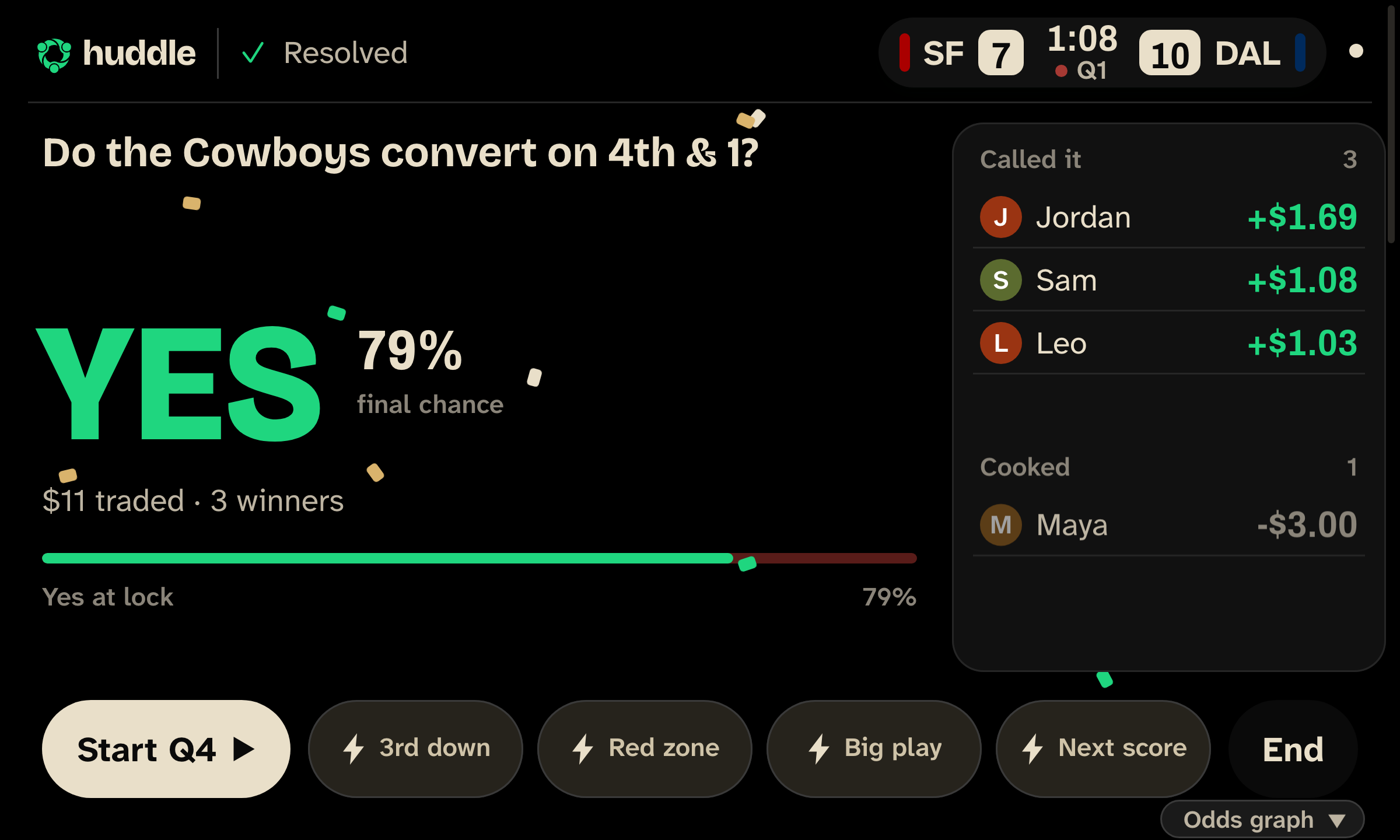
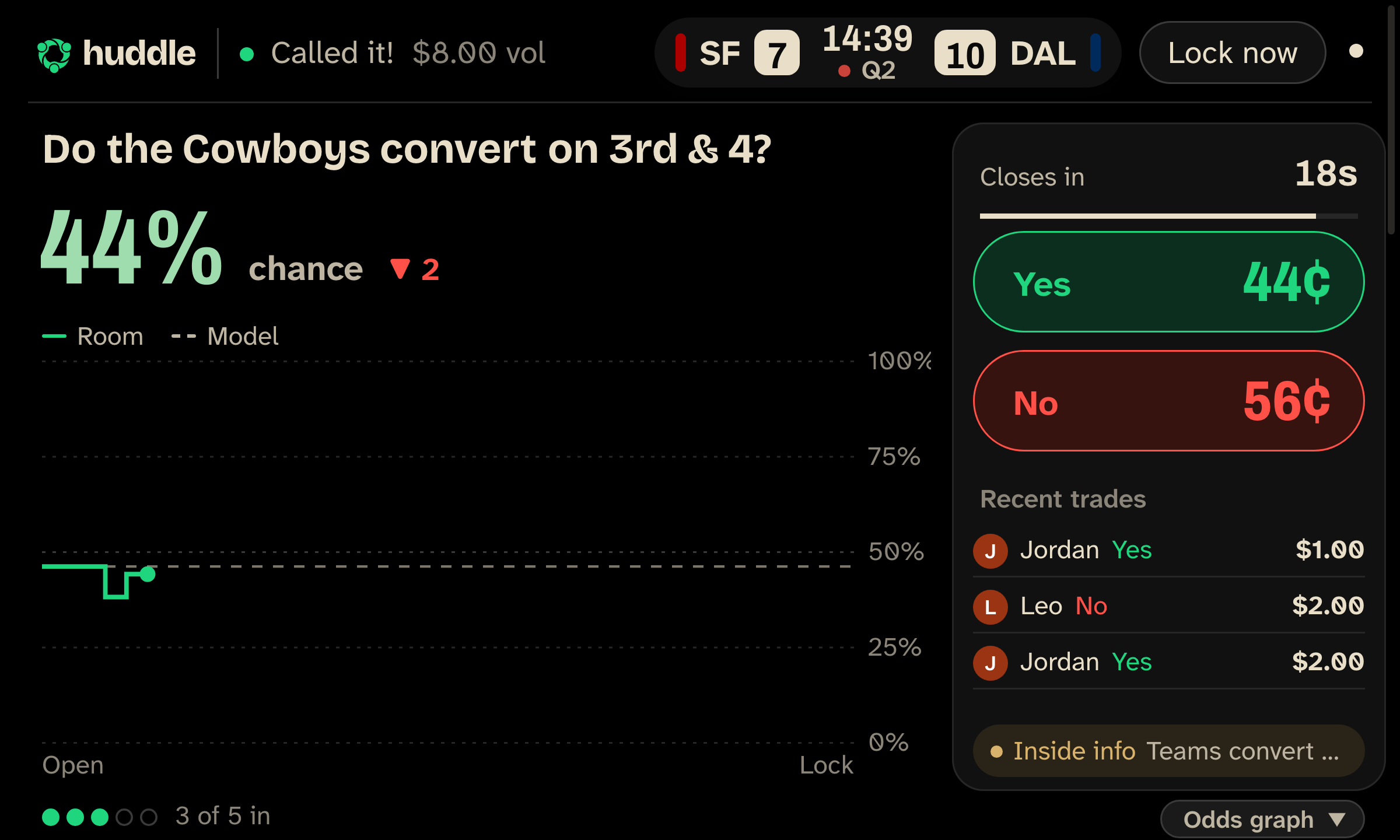
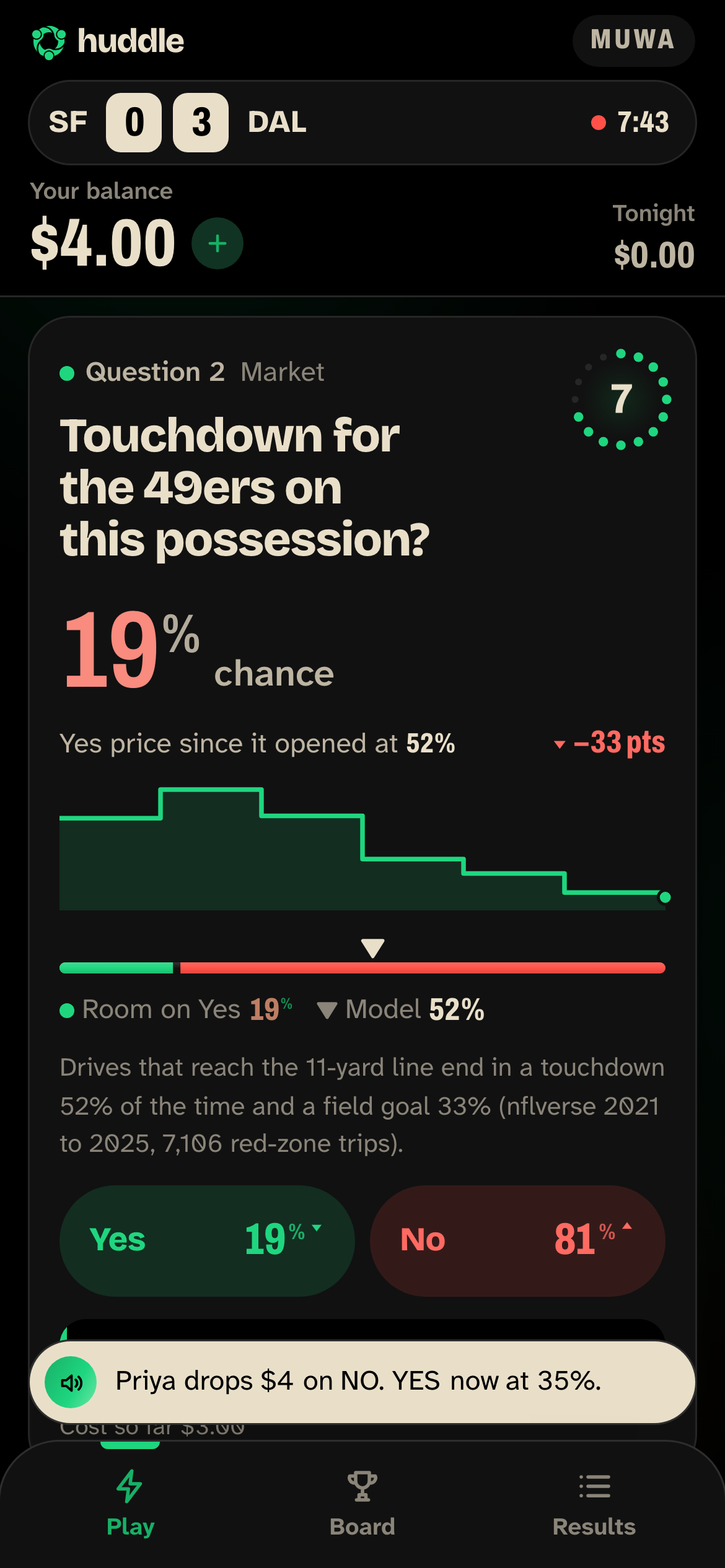
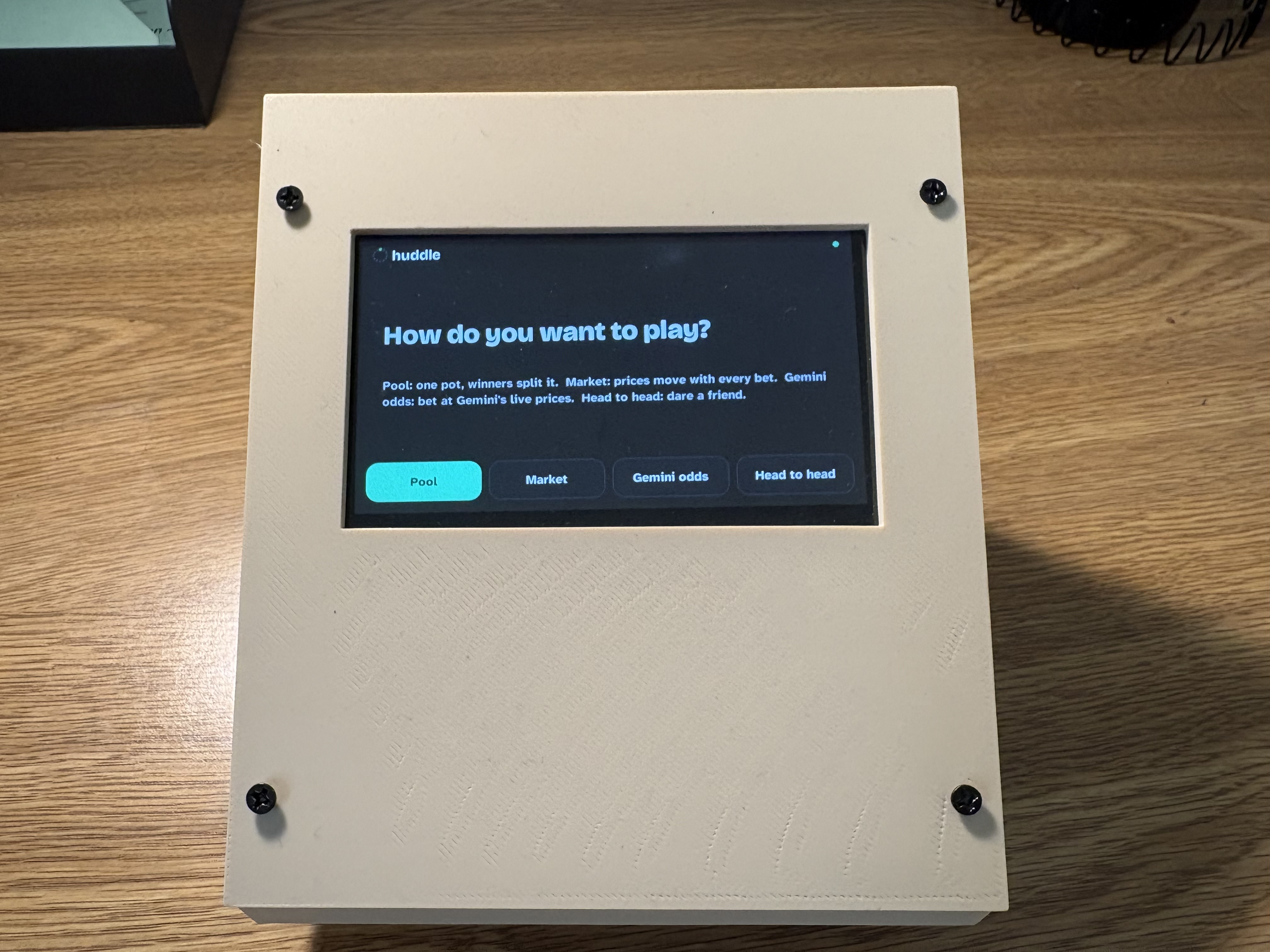
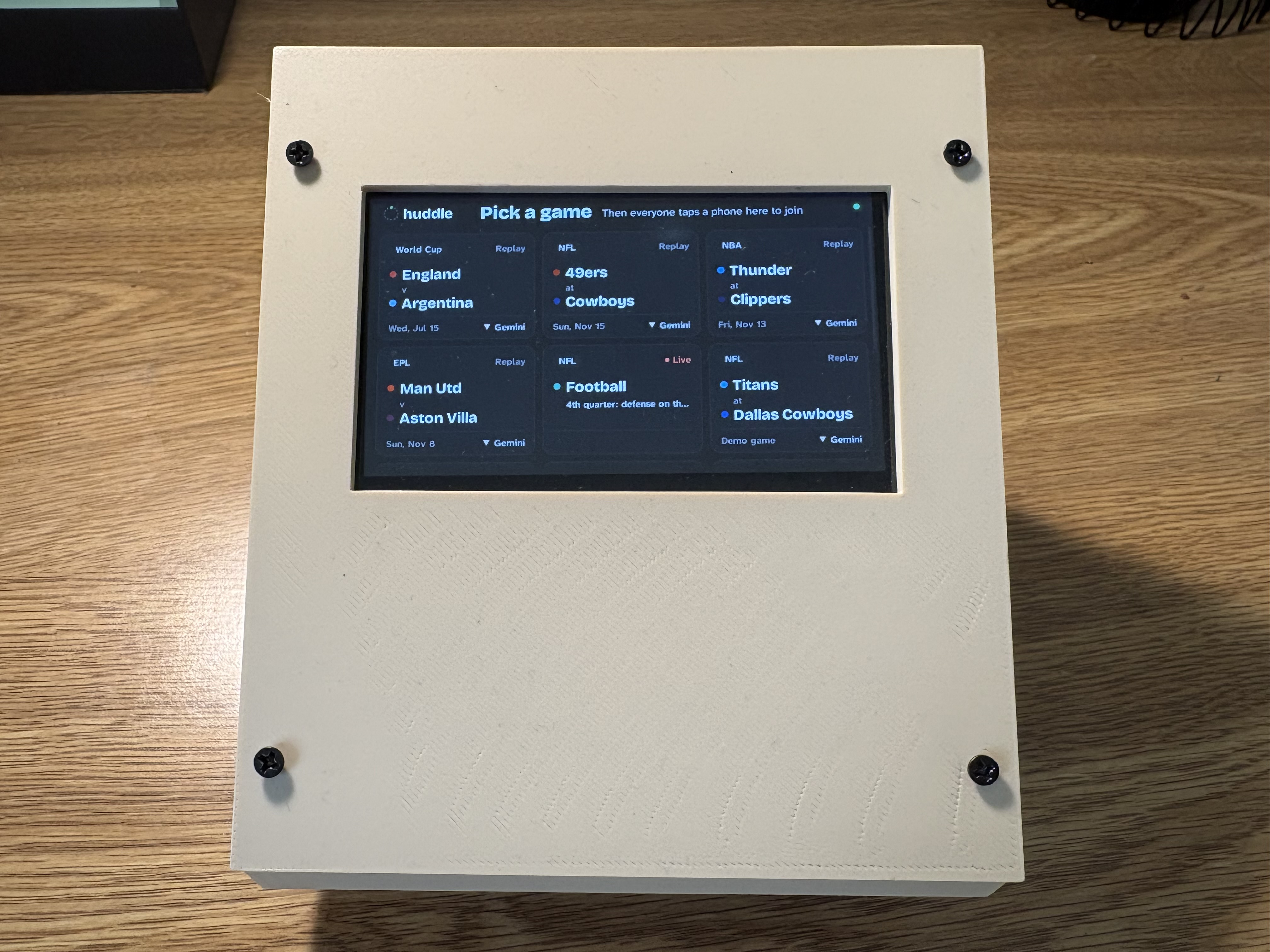
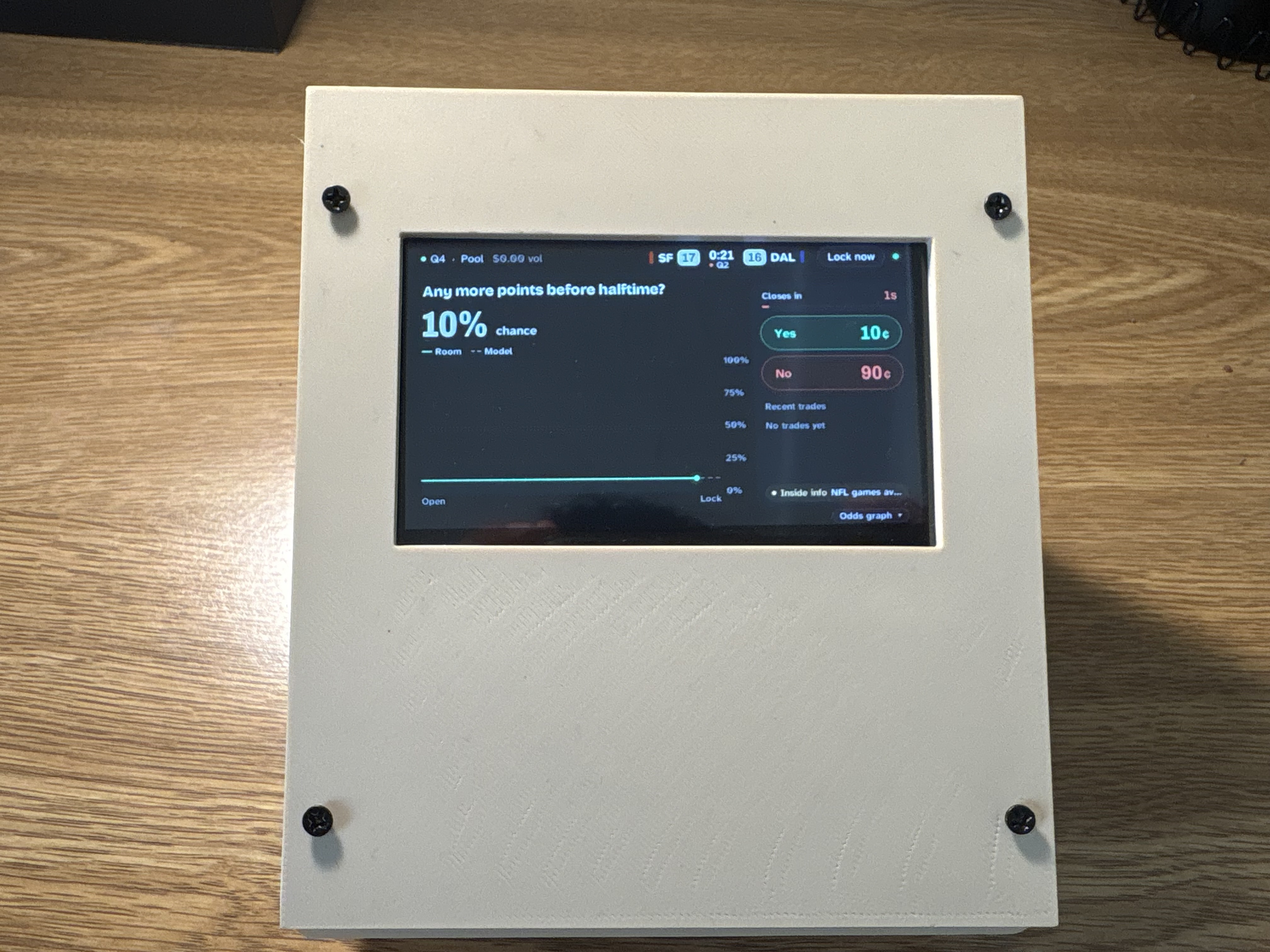
Put a game on the TV, select it on the HuddleBox, and everyone taps their phone on the box to join. No app, no account, no wallet to set up. Then the questions start rolling in: Will the defense intercept on the next play? Huddle deliberately picks the most contested bets, so the room is always split. Everyone picks YES or NO on their phone, and the box's own commentator calls the outcomes live.
Odds set by your friends
The odds aren't set by some unknown third party, but by your friends. Each question has a YES pool \( Y \) and a NO pool \( N \), and the price of YES is just the share of money on YES:
$$ p_{\text{YES}} = \frac{Y}{Y + N} $$
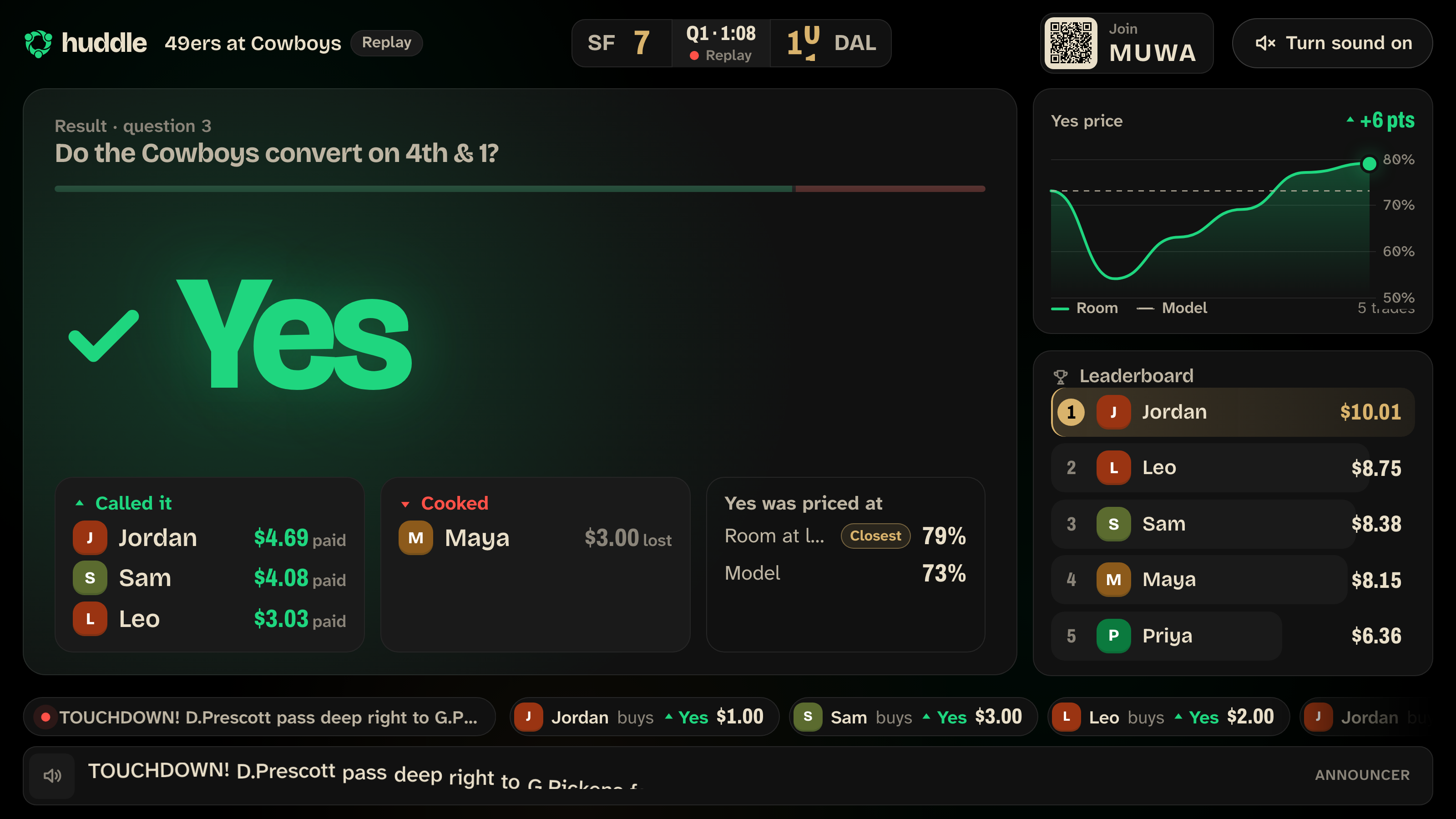
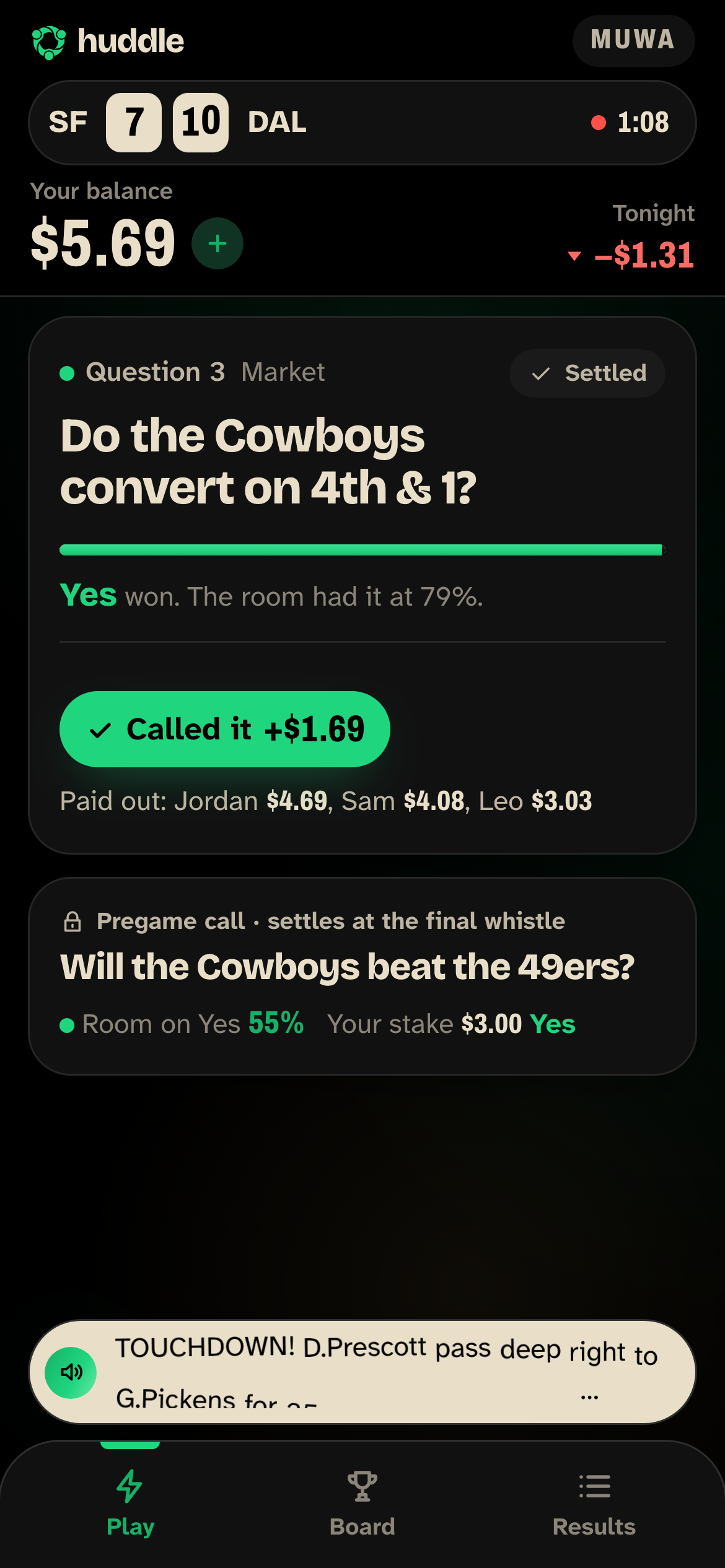
Bet big on YES and you push the price up for everyone else. When the play happens, winners split the whole pot by how much they put in, with no house cut:
$$ \text{payout}_i = \frac{s_i}{W}\,(Y + N) $$
where \( s_i \) is your stake and \( W \) is the total on the winning side. If nobody took the other side, everyone gets their money back.
Your room vs. the market
Every question shows your room's price right next to Gemini's live prediction-market price, and a graph on the box tracks the two over time. At the end of the game, a scorecard settles the real argument: who called it best, the room or the market? We score it with the Brier score:
$$ \text{Brier} = \frac{1}{n} \sum_{t=1}^{n} \left( p_t - o_t \right)^2 $$
where \( p_t \) is the predicted probability and \( o_t \) is what actually happened (1 or 0). Lower is better, and yes, sometimes your friends actually beat the market.
How we built it
Huddle is built around the HuddleBox and the mobile experience.
The HuddleBox
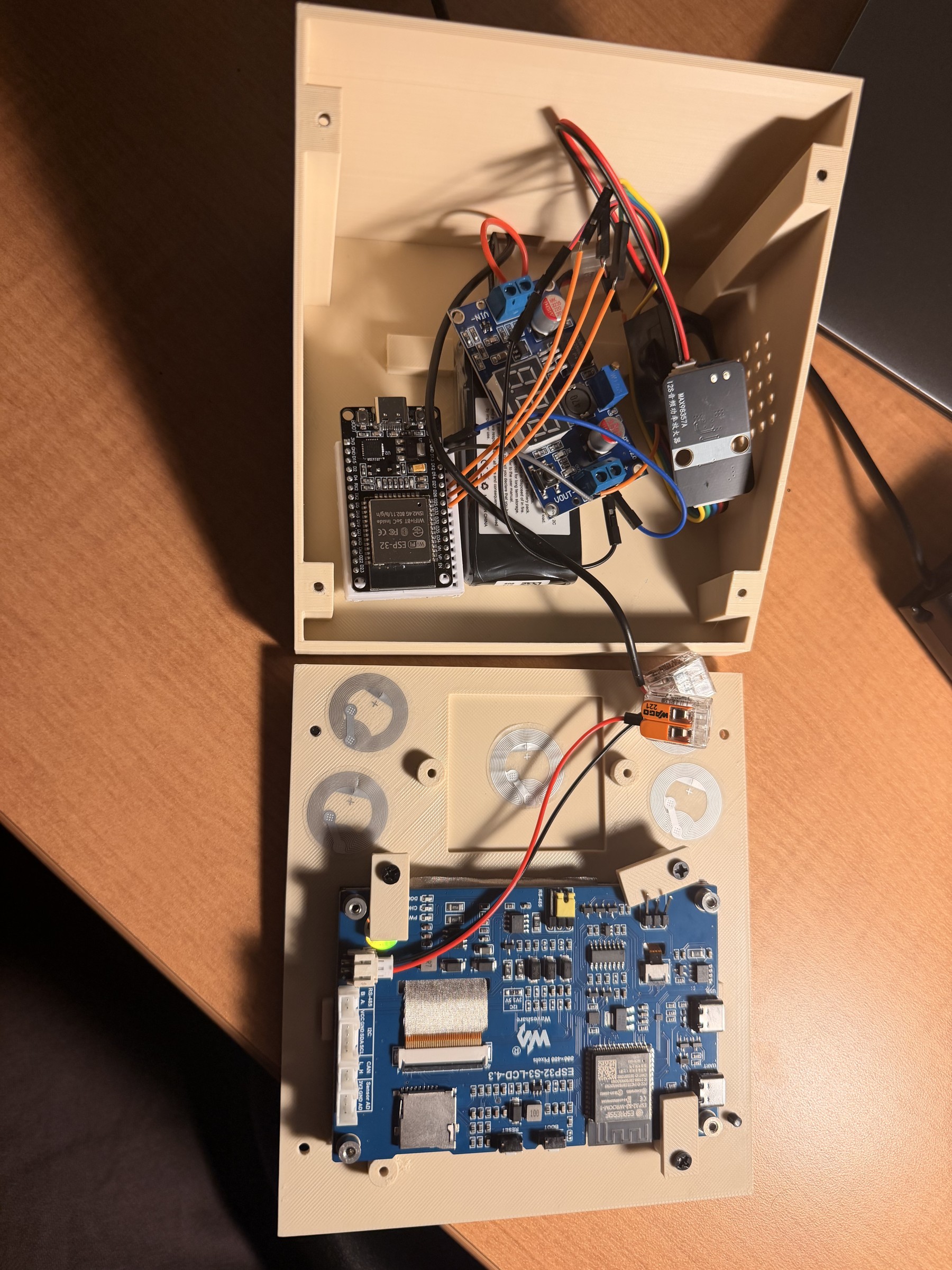
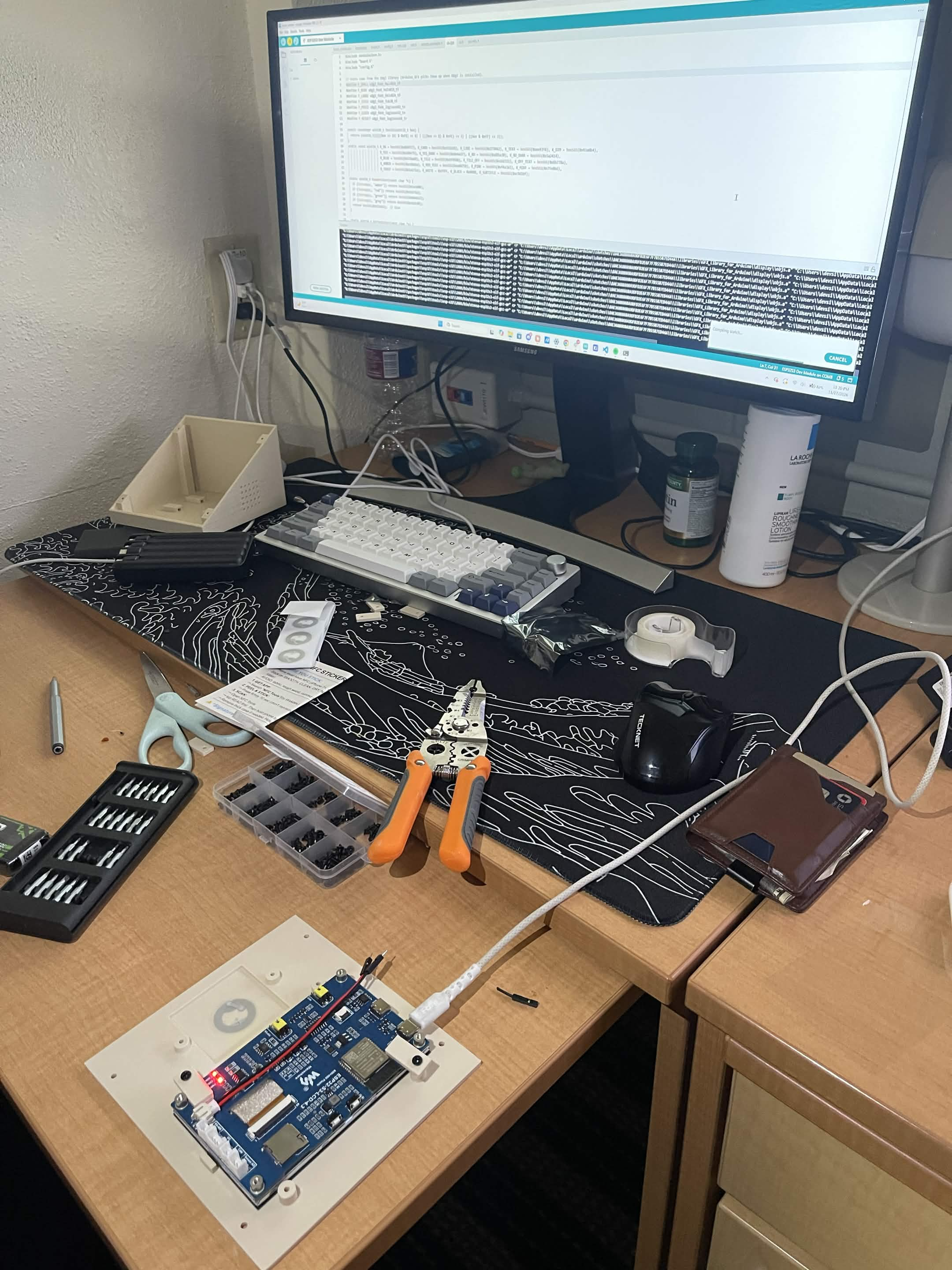
- Face: a Waveshare 4.3" touchscreen with a built-in ESP32-S3.
- Voice: a second ESP32 driving a MAX98357 amp and a speaker.
- Tap to join: an NFC tag hidden behind the front panel.
- Body: a three-part case we designed and 3D-printed, held together with M3 screws.
The voice: ElevenLabs
ElevenLabs Flash text-to-speech narrates every event, with a different voice for each sport and each game. Lines are generated ahead of time and streamed as WAV audio straight to the ESP32, so the call lands the moment the play does.
The money: Solana
- Bets are real USDC on Solana devnet, held in a custom Anchor vault program that takes deposits and settles payouts on chain.
- Every player gets a built-in wallet: a single tap creates their token account, mints and transfers in one transaction, confirmed in about two seconds.
- Deposits also go through Solana Pay QR codes, on the phone and on the box, each with a reference key so every payment matches the right player.
- The house pays every fee, so players never see one.
Real-time deposits: QuickNode
QuickNode watches devnet in real time, filtered to our vault program and treasury account, and sends matching transactions to a secured webhook that credits deposits automatically. A deposit from any wallet shows up in the game within seconds, with no waiting on a poll.
The market data: Gemini
In Gemini odds mode, friends bet together at Gemini's live prices, which makes Huddle a social front end for a real prediction market. Our own model is calibrated to Gemini's moneyline, and replayed games use Gemini's real historical prices, so the room-vs-market comparison is honest.
Challenges we ran into
- Software and hardware in sync. The game logic, phone pages and TV view all live on our server, and keeping the HuddleBox's small screen in sync with everything else took a lot of iteration.
- Fitting it all in. We had to fit a touchscreen, two microcontrollers, an amp, a speaker and an NFC tag into a case we'd designed around estimated dimensions.
- Invisible crypto. The hardest challenge was getting real money flowing on Solana while keeping the blockchain completely out of sight. Every wallet prompt, fee or confirmation screen we exposed was a potential hit to the experience, so we kept pushing the crypto further underground until it felt as smooth as possible.
Accomplishments that we're proud of
We built a real piece of hardware you can hold and use, not just a website marketed as a full product. We're proud that any stranger can walk up, tap, and be betting with real USDC on Solana in seconds without needing to understand the word "crypto."
What we learned
- How to split a system between hardware and software while keeping the user experience seamless.
- How prediction markets actually price the world, and how a pool-based market differs from the order books behind Polymarket and Kalshi.
- How important it is for the crypto to be invisible, and that hiding it is far harder than we expected.
- That a physical object can genuinely change how people behave. A group of friends crowding around the HuddleBox feels completely different from everyone staring at their own screens.
What's next for Huddle
- A better HuddleBox: a slimmer, premium enclosure with an edge-to-edge screen, a built-in battery and a single custom circuit board.
- A box that feels alive: an LED odds bar that shifts green and red as money moves, and a glow that pulses faster as the countdown runs out.
- Lower latency: faster and more tightly synced with the live game.
All of it works toward the same goal: an engaging multiplayer betting experience people enjoy without ever knowing what crypto is.