Decorate shoebox dioramas to document the highs and lows of everyday life so that we all celebrate the beauty of human life, whether that's the exciting or boring, good or bad.
Prototype link (Please submit a link to a playable prototype, not a link to your design file) Link
Describe your project (max 150 words)
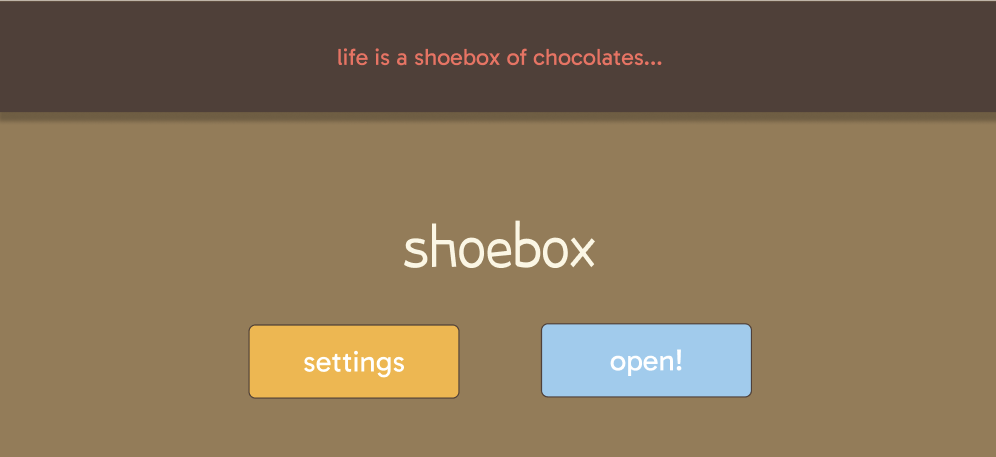
shoebox is an interactive, engaging mobile app where you can easily document the highs and lows of everyday life. Decorate shoebox dioramas that represent your day by creating audio records, taking polaroid photos, taking notes to yourself, and adding memorable collectibles. By creating dioramas that document your everyday life, we celebrate the beauty of human life, whether that's the exciting or boring, good or bad.
Describe your research process and findings. If you conducted any surveys or interviews, please include the survey form and/or interview questions here. If you conducted secondary research by pulling from online sources, please include a link to your sources. (Max 500 words)
After brainstorming with the team, we decided that a key part of being human is how we make mistakes, have bad days, and deal with positive and negative emotions. We conducted user research through a survey, asking users ages 19-28 for their insights on mental health and the inclusion of AI in that space. We found that most users had varied opinions on how to handle negative emotions, with some users liking to think through worst-case scenarios and other users trying to distract themselves. We also found that most users wouldn't feel comfortable with the cooperation of AI in an application that is helping them with their mental health and emotions due to security issues and the possibilities of codependency. We also saw that most users did not like to journal and when it comes to documenting daily life, many users found photos and videos as the easiest option. Thus, we decided to further explore the route of celebrating life, the good and bad, through documentation rather than providing coping mechanisms to help users through negative emotions because different methods work for different people.
Describe your most important design decisions. What research findings and/or user testing results led you to make these decisions? (Max 500 words)
At the beginning, our main decision was deciding between focusing more on therapy, where we would provide users with advice and words of comfort as they took on life, versus documentation, where we would encourage users to note down (through various forms of media) what was happening in their day-to-day lives. Both of these routes would highlight aspects of staying human in our age of AI, but we were having trouble narrowing down a specific scope. Based on our user research, we found that a lot of our user-base (which was generally young adults ages 19-28) were actually able to find ways themselves to cope with difficult situations through logically approaching situations or accepting that what has happened has happened and approaching life with a progressive outlook. In addition, we found that one common strategy that our users used to process thoughts was taking some time to think to themselves, and that these were individuals that commonly documented their lives as a way to look back on moments.
For the therapy route, we also considered an option of an AI chatbot or companion, where one’s responses to the bot, if considered “positive” would keep it alive (like a happiness Tamagotchi). Our user’s responses to being asked about their opinions on an AI companion, there were mixed responses. Most found the concept interesting, but believed that it would not compare to talking their problems out with a friend or trusted individual. There were also concerns over privacy, and how discussing their daily lives with a bot-friend wouldn’t feel very secure. Based on this, we felt that pursuing a different route would be ideal.
From these results, we decided to focus on a more documentation-based route, while encouraging self-reflection as a user logged their memories. We wanted to provide an easy way for users to store their memories while being encouraged to reflect. We realized that there was a high usage of photo-taking and documentation apps – apps like BeReal, the photos app, etc – but not a lot of apps that encouraged meditating on these moments. BeReal stored your daily selfies, but the app interface didn’t feel like a place users would want to stay to recollect their thoughts. shoebox, our app, encourages users to take their time to reflect and mull over their life’s moments in a private space of their own. Decorating their box and logging their day-to-day acts as a digital archive, like their own digital time capsule. This way they can reflect how they want to, either in written, video, or audio form, and will continue to want to come back daily to decorate their space with the new moments they have captured. Life is a shoebox of chocolates!

Log in or sign up for Devpost to join the conversation.