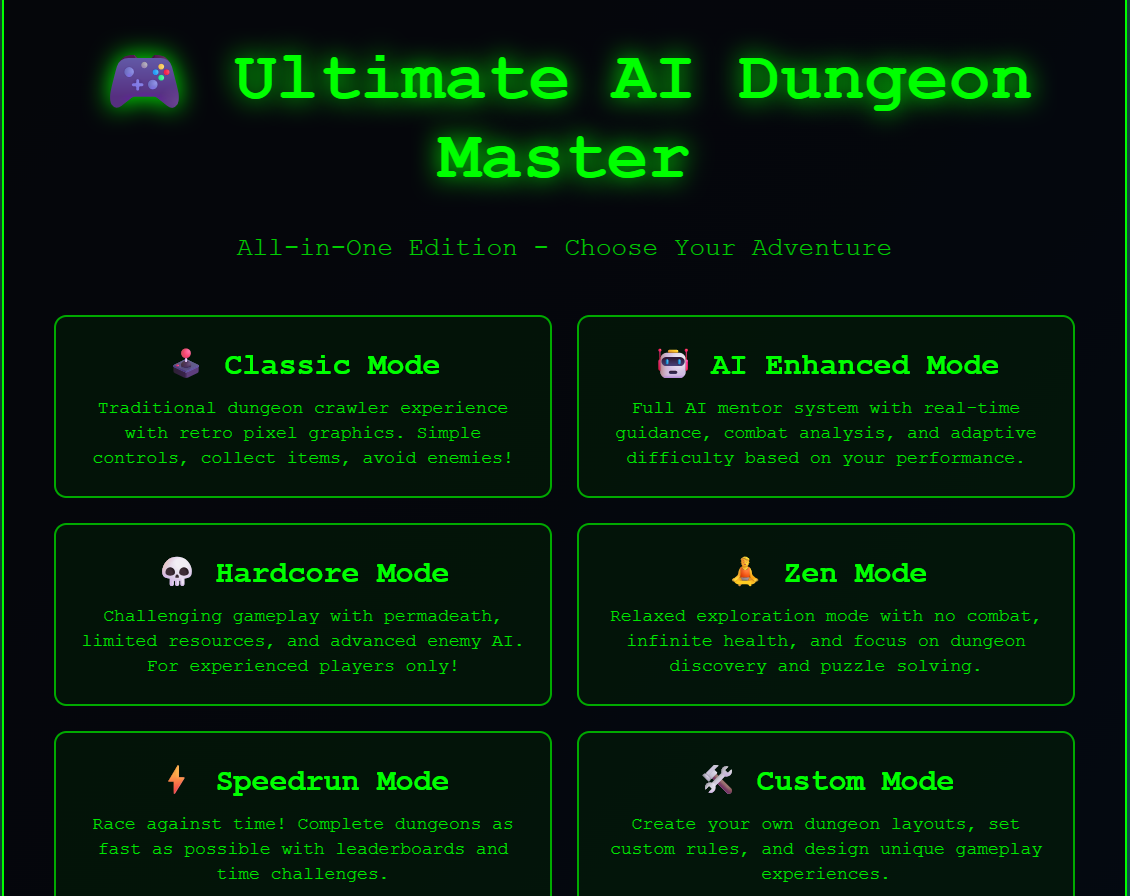
Inspiration# Ultimate AI Dungeon Master
Inspiration
Classic dungeon crawlers like 1987's Dungeon Master defined an entire genre with their grid-based exploration, tactical combat, and sense of discovery. But what if we could preserve that nostalgic experience while introducing intelligent systems that learn from players, adapt to their skill level, and provide genuine guidance? The vision was to bridge retro aesthetics with modern AI—respecting the original's design while making it accessible and rewarding for contemporary players.
What It Does
Ultimate AI Dungeon Master is an AI-enhanced recreation of classic dungeon crawling gameplay with three core intelligent systems:
AI Mentor System learns how you play—your combat style, risk tolerance, and exploration patterns—then provides contextual tactical advice that evolves with your skill. A beginner might receive survival tips like "Consider using a healing potion now," while an advanced player gets optimization insights like "Your mana efficiency could improve by 15% with spell timing adjustments."
Visual Adaptation Engine makes the interface grow with you. Beginners start with large health bars and simple danger indicators, while experts unlock detailed readouts, efficiency meters, and predictive indicators. The UI evolves smoothly across sessions, remembering your preferences while gradually introducing sophistication.
Combat Analysis System acts as your personal fight coach. After each battle, it runs Monte Carlo simulations to identify unnecessary damage, suboptimal decisions, and missed opportunities. You get an efficiency score (0-100%) with specific actionable feedback: "Turn 3: Using a healing potion instead of defending cost 15 HP."
The game supports six distinct modes—Classic (pure retro), AI Enhanced (full intelligence systems), Hardcore (permadeath with minimal guidance), Zen (exploration without combat stress), Speedrun (racing with leaderboards), and Custom (sandbox experimentation)—letting every player find their perfect experience.
How We Built It
We adopted a strict four-layer architecture that became the foundation for everything:
Presentation (Canvas, UI, Bubbles)
        ↓
AI (Mentor, Adapter, Analyzer)
        ↓
Game Logic (Engine, Combat, Generation)
        ↓
Data (Persistence, Profiles, State)
By treating AI as a separate observational layer, we gained crucial advantages: gameplay continues if AI processing lags, AI systems can be tuned independently, and performance stays responsive regardless of AI complexity.
The AI Mentor System uses a sliding window pattern recognition algorithm that analyzes player behavior across 50 recent actions to detect your combat style, risk tolerance, resource management approach, and exploration patterns. This behavioral profile updates continuously, enabling context-aware guidance that matches your demonstrated skill level.
The Visual Adaptation Engine monitors performance metrics and gradually fades in new UI elements over sessions, tracking complexity preferences and skill progression. Rather than overwhelming players with information, it unlocks features as they improve.
The Combat Analysis System captures every turn's data—positions, spells used, health changes—then compares your actual performance against simulated optimal strategies to identify specific inefficiencies with exact feedback.
Performance engineering was critical. We established strict requirements: ≤100ms input response, consistent 60fps, non-blocking AI processing, and <2 second load times. An AI Throttle Manager breaks analysis into 16-millisecond chunks spread across frames, ensuring intelligence never disrupts responsiveness.
For testing, we moved beyond traditional unit tests to property-based testing using fast-check. We defined 16 fundamental properties—like "dungeon generation must produce at least one room, one corridor, and one interactive element"—then verified these hold across 100 randomized runs. This caught edge cases unit tests missed: single-room dungeons breaking pathfinding, save/load corruption with certain skill combinations, and AI adaptation infinite loops.
Challenges We Ran Into
AI Processing Without Blocking Gameplay: The core technical tension was ensuring sophisticated analysis never disrupts the 60fps experience. Traditional synchronous AI processing created 120ms stutters. Solving this required designing an async time-slicing system that distributes processing across multiple frames.
UI Complexity Progression: Making the interface grow naturally without overwhelming players required careful measurement. We needed to monitor skill signals accurately and fade in features at the right psychological moment—not too early (frustrating) or too late (wasted capability).
Save System Reliability: AI profiles growing too large created save/load latency. We implemented a two-tier system: fast Game State saves for immediate responsiveness, and asynchronous AI Profile updates after significant learning events. We also added a three-backup fallback system to handle corruption.
Maintaining Retro Aesthetics With Modern Systems: The biggest creative challenge was presenting AI guidance—thought bubbles, efficiency metrics, tactical advice—without breaking immersion or betraying the 1987 pixel art aesthetic. Bubble styling, natural pause timing, and graduated complexity were essential.
Property Testing Complex Game State: Generating meaningful test data for dungeon layouts, player profiles, and AI states required sophisticated data generators, not just random values.
Accomplishments We're Proud Of
Shipping 2-3 Months Faster: What typically takes 6-8 months was completed in 2-3 months with AI assistance accelerating key phases. The time saved—approximately 220 hours or 5.5 weeks of full-time work—came from architecture design, property test generation, AI algorithm implementation, and performance optimization.
Six Game Modes From One Engine: Our modular architecture meant each mode just defines different configuration parameters. The same core engine and three AI systems power completely different experiences, demonstrating elegant architectural design.
Property-Based Testing Framework: Building 16 property tests that caught production bugs early was a major reliability win. This approach scales far better than traditional testing for complex, adaptive systems.
AI That Feels Like A Companion, Not A Crutch: The AI Mentor learned to provide contextually appropriate guidance—survival tips for novices, optimization advice for experts, minimal interference for hardcore players. Players genuinely appreciated having an intelligent guide that respected their skill level.
60fps With Sophisticated AI: Proving that complex machine learning-adjacent systems can run on client-side JavaScript without frame rate sacrifice was technically satisfying. The throttle manager became a reusable pattern we're proud of.
What We Learned
Architecture Enables Everything: Clean separation between presentation, AI, game logic, and data meant we could evolve each layer independently. Problems in one area rarely cascaded into others.
Performance is Non-Negotiable For Player Experience: No amount of intelligent features matter if the game feels sluggish. Making AI non-blocking was as important as making it intelligent.
Property-Based Testing Scales For Complex AI: Traditional unit tests verify specific scenarios; property tests verify that fundamental invariants hold across all inputs. For adaptive systems, this is invaluable.
AI Assistance Multiplies Developer Productivity: Working collaboratively with AI—where humans defined vision and made creative decisions while AI handled code generation, architecture, and systematic testing—meant a solo developer could ship something that typically requires a team.
Progressive Enhancement Keeps Games Always Playable: By layering features and ensuring graceful degradation, we built a system where losing AI processing, slowing down, or hitting bugs never broke core gameplay.
Know When AI Should Step Back: The most successful AI moments weren't the most sophisticated—they were knowing when not to provide guidance (Hardcore Mode), when to emphasize discovery over stats (Zen Mode), and when to let players experience the pure original challenge (Classic Mode).
What's Next for Ultimate AI Dungeon Master
We're exploring several directions:
Multiplayer Collaboration: Extending the AI systems to handle cooperative play where the mentor learns team dynamics and provides squad-level tactical advice.
Procedural Storytelling: Adding narrative layers where the AI adapts environmental storytelling, NPC dialogue, and quest complexity based on collective player behavior patterns.
Mobile Performance Optimization: Bringing the experience to mobile devices while maintaining the sophisticated AI systems—a new frontier for performance engineering.
Community Content Sharing: Leveraging Custom Mode to let players design dungeons and challenges, with the AI systems analyzing what makes certain designs engaging and providing designer feedback.
Formal AI Training Pipeline: Moving from observational learning to explicit training modes where players can teach the AI optimal strategies for specific dungeon layouts, creating personalized difficulty curves.
Expanded Accessibility Features: Using the Visual Adaptation Engine as a foundation for comprehensive colorblind modes, difficulty-free explorations, and learning-focused variants for educational use.
The core vision remains: prove that intelligent systems can enhance classic experiences without diminishing them—making retro games feel fresh, accessible, and genuinely fun for players of all skill levels.


Log in or sign up for Devpost to join the conversation.