-
-
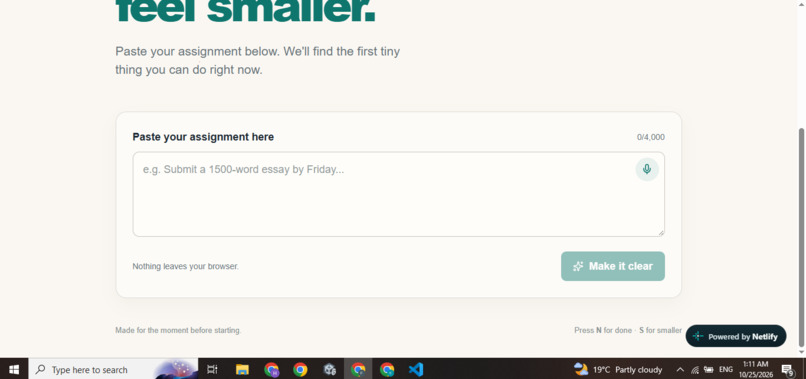
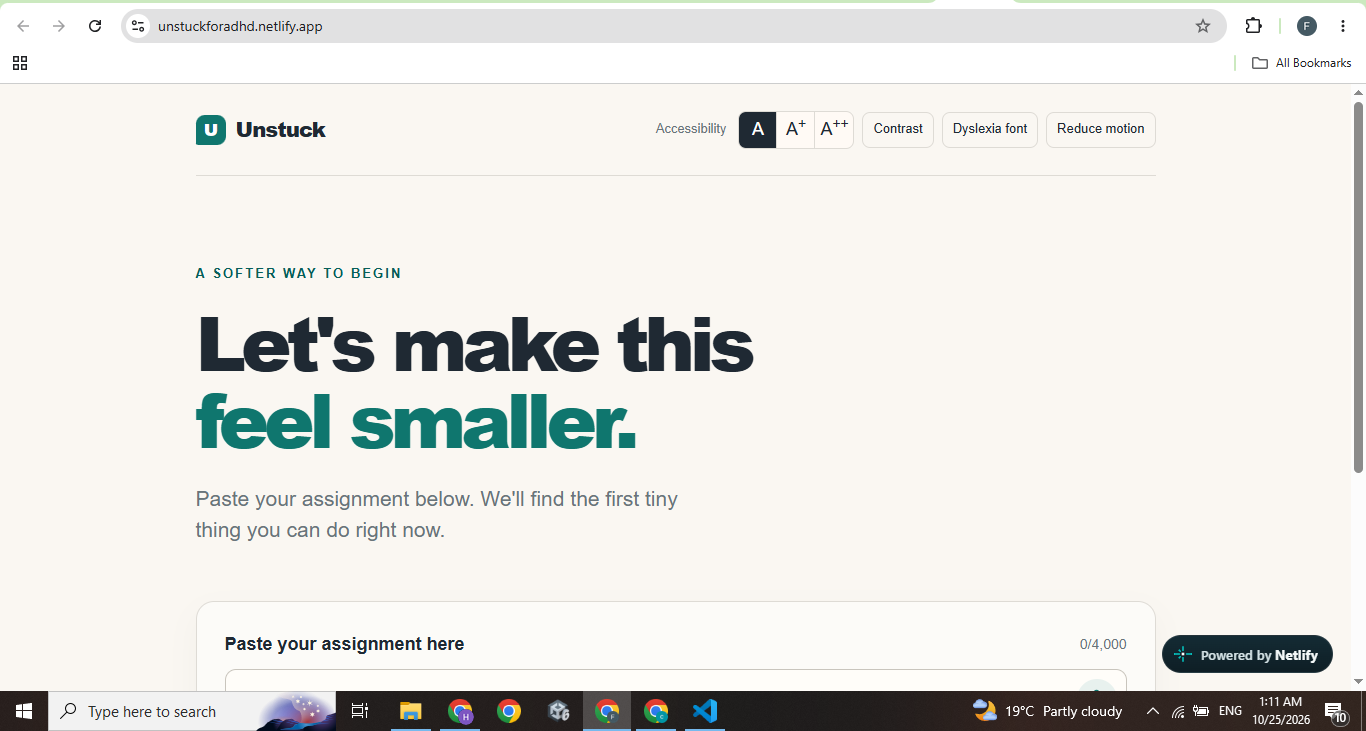
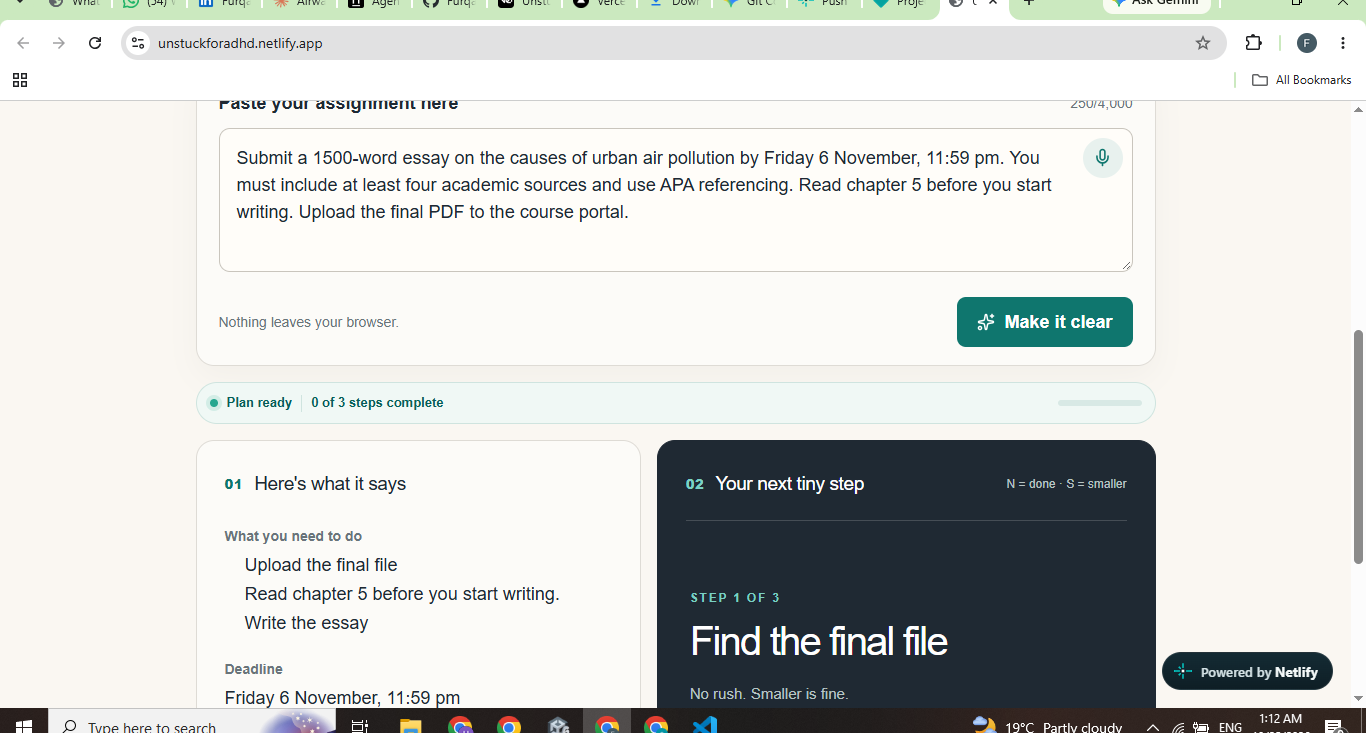
this is my website page
-
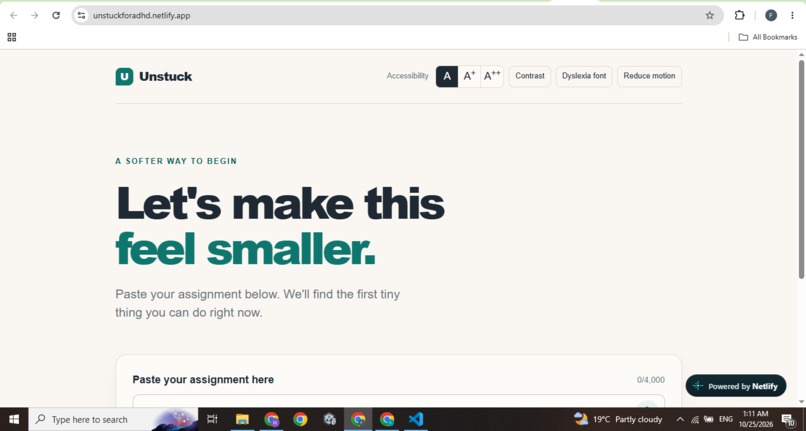
here you can see that waht to do
-
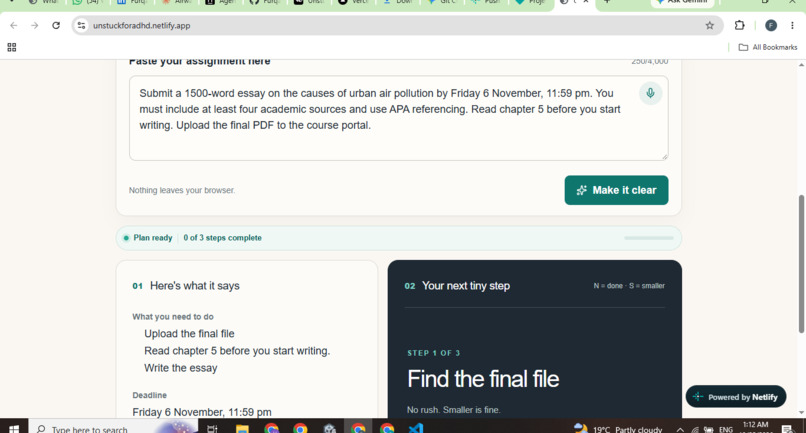
when added the assigment it shows what to do and if a tudent still diddn get he press i a stuck button it will show the steps what to do
Inspiration
Most people who struggle with work do not struggle with the work itself. They struggle with the moment before it: staring at a long, vague assignment and not knowing where to begin. For many students with ADHD, this is a real cognitive block, not laziness. They want to start, but the task feels too big and too unclear.
Almost every productivity tool answers this with a bigger to-do list. But typing a list, sorting it and breaking it down is exactly the hard part. We wanted a tool for the moment before starting.
We built Unstuck for one imagined user, Hamza, a second-year student with ADHD (a fictional persona we created for this project). He wants to do his assignments, but a long brief makes him freeze before he even begins. The barrier is two problems stacked together: he cannot tell exactly what is being asked, and he cannot tell where to begin.
What it does
Unstuck turns an overwhelming assignment into one clear, tiny action.
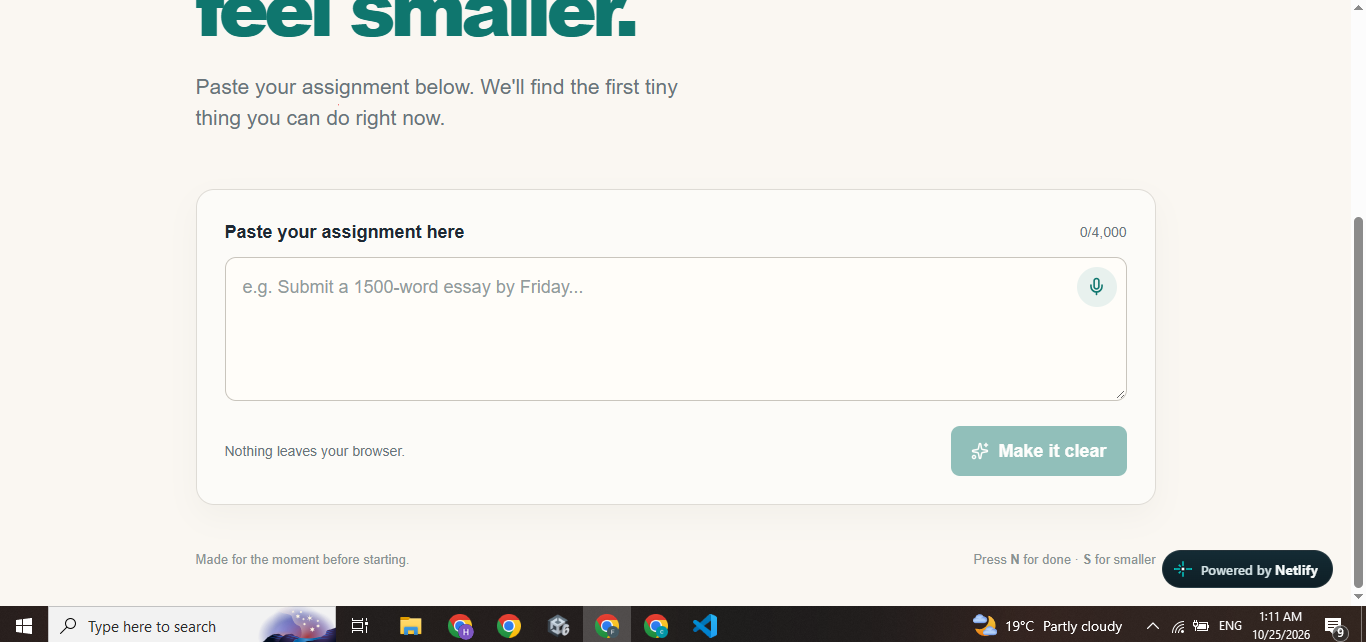
- Paste the assignment text, or dictate it by voice.
- Press Make it clear. Unstuck pulls out the deadline, the actions to do and the requirements, and shows them in plain language.
- It shows only one small first step, never a full list.
- Press Done to move to the next step, or I'm stuck to make the current step smaller. A step like "Read the first page" becomes "Open the book", then "Find where the reading is".
- An optional two-minute timer gives a gentle starting ritual. It never starts by itself.
The "I'm stuck" loop is the heart of the project. Most tools break a task into steps once and stop. Unstuck keeps shrinking the step until it is small enough to start.
Accessibility is built in, not added later: three text sizes, a high-contrast mode, dyslexia-friendly spacing, a reduced-motion mode, full keyboard use (N for done, S for smaller), screen-reader announcements for each new step, and voice input where the browser supports it.
How we built it
- Framework: Next.js (App Router), React and TypeScript
- Styling: Tailwind CSS with custom design tokens for a calm, quiet look
- Icons: Lucide React
- Logic: all assignment parsing runs in the browser with simple rules. It finds deadlines with date patterns, finds actions by looking for verbs such as write, read, submit and research, and finds requirements by looking for words such as must, at least and minimum. Each action maps to a hand-written four-level ladder, from a normal step down to the smallest possible one.
- Voice input: the browser's Web Speech API
- Privacy: pasted text stays in the browser and is never sent to a server.
We chose rules over AI for the core on purpose. It makes the site fast, free, able to work offline, and predictable, so it does not break in a live demo.
Challenges we ran into
- Scope. We had very little time. A tool for "all neurodivergent needs" would have been too big, so we cut it down to one user, one barrier and one loop.
- Messy text. Real assignment briefs are written in many styles. Getting deadlines and actions out of them with rules alone was harder than it sounds, and some wording is still missed.
- Making the steps feel right. A step that is too vague is useless, and one that is too small feels silly. Writing ladders that shrink naturally took the most thought.
- Real accessibility. Adding toggles is easy. Making the whole flow work with a keyboard and a screen reader, without relying on animation or color alone, took careful checking.
What we learned
- A smaller scope with a working demo beats a bigger idea that is half built.
- The most useful feature was not a smarter plan but a way to respond when the plan still feels too big.
- Rule-based logic can be a strength: it is simple to explain, easy to test and fully private.
- Designing for one person's real experience first makes the project clearer for everyone else too.
Limitations
- The reader works best on English text with clear sentences.
- We have not tested Unstuck with real students who have ADHD. The persona is fictional, and Unstuck is not medical advice or a treatment.
- Voice input depends on the browser and works best in Chrome.
- Nothing is saved between visits, and there are no accounts.
- The step ladders are written by hand for a limited set of action types.
What's next
- An optional AI mode, using a server-side route that returns validated structured output, to understand unusual assignment wording.
- A shareable plan link so a student can return to a plan later.
- Testing with real students and adjusting the steps from their feedback.
- A short first-time example that explains the "smaller step" idea.
AI assistance and pre-existing work
Claude helped us to polish my idea
Built With
- css
- javascript
- lucide-react
- next.js
- react
- shadcn-ui
- tailwind-css
- typescript
- web-speech-api

Log in or sign up for Devpost to join the conversation.