-
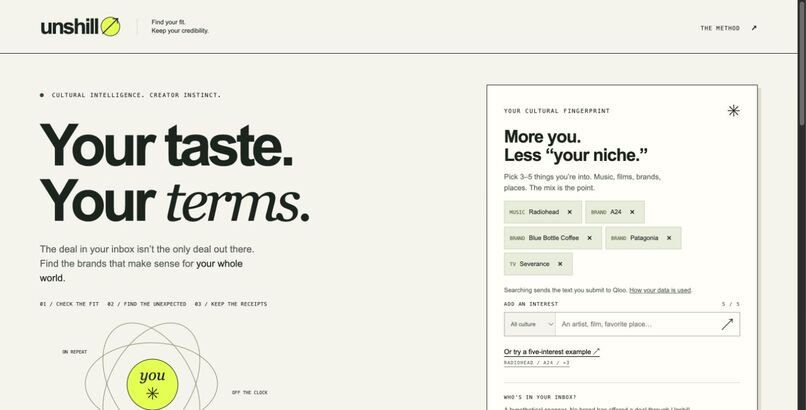
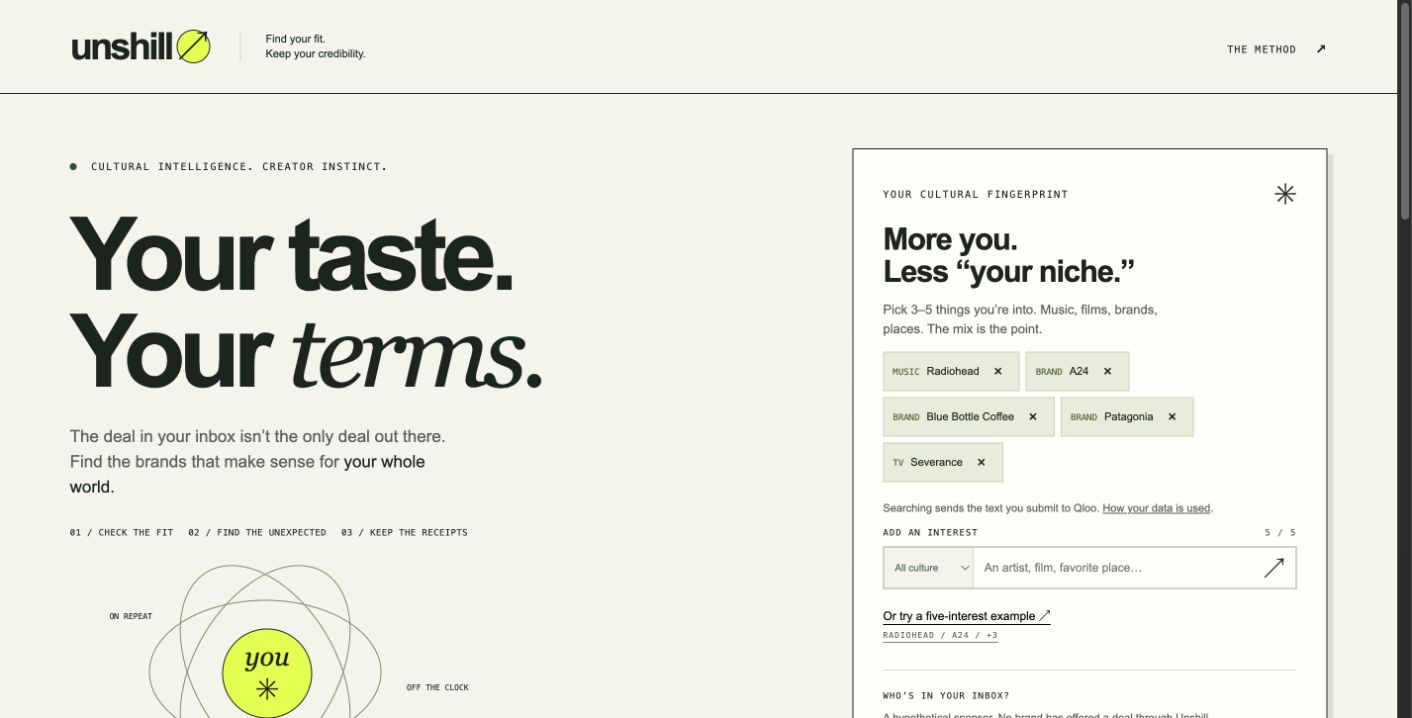
1. Your cultural profile
-
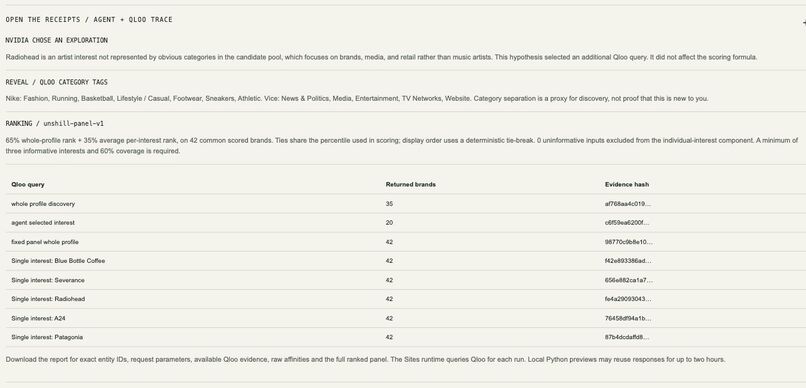
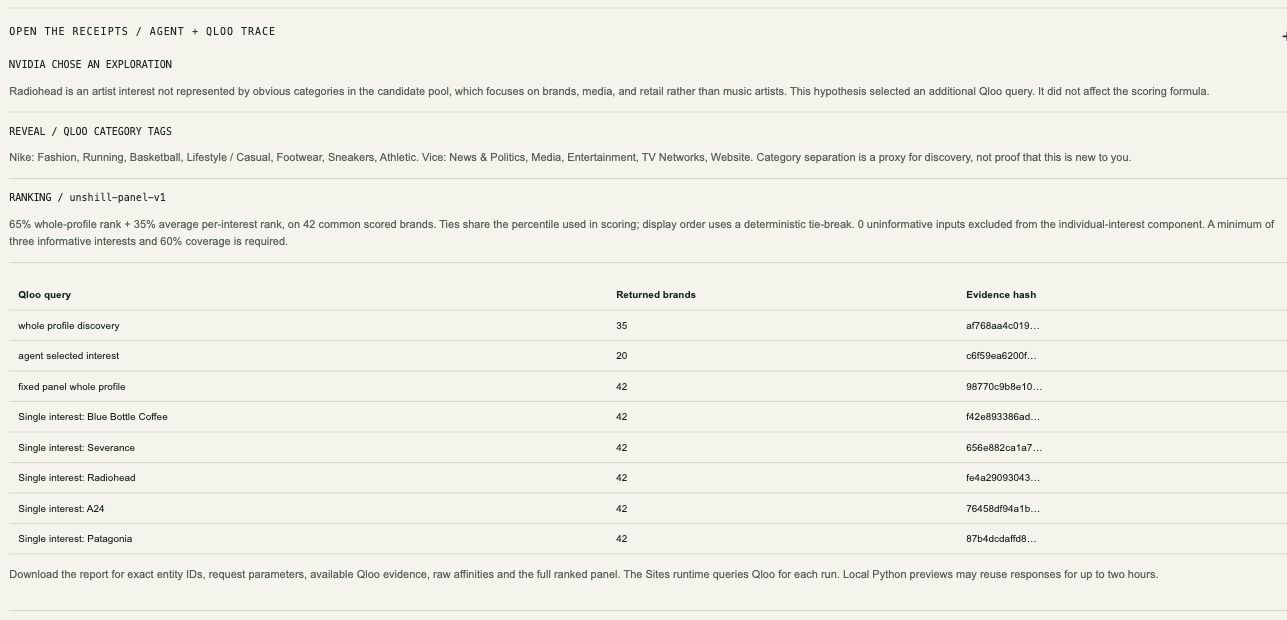
3. The agent’s evidence trail
-
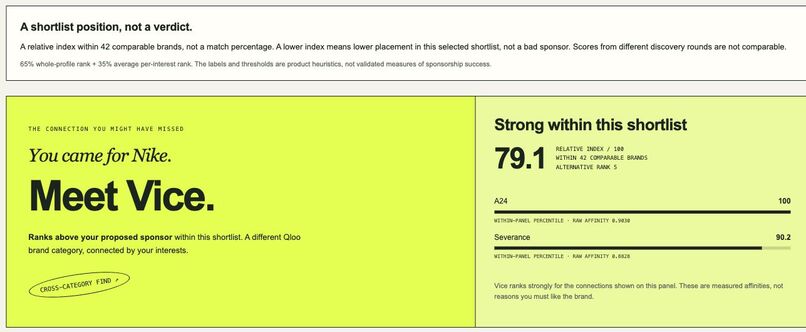
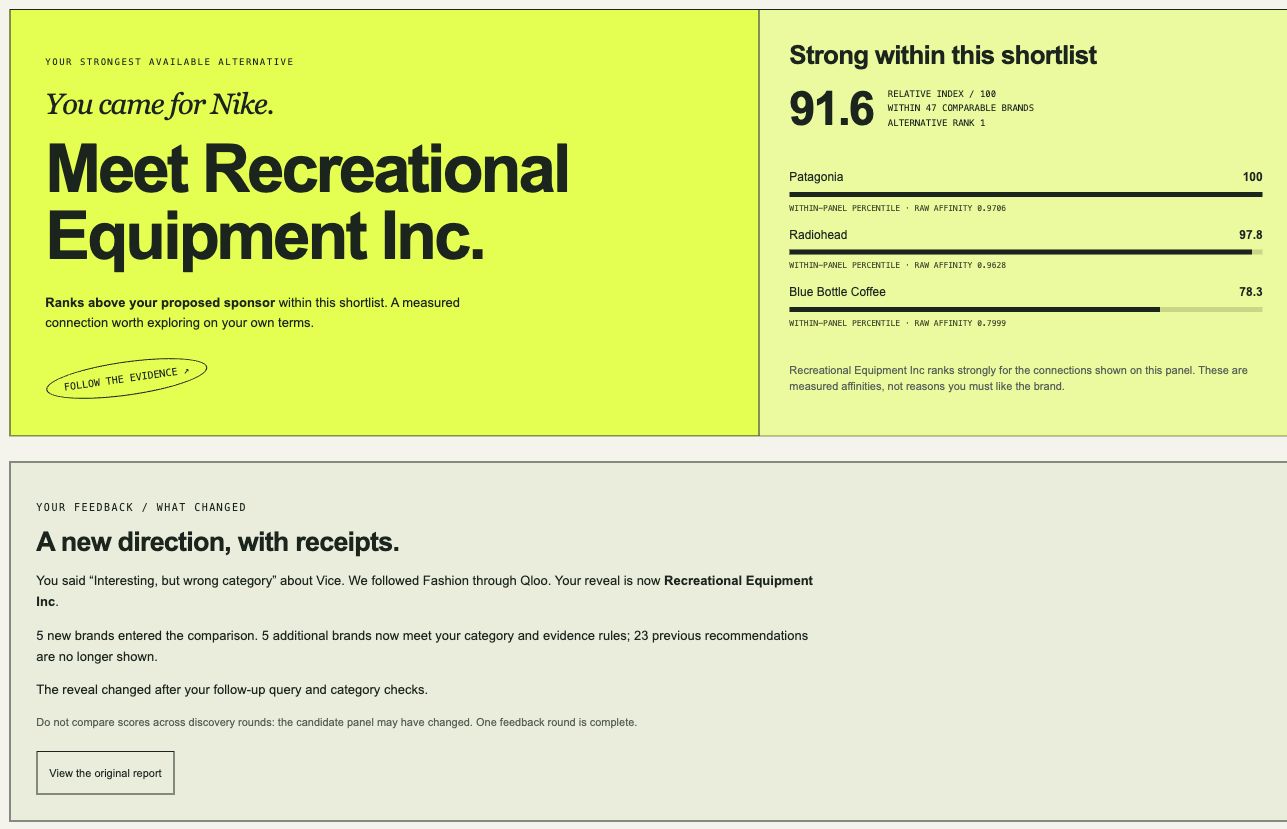
4. Feedback changes the discovery
-
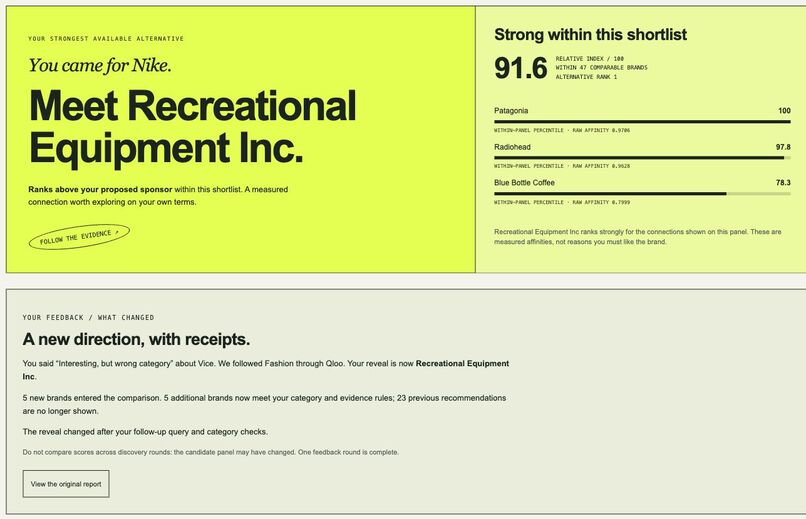
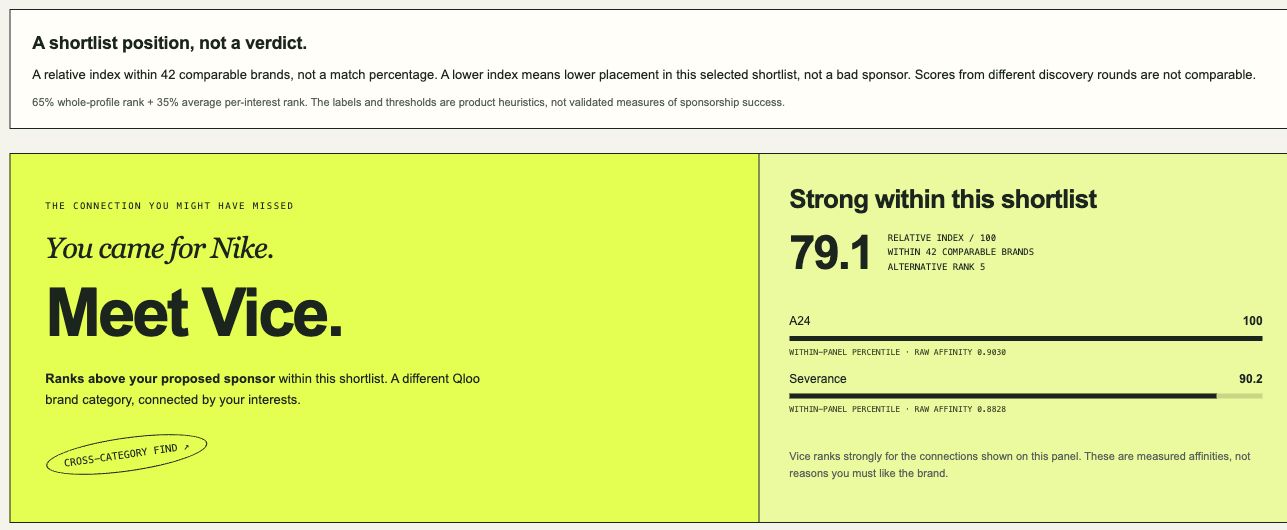
2. An unexpected discovery
Inspiration
Creators are more than a niche. Someone can love experimental music, workplace dramas, outdoor gear, and specialty coffee—and that combination may reveal sponsorship possibilities a conventional category label misses. Unshill started with a question: What if creators could investigate sponsorship opportunities from their own interests, instead of starting with a brand’s audience brief? The goal is to give creators a stronger starting point for a conversation while keeping the final judgment with them.
What it does
Pick three to five cultural interests and a hypothetical sponsor. Unshill uses Qloo to discover related brands, compare them on a shared panel, and show the connections behind the results. Creators can:
- Set sponsorship categories they accept or exclude.
- Inspect relative rankings, cultural bridges, and evidence gaps.
- Leave one interest out to see how the same brands’ rankings change.
- Give feedback and direct another discovery query.
- Return to the original report and export the measured evidence. A surprising connection is an invitation to investigate. It does not establish shared values, sponsorship availability, or a reason to endorse a product.
How we built it
Qloo supplies the cultural evidence. It resolves interests, discovers brands, and provides the affinities and category information used throughout the comparison. Without Qloo, live discovery and ranking stop. NVIDIA powers a bounded exploration decision. The agent observes the initial candidate categories and chooses one of the creator’s supplied interests to investigate through an additional Qloo query. Its decision changes the evidence gathered; it cannot invent brands, affinities, or scores. Creator feedback drives a separate refinement step. For example, selecting “Interesting, but wrong category” and choosing Fashion triggers another Qloo query. The resulting report identifies new and withheld candidates while preserving the original. Ranking is deterministic: 65% whole-profile percentile plus 35% average per-interest percentile, calculated within the same comparison panel. The score is a relative index, not a match probability. The live Sites implementation’s campaign concept is separately labeled as a deterministic creative template. The application runs as a JavaScript Worker with D1 storage on ChatGPT Sites. A Python reference implementation supports scoring and parity checks. Shared API components were adapted from my separate taste-prediction project; Unshill adds its own creator workflow, scoring method, interface, and feedback controls.
Challenges we ran into
The hardest challenge was making the results understandable without overstating them. An entity can appear in search but be unusable in a later comparison. Unshill identifies rejected interests rather than silently replacing them. Missing or flat evidence remains unknown. Cross-category discoveries also needed careful presentation. A surprising brand should not appear to be the highest-ranked option simply because it makes an interesting reveal. Reliability mattered too: expiring jobs, reconnecting requests, anonymous usage limits, provider budgets, and explicit failure states. Live failures never silently become recorded results.
Accomplishments that we're proud of
We built a complete loop from cultural discovery to creator feedback: Qloo supplies the evidence, the NVIDIA agent chooses a thread to investigate, and the creator can steer the next query. The results are inspectable. Every scored brand shares a comparison panel, surprising discoveries retain their actual rank, and missing evidence stays unknown. Creators can test an interest’s influence without losing their original report. We also brought the Python prototype to a hosted JavaScript runtime, with scoring parity checks, anonymous usage controls, evidence exports, and 84 passing automated tests.
What we learned
The strongest demonstration is an observable change in evidence. In one verified run, Vice ranked fifth among 42 brands. Leaving A24 out moved it to twenty-fourth on the same panel. Fashion feedback then discovered five additional brands on a new panel. These demonstrate input sensitivity and directed rediscovery—not causality or improved campaign performance. The release candidate passed 84 automated tests, including Python/JavaScript scoring parity, plus production build and database setup checks. Unshill’s central lesson is that cultural intelligence becomes more useful when creators can question it, inspect its limits, and steer what happens next.
What's next for Unshill
Next, we want to test Unshill with creators: Are the discoveries useful? Are the explanations clear? Does feedback lead to brands they would seriously investigate? Would they want Unshill to help them with pitches to those brands? Those conversations should guide improvements to category refinement and evidence presentation. We also want to evaluate when the agent’s additional exploration produces useful discoveries compared with the fixed discovery path. The guiding principle stays the same: help creators ask better questions before they put their credibility behind a brand.

Log in or sign up for Devpost to join the conversation.