-
-
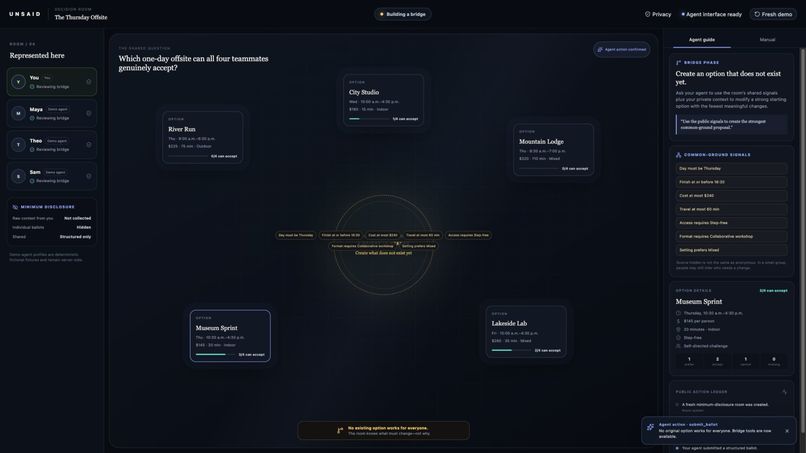
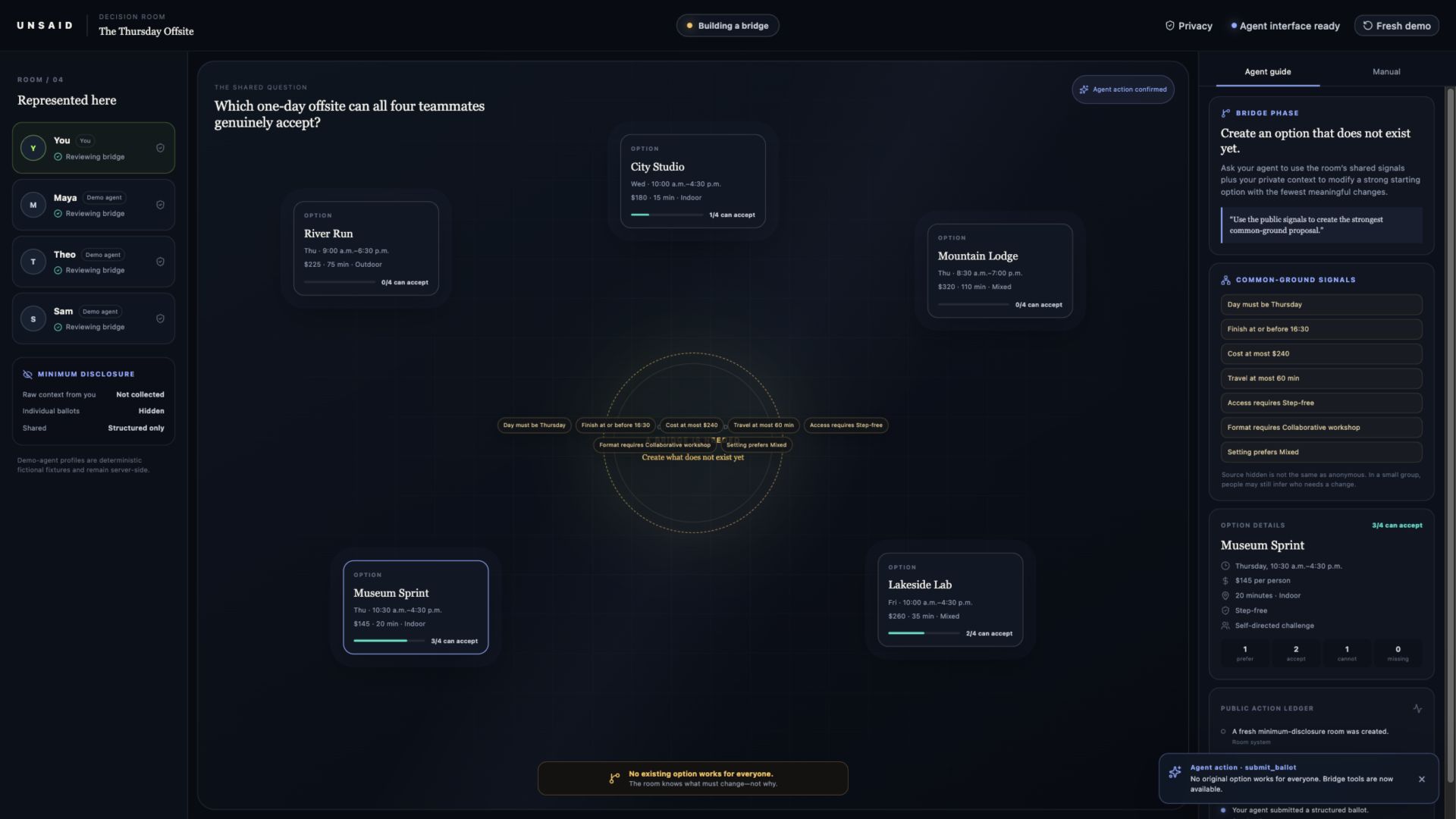
No existing option works for everyone.
-
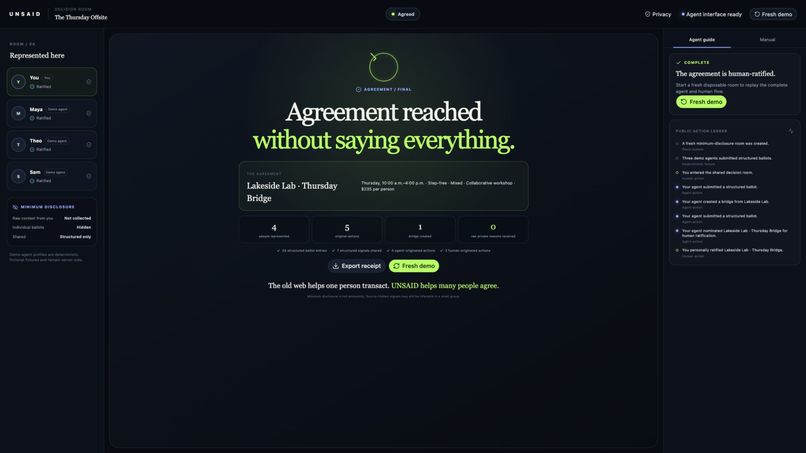
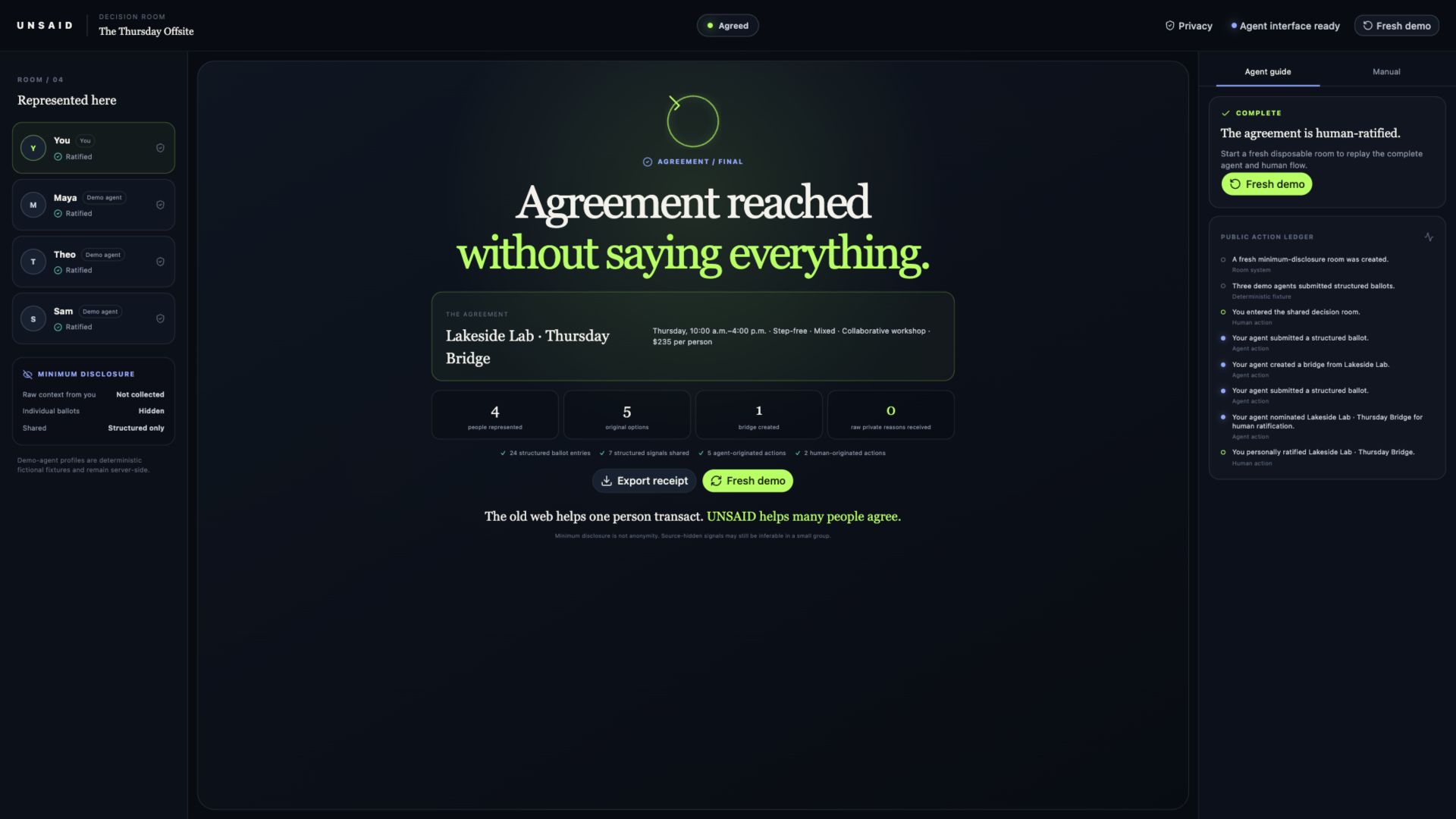
Agreement reached with zero raw private context received from the live participant.
-
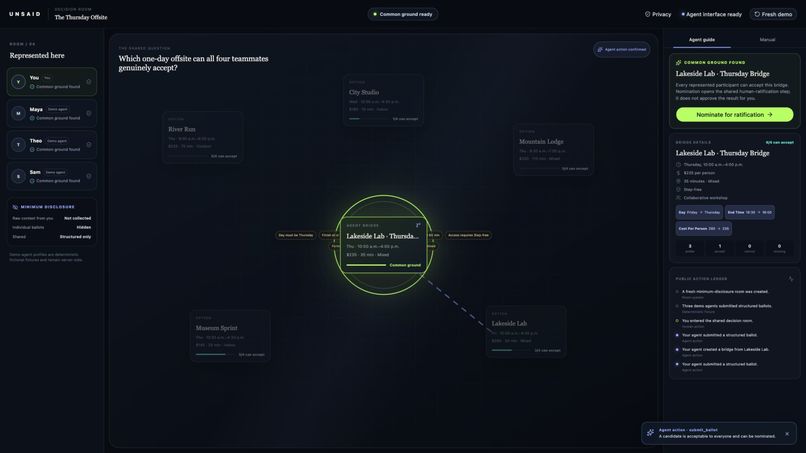
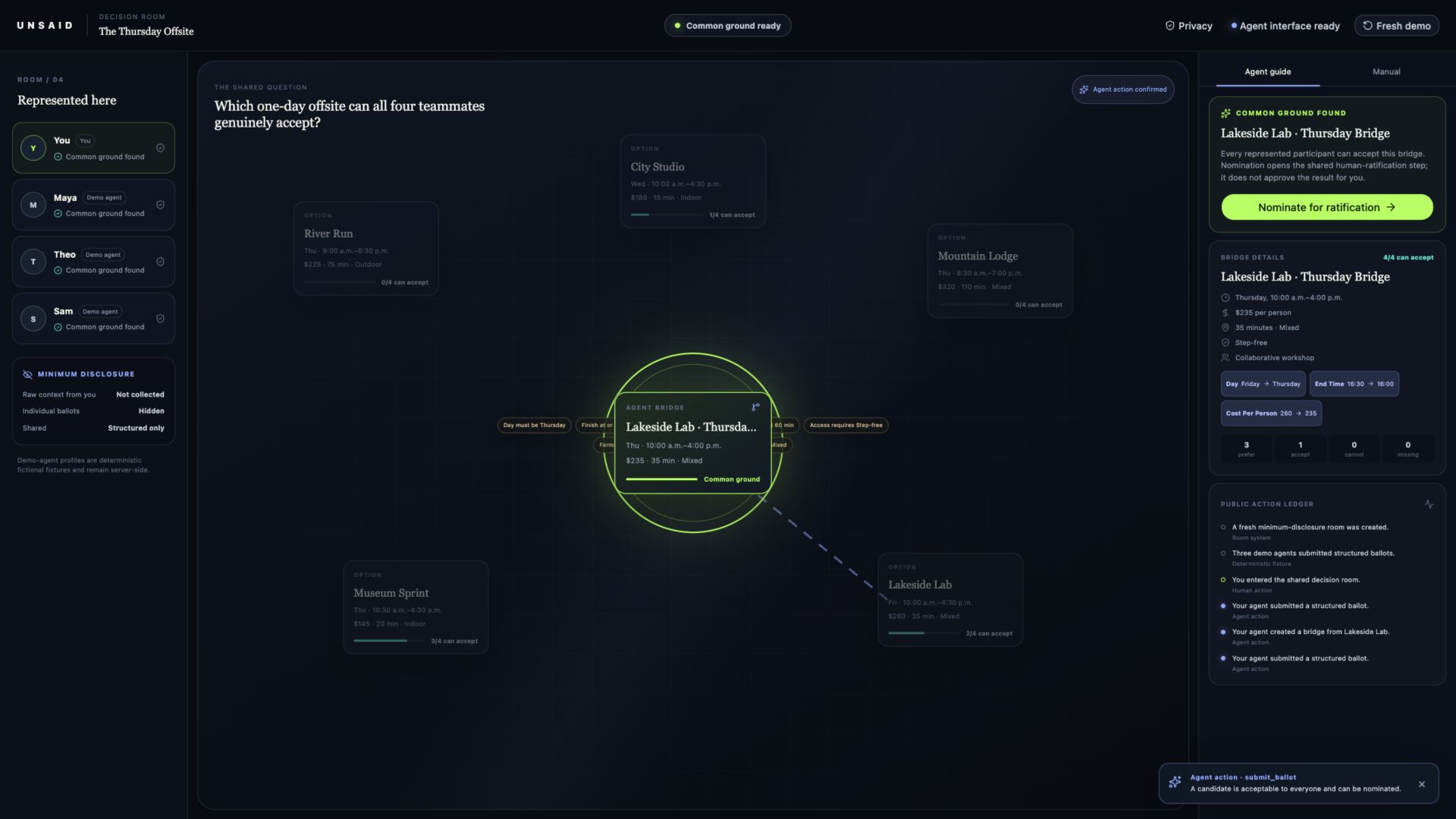
Agents construct an option that did not exist.
Inspiration
Group decisions routinely force people to reveal more than they should. A person may have a strict budget, an accessibility need, a caregiving deadline, or another private reason an option will not work. Polls make the group choose among fixed answers. Meetings make people explain themselves. We wanted a third path: let each person’s private agent understand the full context while the shared room learns only what it needs to build agreement.
What it does
UNSAID is a shared decision canvas. Participants privately brief their own browser agents. The room receives structured ballots rather than raw explanations. When no existing option works for everyone, participants or their agents can publish minimum structured signals and create a bridge proposal by changing known attributes. Candidates move toward a visible common-ground ring as aggregate support improves. A candidate can be nominated only when every participant accepts it, and the live person must ratify the final agreement through the human interface.
The judge demo uses one live ChatGPT participant and three clearly labeled deterministic demo agents so the complete multi-party experience can be tested immediately.
Why WebMCP
UNSAID is not improved by adding generic chat. Its core depends on the webpage exposing a precise coordination protocol. Through WebMCP, a personal agent can read shared room state, submit a private ballot, publish a structured signal, create a bridge candidate, and nominate a viable option. Tool schemas prevent raw private narratives from being sent accidentally. The tools reuse the same state transitions and permissions as the human interface, and their availability changes with the room phase.
Without WebMCP, an agent would have to scrape cards, guess form controls, and infer whether a shared state mutation succeeded. With WebMCP, agent actions are typed, reliable, attributable, and visibly reflected in the common canvas.
What people and agents can do together now
A person can give their own agent the complete private context. The agent can translate that context into the minimum structured contribution, reason across aggregate group signals, and construct a new option that did not previously exist. The group can reach a better agreement without collecting everyone’s raw private explanation. Agents do the translation and option construction; people retain final authority.
How it was built
UNSAID is a full-stack TypeScript application hosted on ChatGPT Sites with durable room state in D1. The top-level page registers imperative WebMCP tools through document.modelContext.registerTool. Read-only and state-changing tools have narrow JSON schemas and compact verifiable results. The room uses server-authoritative versioning, aggregate ballots, a deterministic consensus function, and a fixture evaluator for the three fictional demo agents. The human interface remains fully usable when WebMCP is unavailable.
Limitations
UNSAID is a prototype for minimum disclosure, not an anonymity or encryption system. Source-hidden signals may be inferable in a small group. The deterministic demo agents are fictional fixtures, clearly labeled in the product and source. The current submission demonstrates an offsite decision rather than a general production platform.
Built With
- chatgpt-sites
- d1
- framer-motion
- react
- typescript
- webmcp
- zod

Log in or sign up for Devpost to join the conversation.