-
-
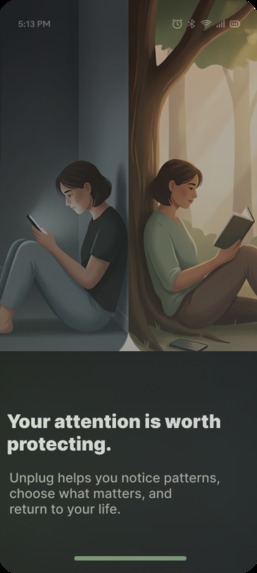
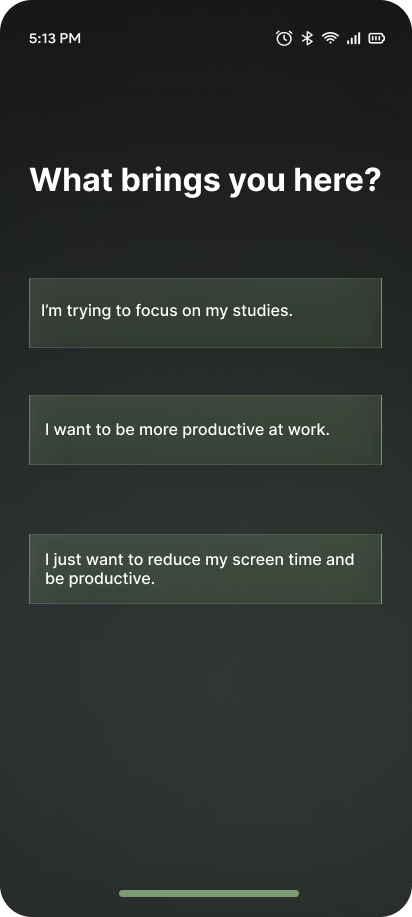
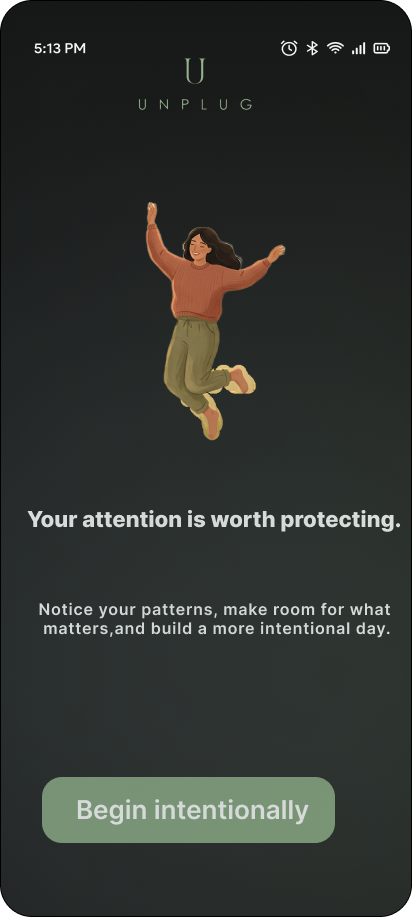
Welcome/intention screen
-
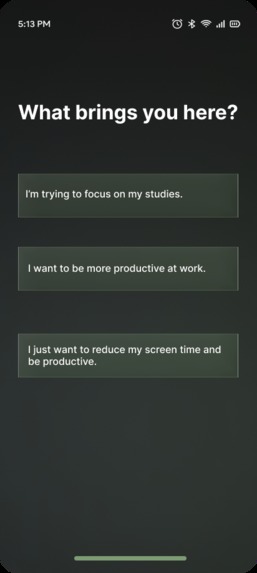
It starts by understanding why you're here
-
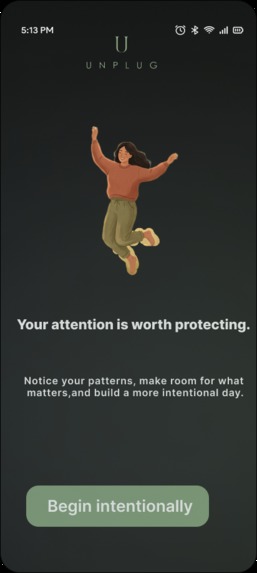
Take back control of your attention
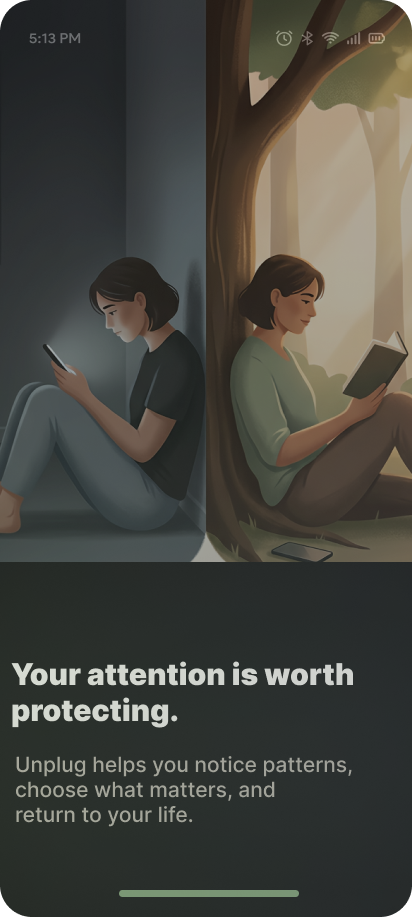
Inspiration
Every Monday at 9 a.m., I dread a notification that appears on my phone.
Even though I know it's coming, it still makes my heart skip.
"Last week, you averaged 18 hours and 25 minutes of screen time per day on this device."
Every week it reminds me how quickly seconds become minutes, minutes become hours, and before you know it, hours have turned into days, weeks, months, and even years.
It makes me think about everything I could have been doing instead: spending more quality time with my children, learning new skills, reading, building meaningful relationships, or simply being more present.
Instead, so much of that time disappeared into endless scrolling on TikTok, Instagram, X, YouTube, Facebook, and countless other apps designed to keep me engaged.
One night, while scrolling through Reddit, I realised I wasn't the only one struggling. Thousands of people were sharing the same frustration. They weren't lazy, they were simply trapped in habits that were incredibly difficult to break.
That was the moment I asked myself:
What if screen-time apps stopped making us feel guilty and started helping us reconnect with what actually matters?
That's how Unplug was born.
When OpenAI announced Build Week and I received credits to build with GPT-5.6, I finally had the opportunity to turn that idea into something real.
Unplug isn't designed to shame people for using their phones. It's designed to gently help them reclaim their attention, spend less time scrolling, and more time living.
What it does
Unplug is an AI-powered intentional living companion that helps people build healthier relationships with their phones.
Instead of simply tracking screen time, Unplug helps users become more intentional about how they spend their time.
Users begin by setting a daily screen-time goal and selecting distracting apps, such as social media, games, or other time-consuming apps, to limit once their daily allowance has been used. Rather than relying on guilt or fear, Unplug encourages users to reconnect with the activities they said matter most.
Users can:
Set a personalised daily screen-time goal.
Choose which distracting apps should be restricted after their limit is reached.
Create meaningful daily tasks and intentions.
Journal and reflect on their day.
Track their screen-time progress and daily habits .
Receive AI-powered coaching that connects their real phone usage with their personal goals and encourages small, achievable next steps.
Instead of showing another generic notification like:
"You spent 6 hours on your phone today."
Unplug aims to say:
"You reclaimed 47 minutes today. Earlier, you wanted to finish your coding project. Would you like to continue?"
By connecting screen-time data with a user's goals and reflections, Unplug transforms passive tracking into meaningful action. Our goal isn't to stop people from using technology, it's to help them use it more intentionally and spend more time on what truly matters.
How we built it
Unplug was built as a cross-platform mobile application using React Native and Expo.
The app uses Firebase Authentication and Cloud Firestore to securely manage user accounts and store tasks, journals, and user data.
One of the most challenging features was accessing Android's UsageStats API to retrieve real screen-time information. Since this isn't available directly in Expo, I created a custom native module in Kotlin to bridge Android's Usage Access permission into the React Native application.
Throughout development, I collaborated extensively with OpenAI Codex and GPT-5.6 to debug Android native issues, improve the application architecture, refine the user experience, and generate ideas for AI-powered coaching.
The AI vision behind Unplug is to move beyond static reminders by providing personalised encouragement based on a user's goals, tasks, screen-time behaviour, time of day, and reflections.
Challenges we ran into
The biggest challenge was time.
I built Unplug during OpenAI Build Week while learning new technologies at the same time.
Integrating Android's Usage Access permission proved to be far more difficult than expected. I spent hours troubleshooting Android SDK configuration issues, rebuilding native modules, configuring ADB connections, debugging wireless device connections, and understanding how Android's AppOps permission system works.
Another challenge was balancing ambition with the hackathon deadline. My original vision included AI coaching, intelligent app blocking, richer analytics, and deeper habit tracking. I quickly realised that building fewer features exceptionally well would create a much stronger experience than trying to build everything.
Finding design support was also difficult. I initially hoped to work with a UX/UI designer, but due to the short timeline, they couldn't commit. I ultimately have to start learing how to design on figma designed much of the onboarding experience myself, focusing on creating a premium, calming experience inspired by intentional living rather than fear or guilt.
Despite these challenges, the experience reinforced that meaningful products are built through constant iteration, persistence, and a willingness to learn unfamiliar technologies.
Accomplishments that we're proud of
Building Unplug in such a short time pushed me far beyond my comfort zone. What started as an idea inspired by my own struggle with excessive screen time became a working prototype that combines thoughtful design with real functionality.
Some accomplishments I'm especially proud of include:
- Building a cross-platform mobile application using React Native, Expo, Firebase Authentication, and Cloud Firestore.
- Successfully integrating Android's UsageStats API through a custom Kotlin native module to retrieve real screen-time data.
- Designing the foundation for an AI-powered intentional living companion, moving beyond traditional screen-time tracking toward personalised guidance and accountability.
- Creating a premium, calming UI inspired by wellness and editorial design, with a strong focus on accessibility, simplicity, and intentional user experiences.
- Reimagining screen-time management by encouraging users to reconnect with meaningful offline activities instead of simply restricting phone use.
- Overcoming Android SDK configuration issues, native module debugging, permission handling, and development environment challenges while learning unfamiliar technologies.
- Collaborating with OpenAI Codex and GPT-5.6 throughout the development process to accelerate debugging, refine the architecture, and improve both the user experience and implementation.
Above all, I'm proud of turning a personal frustration into something that has the potential to help others build healthier relationships with technology. Unplug isn't just about reducing screen time, it's about helping people reclaim their attention and spend more time on what truly matters.
What we learned
Building Unplug taught me that solving screen addiction isn't just a technical problem, it's a human one.
At first, I thought building a screen-time tracker would be enough. As I researched and spoke to others, I realised people don't need another app telling them how many hours they've spent on their phone. Most of us already know we're spending too much time scrolling.
What we're missing is gentle guidance and accountability.
I also learned how important design is in shaping behaviour. Every colour, illustration, interaction, and message influences how users feel. I deliberately designed Unplug to feel calm, supportive, and encouraging rather than guilt-inducing or restrictive.
Finally, I learned a great deal about React Native, Expo native modules, Android permissions, and integrating native Kotlin code into an Expo application, something I had never done before.
What's next for UNPLUG
This is just the beginning.
Our vision is for Unplug to become an AI-powered companion that helps people build a healthier relationship with technology, not by forcing them offline, but by helping them spend more time on what truly matters.
Next, we plan to:
Personalize AI coaching by generating guidance based on a user's goals, screen-time habits, journal entries, time of day, and previous behaviour instead of using generic reminders.
Build intelligent habit tracking that helps users understand how their screen time affects their productivity, wellbeing, and consistency over time.
Introduce proactive coaching, where Unplug notices patterns and gently suggests the right moment to take a break, refocus, or continue working on a meaningful task.
Expand intentional living features, including guided reflection, mindful routines, and wellbeing check-ins that encourage balance rather than perfection.
Bring Unplug to more people by refining the Android experience, expanding to iOS, and making the app accessible to anyone looking to reclaim their attention.
Elevate the visual experience with polished micro-interactions, smoother animations, richer illustrations, and a cohesive design system that reinforces Unplug's identity as a premium intentional-living companion.
Continue refining the UI and UX to make Unplug feel calm, intuitive, and accessible for everyone.
We're designing every interaction, from onboarding to AI coaching with simplicity, thoughtful animations, inclusive design principles, and accessibility in mind, ensuring the experience is as supportive as it is beautiful.
Ultimately, our goal is simple:
To help people spend less time wondering where their day went, and more time creating memories, building meaningful skills, and living intentionally.
Built With
- cloud
- codex
- expo-native-modules
- firebase
- github
- gpt5.6
- kotlin
- react
- react-native
- tailwindcss
- typescript
- usagestatsapi
- vite
- windsurf


Log in or sign up for Devpost to join the conversation.