
Inspiration
APIs are powerful but speaking their language requires reading documentation, understanding endpoints, crafting exact requests, and parsing responses. We imagined a world where anyone could interact with any API using plain English—no code required. What if you could say "show me the latest products" instead of GET /products?sort=desc? That's what inspired Agentify: democratizing API access through natural conversation.
What it does
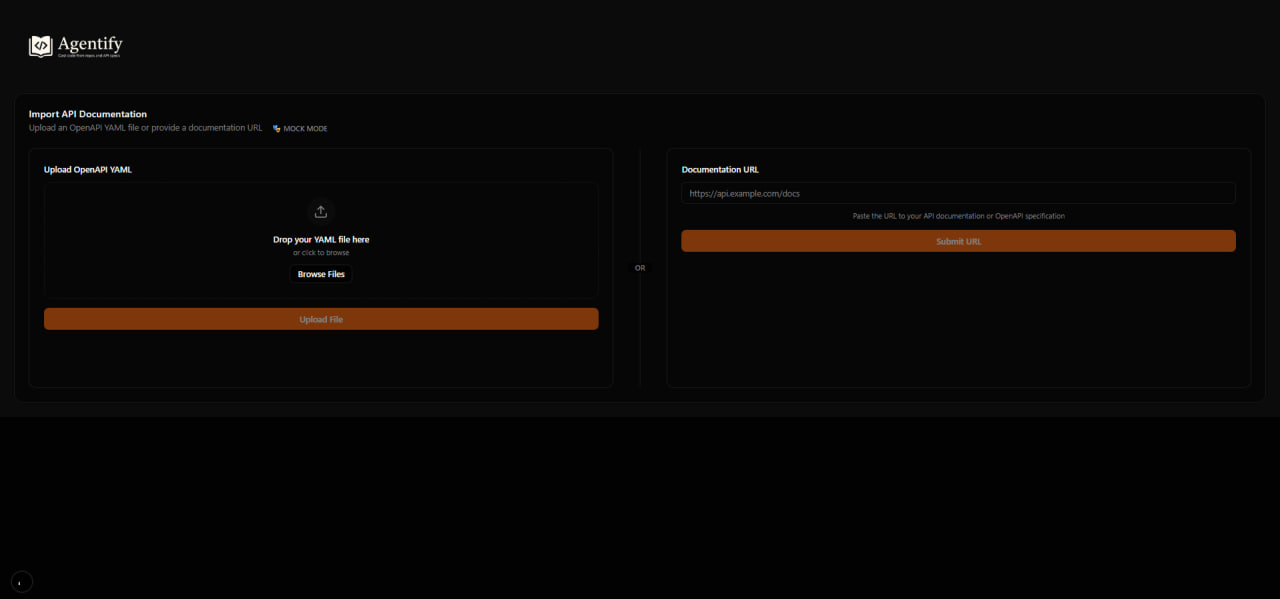
Agentify transforms any OpenAPI-documented API into an intelligent conversational agent. Users can: Import APIs instantly: Drop in an OpenAPI spec (YAML/JSON) and Agentify automatically generates an AI agent with full API capabilities Chat naturally: Ask questions in plain English like "What products cost under $50?" or "Add item to my cart" Multi-API orchestration: The agent can access multiple APIs simultaneously, combining data from different sources in a single conversation Persistent memory: Conversations maintain context across messages using thread-based memory Authentication handling: Supports various auth methods (Bearer tokens, API keys, custom headers) The system comes with a sleek Next.js frontend featuring WebGL particle animations and a clean form interface, backed by a FastAPI server that orchestrates Google Gemini AI through LangChain.
How we built it Backend (Python): FastAPI for high-performance REST API endpoints LangChain for AI agent orchestration and tool management LangGraph with MemorySaver for conversation persistence Google Gemini 2.5 Flash as the reasoning engine Modular service architecture (agent_service, tool_service, config_manager) Dynamic OpenAPI spec parsing and tool generation JSON-based configuration for easy tool management Frontend (Next.js/React): Next.js 15 with App Router architecture Shadcn UI components for polished interfaces Three.js for stunning WebGL particle animations Tailwind CSS 4 for modern, responsive styling React Hook Form + Zod for robust form validation
Infrastructure: Docker containerization for deployment Environment-based configuration (.env management) CORS-enabled for cross-origin frontend integration Comprehensive error handling and rate limit recovery
Challenges we ran into OpenAPI spec variations: Different APIs structure their specs differently. We built a robust parser with URL fixing, server configuration handling, and edge case management. AI provider flexibility: Initially built for AWS Bedrock, we pivoted to support multiple providers (Gemini, Bedrock) with a clean abstraction layer—then streamlined to focus on Gemini for reliability. Response format inconsistencies: LangChain agents return different response structures. We implemented sophisticated response parsing to extract meaningful content from various formats (structured responses, message objects, complex content arrays). Rate limiting: Google's free tier has strict limits. We built intelligent rate limit detection with regex pattern matching and graceful error handling. Memory management: Implementing thread-based conversation memory required careful configuration with LangGraph's checkpointing system to maintain context without memory leaks.
Accomplishments that we're proud of
✅ Zero-code API integration: Truly dynamic—add any OpenAPI spec and it just works
✅ Production-ready architecture: Modular, maintainable, and extensible codebase
✅ Beautiful UX: Custom WebGL animations create an engaging, modern interface
✅ Smart error recovery: Handles rate limits, network failures, and malformed responses gracefully
✅ Real conversation memory: Context persists across messages for natural multi-turn dialogues
✅ Multi-API demos: Successfully integrated FakeStoreAPI, CoinGecko, and NewsAPI
✅ Comprehensive documentation: README files, API docs, and inline code comments throughout
What we learned LangChain's power and quirks: The framework is incredibly powerful but response handling requires careful attention to varying data structures
OpenAPI standardization matters: While OpenAPI is a "standard," real-world implementations vary wildly in quality and completeness
AI provider trade-offs: Different LLMs have different strengths—Gemini excels at tool calling, while understanding rate limits is crucial for free tiers
UX is everything: A beautiful frontend transforms a backend API demo into an actual product people want to use
Modular architecture pays off: Separating concerns (services, models, config) made debugging and iteration dramatically faster
What's next for Agentify Short-term:
🔄 WebSocket support for real-time streaming responses
🗄️ Database integration for persistent conversation history across sessions
🔐 User authentication and multi-tenant session management
📊 Analytics dashboard to track API usage, conversation quality, and user patterns
Medium-term:
🤖 Multi-agent collaboration: Let multiple specialized agents work together on complex tasks
🧪 GraphQL support: Extend beyond REST to support GraphQL APIs
🎨 No-code API builder: Visual interface for creating custom API wrappers
📈 Enhanced monitoring: Metrics, logging, and performance tracking with LangSmith integration
Long-term:
🌐 Agentify Marketplace: Community-driven library of pre-configured API agents
🔌 Plugin ecosystem: Allow developers to extend functionality with custom tools
🧠 Fine-tuned models: Train specialized models for specific API domains
🚀 Enterprise features: SLA guarantees, dedicated infrastructure, and white-label solutions
Vision: Agentify will become the universal interface layer between humans and the digital services they use daily—making every API accessible through natural conversation.
Built With
- amazon-web-services
- bedrock
- ec2
- langchain
- python


Log in or sign up for Devpost to join the conversation.