
💭Inspiration
Our financial plans worked perfectly… until life opened a new tab called “unexpected expenses.” Major financial decisions are often made with gut feel, a single spreadsheet, or generic advice that assumes nothing goes wrong. In reality, life is full of uncertainty — income delays, surprise expenses, timing mismatches, and cascading failures.
High-performance computing is excellent at exploring uncertainty by running thousands of simulations in parallel, but most people who need these insights are not computing experts. We were inspired to bridge this gap by making HPC-style simulation accessible to non-experts, so anyone can explore “what if” scenarios and understand whether they can survive when life doesn’t go as planned.
💡What it does
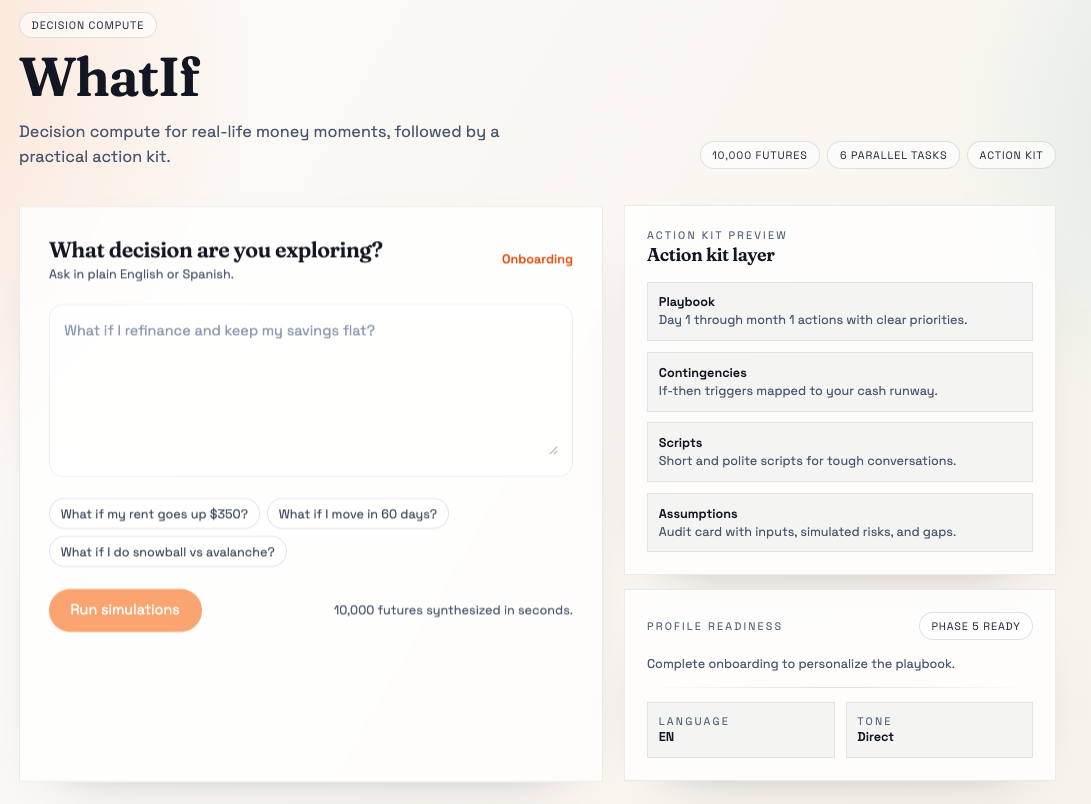
WhatIf is a decision compute platform that allows non-experts to submit financial decisions as compute jobs.
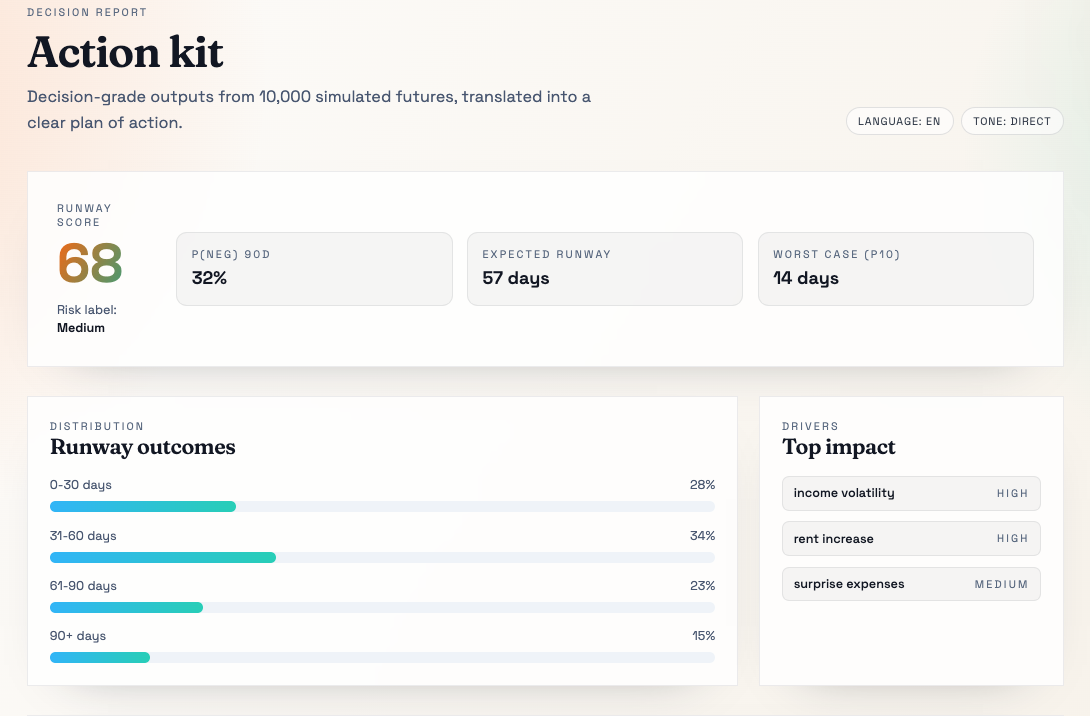
Users describe a decision in plain English or Spanish, answer a few structured questions, and submit a job. Behind the scenes, the system runs 10,000 simulated futures in parallel on a simulated HPC cluster. The results are aggregated and transformed into decision-ready outputs including a runway score, risk distribution, top risk drivers, a two-week stabilization plan, contingency decision trees, and real-world scripts users can act on immediately.
Instead of returning raw analytics or generic advice, WhatIf delivers a practical playbook for real-world decision-making under uncertainty.
💻How we built it
We designed WhatIf using an HPC-inspired architecture that separates a control plane from a compute plane.
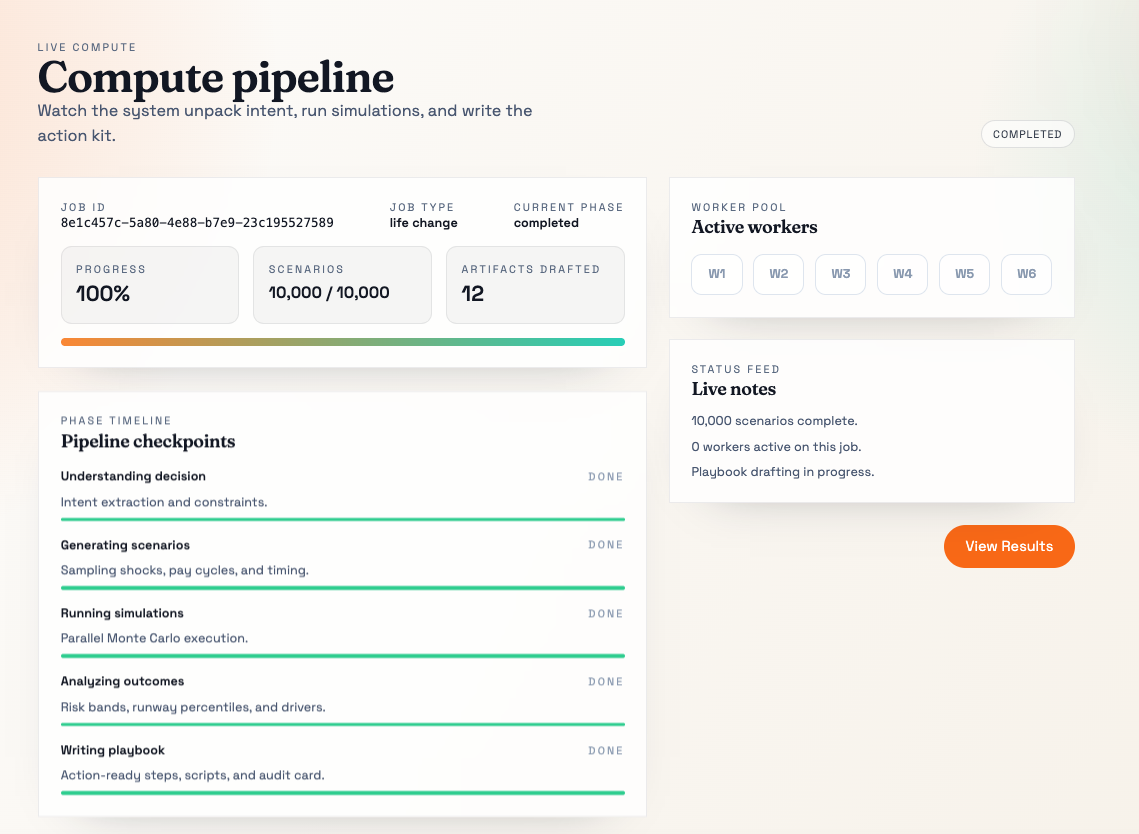
On the control plane, a web interface built with Next.js allows users to submit structured jobs and track progress. On the compute plane, a FastAPI backend orchestrates a job pipeline that converts user intent into a JobSpec, generates simulation scenarios, executes thousands of Monte Carlo simulations in parallel worker chunks, aggregates the results, and produces final artifacts.
We intentionally expose the job lifecycle queued, running, aggregating, and generating playbooks to demonstrate large-scale processing abstraction. Generative AI is used as a transformation layer after computation to convert aggregated results into actionable plans, scripts, and audit cards, rather than replacing the computation itself.
❌Challenges we ran into
One major challenge was balancing realism with simplicity. We wanted the system to feel like a real HPC workload without overwhelming users or overengineering the simulation model. Designing progress indicators and worker abstractions that clearly conveyed parallel computation without exposing technical complexity required careful iteration.
Another challenge was ensuring determinism and stability for demos while still modeling uncertainty. We solved this by fixing random seeds in demo mode and structuring simulations to be reproducible.
Integrating generative AI in a constrained, reliable way was also challenging. We enforced strict JSON schemas and built fallback logic to ensure the system always produced usable artifacts, even if the AI layer failed.
🏆Accomplishments that we're proud of
We’re proud of building a system that makes large-scale simulation understandable to non-experts without sacrificing technical rigor. The visible job lifecycle, parallel worker abstraction, and scenario counters clearly communicate how computation is happening behind the scenes.
We’re also proud that WhatIf doesn’t stop at analytics. The transformation of raw simulation output into concrete action plans, contingency trees, and real-world scripts turns HPC results into something people can actually use.
Most importantly, we delivered an end-to-end platform from job submission to actionable outputs within the hackathon timeframe.
🚀What's next for WhatIf
Next, we plan to scale the compute engine to support longer horizons and additional decision types, including healthcare and career planning. We also want to integrate real-time data sources and deploy the compute plane on actual cloud infrastructure to support larger workloads.
On the product side, we plan to expand comparison features, add collaborative decision-making, and refine the playbooks based on user feedback. Ultimately, our goal is to make HPC-powered decision support accessible to anyone facing high-stakes uncertainty.


Log in or sign up for Devpost to join the conversation.