-
-
unmeasured-act3-fullstory
-
unmeasured-datahub-ui-finding
-
unmeasured-architecture
-
unmeasured-thumbnail
Inspiration
I run several production systems solo. The most expensive bugs I have shipped were never crashes — they were dashboards that kept looking right after the input went wrong.
Everyone idealizes the outcome; almost nobody writes down the worst failure first. Agents make this worse, not better: an agent infers from the nearest available result unless the structure forces it back to the source.
So I built the refusals before I built the answers.
What it does
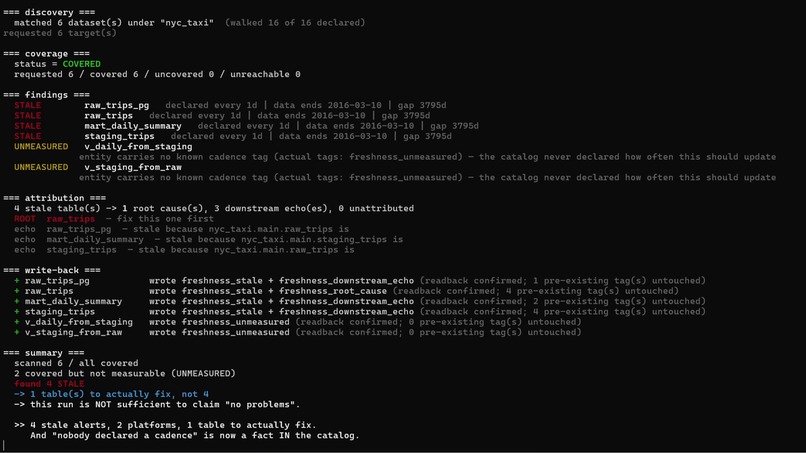
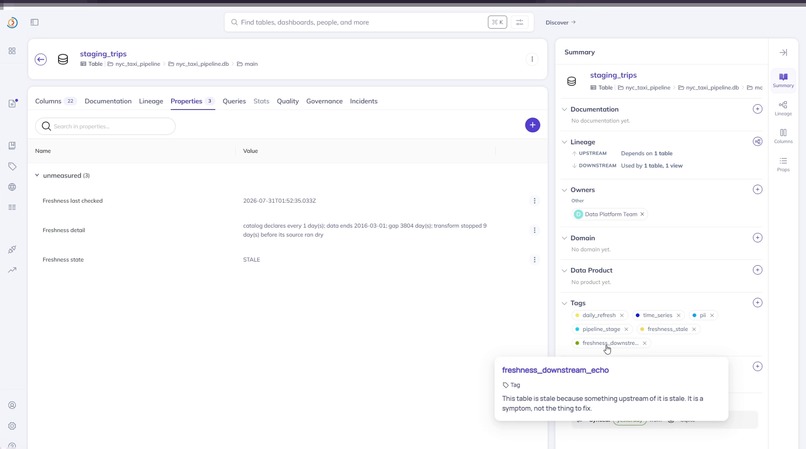
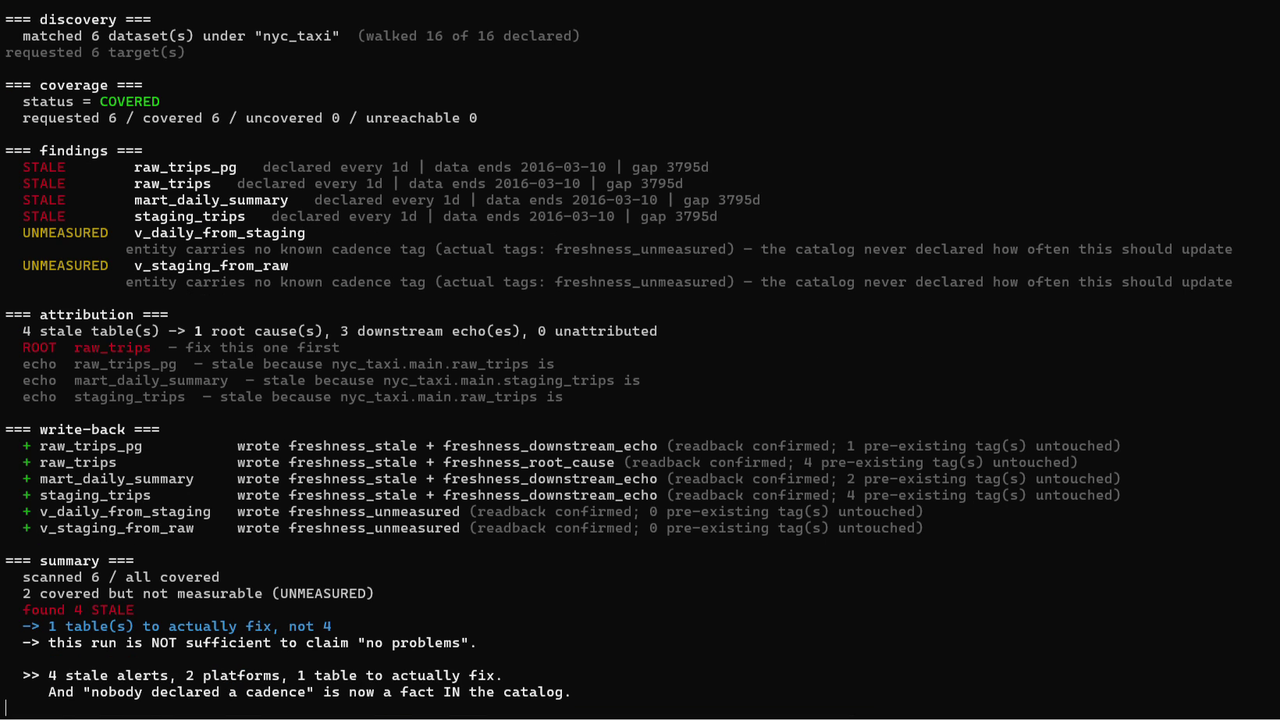
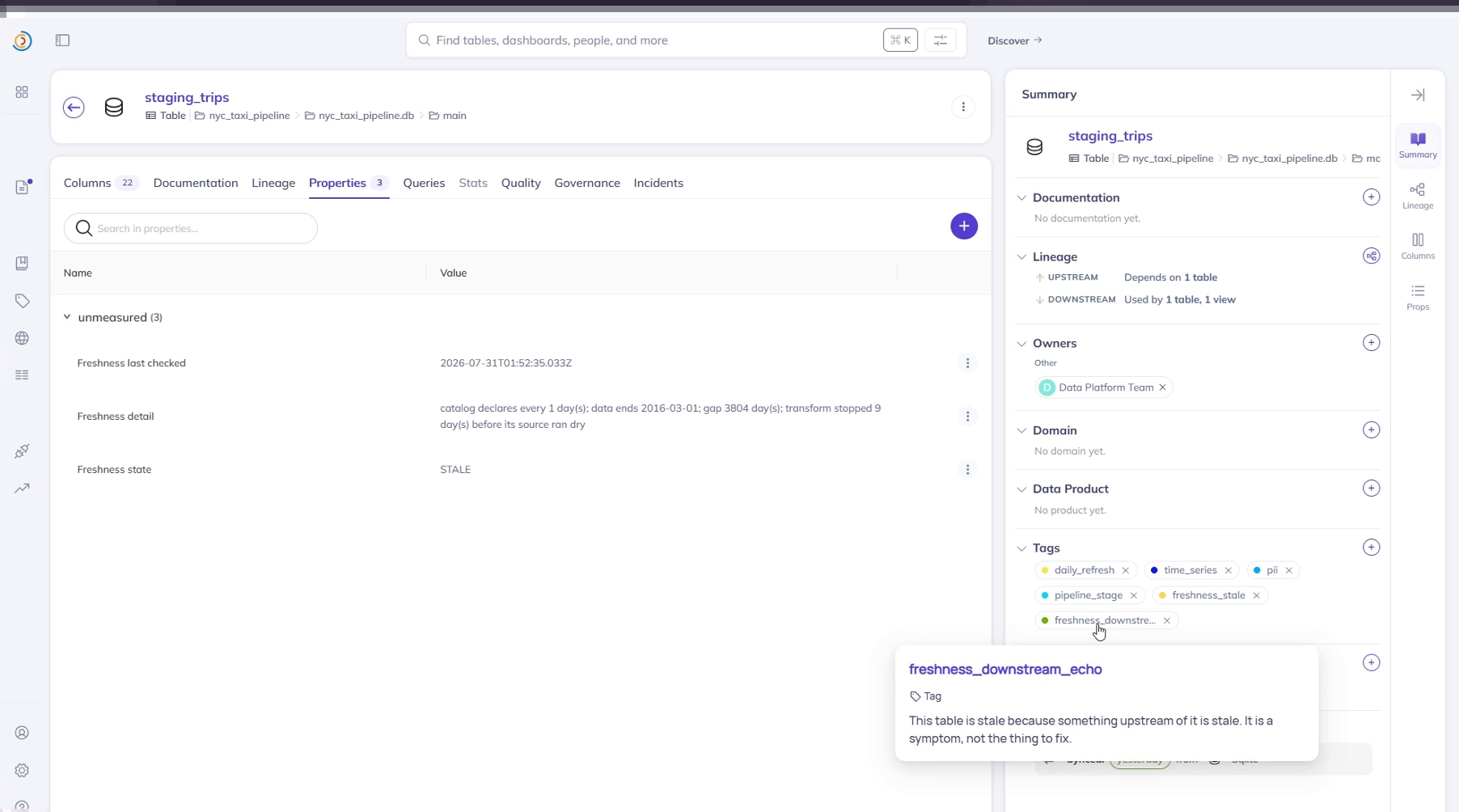
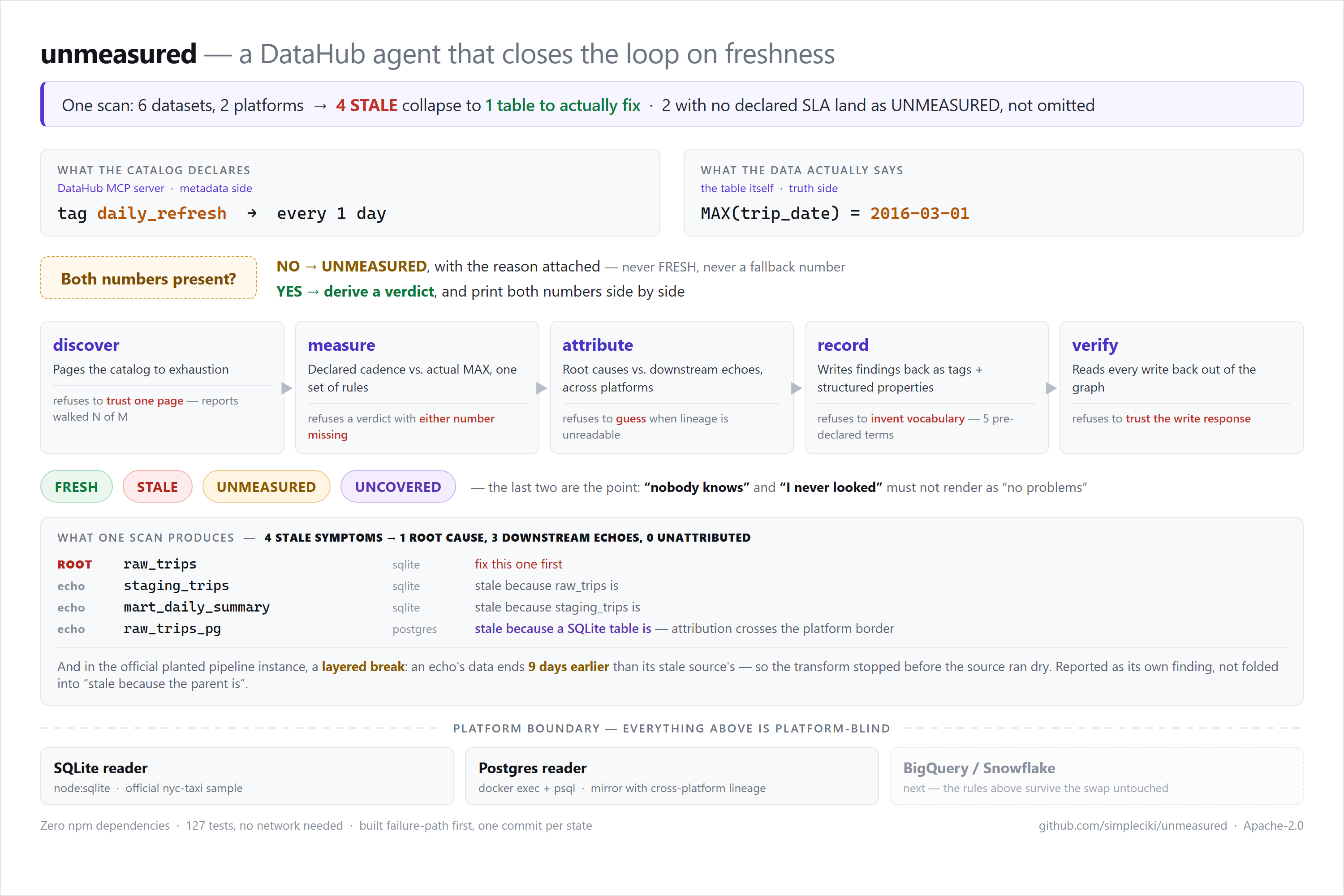
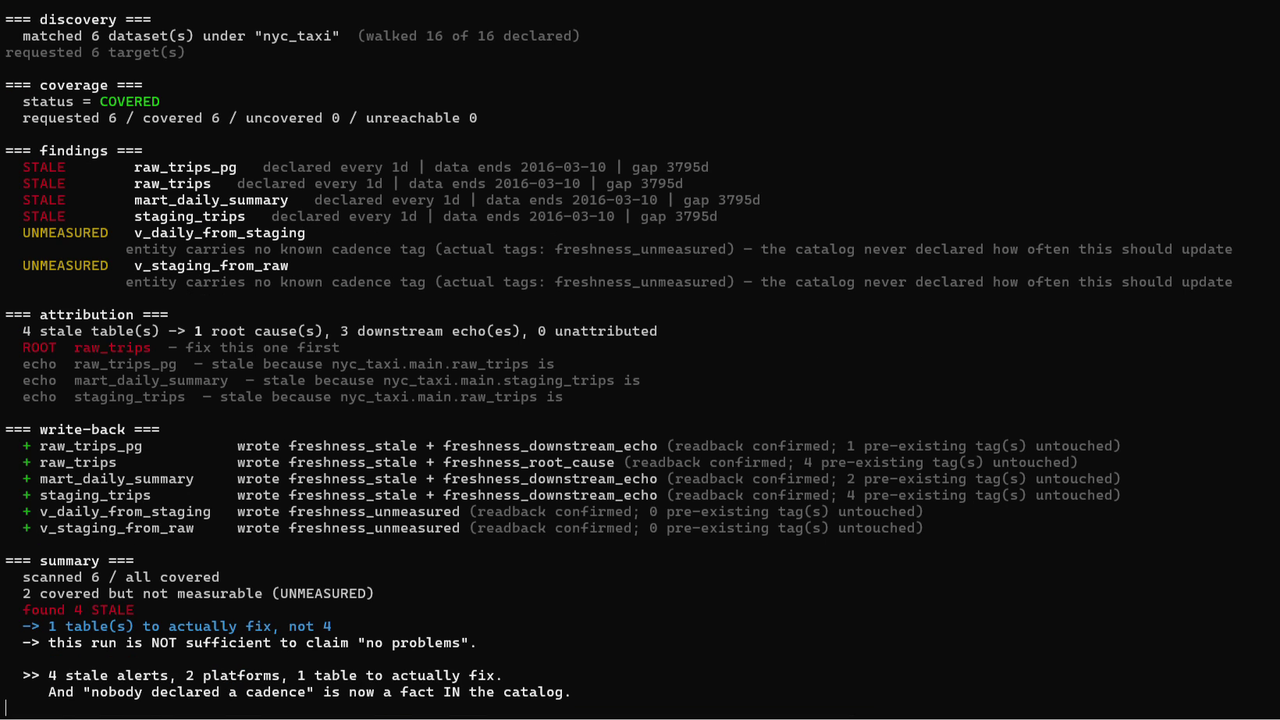
Four stale alerts across two platforms collapse to ONE table to fix — and the datasets nobody declared an SLA for become visibly UNMEASURED in the DataHub UI, instead of silently absent from the report.
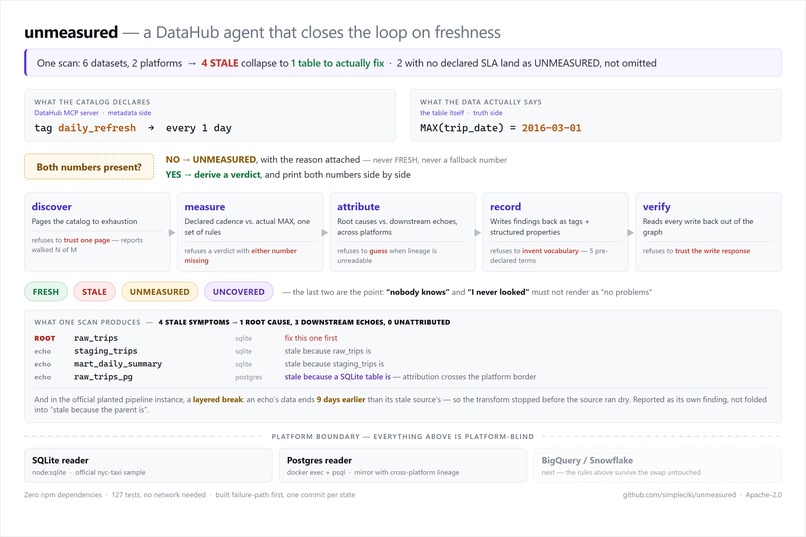
The full loop, in one pass: discover → measure → attribute → record → verify
| Stage | What it does | What it refuses to do |
|---|---|---|
| discover | Pages the catalog to exhaustion, then compares what it collected against the total the server declared | Trust one page. Measured here: the catalog's search API declared total: 15 and returned 10 |
| measure | Puts the catalog's declared cadence and the data's actual MAX timestamp side by side — SQLite and Postgres, through one set of rules | Emit a verdict with either number missing. That is UNMEASURED, with the reason attached |
| attribute | Walks lineage to collapse N stale symptoms into root causes vs. downstream echoes — across the platform border | Guess. Unreadable lineage is reported as unattributed, not as a root cause |
| record | Writes every finding — including UNMEASURED — into the graph as tags + structured properties | Invent vocabulary. Only 5 pre-declared terms are writable |
| verify | Reads every write back and compares | Trust the write response. A mismatch is reported as loudly as a failure |
It also reads layered breaks: when an echo's data ends earlier than its stale source's, the transform stopped before the source ran dry. The official sample pipeline plants exactly this — a 9-day gap — and the agent says so instead of folding it into "stale because the parent is".
How I built it
Failure-path first, one commit each, in the order a failure would poison the next stage:
- UNMEASURED — before anything could report a number
- UNCOVERED — "no results" must never render as "no problems"
- STALE — only then, with both numbers printed side by side
- FRESH — a live-seeded control, because an agent that always says STALE would pass every test above
- discovery that must confess "walked N of M"
- attribution that refuses when lineage is unreadable
- write-back where a readback mismatch is a failure
- Zero npm dependencies — built-in
node:sqliteplus a bare stdio JSON-RPC client for the DataHub MCP server - 127 tests, no network needed — and mutation-verified: I broke each guard on purpose to confirm its own tests go red. Three of them did not. I only found that because I ran the check instead of repeating the claim — and those three are covered now.
- The demo is a script in the repo (
bin/demo.mjs --paced) — every beat is versioned, so what you watch is the script running for real, at the speed it ran. Two edits, both outside the agent's output: one window switch cut, one personal sidebar blurred. The recording also predates two committed output changes — a line printed while the MCP server starts, and no more "1 table to fix, not 1" when nothing collapsed. Same beats, same commands, same results; the repo has the newer script.
Challenges I ran into
Three findings changed the design — and two of them were my own bugs.
- The metadata clock is the wrong clock. The read-only MCP surface exposes no data-side update timestamp; I measured all five tools. And
lastObservedwould be wrong anyway — it is when DataHub last saw the metadata, not when data arrived. Using it produces a beautiful, wrong number. Recorded in code as a first-class UNMEASURED reason. - My own acceptance test caught my own code on day one.
get_entitiesreturns not-found as an error payload inside anisError: falseenvelope. My presence check read an explicit "not found" as "found". The nearest signal beat the source — the exact failure this agent exists to prevent, committed by its author. - It happened again, in my own filter. The day the catalog held both official instances, this repo's
namePrefixfilter silently swallowed the second one —nyc_taximatchednyc_taxi_pipelinetoo, so a scan reported on a set that had quietly changed under it. The nearest match beat the actual identity, again. A filter bug is a coverage bug. Fixed, regression-tested, and kept in the README.
Accomplishments that I'm proud of
A closed loop that survives its own audit:
- 6 datasets across 2 platforms in one scan
- 4 STALE collapsed to 1 root cause + 3 echoes, with one echo on Postgres blaming a SQLite table
- The planted 9-day mid-pipeline break read correctly, not smoothed over
- Every write confirmed by independent readback; re-runs are idempotent, and human tags are never touched
Open-source contributions to DataHub
Building against the official sample dataset meant reading it the way this agent reads a catalog. That surfaced six reproducible problems, filed upstream as three issues plus a fix PR — all public:
- datahub#18753 — a platform-level bug: ghost edges in the graph index. Three storage layers returned three different answers about the same write, hours after it landed. Reproduced 3/3 across three client versions, against a 0/10 control group. This is why the agent reads every write back instead of trusting the write response. Update, Aug 3: closed as completed — a DataHub maintainer thanked me for the analysis and traced the underlying cause to a fix landing in v1.6.x (datahub#17204), with an
ELASTICSEARCH_THREAD_COUNT=1workaround for v1.5.x. The agent never depended on the bug existing — readback is unconditional — so it behaves the same on patched clusters and on the v1.5.x deployments where the race remains. - static-assets#218 — three bugs in the sample dataset's own metadata script. The one that matters most here: it emits a whole aspect per tag, so each emit replaces the last and every table ends up with exactly one surviving tag — silently removing the very
daily_refreshdeclaration a freshness agent reads. Also filed: ownership points at a group that is never created, and--dry-runprints a success banner while doing nothing. - static-assets#219 — two documentation-versus-data mismatches. The README describes staging stopping 3 days before raw; the actual set difference is a single missing load day, which reads as 9 calendar days because the dates are sparse — confirmed by row math (248,315 − 208,675 = 39,640, exactly that day's rows). That 9-day gap is the one this agent reports. The row count is documented as both 500k and 250k; the committed data is 250,000 exactly. I trusted those numbers only because I measured the data instead of reading the docs — which is the same rule the agent runs on.
- static-assets PR#220 — the fixes for all three bugs in #218, +92/−33 in one file, each tested against a live quickstart. It also fixes the Windows console crash another participant reported in #211. Open, no conflicts, awaiting review. #219 is a documentation-versus-data mismatch and is not addressed by this PR — it needs a maintainer decision on whether to regenerate the planted variant or correct the README.
I also posted a public self-correction on #18753: my original report said the inconsistency persisted "2.5+ hours", which was an estimate I had not actually timed. I retracted it, replaced it with the documentable ~2h15m, and stated which parts of the report were unaffected and why. A bug report is a measurement claim like any other; if the agent has to say how it knows a number, so do I.
Status, stated plainly, as of August 8: #218, #219 and PR#220 remain open and unmerged. #18753 is closed as completed — that one now has a human maintainer's answer, and the account above reflects what they wrote, no more.
What I learned
Define the error you refuse to see, before the outcome you hope for. A "perfect result" is an essay with no exam question — anything can grade itself well against it.
And a write response is a claim, not evidence. Three storage layers gave three different answers about the same write. So this agent reads every write back — and the demo's finale asks the graph directly over GraphQL, a channel the agent does not own.
What's next
- More readers behind the same boundary — BigQuery or Snowflake is the same exercise as Postgres was; the honesty rules live above the platform boundary and survive the swap untouched
- A CI gate mode — the self-check gates already exit non-zero
- Freshness history — consecutive runs writing trend, not just state
Built With
- datahub
- docker
- mcp
- node.js
- postgresql
- python
- sqlite

Log in or sign up for Devpost to join the conversation.