Inspiration
Video calls used to be how we checked someone was real. Not any more: real-time face-swap software plugs into WhatsApp, Meet or Zoom as a virtual camera, and scammers use it to pose as a relative, a partner or a boss, then ask for money. We wanted a tool a non-expert can use during the call, that tells them what to do next, and that is honest when it can't tell.
What it does
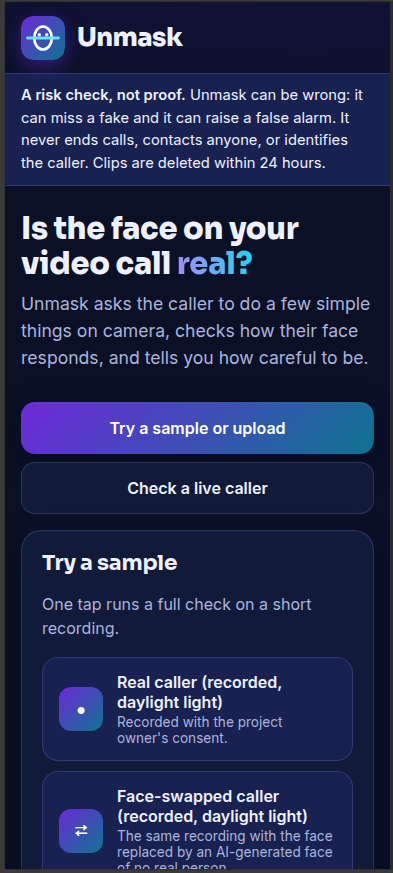
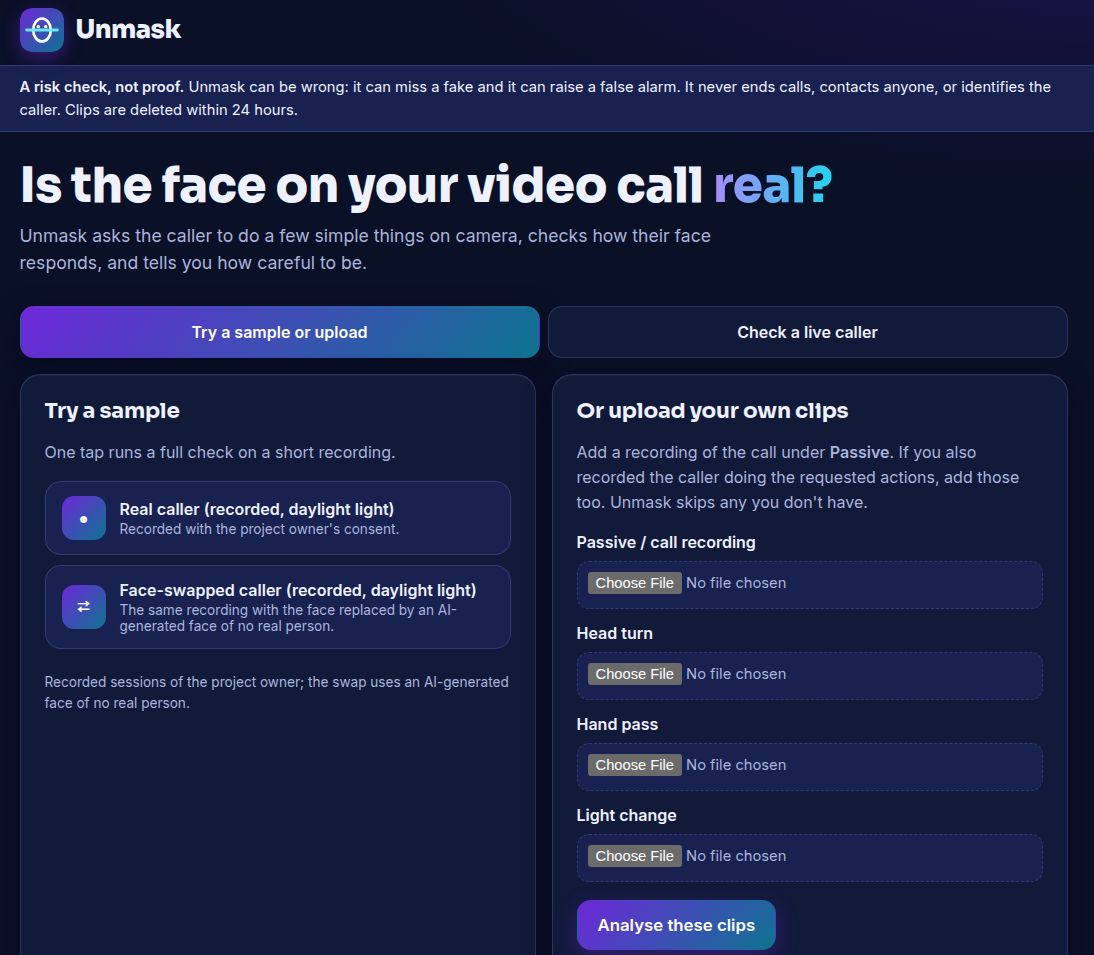
Unmask runs in a browser tab beside your call. You share the call window, and:
- OpenCV 5 measures the caller's face during a 10-second passive scan.
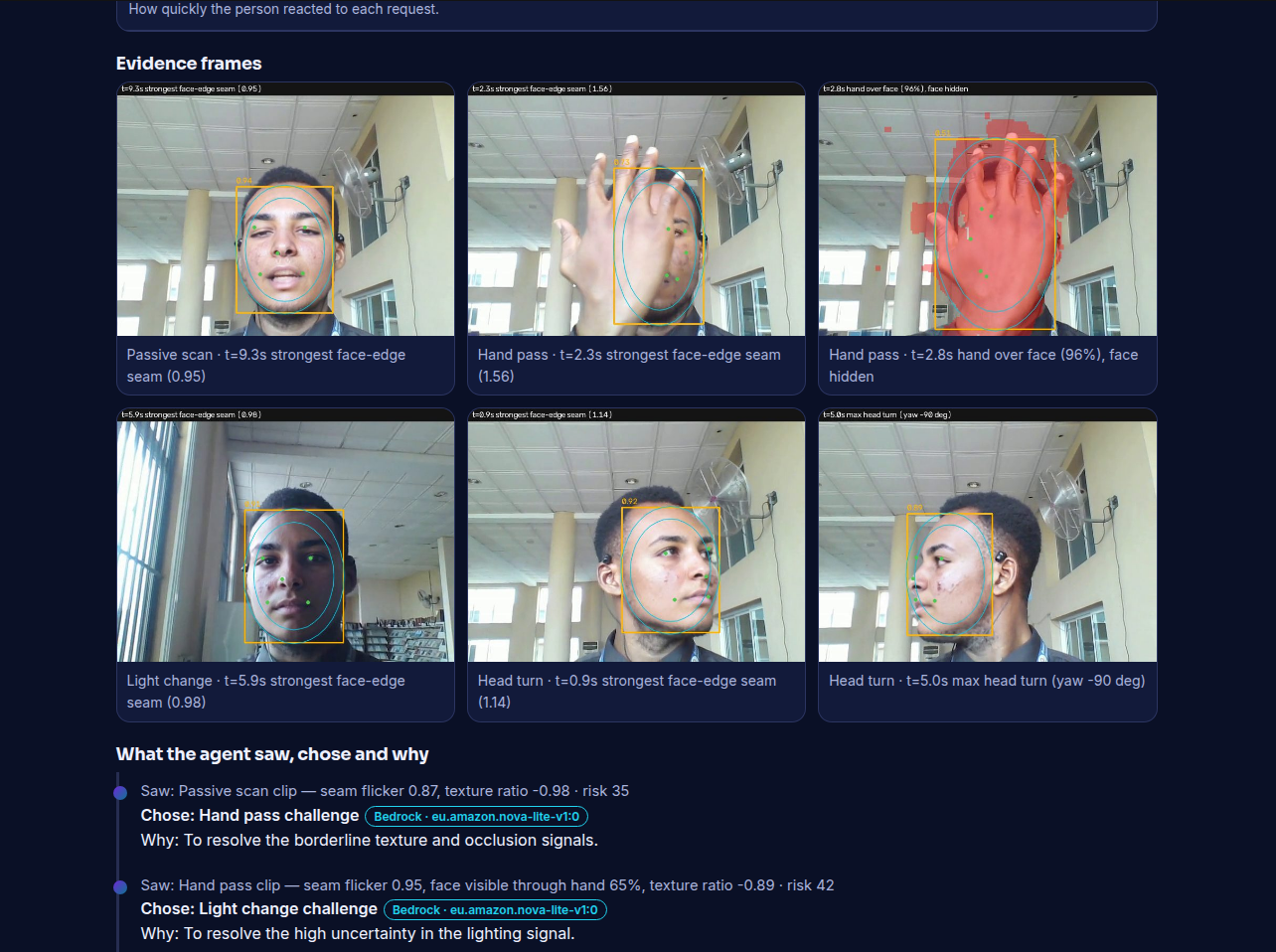
- An agent (Amazon Nova Lite on Bedrock, via Converse tool use) picks the physical challenge that best resolves what the measurements are unsure about: turn your head fully, pass a hand across your face, or move towards a light. It shows the challenge as a prompt for you to read out.
- Unmask measures the response, updates the scores and repeats (at most four challenges).
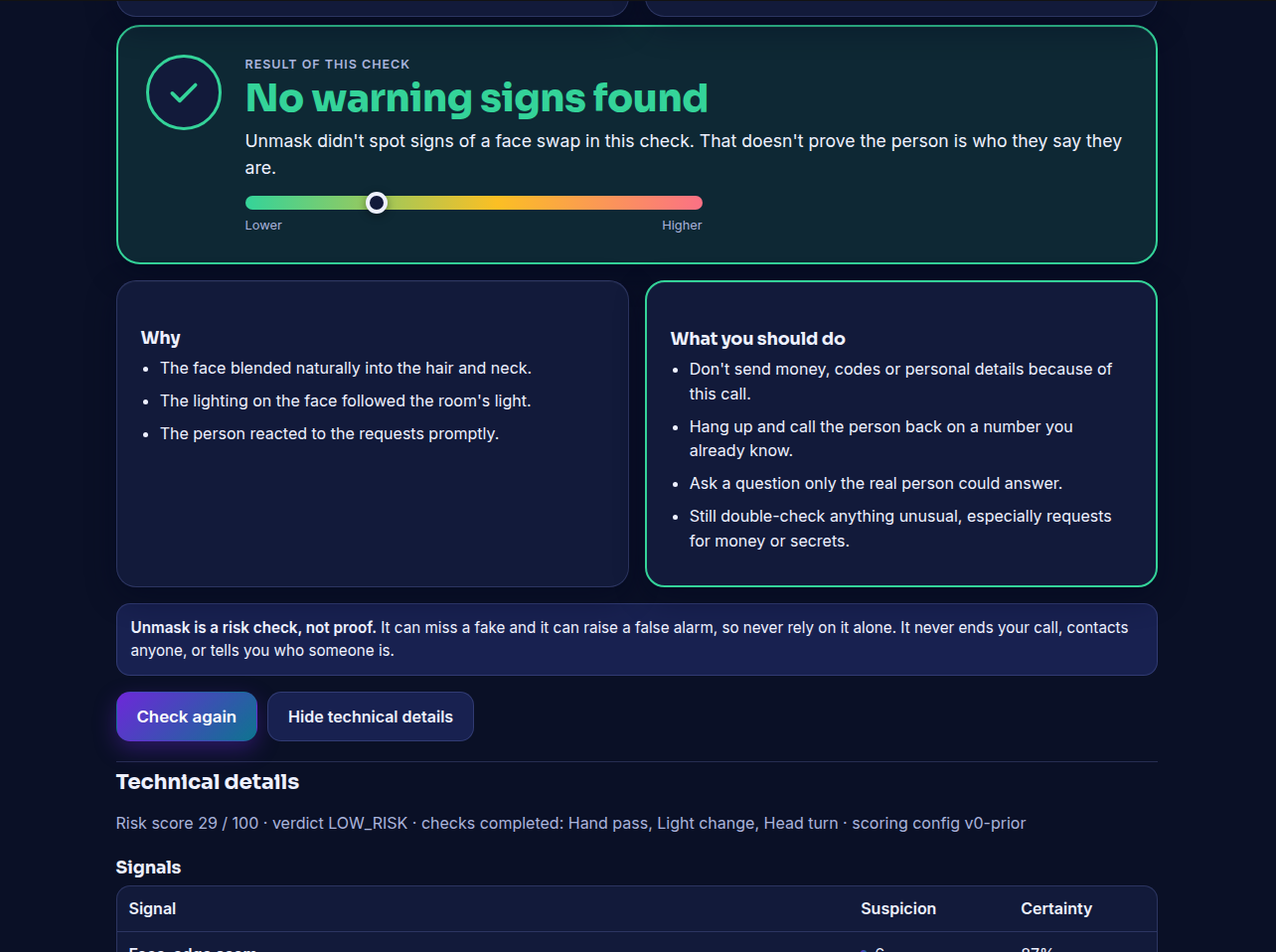
- It gives a cautious verdict (Low risk, Suspicious, High risk or Inconclusive) in plain language, with clear advice: "Don't send money; call them back on a number you know."
Analysts can open the technical view: every signal, annotated evidence frames, and the agent's saw/chose/why trail, downloadable as JSON. Upload mode and one-click samples let judges try it without a call.
How we built it
- OpenCV 5.0 does all the vision: YuNet face detection and landmarks, head pose via solvePnP, a face-boundary seam score, texture mismatch (Laplacian and FFT), hand-occlusion analysis (Farneback optical flow and MOG2), lighting consistency in Lab colour space, response latency, and quality gates.
- A deterministic scorer turns these into the verdict. The language model never decides the verdict.
- The agent makes one tool call per step (
issue_challenge,request_better_conditions,conclude). Guardrails validate every call, and a rule-based policy takes over on errors. - AWS, all from one SAM template in eu-north-1: S3 + CloudFront, API Gateway, a Lambda container with OpenCV 5, Bedrock, DynamoDB traces with a 24-hour expiry, a private clip bucket that deletes after one day, and CloudWatch metrics with a dashboard. Images build in CodeBuild for a one-command deploy.
Challenges we ran into
- Our honest result: the detector doesn't work yet. We recorded one participant in three lighting sessions and face-swapped each clip with an AI-generated face (an open-source swap tool at default settings). Evaluated leave-one-session-out, every strategy flagged 2 of 3 swaps and 2 of 3 real sessions, so there was no separation. The live demo agrees: the swapped sample ends Low risk.
- Two pre-registered fixes, both failed. We wrote down new passive signals (resolution, sensor noise, skin tone, dropout) and the success criterion before computing anything; balanced accuracy was 0.46, against 0.50 before. A second idea, that the swap breaks during challenges, was wrong: the swapped face was more stable in all 6 pairs. We deployed neither.
- Why: differences between lighting sessions were larger than the differences between real and swapped faces.
- Engineering: messy browser video timestamps, OpenCV 5's slower DNN engine on CPU (fixed by detecting on a downscaled copy), Lambda cold starts (fixed with a keep-warm ping), and a very slow internet connection (we ran the swap job in a temporary private AWS stack and deleted everything afterwards).
Accomplishments that we're proud of
- A real agent loop where OpenCV output changes the next tool call, with an exported trace that proves it.
- Honest, pre-registered evaluation with controls, confidence intervals and failure cases, including a negative result.
- Responsible defaults: 24-hour deletion, no face database, no identification, synthetic swap faces only, and a delete-now button.
- Observability and reproducibility: CloudWatch dashboard, structured logs, and a one-command deploy.
What we learned
- Modern face-swaps beat every classical signal we tested on this data.
- The agent saved effort (2.67 challenges on average instead of 3), not accuracy.
- Within the same recording, the swapped face was smoother in every pair, so comparing a caller against themselves looks more promising than fixed thresholds.
- Limiting the language model to "what to test next", with a deterministic scorer for "what the evidence says", is a clean and safe design.
What's next
- Many more participants, skin tones, devices, call apps and swap tools.
- Paired, self-referenced checks instead of fixed thresholds.
- Audio–lip-sync and voice-clone checks as extra challenges.
- A browser extension that captures the call automatically, and an on-device passive scan for privacy.
Full technical report, results and code: https://github.com/breakthrough-child/unmask
Built With
- amazon-api-gateway
- amazon-bedrock
- amazon-cloudfront
- amazon-cloudwatch
- amazon-dynamodb
- amazon-nova
- amazon-web-services
- aws-codebuild
- aws-lambda
- aws-sam
- css3
- html5
- javascript
- opencv
- python

Log in or sign up for Devpost to join the conversation.