-
-
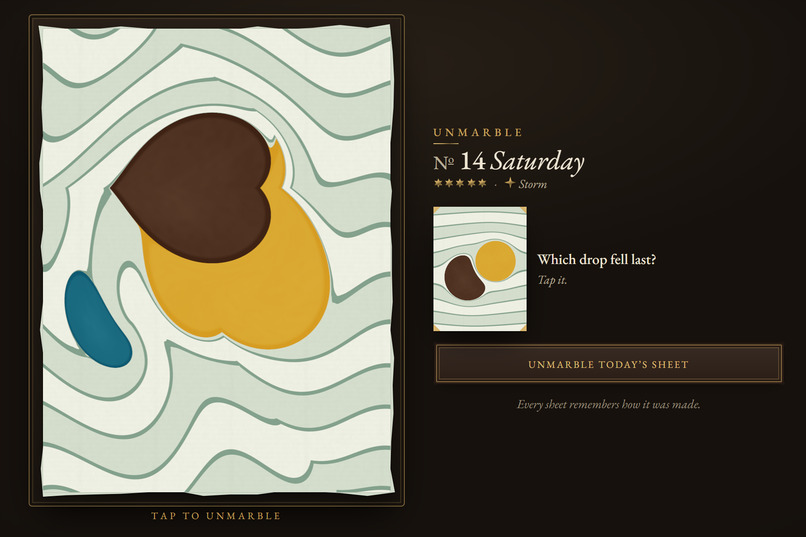
The daily post in the feed: today's sheet and a two-drop teaser
-

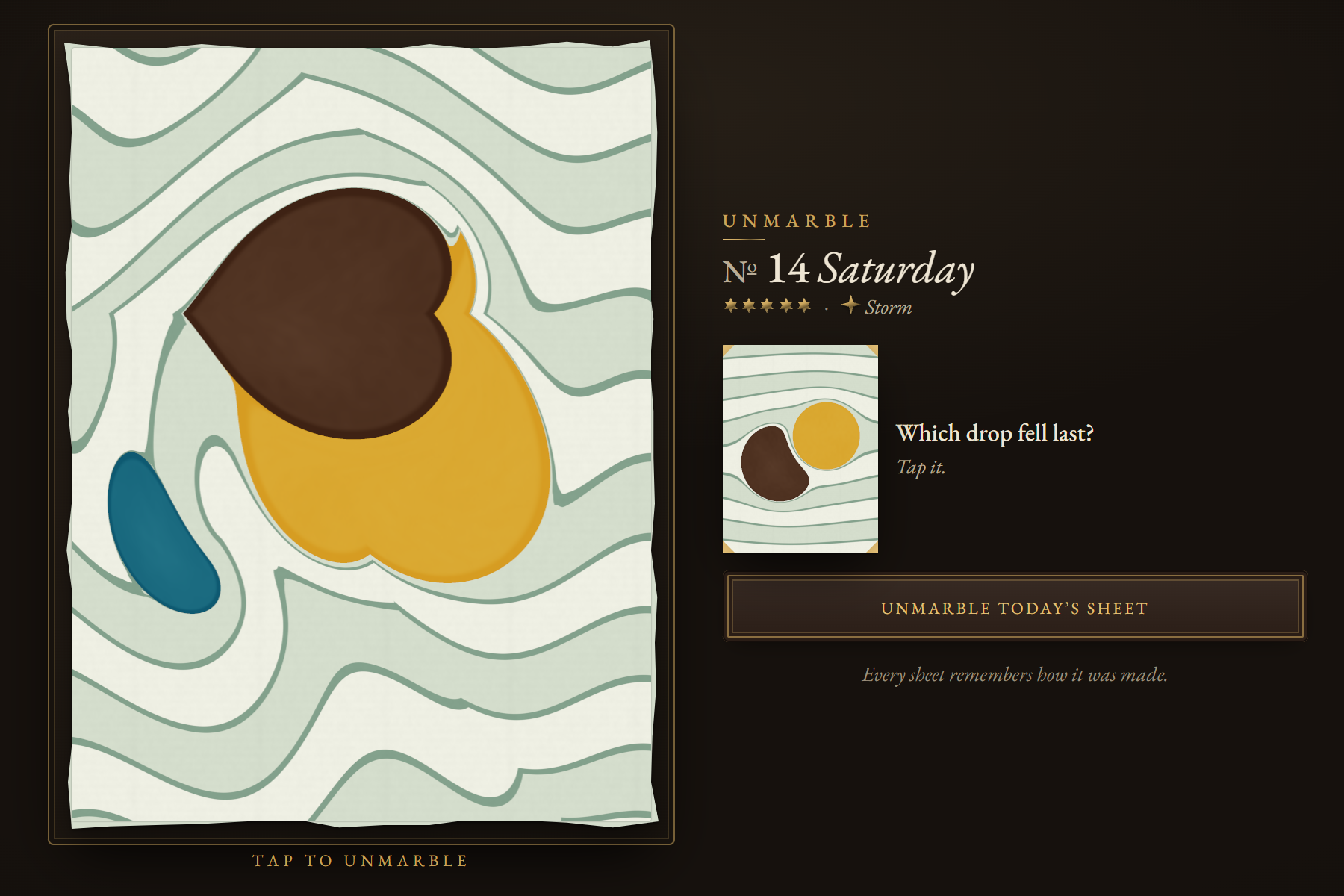
A Saturday ★★★★★ special: Storm, two swirls turning opposite ways.
-
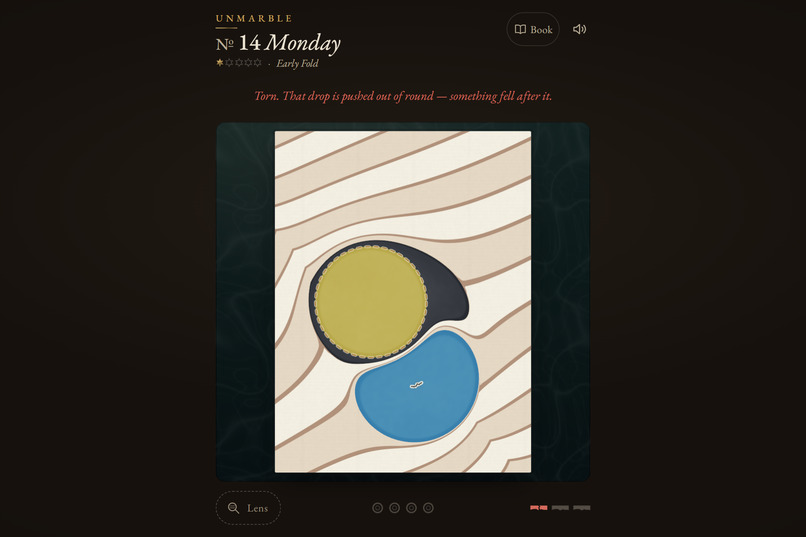
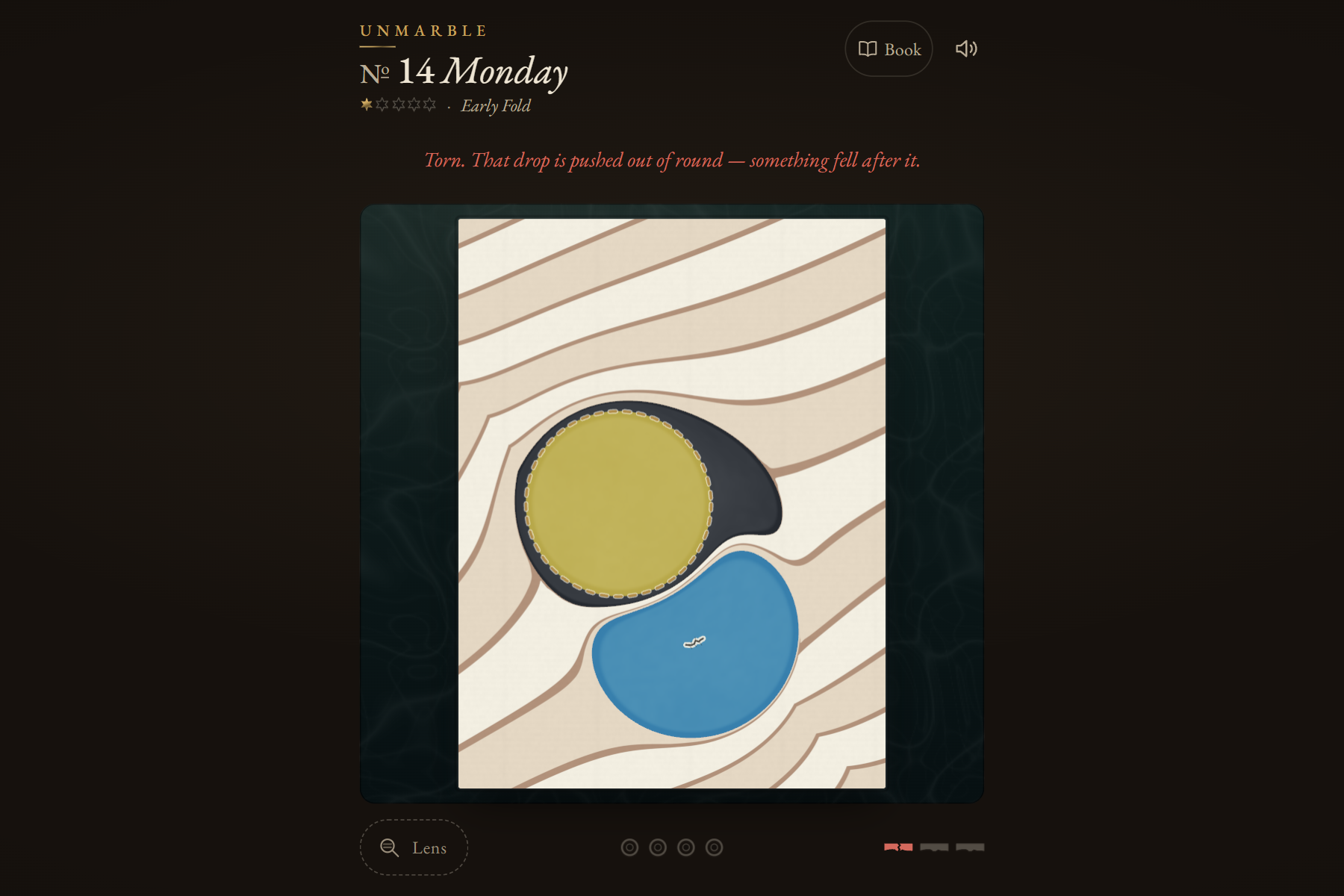
A misread: the paper tears and outlines the drop that fell later.
-
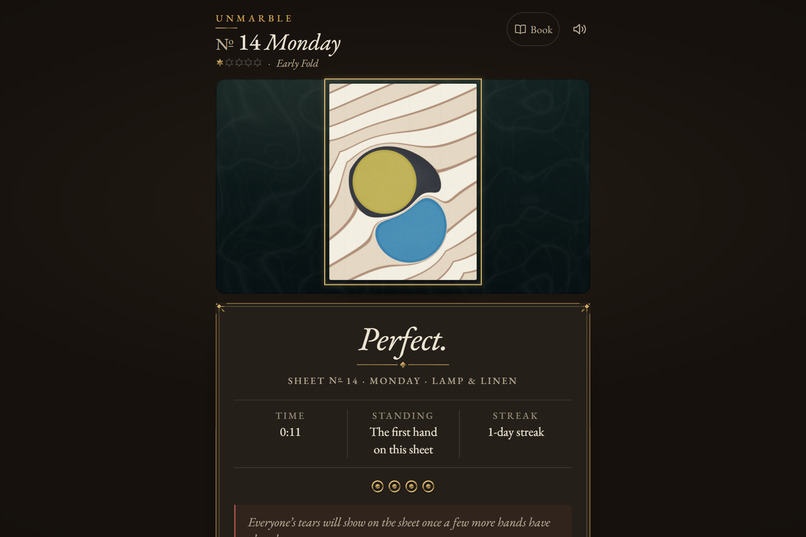
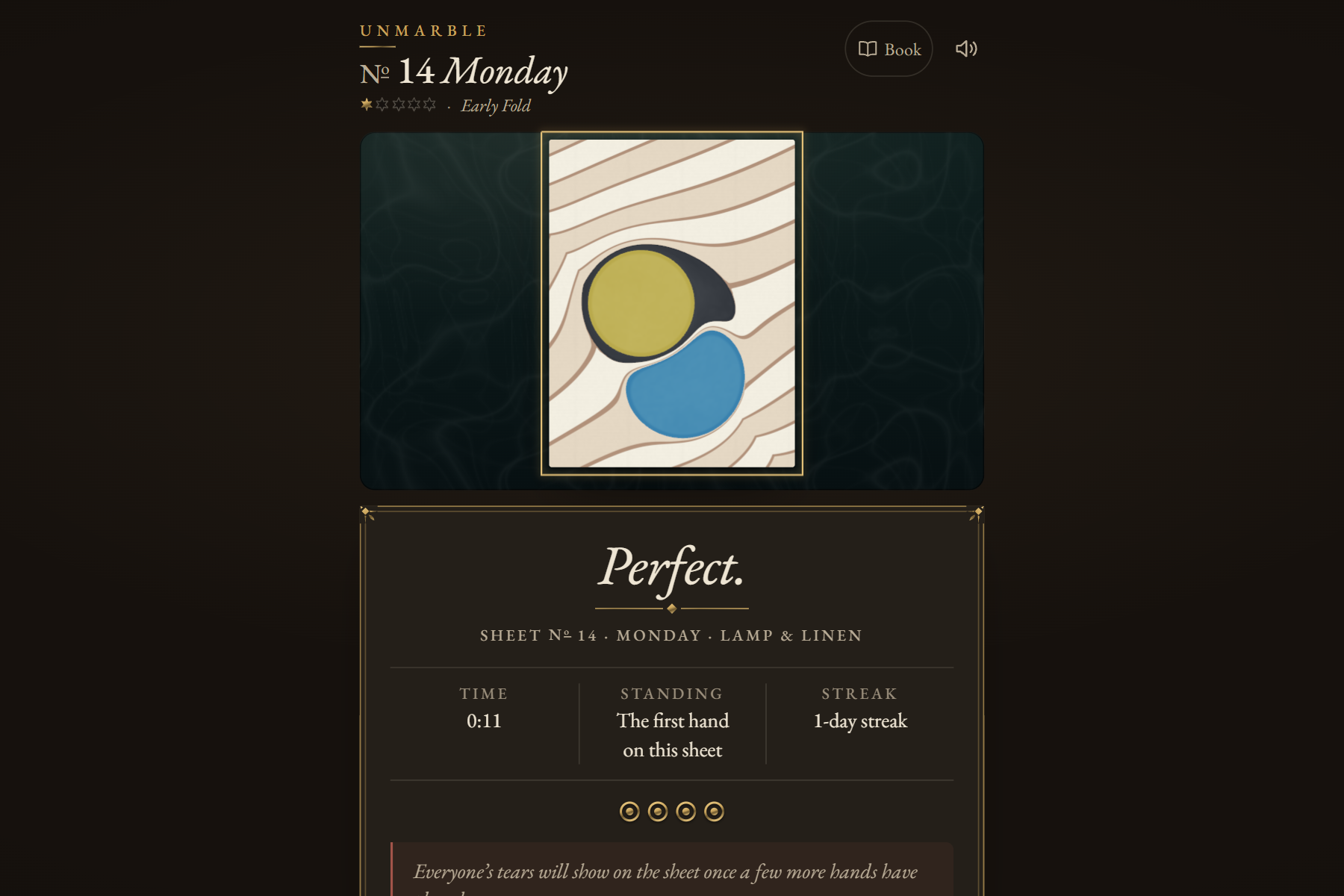
A clean sheet: the result card.
-
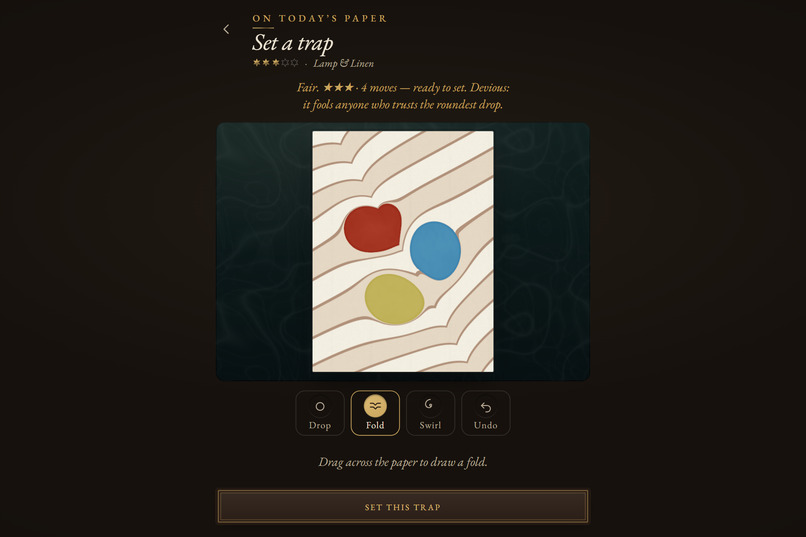
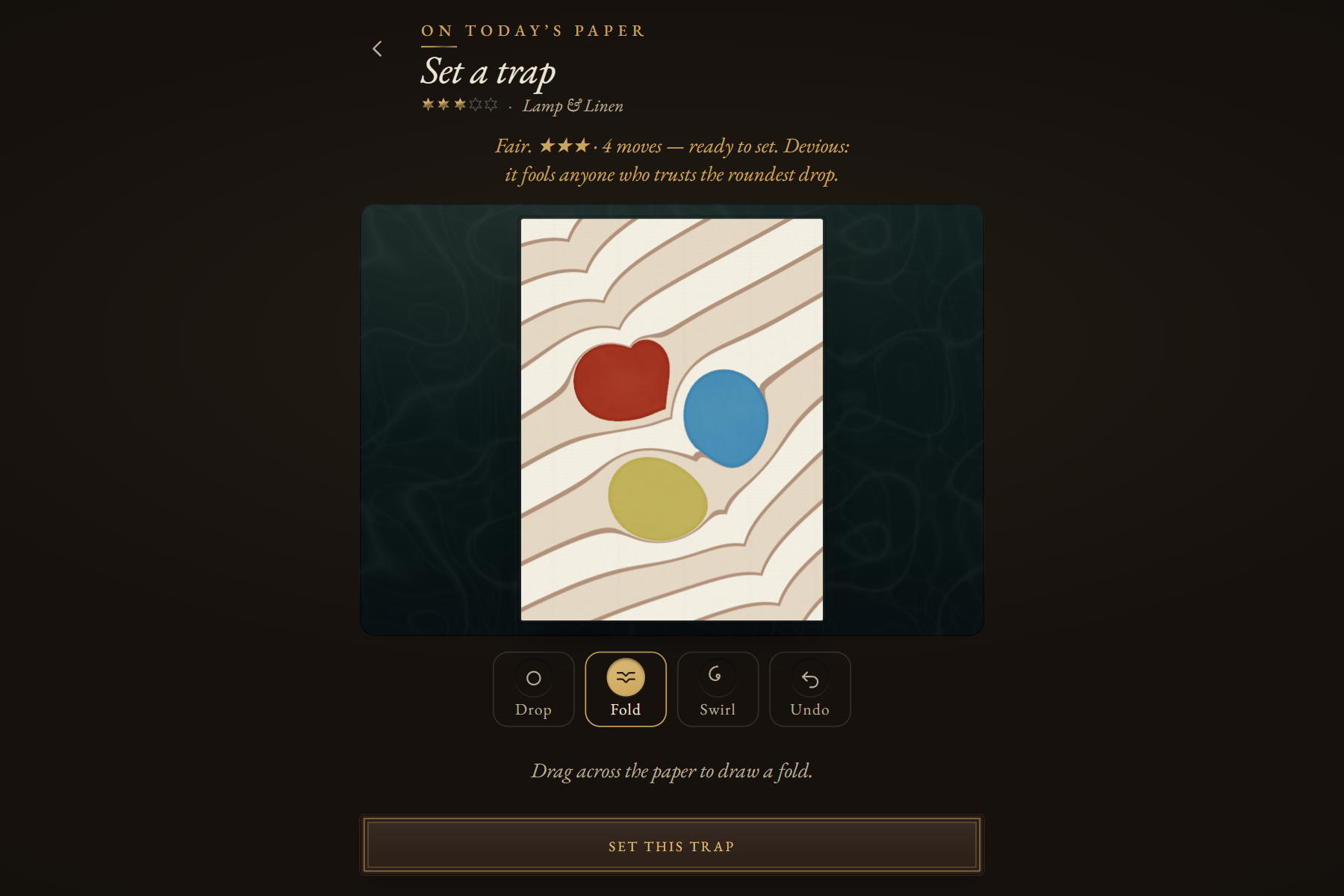
The trap editor checks fairness live and calls this one devious.
-
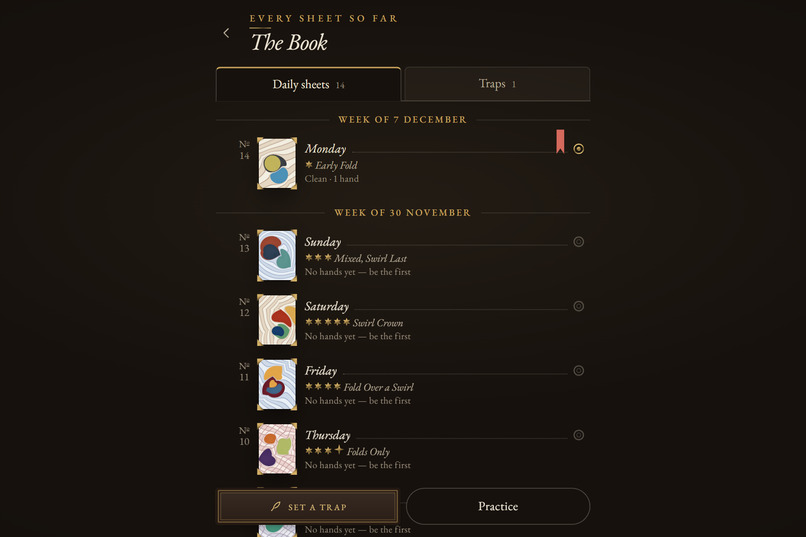
The Book: past sheets and community traps.
-
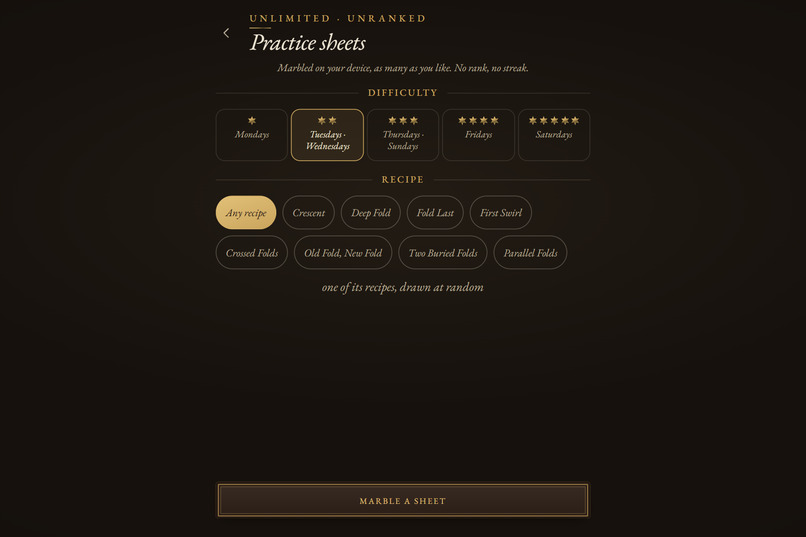
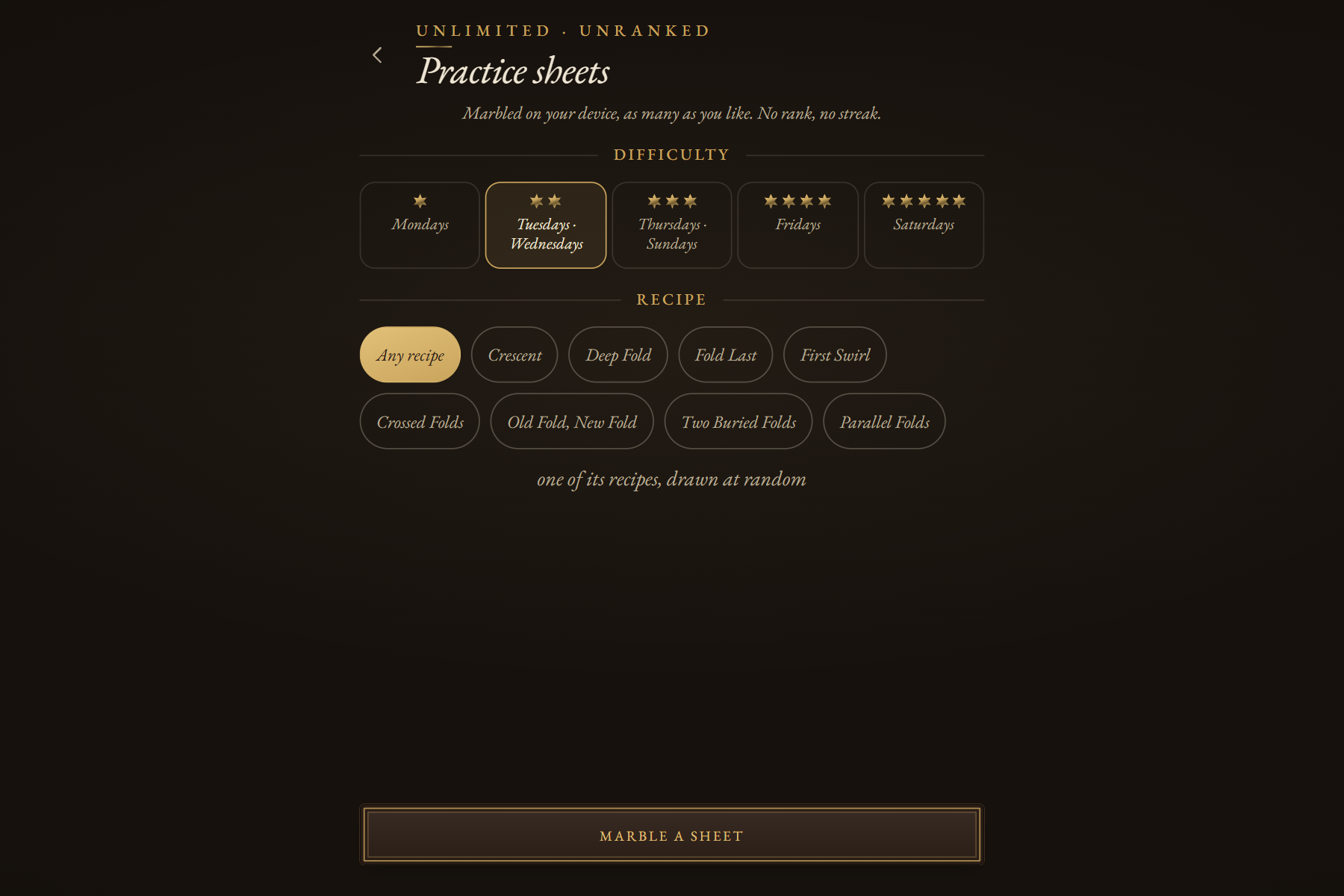
Practice: unlimited, unranked sheets at any difficulty.


Judge it in 3 minutes
- Open r/UnmarbleGame. In the feed, the daily post shows today's sheet — tap the little two-drop question right in the card ("Which drop fell last?").
- Tap the sheet to open the game. Three short first-visit lessons teach tapping a drop and dragging a fold (a ghost finger shows each one). Circling a swirl is taught before your first sheet with a swirl.
- Play today's sheet. Make one mistake on purpose: tap a drop that isn't perfectly round. The paper tears and outlines the later move that gave the order away.
- On the result card: open Set a trap, pour a few drops, draw a fold — the editor tells you live whether your trap is fair and whether it is devious.
- Open the Book (top right): the last month of sheets, the newest traps, and Practice — unlimited sheets at any difficulty.
Inspiration
Marbled paper is made by floating ink on water and combing it. The patterns are beautiful, and they are a record: every drop pushes the drops before it, every comb drags them. I wondered whether you could read that record — look at a finished sheet and tell, from the shapes alone, what happened last. It turns out you can, and it makes a small, calm, satisfying daily puzzle.
What it does
Every day your subreddit gets one marbled sheet. You unmarble it, last move first:
- Drops — the only perfectly round drop fell last. Tap it and it sinks back into the water.
- Folds — nothing round? A stylus combed the water. Drag along the bent stripes, against the fold's point.
- Swirls — the water turned around an eye. Circle it, against the turn.
Misread the sheet and the paper tears: you keep a scar, and the sheet shows you which later move gave the order away. Three tears and it gives way — then it replays how it was really made, step by step, so you always learn the answer.
Daily content. A new sheet every day at 00:00 UTC, generated from a secret per community, so it can't be predicted. The week climbs from ★ on Monday to ★★★★★ on Saturday like a crossword; each weekday rotates through several recipes (33 in all, e.g. Crescent, False Round, Crossed Folds, Swirl Crown), never repeating a weekday's recipe within three weeks, and about one day in ten is a special (Ink Only, Folds Only, Storm). The result card teases tomorrow's recipe. 28 colourways on six tinted laid papers, and six kinds of ruled ground.
Community.
- Set a trap. Once a day, marble a sheet of your own on today's paper. The editor checks it live against the same fairness rules as the daily sheets and celebrates a devious one (it fools anyone who trusts the roundest drop). Your trap is posted to the subreddit with your name in the title, and a pinned comment keeps count of how many hands it caught.
- Sunday can be chosen by the community. The week's most-played trap that at least three signed-in players tried, and that between 30% and 85% of them solved cleanly, becomes Sunday's sheet, credited to its maker. Otherwise Sunday is a mixed sheet.
- Name the sheet. Each daily post has a pinned comment: reply with up to three words; once it has enough upvotes, the best-voted reply names the sheet.
- Shared scars. After you finish, see where everyone else tore the sheet, and which move caught the most hands.
- Streaks and opt-in streak flair, which gives you back your previous flair when you switch it off, and steps aside for good if a moderator sets your flair meanwhile.
The Book and Practice. The last month of sheets stays playable from the Book, and the newest traps are one tap away. Practice sheets are unlimited, generated on your device at the difficulty and recipe you choose, unranked and never sent to the server.
How I built it
- Devvit Web: React 19 for the inline feed card and the expanded game, a Hono server, Redis for attempts, ranks, streaks, traps and names, triggers and scheduled jobs for the daily post, the pinned comments and the trap counts.
- Exact marbling physics. Drops, combs and swirls are closed-form transforms in the spirit of Lu, Jaffer et al.'s Mathematical Marbling; every pixel is pulled back exactly through the moves, so undoing a move restores the previous sheet perfectly and every animation is a physically valid sheet. A drop at $c$ with radius $r$, for example, maps $p \mapsto c + (p - c)\sqrt{1 + r^2/\lvert p - c\rvert^2}$.
- A WebGL2 fragment shader and a CPU rasterizer share one shading model (ink with a pooled tide line, laid paper, pen-ruled hairlines of near-constant weight from the exact Jacobian of the field). Every constant is fed to both from one table, enforced by tests, and a lab board diffs the two renderers pixel by pixel.
- A fairness contract proves every sheet before anyone sees it: a rule-reading solver must solve it without a mistake, every covered move must carry a mark above a human threshold, and every reasonable swipe or circle that undoes the top move must resolve to it — so a tear is always a misreading, never a misaim. A full simulated year generates with zero failures.
- Server authority: the client plays optimistically, the server replays the same log through the same reducer, so results can't be forged and a reload can't undo a tear.
- Accessibility: colour-vision-deficiency checks on every palette, reduced motion respected, 44 px targets, AA contrast by design.
Challenges I ran into
- Making "which move came last" always readable by a human. The answer was the contract above — and the discovery that a straight swipe near a swirl's eye could be misread as a circle, which I fixed in the gesture reader and the contract.
- Keeping the CPU fallback and the GPU shader within 3/255 of each other while making the paper look like paper.
- Designing traps that are devious but never unfair, and a Sunday selection that logged-out devices and the maker's own play can't lift.
Accomplishments that I'm proud of
- A puzzle mechanic I haven't seen anywhere else, grounded in real fluid geometry.
- Community-made content that becomes the daily content, with credit.
- 314 automated tests; every daily sheet is proven fair before it is posted.
What I learned
Good daily puzzles are mostly about trust: the player has to believe that every mistake was theirs to avoid. Most of my engineering went into earning that trust.
What's next
Seasonal recipes, a weekly "hardest trap" leaderboard per community, and Devvit Journeys events for streak verification.
