-
-
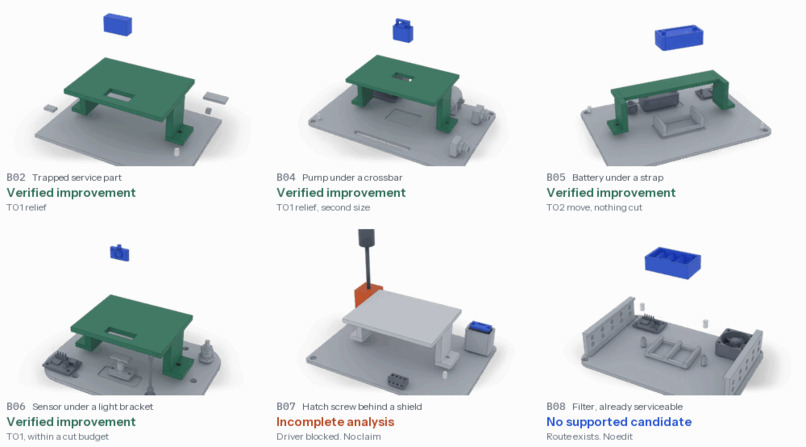
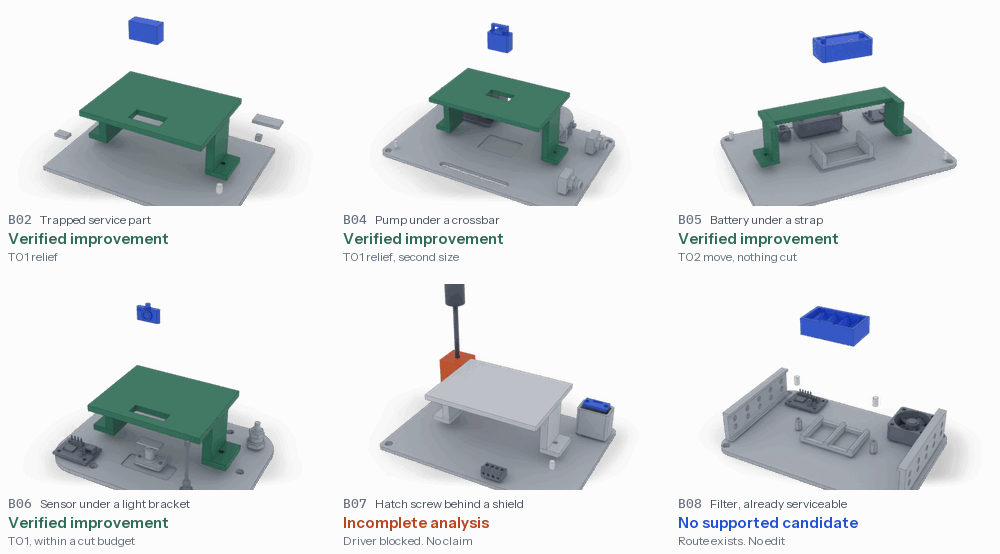
Six synthetic assemblies, including verified improvements, blocked designs and an already-serviceable part.
-
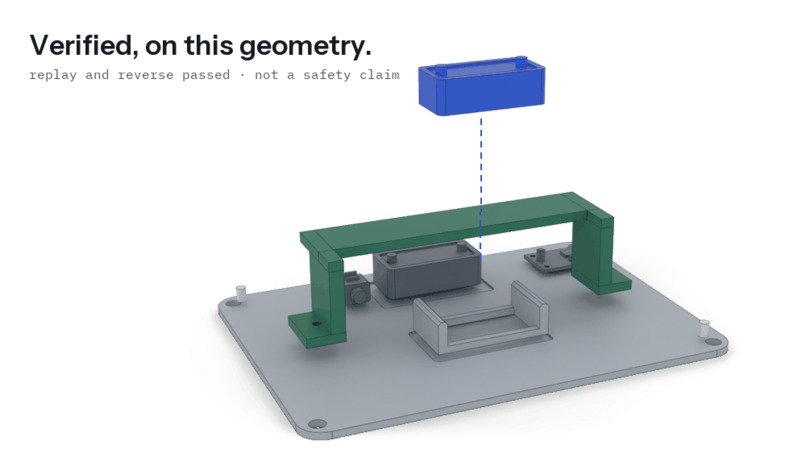
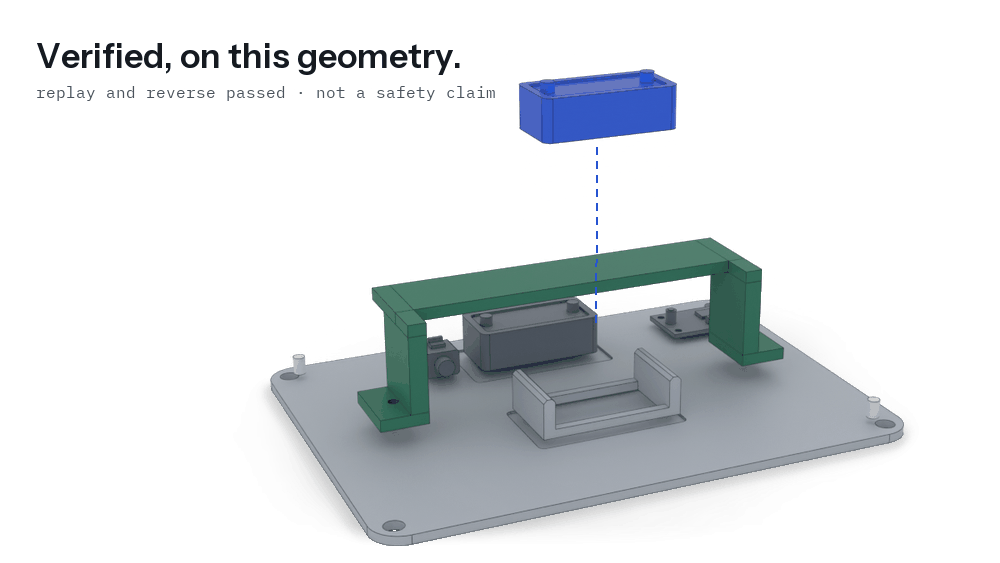
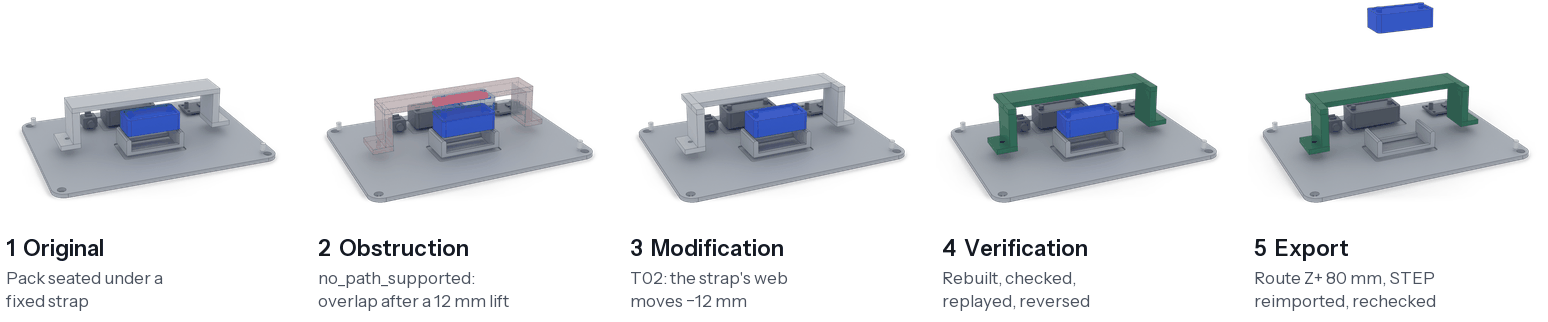
B05: a 12 mm strap offset clears the battery removal route without cutting material.
-
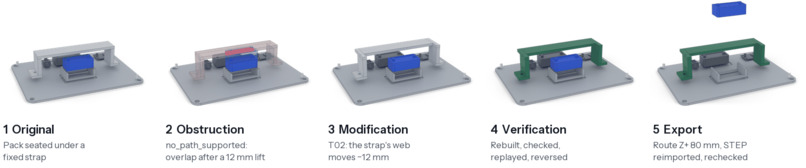
Inspect, redesign, verify and export: recorded geometric evidence accompanies each candidate.
-
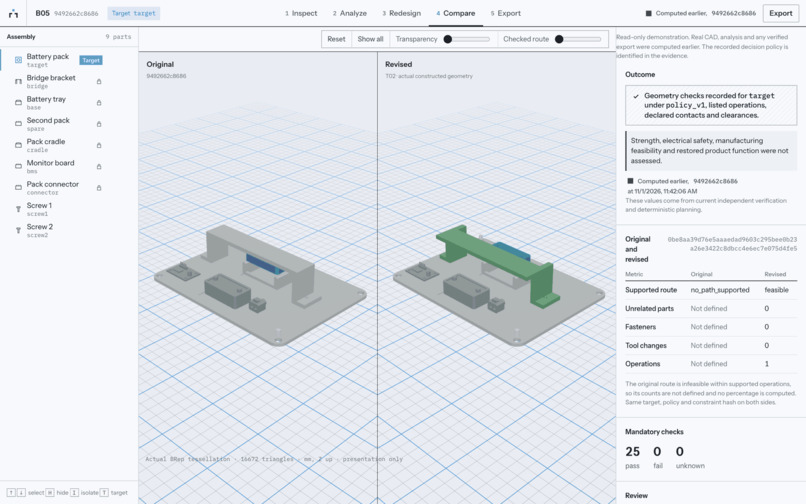
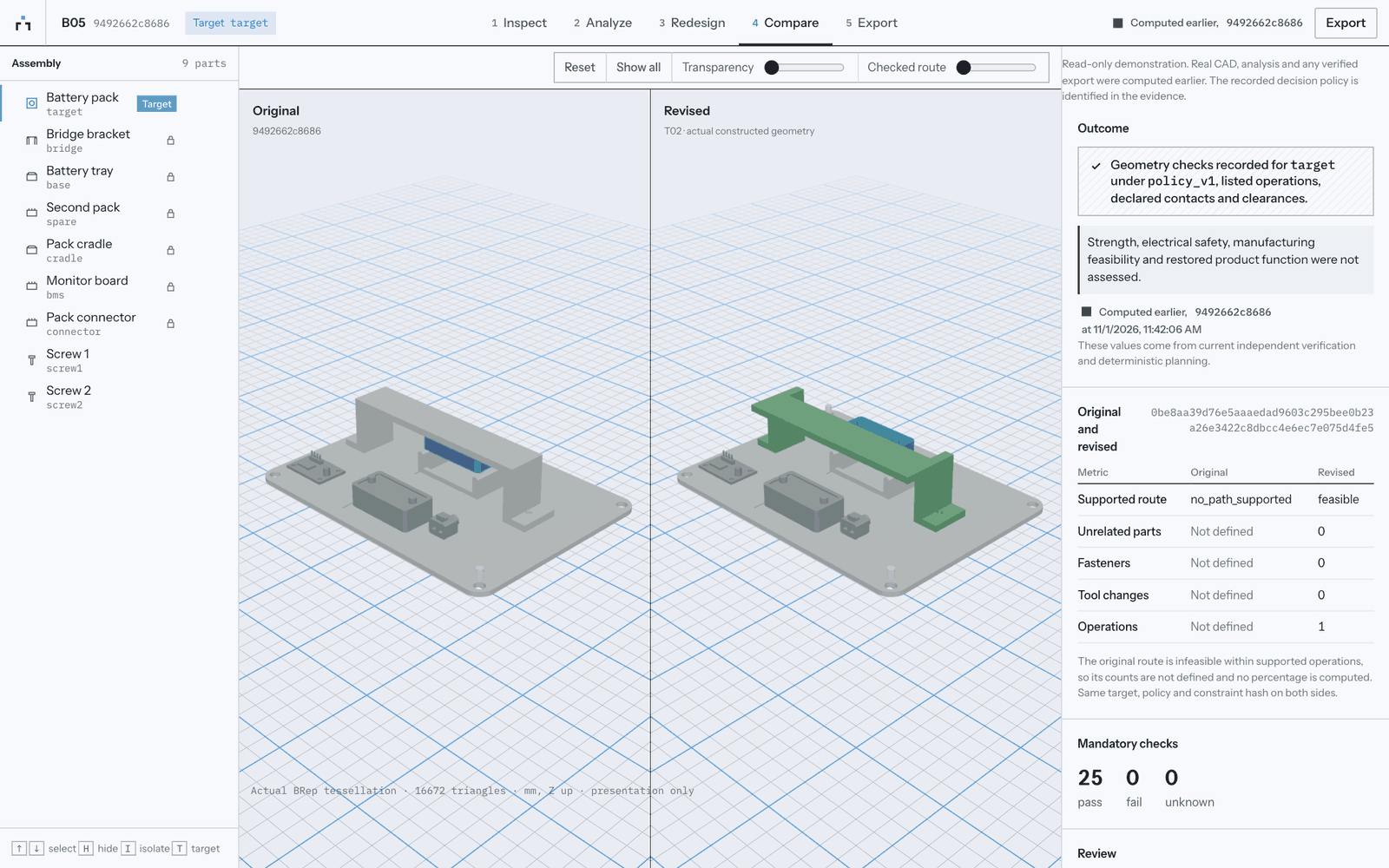
The interactive workspace compares original and revised CAD alongside constraint checks.
Inspiration
A failed part should not make the product around it disposable.
A battery can be replaceable on the parts list and trapped in the actual assembly. A retaining strap crosses its removal path. A bracket blocks the fan. A shield covers the screw. These are geometric decisions made in CAD, when changing them is still much easier than repairing the finished product.
UNLOCK asks: Can this part come out—and if it cannot, which supported design change lets it? It is a research prototype for mechanical designers investigating repairability before a product reaches the factory.
What it does
UNLOCK takes a STEP assembly and an engineering manifest, identifies what blocks a selected component, proposes a bounded redesign, and independently checks the resulting CAD geometry.
- Find the obstruction. A deterministic planner searches six-axis removal routes against exact boundary-representation geometry. When a route is blocked, it produces measured obstruction evidence.
- Choose a change. Muse Spark 1.3 investigates that evidence through eight allowlisted engineering tools. It chooses a supported edit and parameters, with citations to evidence from the current run.
- Build real CAD. A trusted CadQuery/OpenCASCADE constructor creates the change. The language model writes neither executable code nor free-form geometry.
- Check independently. A fresh process reconstructs the candidate from frozen inputs, measures the geometry and declared constraints, and checks the removal route and reverse insertion.
- Export an inspectable record. After review, the STEP assembly is written, reimported and rechecked. Artifacts are addressed by SHA-256.
The AI proposes. The CAD engine decides. The model cannot override a failed check or make its own success claim authoritative.
What we demonstrated
Two recorded live Muse Spark redesign runs reached VERIFIED_IMPROVEMENT_FOUND:
- B02, trapped service component: a 40 × 16 mm relief cut, completed in 48.1 seconds.
- B05, battery under a strap: a 12 mm strap offset, completed in 73.3 seconds, without cutting material.
The public gallery contains six synthetic assemblies and their computed engineering records. It includes a blocked screw behind a fixed shield, where no verified improvement is claimed, and an already-serviceable filter, where no redesign is needed. Refusal is a meaningful result.
Try it: open the live gallery, select B05, and compare the original and revised geometry. Inspect the constraint checks and recorded route. The demo video shows the workflow; the repository contains source, setup instructions and run evidence.
Demo provenance: the hosted gallery serves previously computed CAD results using an offline scripted policy. It does not run live model inference for anonymous visitors. The separate live Muse Spark run reports are linked in the repository. A locally configured backend supports live inference with the operator's own API key.
How we built it
Python 3.12, CadQuery and OpenCASCADE handle the engineering. FastAPI coordinates persistent jobs, immutable revisions and resumable progress. React, TypeScript and Three.js provide the interactive workspace. Cloudflare Pages hosts the frontend; bounded private CPU workers and recorded artifacts run on Modal.
The model uses the direct Meta Model API with native tool calling. Tool schemas also validate the actual calls. A controller checks tool permissions, schemas, frozen revision identity, issued evidence, finite parameter domains and remaining budget. Limits include three candidates, twelve tool calls, six turns and 120 seconds.
Challenges and what we learned
The difficult part was separating a plausible proposal from a defensible result. The preview mesh cannot determine engineering truth. A model's confident closing message cannot determine it either. Unknown or missing mandatory checks must prevent a pass.
One live run exposed a communication defect: a proposal was refused for its citations, but the feedback did not clearly say that the same geometry could be resubmitted. The model moved to a larger cut. We corrected the feedback, added a regression test and preserved the original run.
Our repository's recorded inventory contains 389 tests; the last recorded full run reports 342 passed and 27 deselected. These are dated records, not a claim that every test was rerun for this submission. A deterministic selector also matches or beats the model on the current small fixtures. Broader model advantage remains a question to measure.
Impact, scope and next steps
The intended benefit is fewer products discarded because a small failed component cannot be reached. We have demonstrated geometric repairability improvements on synthetic assemblies; we have not measured avoided waste, field repair time or emissions reductions.
The prototype supports small rigid STEP assemblies, axis-aligned translations and two bounded bracket-edit families. A passing report does not establish structural strength, electrical safety, manufacturing feasibility or restored function.
Next, we want to evaluate authorized real assemblies with mechanical engineers, measure repair outcomes, and add independently checked edit families. Better evidence should expand what UNLOCK can verify.
Credits and project history
Created by Shreyas Pabbathi and Maanas Pabbathi. Development began in October 2026, with an earlier Meta hackathon submission. We disclose this history rather than presenting the existing engine as a new build for every event. Event-specific descriptions identify the work within the relevant build window.
Source and documentation are Apache-2.0; the published synthetic demonstration fixtures have separate CC BY 4.0 grants. Dependencies and model services retain their own terms. OpenAI Codex assisted the current presentation, documentation and frontend refinements. The runtime agent is Muse Spark 1.3, with offline demonstration policies identified separately.
Rethinking waste
Small component failures can lead to whole-product replacement when a battery, filter or service module cannot be removed. UNLOCK targets the geometric obstruction before manufacture. We would measure impact first on authorized real assemblies: compare supported removal routes and prerequisite part removals, then measure successful physical replacements, repair time and retained product mass. Only field measurements would support estimates of avoided waste or emissions. Our current six synthetic fixtures demonstrate geometric behavior, including a failed case and a no-change case; they do not establish environmental savings.
Development timeline and event contributions
Development began October 27, 2026. The geometry and agent core existed before October 30. Work during October 30-November 1 added bounded Modal cloud execution, the read-only publication boundary, authenticated private uploads, a six-assembly gallery and checked cloud artifacts. The recorded live B05 offset redesign ran November 1. November 14 work refined the public demo, navigation, private-access flow and documentation. The public Git history and run reports preserve those dates. We submit the Hackathon Pathway as an extension of the earlier core, with those event-period contributions identified.
Industrial design and repairability
A product's form determines whether its components remain accessible when they fail. UNLOCK makes that relationship visible during design: compare the original and revised assembly, inspect a supported removal route, and export the changed CAD. Its creative role is to help a designer explore a bounded physical intervention while preserving a clear distinction between a proposal and a checked result. The six synthetic assemblies form an interactive design study, including cases where changing nothing or refusing a redesign is the correct outcome. This is a tool for product design and serviceability; it does not claim to generate artwork or certify a manufactured product.
Built With
- cadquery
- cloudflare
- fastapi
- meta-model-api
- modal
- muse-spark
- opencascade
- python
- react
- sqlite
- three.js
- typescript
- vite

