-
-
Outlook
-
Intro Team
THE CHALLENGE
In our everyday work with public schools, we find students with little access to education.
The “digital divide”, the gap between people with access to technology and those with no access is worse now, when all students study from home. Problems of the underserved groups increase and less than half of Europe’s students aged 6-16 can access regularly quality teaching and have good learning experiences at home.
Pandemic time has showed us more problems and the sheer lack of suitable solutions for learning: lack of affordable devices and software, teachers capability for digital & distance learning, scarcity and reasonably priced educational content on the market, ready to be delivered on a large scale on students’ devices and poor infrastructure, internet connectivity and communication tools.
THE SOLUTION
The project was designed on the concept: collaborative work and resources in digital times for unlimited education.
During the pandemic lockdown we have successfully piloted several remote learning solutions (hardware, software and connectivity packages, digital content & trainings on economic & financial education, entrepreneurship and working skills), working together with more than 500 teachers and 10,000+ students and aggregating several IT solutions available on the market.
The pilot shows us very good results and the opportunity to design a “template” of such process and tools to use at low cost and easy to be customized on different educational levels and curricular areas.
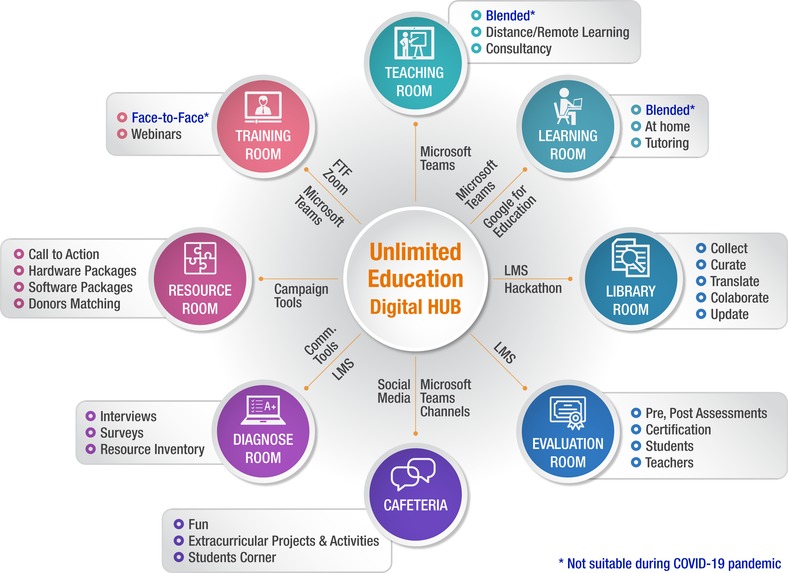
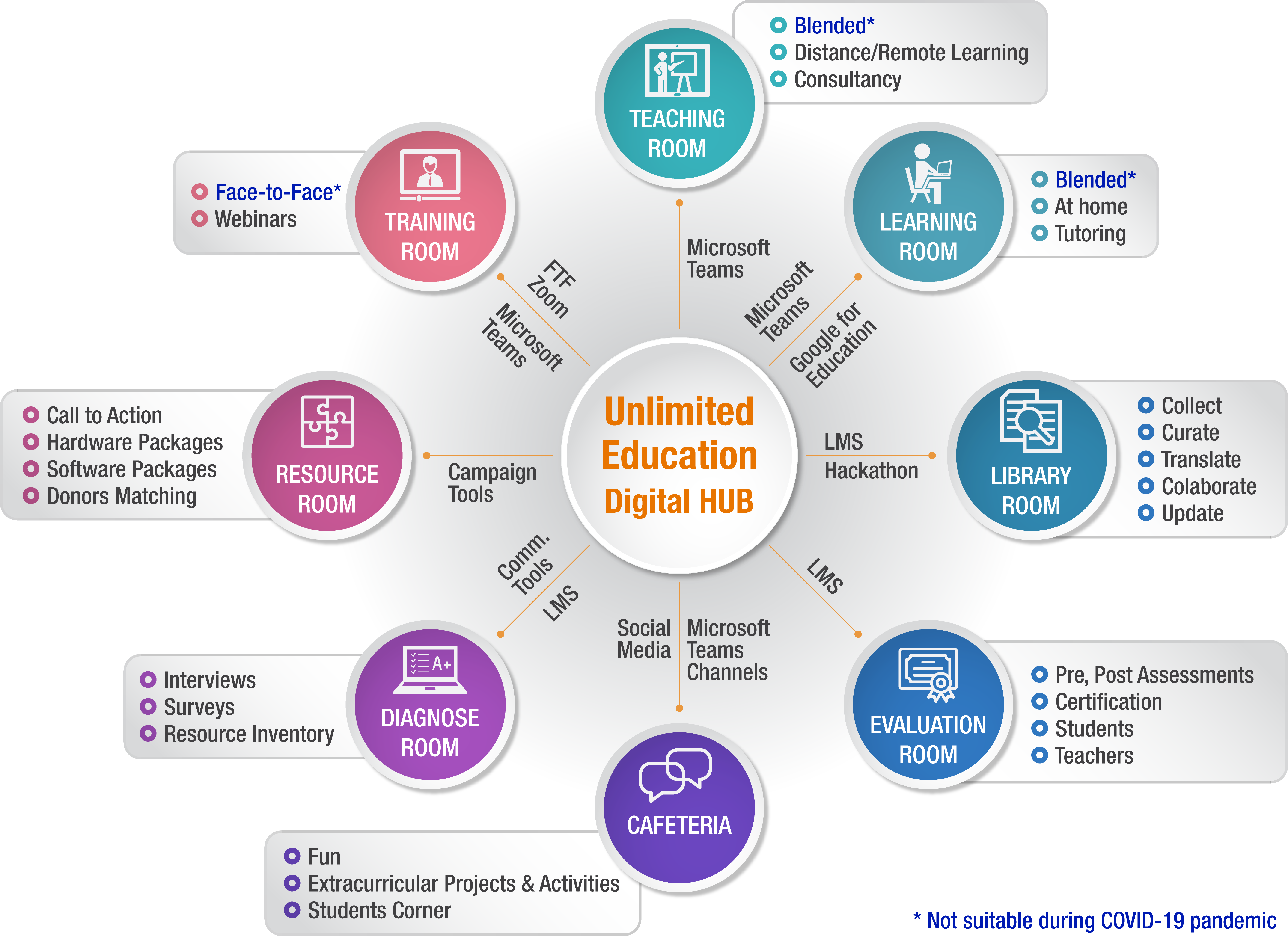
This is what we propose: the Unlimited Education Digital Hub, which reunites under the same group of stakeholders (students, teachers, parents, business community) different digital spaces (named “rooms”) related to an educational process and the IT necessary packs.
It was designed to cover all we experienced during the pilot carried out in the beginning of the lockdown period, working with more than 500 teachers and 10,000+ students to create a “product” able to be customizable and expandable.
The Digital HUB is organised in 8 virtual “rooms”, each with its own processes and recommended technology tools (available on the market at affordable costs or free of charge) to be used based on Junior Achievement`s experience and piloted during the lockdown:
Diagnose room (find the school/teacher/students’ needs through interviews, surveys, inventories of the available resource)
Resources room (Call to Action and Digital Campaigns to identify affordable hardware, connectivity and software packages (under 100 USD/student) and donors in an “Adopt your former school” campaign formula)
Training room (training packages to be delivered from main trainers to local trainers through webinars or/and face-to-face trainings during normal times)
Teaching room (tools and content to be delivered as distance learning during lockdown or later in blended form, with projection version for low income areas; consultancy channels for teachers and volunteers to mentor teachers)
Learning room (tools and content dedicated to students to be used at home or in class; tutoring channels for students and teachers)
Library room (tools to collect educational materials, curate them, translate quality materials into local language, digitalize them; collaboration tools dedicated to build new educational content or to update the current one as planned; summer Hackathons with teachers, organised by curricular areas or educational school level: Primary, Middle Grade, High School)
Evaluation room (tools to do pre-, middle- and post-tests/assessments, certification for teachers and students for educational modules available on the HUB)
Cafeteria room (virtual space for teachers to share experiences, extracurricular projects and have fun; Student Corner)
WHAT WE DID HERE
Our work at hackathon included:
polishing the design and HUB template,
completing the solution and (content + process + IT tools) the packages for schools, teachers and students,
working on the ways the digital HUB can be customizable in other countries and/or educational areas
consulting in place mentors on several topics: digital educational content development, Single Sign-In issue, GDPR issue, time students spend on mobiles, how to use AI in education for localizing quality content
SOLUTION IMPACT TO THE CRISIS
All the components of the project had been successfully tested in the pilot JA did during the lockdown with 500+ teachers from different areas as economic environment or academic level, and 10,000+ students. We used JA’s educational content for economic, financial, entrepreneurship and workforce readiness and aggregated IT tools (JA Inspire™ LMS, MS Teams, Google tools for Education, social media: FB, LinkedIn, Instagram, mobile apps).
The process and packages are designed for in school use and at home learning.
Proposed IT solutions and (content + process + tools) proposed packages work well and the process was tested and updated for efficiency and easy usage according to the teachers’ capability, technology in place and low or medium connectivity bandwidth.
The GDPR issue was solved at the JA Inspire™ LMS level, using access codes for students under 18, instead of personal data.
Our solution addresses all stakeholders during the process: teachers, parents, students, local business community, technology providers and producers and works on a sharing experience and transfer of knowledge and technology (refurbished equipment, new old stock smartphones or IT products) from those who have it to those with little or without, in a transparent and simple process. “Adopt your former/family school” campaign will be part of the process.
Enough knowledge and access to technology can become “seed solutions” on the digital divide. Local business communities can ”go back to school” supporting the project with online volunteering time, equipment donations and cash support to students in need.
VALUEs after crisis
The project was designed to be used both in regular times and during the lockdown.
Before the lockdown we used part of the described content, process and IT tools as blended learning methods with regular public schools from different areas in terms of economic development and academic level.
JA in Romania serves free of charge, based on business community financial support and grants, annually, 200 000+ students, aged 6-26, from more than 700 localities and works with 4000+ teachers and 100+ businesses. All the components of the Digital Hub are related to those partnerships and experiences we will continue to work on.
The value of the project consists in validating its use during the crisis and possibility to develop new content, new IT packages and social and collaborative components to be added (as summers Hackathons for teachers) in order to collaboratively develop new educational digital content to be used in blended forms or digital Cafeteria for lockdown times and not only.
TO CONTINUE
The solution we are working on now is to consolidate and sustainably build more content (software+hardware+connectivity), affordable or donated packages to those in need and to expand the Digital HUB content and IT tools utilised at national level using our local network of schools and business community and at European level, using JA’s European network of 35+ countries.
We have to:
Develop a Single Sign In process for all the Digital HUB users
Develop easier-to-use and less time-consuming diagnosis tools as correct identification of the needs is of outmost importance for the efficiency of any digital and educational endeavor (identification of equity gaps: access to devices, connectivity, educational content and teachers’ capability)
Develop collaborative work with teachers for educational content, fast development, using technology and mixed teachers’ teams for blended teaching in class in disadvantaged communities (organising summer Hackathons for teachers with those challenges, collaborative blended learning teaching and digital cafeterias)
Involving more local business community and increasing its contribution to low income students and poor areas schools in an “Adopt your former/family school” periodical social media and direct campaign
Produce replicas of the project and multiply it in different communities in at least more 10 European countries during 2020-2022 school years in order to expand it from 10,000 students to 1,000,000+ students, at least 30% from “underserved: background” (low income families, no generation in college, minorities – race/ethnicity)
For more details about the “rooms”, please access https://jar.ro/jaro-ue.
Our video pitch is available at https://youtu.be/WkWcMYCsBSY.
More info about our educational projects and programs available at www.jaromania.org.
URL for this project www.UnlimitedEducation.eu (TBB after hackathon).
Built With
- agregator
- existing
- of
- tools


Log in or sign up for Devpost to join the conversation.