-
-
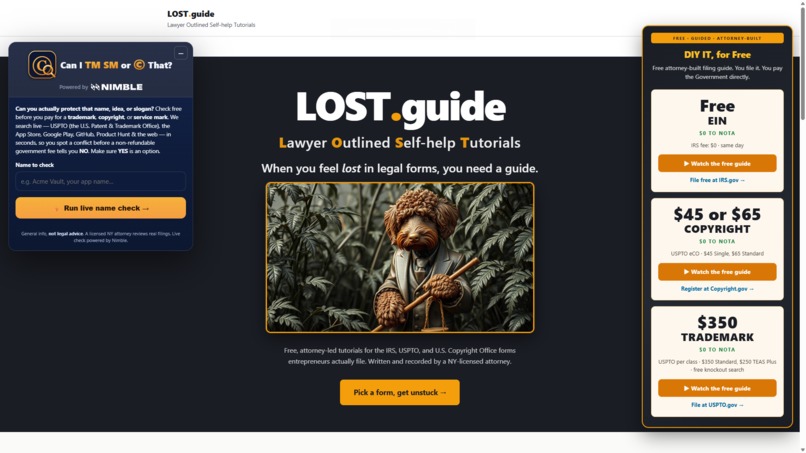
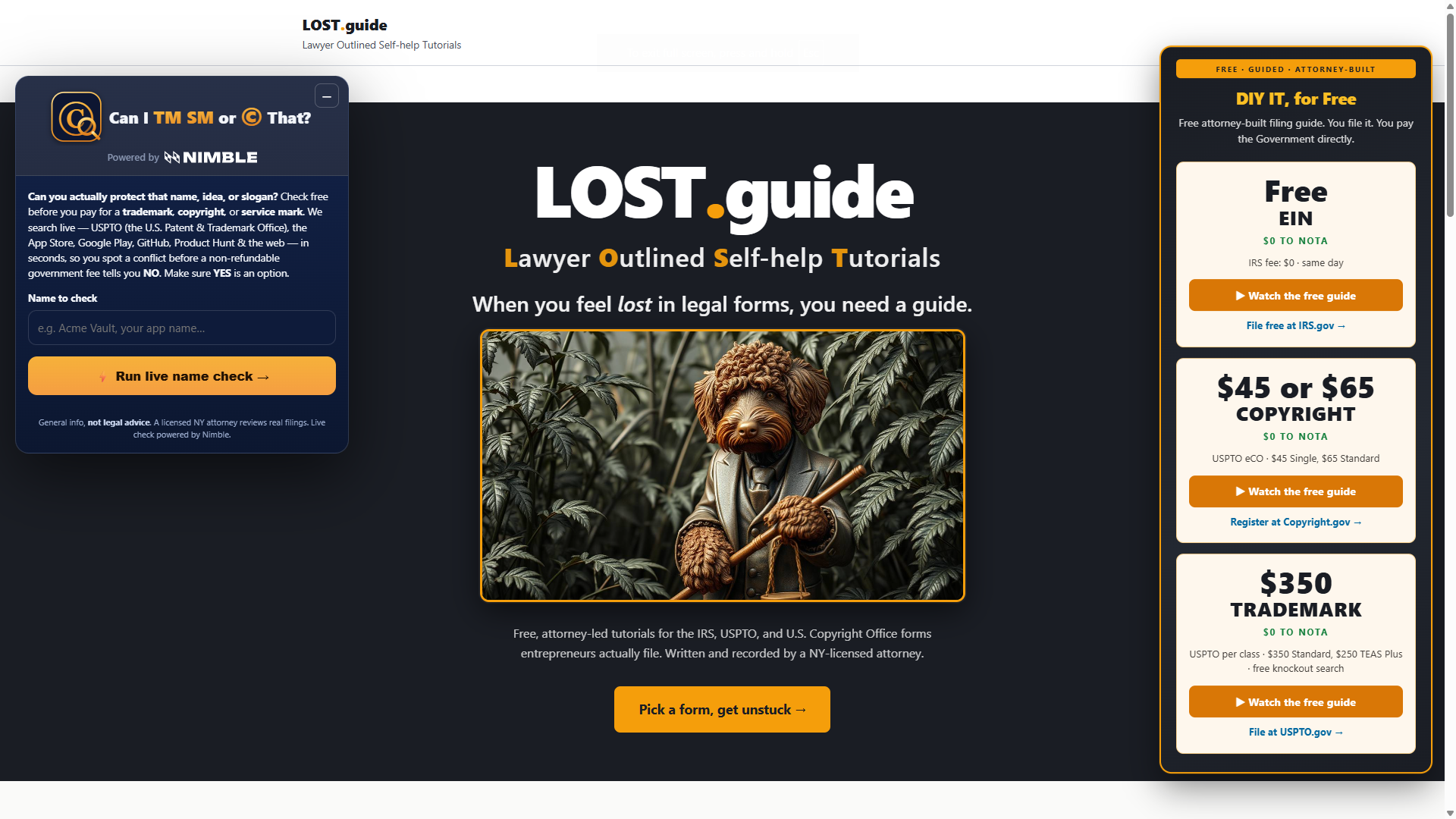
Main screen - USTPO and Trademark scanner upper left
-
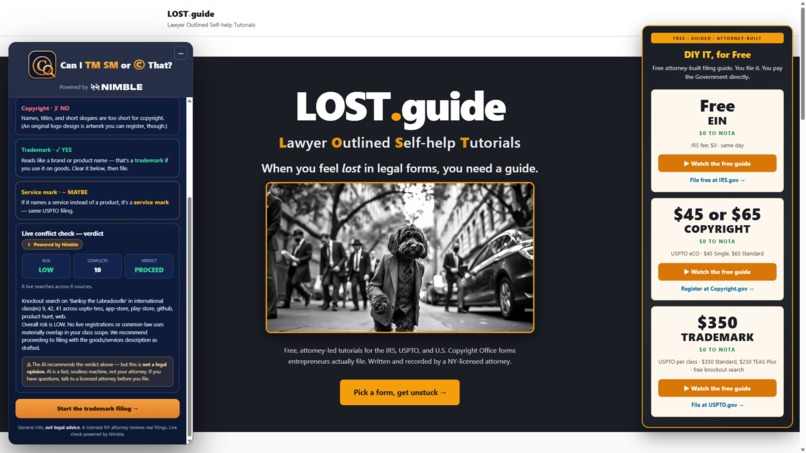
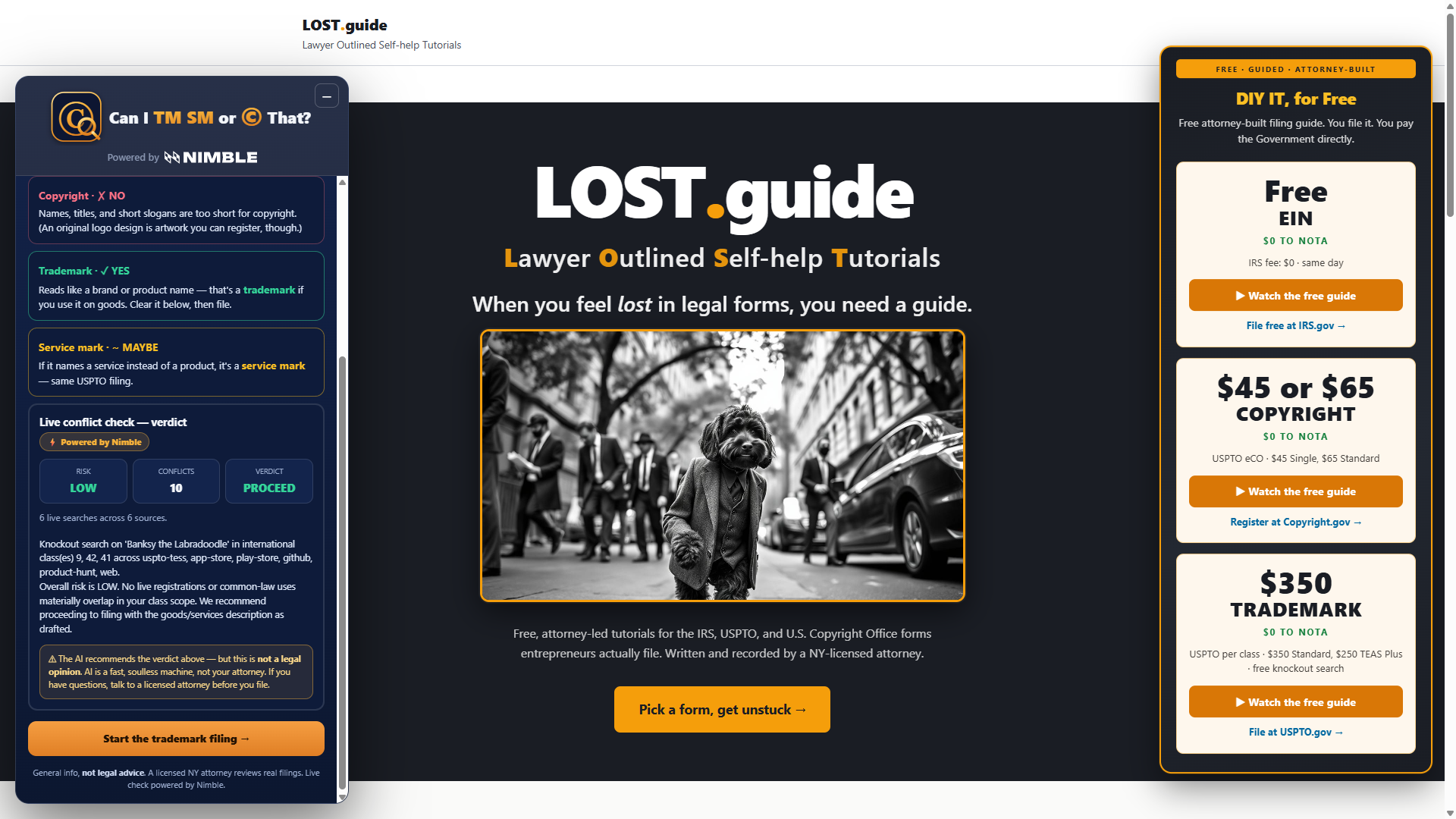
Answers on the left to a question
-
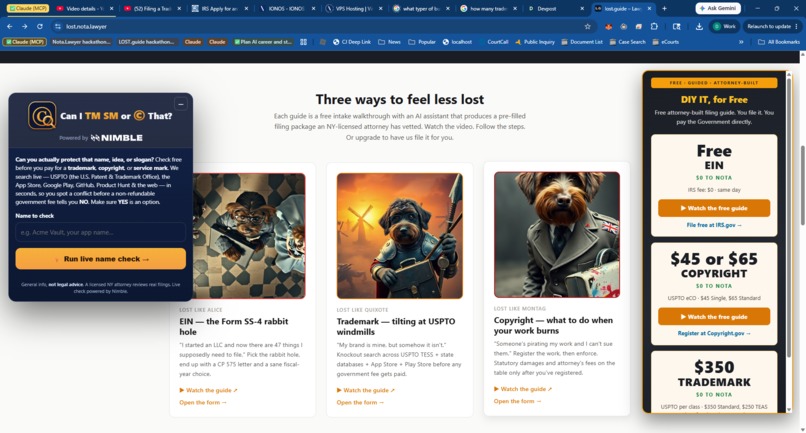
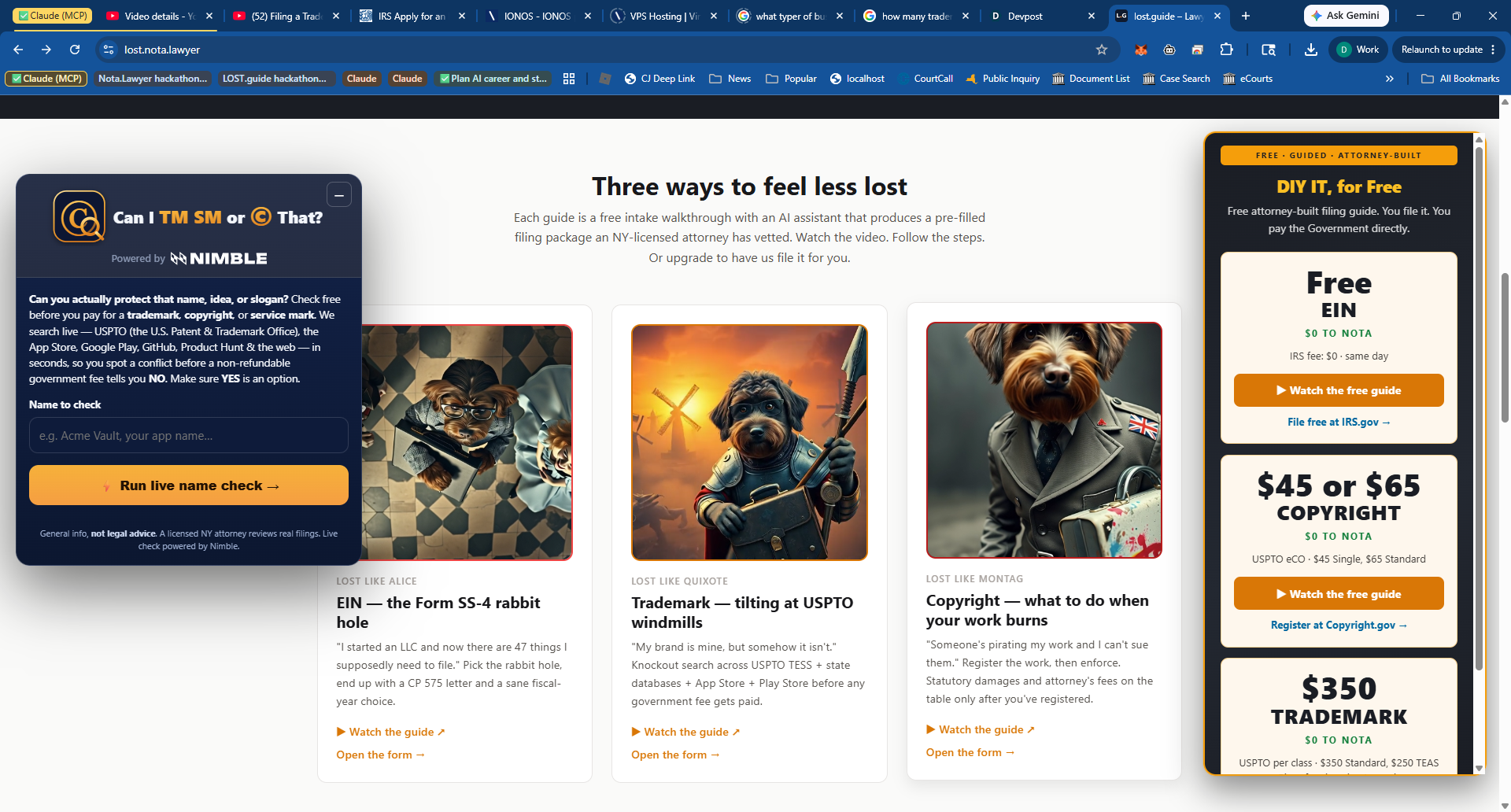
Different links for free Lawyer Outlined Self-help Tutorials
-
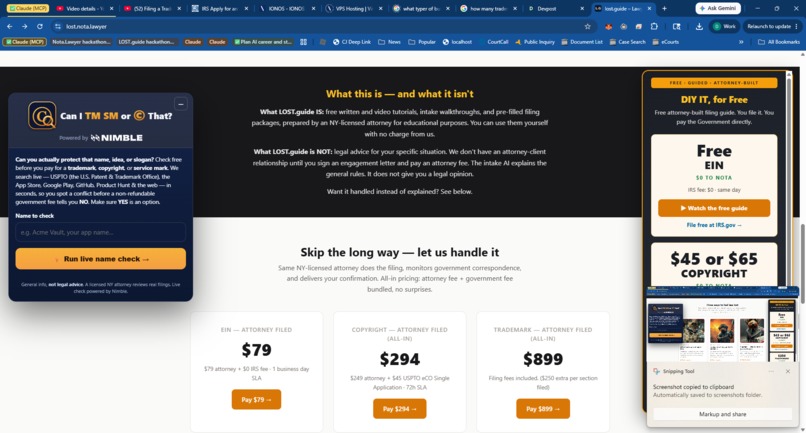
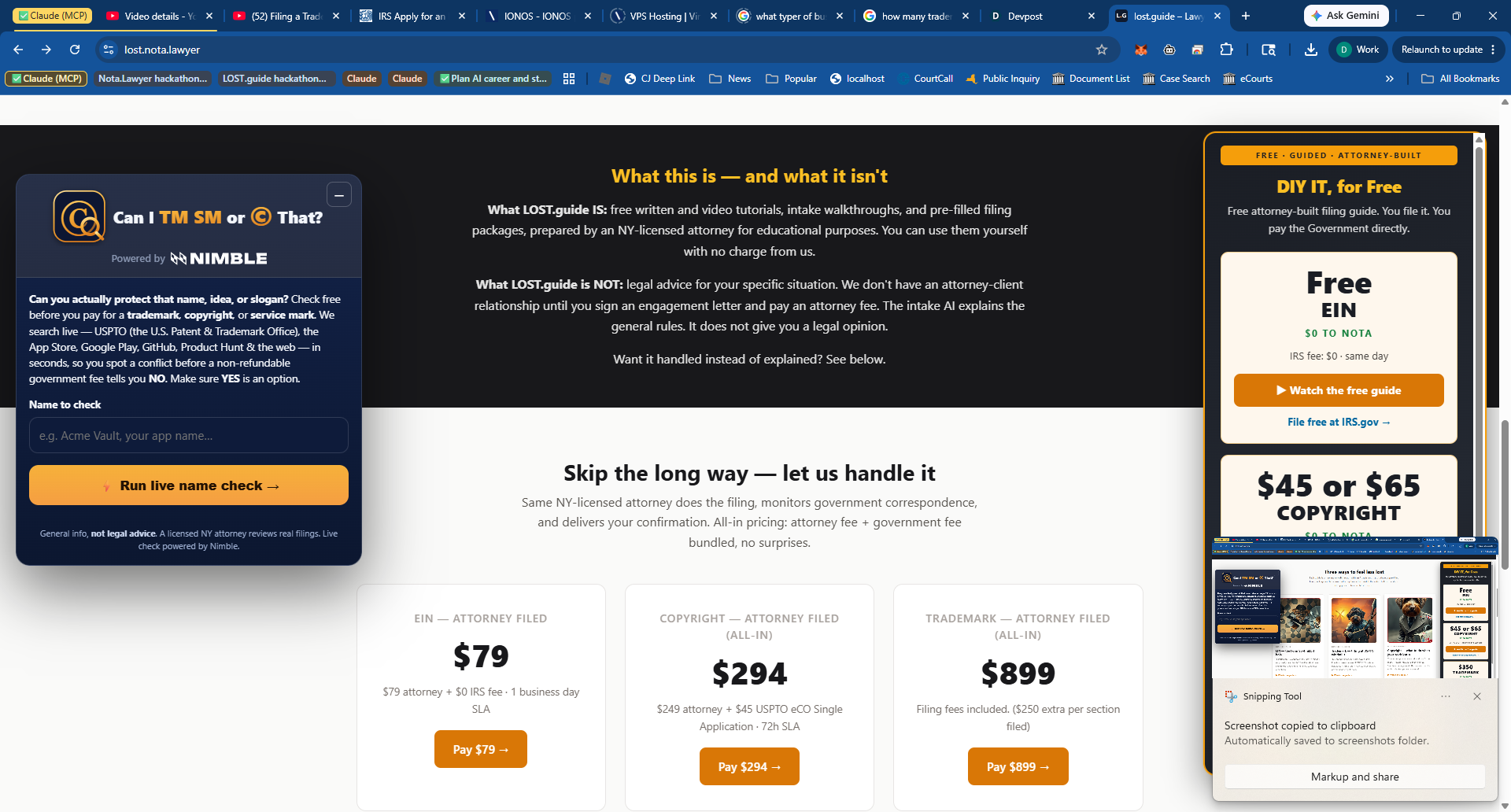
What it is and isn't
-
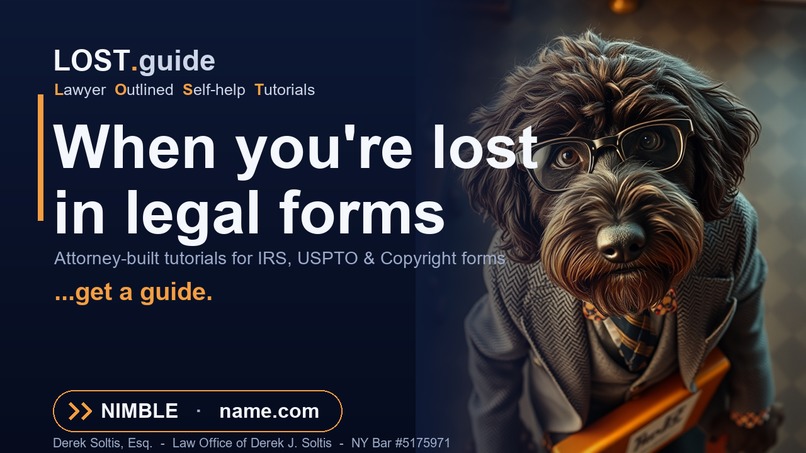
Video
-
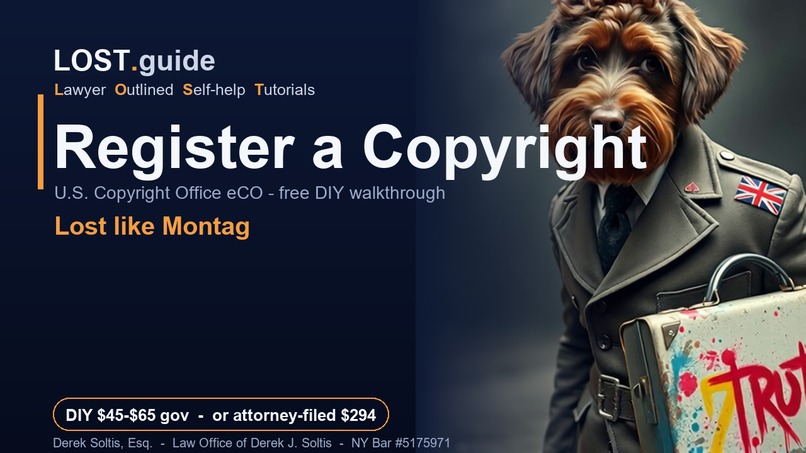
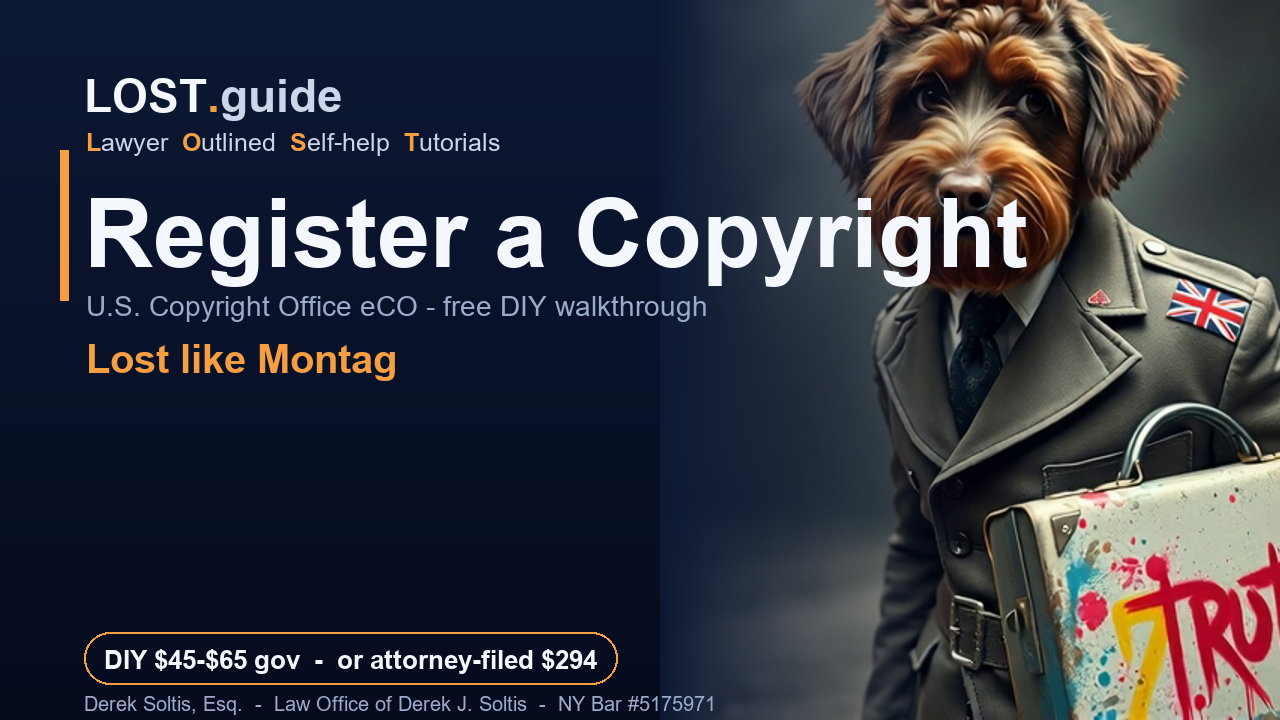
Register a copyright video
-
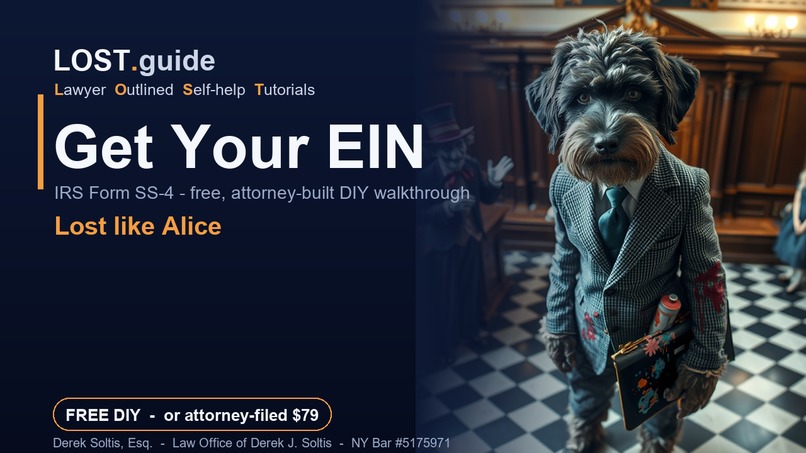
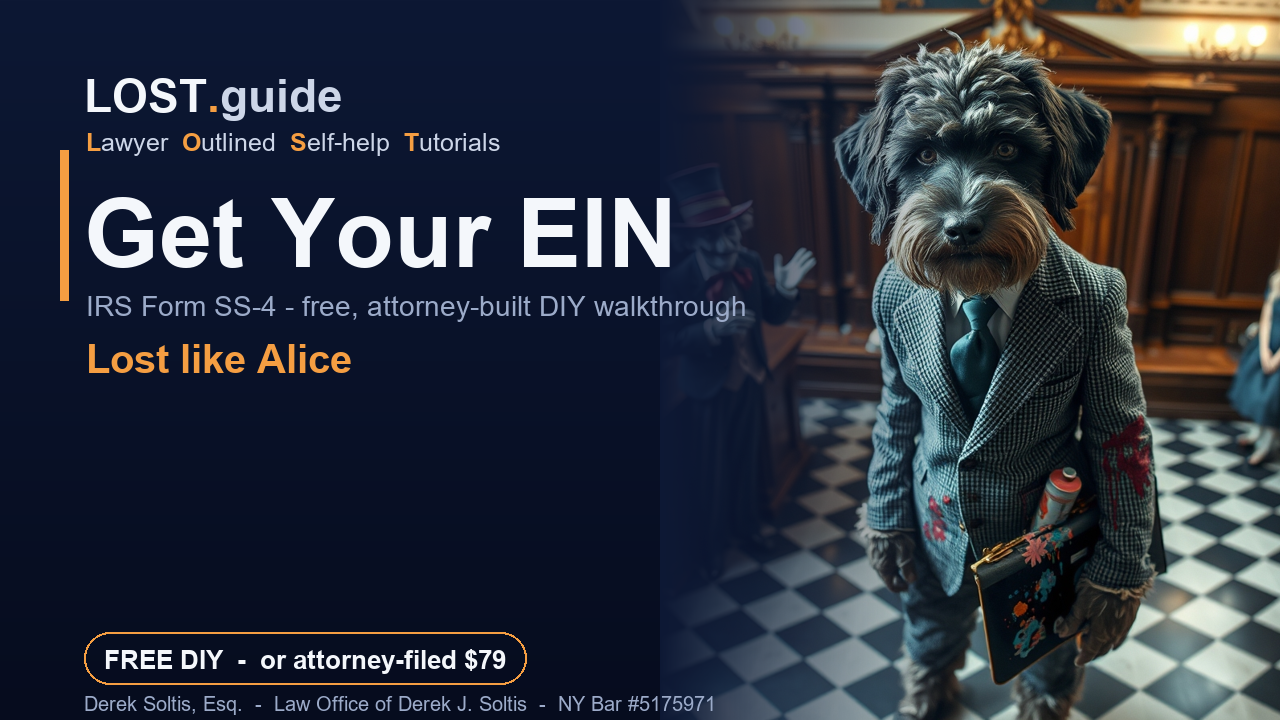
Register an EIN for FREE video
-
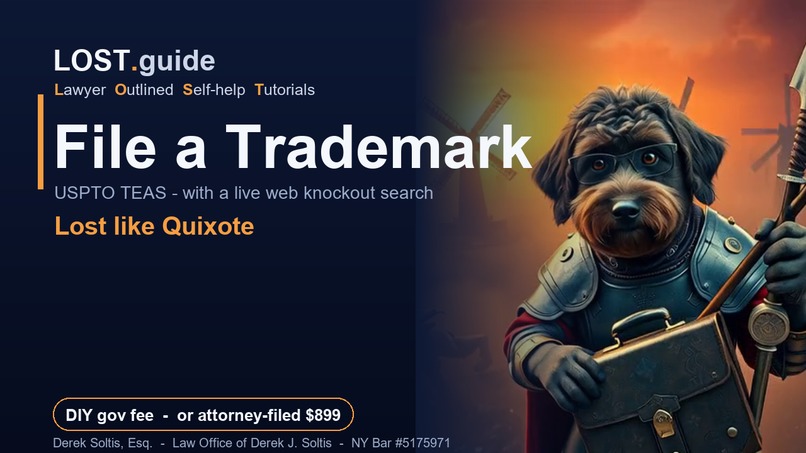
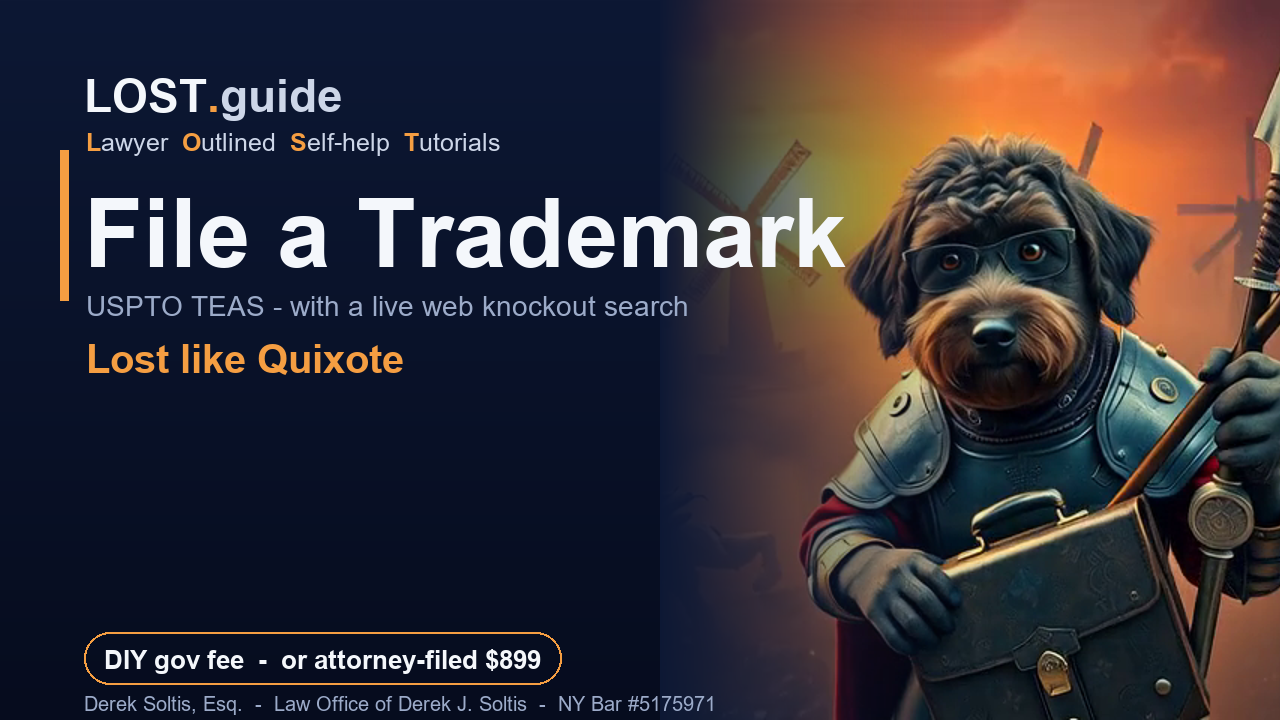
File a trademark Video
Inspiration
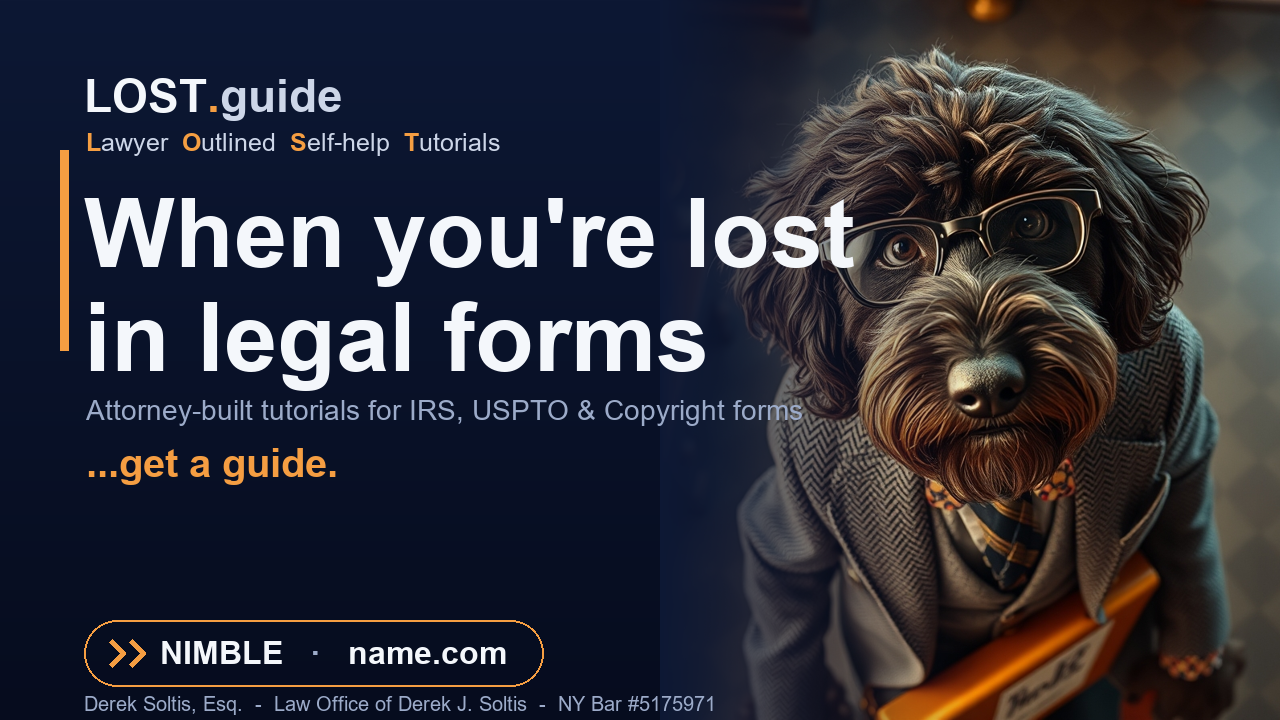
Most hackathon ideas start with a problem. This instead started with a domain. name.com's Domain Roulette provided lost.guide — and instead of a panic-draw, it handed us an entire product in one breath: LOST = Lawyer Outlined Self-help Tutorials. Read the domain out loud and it is the value proposition: when you feel **lost* in legal forms, you need a guide.* Added Banksy the Labradoodle as a mascot, a two-year-old labradoodle who happens to sit in the coding pit.
The problem LOST pointed at is one I watch every week as a practicing New York attorney: the information you need to file most government forms is free and public — but it's scattered across PDFs, buried in jargon, and intimidating enough that people either overpay a middleman for a free form or give up entirely. Trademarks are the cruelest case: people pay a non-refundable $350 government fee for marks that were doomed before they filed, because the conflict wasn't in USPTO's register — it was live on the App Store, Google Play, or GitHub.
LOST.GUIDE inspired free help for people who need it, and the option to use an attorney, if they want someone to fill in the forms for them.
What it does
LOST.guide (lost.nota.lawyer) is an attorney-built front door to U.S. legal filings:
- Free, plain-English guided walkthroughs for IRS, USPTO TESS (United States Patent and Trademark Office - Trademark Electronic Search System), and U.S. Copyright Office filings — three flows live today (EIN [Employer Identification Number - over 271 million IRS forms processed a year including EINS] , Copyright Registration [Over 1100 a day processed by the government] , Trademark Application [over 824,000 filed annually with the US government ]), each with a tutorial narrated in my own cloned voice.
- Two honest paths on every form: DIY free — you pay only the government's fee — or flat-fee attorney-filed, with live Stripe checkout and IOLA-compliant trust accounting.
- "Can I ™ ℠ or © That?" — the headline feature. Type a name and the widget auto-triages copyright vs. trademark vs. service mark, then fires six live Nimble searches in parallel (USPTO TESS, App Store, Google Play, GitHub, Product Hunt, the open web) and returns a verdict in seconds — PROCEED / AMEND FIRST / DO NOT FILE — with an attorney-style narrative citing the real statutory factors (§ 2(d), § 43(a), § 2(e)(1)) and an explicit "AI recommendation, not a legal opinion" disclaimer. Three test names return the full spectrum, live for the demo: Acme Vault → AMEND FIRST, Banksy AI → DO NOT FILE, Banksy the Labradoodle → PROCEED.
- Completed intakes email the firm automatically on the paid path (with sensitive IDs masked client-side before transmission), so a paying client's answers never strand in their browser.
How we built it
A WordPress front end with a single-file Alpine.js + Tailwind intake renderer driven by flow.json specs validated against a shared JSON Schema — adding a form is a data change, not a code change. The knockout agent exists in two forms: a Python module (CLI, plus a Tower Data-to-AI pipeline with Iceberg lakehouse sinks) and a PHP port using curl_multi that runs all six Nimble searches in parallel on plain shared hosting, so the public widget is always-on with no home-lab dependency. The brand — Banksy LL.M., a chocolate labradoodle attorney depicted in literature's most famous "lost" scenes (Alice in Wonderland, Quixote, Fahrenheit 451, Kafka) — fills a 16-scene hero rotator. The site serves at lost.nota.lawyer through a Cloudflare Worker reverse proxy, contact and intake mail ride authenticated SMTP, and the tutorial + demo narration was cloned from my voice with VoxCPM2 and recorded using Logitech screen recorder, GIMP, and Wondershare Filmora to edit.
Challenges we ran into
- The legal line. The hard part of legal tech isn't the tech — it's the boundary between information (free, unlimited) and representation (regulated, paid). Pricing, copy, compliance, and UI all had to fall out of that one distinction, with attorney-advertising rules and IOLTA trust accounting designed in rather than hand-waved. Even for a demo, the legal line was followed to make an active website.
- Trademark "confusion" is legal judgment, not string matching. The real agent work was encoding why a live USPTO registration in your class outweighs a same-name GitHub repo — a transparent source-weight × name-similarity × class-overlap model that produces defensible verdicts instead of yes/no guesses.
- Production is hostile. Shared hosting can't run Python daemons, so the agent was ported to parallel PHP. Serving a branded subdomain whose origin couldn't hold a certificate meant losing a round to SSL-handshake 525s before a Cloudflare Worker reverse proxy won the war. And delivering email from a brand-new domain was its own lesson in SPF, DKIM, and Cloudflare Email Routing than an one would ever wanted to know.
Accomplishments that we're proud of
Three live, payable flows on a real licensed law practice; a knockout agent that is deployed and user-facing — one click for any visitor — rather than a notebook demo; full-spectrum live verdicts; a 28-service catalog where the genuinely tricky regulatory cases (VA fee restrictions under 38 CFR § 14.636, BAPCPA "debt relief agency" rules under 11 USC §§ 526–528) are already accounted for; and a coherent brand world that a random domain wheel built and New York's laws regarded attorney advertising which basically requires its own list of rules to follow.
What we learned
A great domain is load-bearing: lost.guide carries the name, the promise, the mascot, and the information architecture all at once. The live web beats static registers for trademark risk — the dangerous conflicts increasingly live in app stores and developer communities a TESS-only search never sees. And designing the entire product around the information/representation line made every other decision simpler.
What's next for LOST.guide
Per-result Nice-class inference with Nimble Extract, expanding from 3 live flows toward the full 28-service catalog, and a payments + matter dashboard with an attorney review-queue gate — because the AI prepares, but a licensed human approves before anything is filed.
Built With
- alpine.js
- amazon-web-services
- apache-iceberg
- claude
- cloudflare
- cloudflare-workers
- css3
- ffmpeg
- html5
- ionos
- javascript
- json-schema
- nimble
- php
- phpmailer
- python
- smtp
- stripe
- tailwindcss
- tower
- voice-cloning
- voxcpm2
- wan
- wordpress


Log in or sign up for Devpost to join the conversation.