-
-
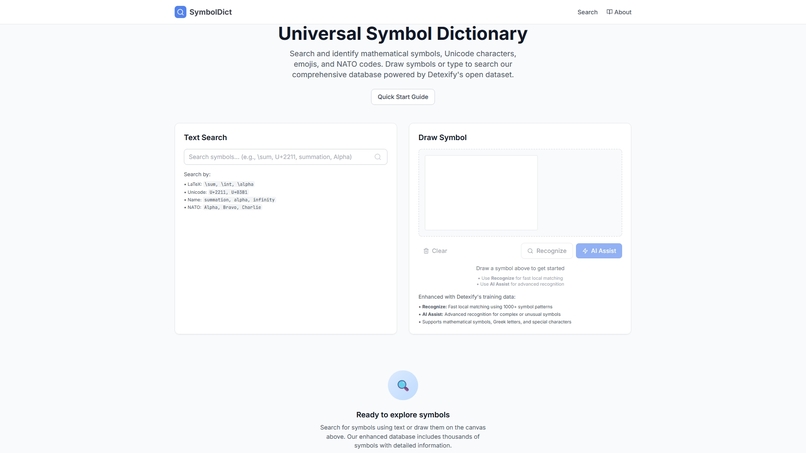
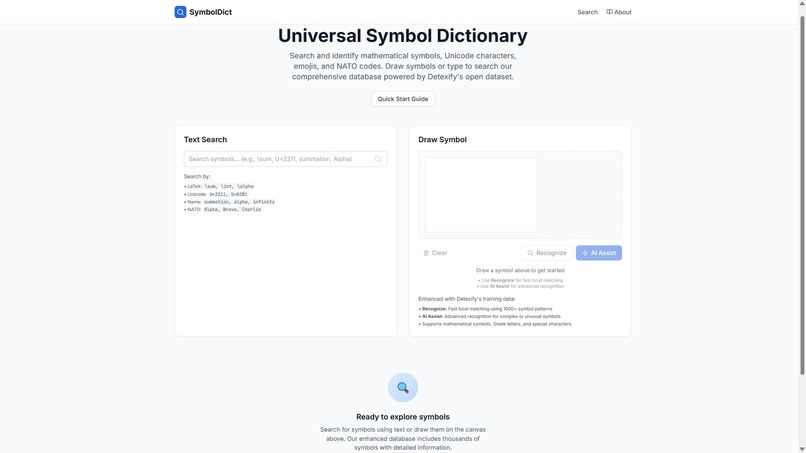
Consistent UI: home view, search, and draw all tested. Clean, accessible design—ready for real users and production.
-
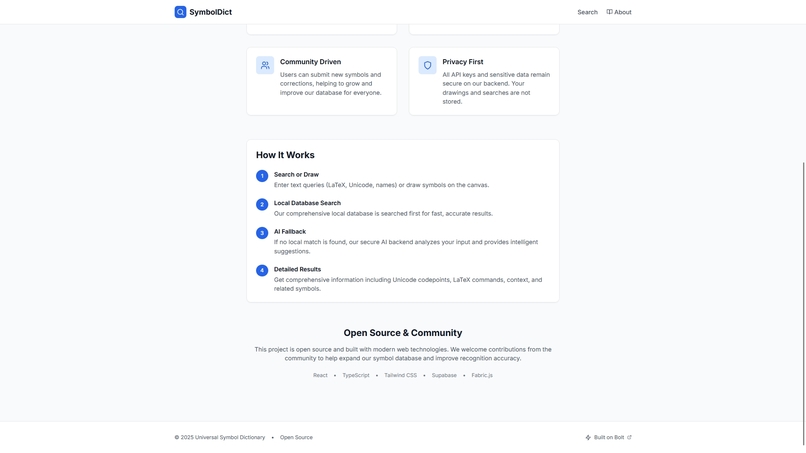
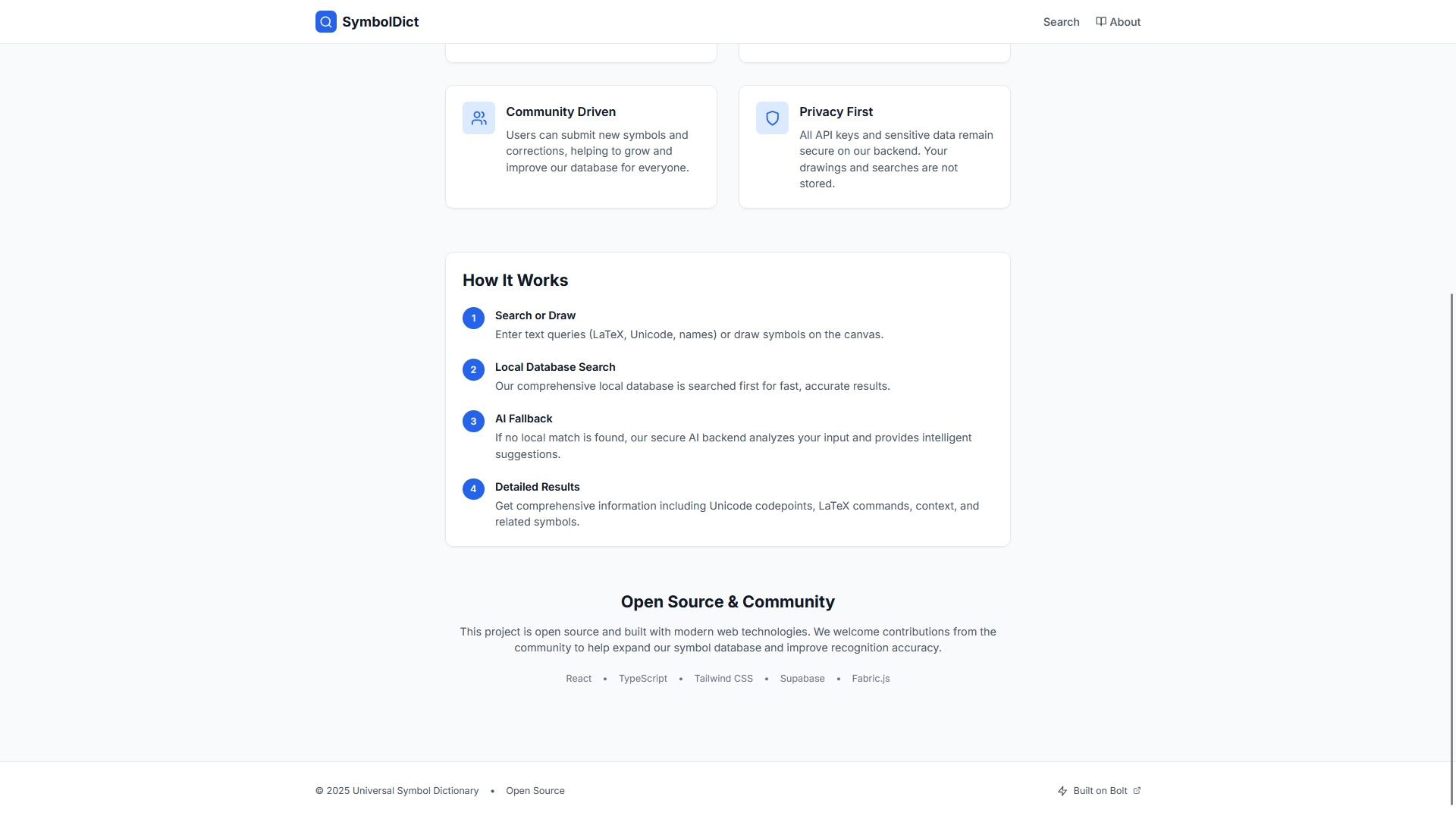
Footer credits: built on modern OSS (React, Supabase, Fabric.js, Tailwind). Fully open, extensible, and ready for scale.
-
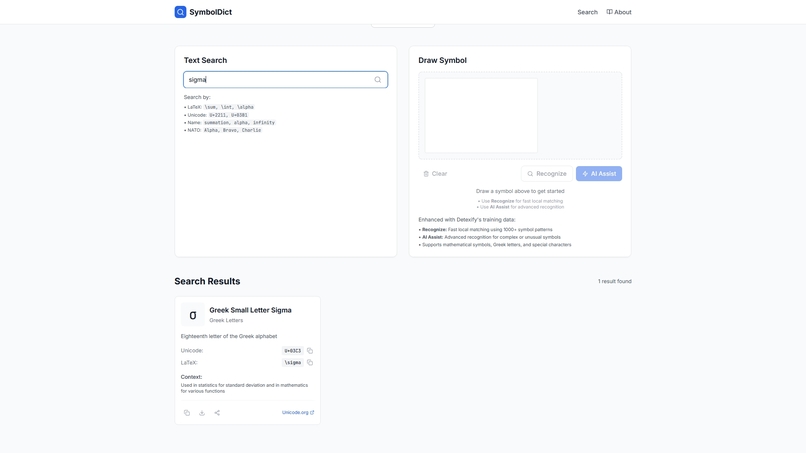
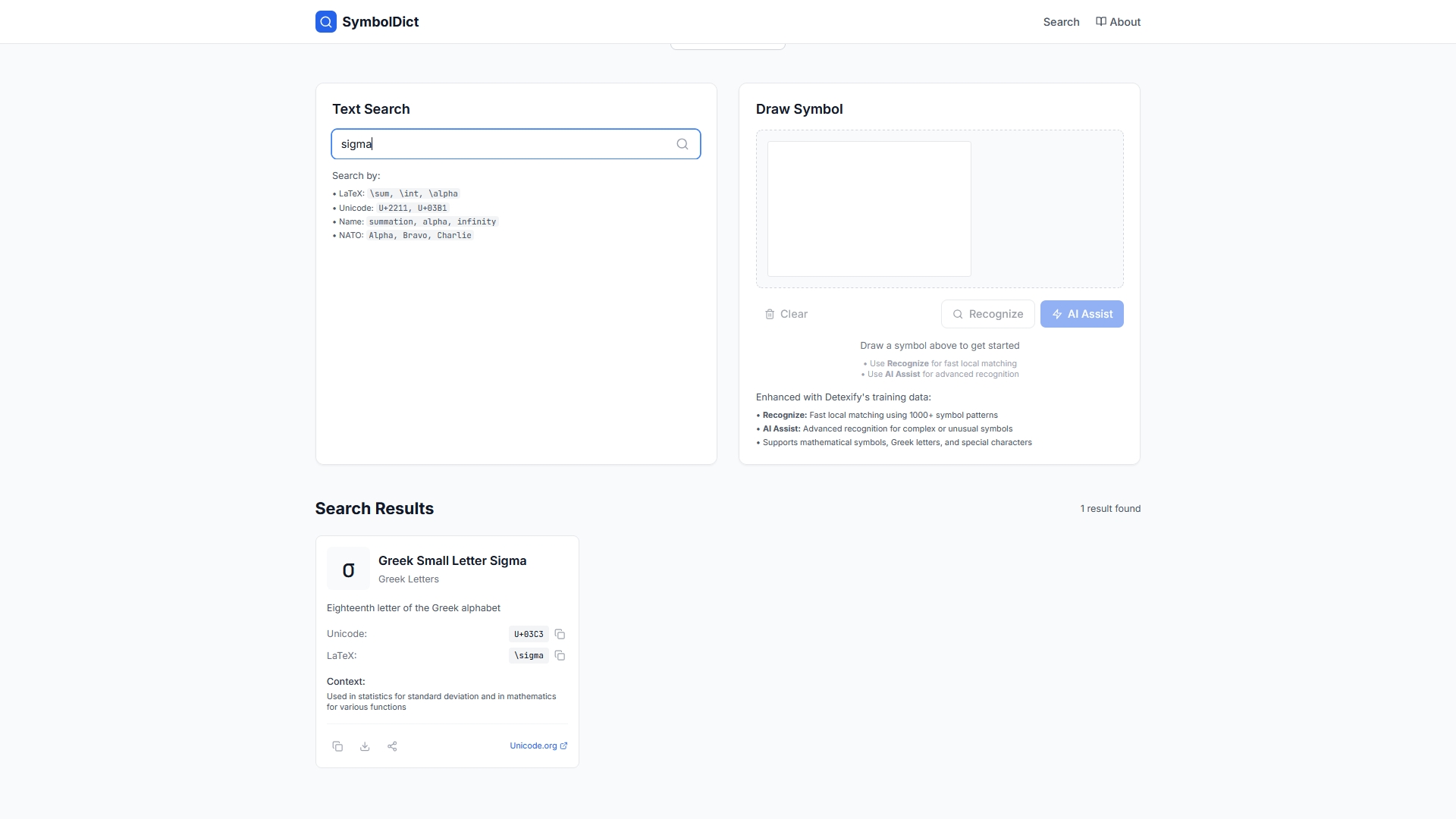
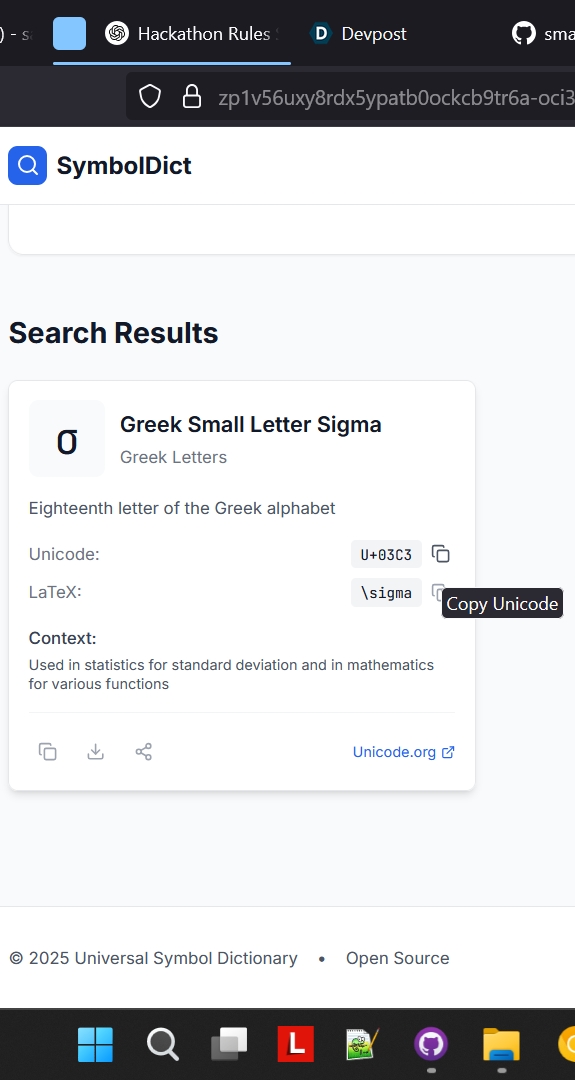
Symbol search demo: find Greek sigma by text, get Unicode/LaTeX/context. Open-data engine, precision, and multi-field output.
-
How it works: step-by-step process. Local search, fallback AI, and detailed output ensure reliability and coverage.
-
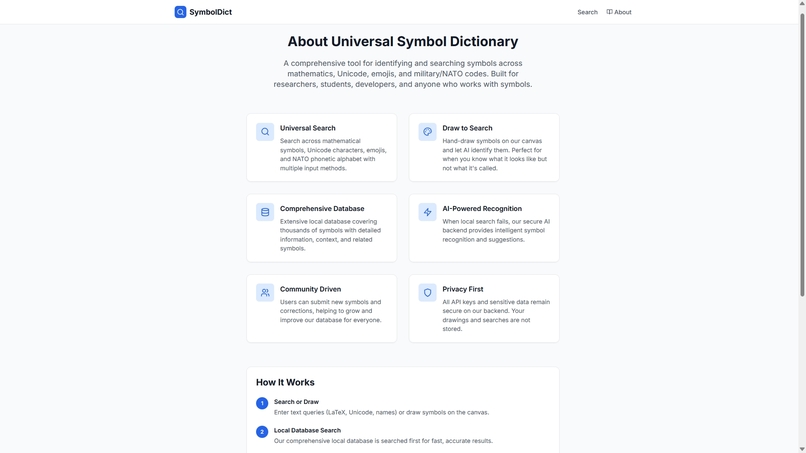
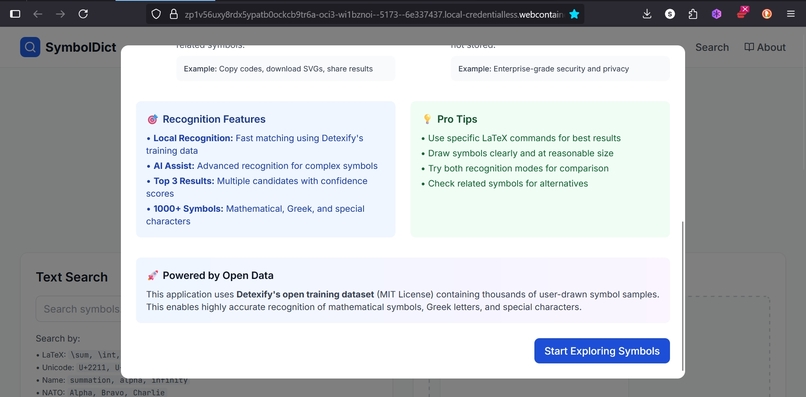
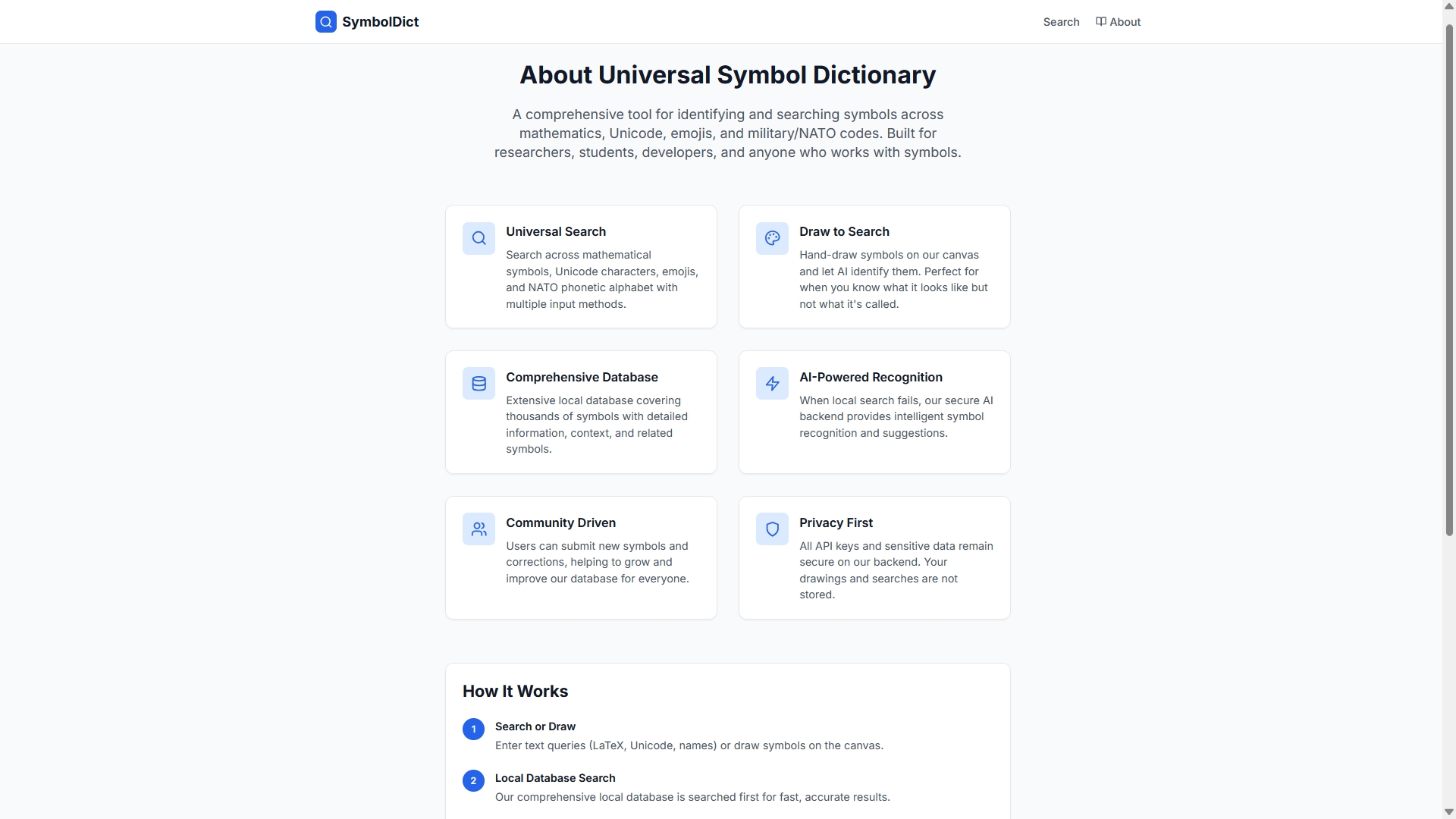
About page: every capability detailed—universal search, AI recognition, privacy-first, open community. Full transparency.
-
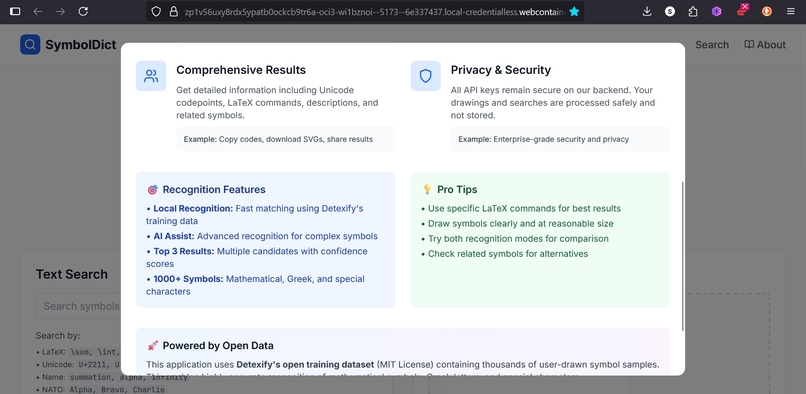
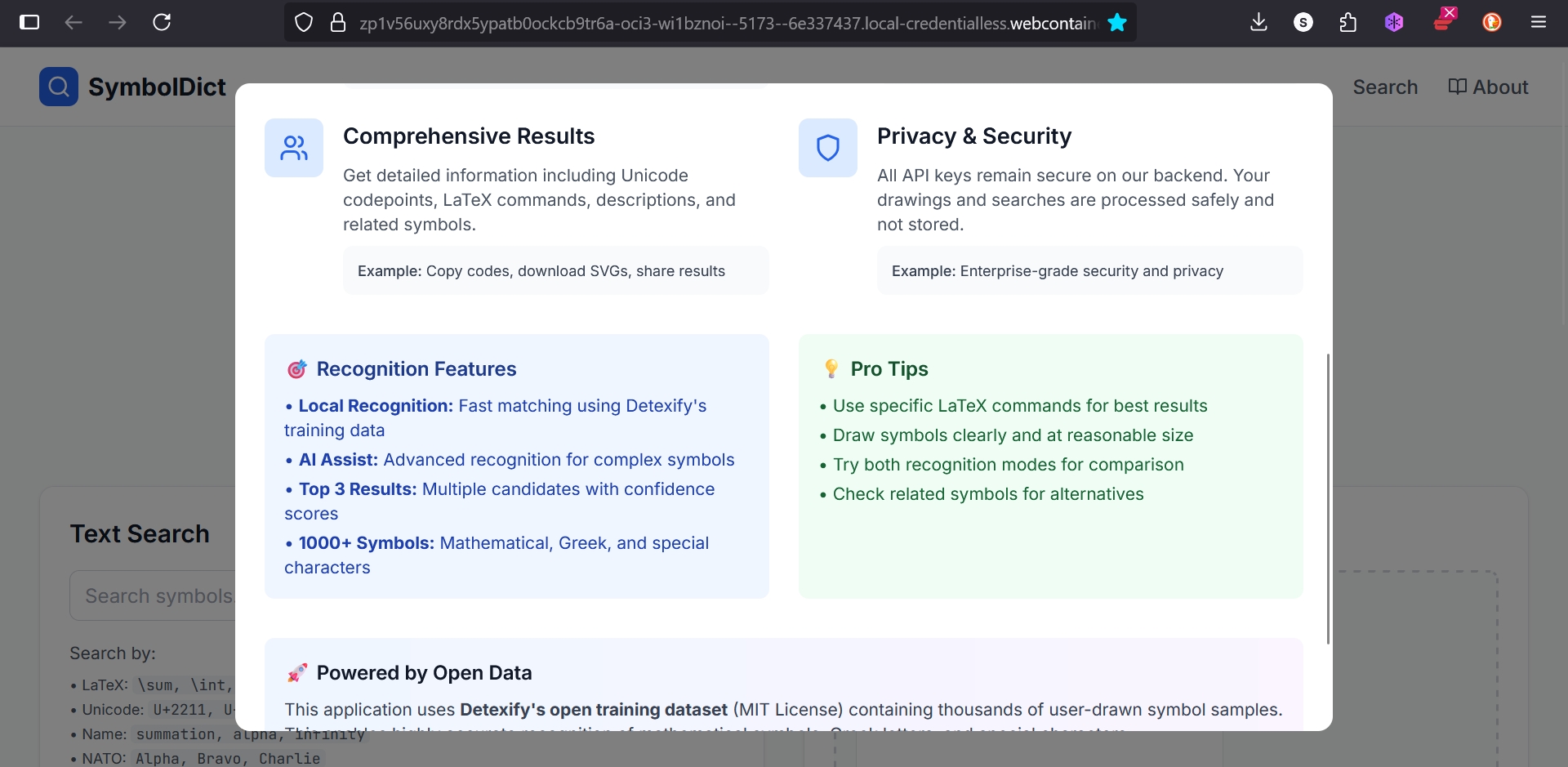
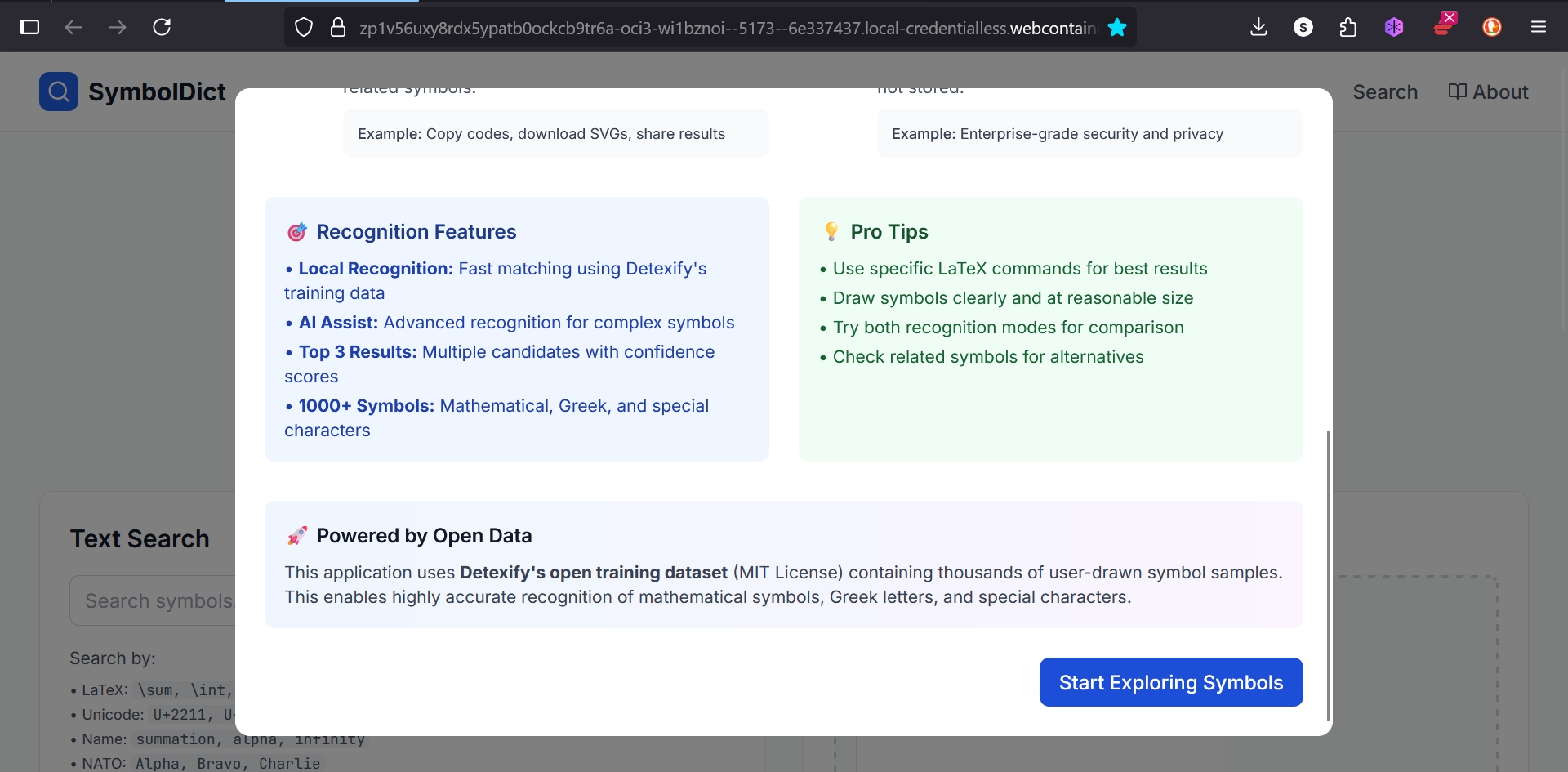
Comprehensive feature overlay: recognition modes, pro tips, open data, and trust-by-design privacy. Fast onboarding for users.
-
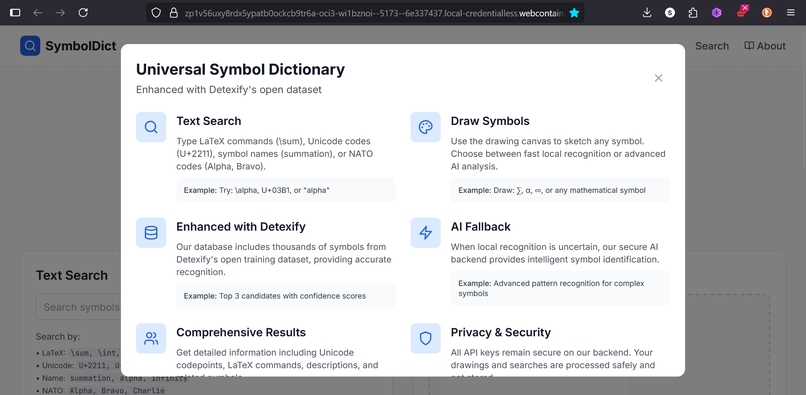
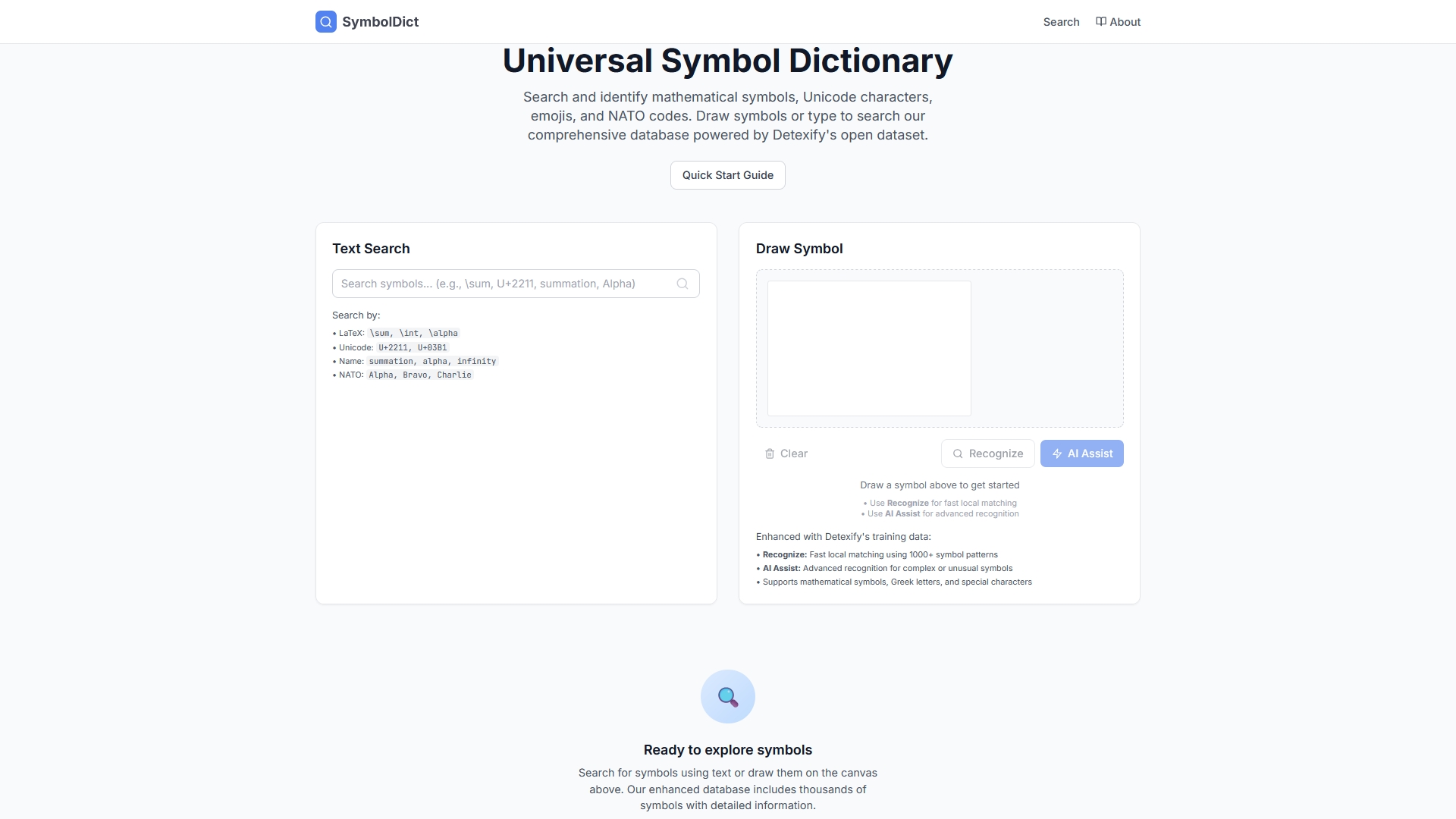
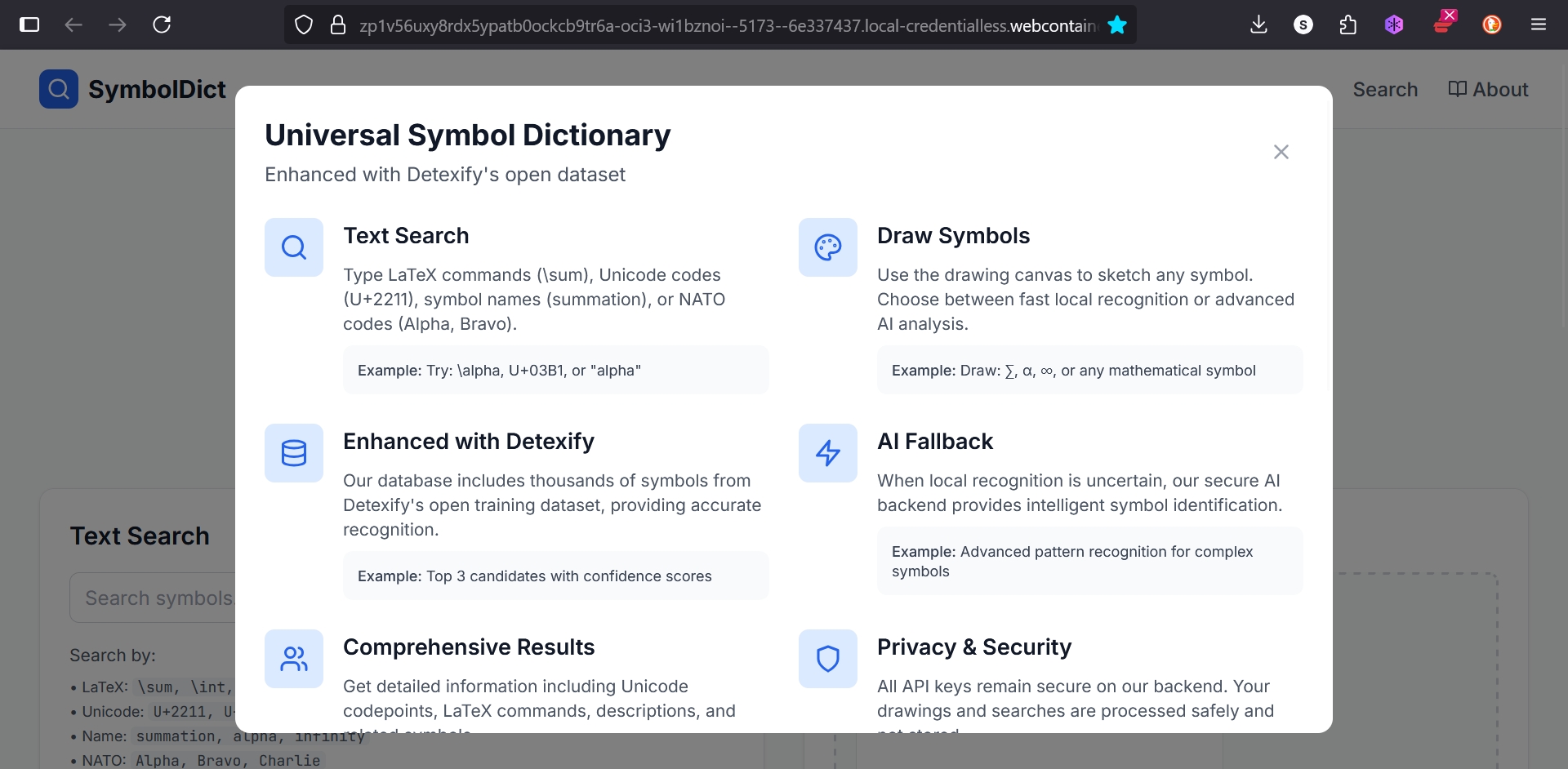
Quick Start overlay: instantly shows all features—text search, draw-to-recognize, Detexify AI, privacy, fallback, and results.
-
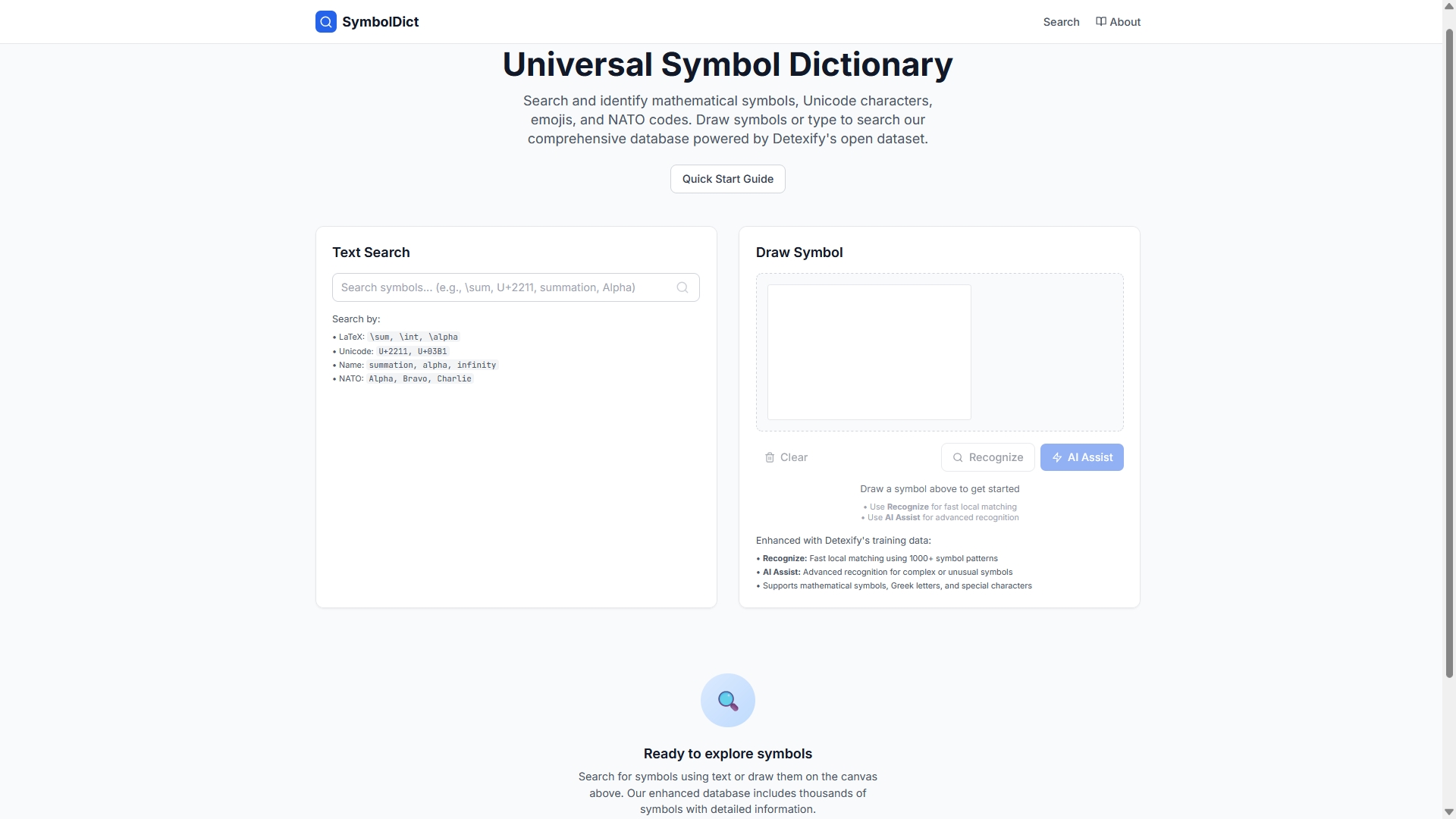
Full homepage view: Universal Symbol Dictionary. Fast text & draw search, Detexify power, clean UX, and instant results.
-
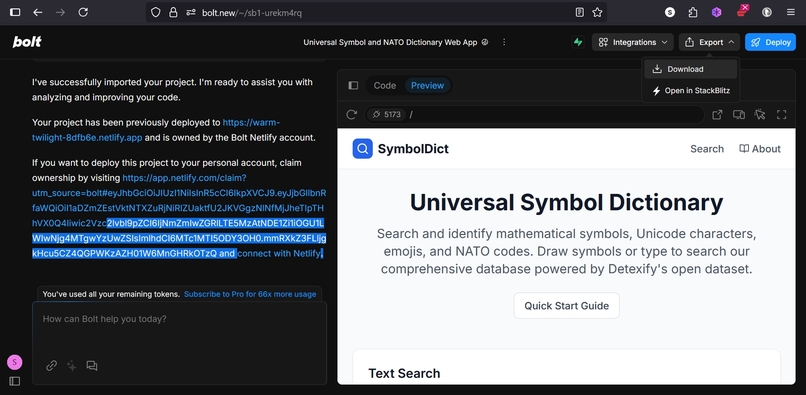
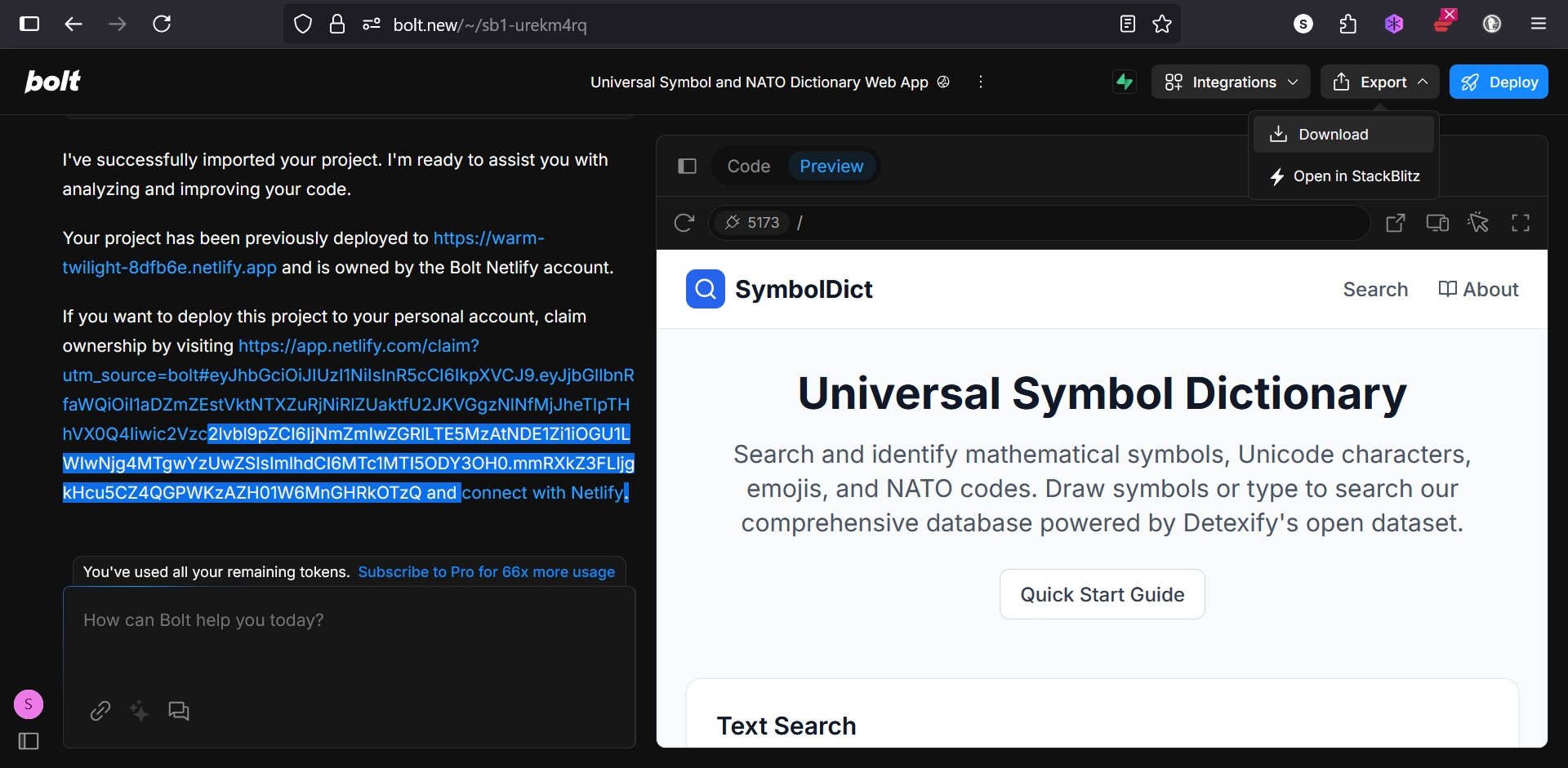
Deployed on Bolt with working Supabase DB: Full stack proof, real data, and end-to-end ownership. Judges: try with my DB or fork!
-
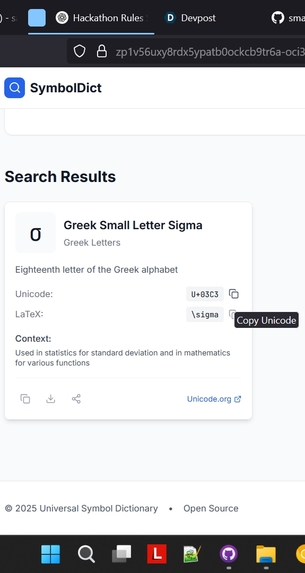
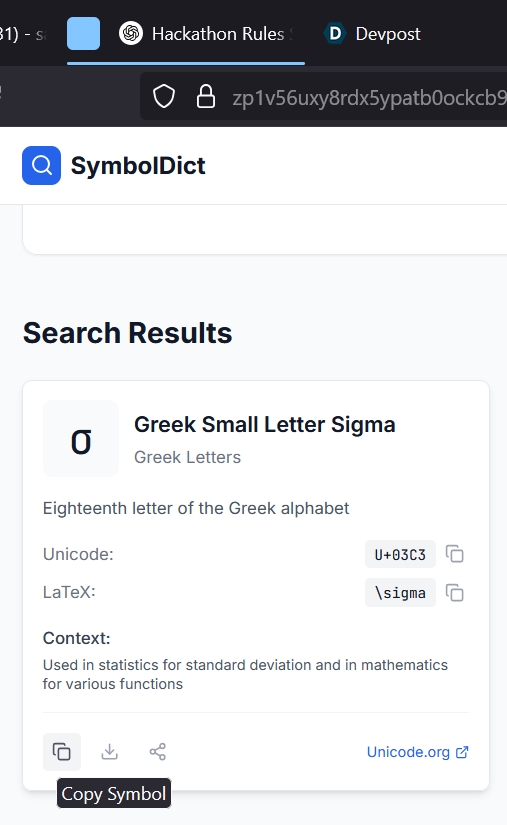
Copied symbol instantly for reuse. Universal Symbol Dictionary streamlines symbol transfer to any document or codebase.
-
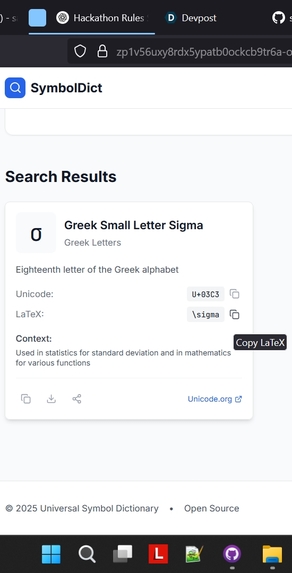
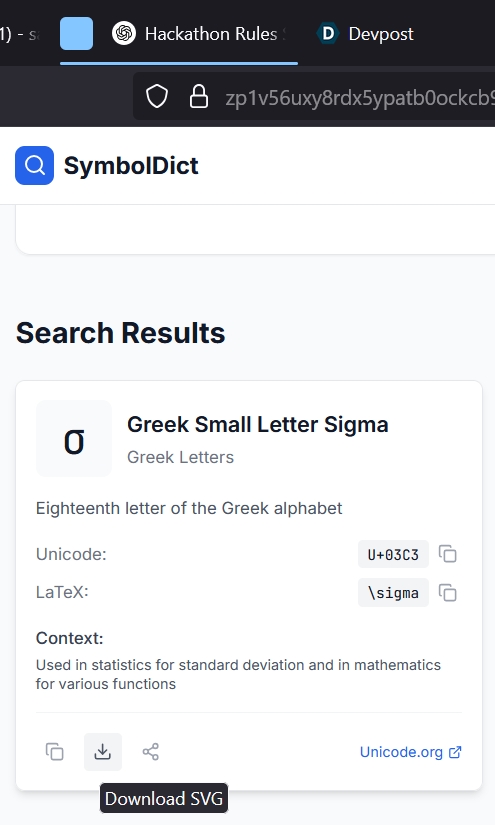
Download symbol as SVG for high-quality graphics and seamless insertion into LaTeX, design, or code projects.
-
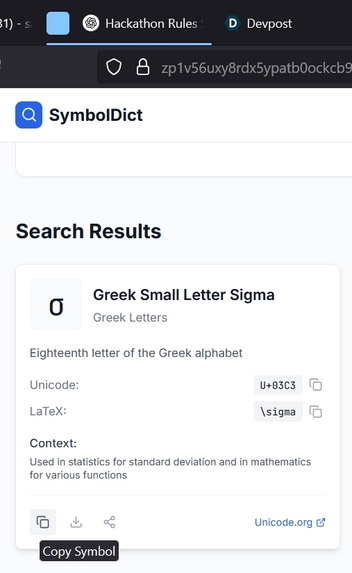
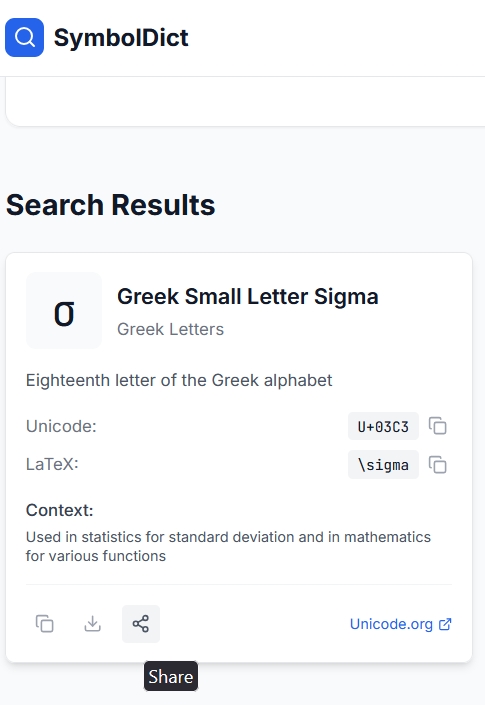
One-click sharing: Easily distribute symbol info with context—collaborators get Unicode, LaTeX, and usage examples.
-
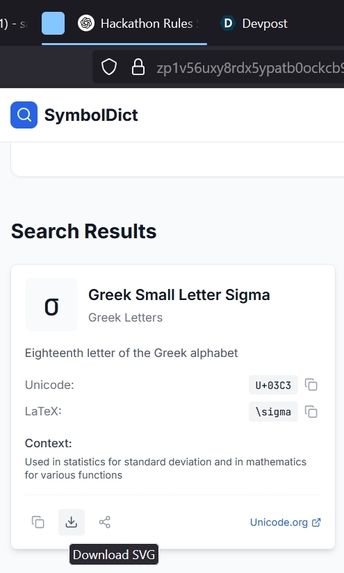
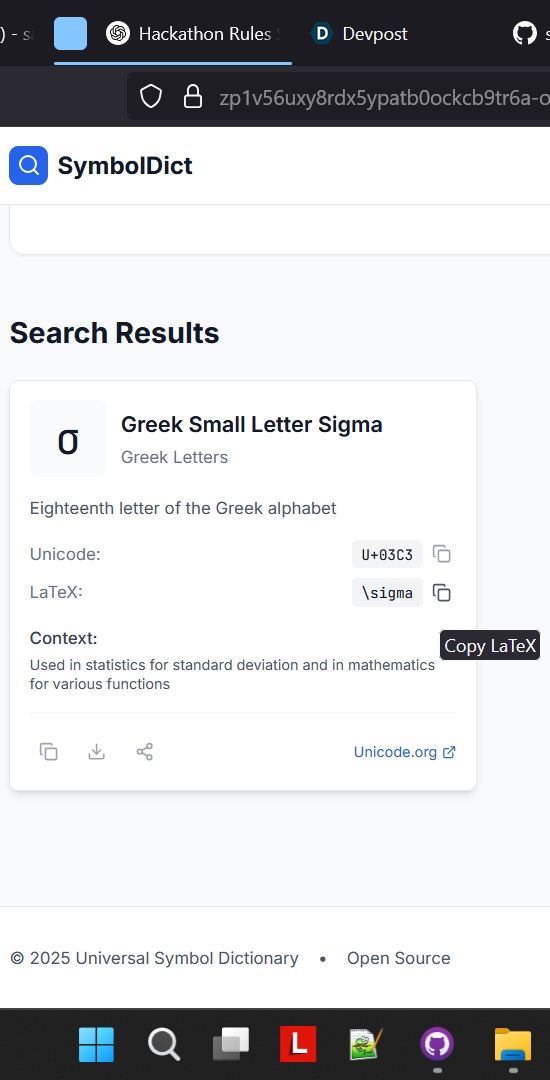
All symbol exports include Unicode and LaTeX for instant copy-paste into research, code, or comms—no manual lookup needed.
-
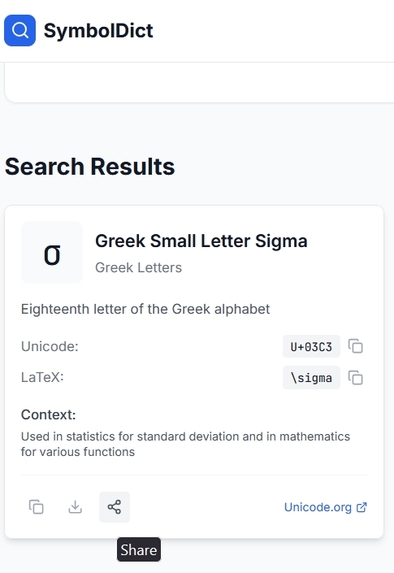
Universal Symbol Dictionary completes the workflow: identify, export, and share symbols for true productivity gains.
Inspiration
I built Universal Symbol Dictionary because I repeatedly faced challenges identifying mathematical, Unicode, emoji, and military or NATO symbols during my work as a data scientist and developer. Existing tools were either domain-specific, incomplete, or not intuitive. This project was inspired by the vision of providing an all-in-one solution. My goal was to empower students, researchers, engineers, and anyone working with symbols to instantly decode and understand any symbol in a seamless way. I wanted to build what could be called the "Google Translate for symbols."
What it does
Universal Symbol Dictionary is a web application that enables anyone to:
- Draw, type, or paste any symbol, including mathematical, Unicode, emoji, and military or NATO codes.
- Instantly view the symbol's name, Unicode codepoint, LaTeX command, and meaning.
- Use AI assistance for identifying rare or unknown symbols if no local match is found.
- Share or export symbols in SVG, PNG, or code formats.
- Contribute missing symbols to expand the community-driven database.
How I built it
I developed the frontend using React 18, TypeScript, and Tailwind CSS to achieve a modern, accessible, and mobile-first user experience. The drawing canvas is implemented with Fabric.js, allowing fast and accurate symbol sketching and pattern recognition. I unified several datasets, including open Detexify handwriting data, Unicode and emoji lists, and a custom-curated set of NATO and military codes. The recognition engine matches input against thousands of samples and presents the top three candidates for user confirmation. AI fallback is handled through secure backend or edge functions, which send sketches to a large language model when local recognition is uncertain. Supabase is used for data storage, community submissions, and analytics. The app supports one-click copy and download for any symbol. Deployment is managed via Netlify with support for custom domains.
Challenges I ran into
Visual ambiguity was a key technical challenge, especially with symbols like Omega and infinity that are easily confused in handwriting. I addressed this by returning the top three most likely candidates and prompting the user for confirmation. Another major challenge was unifying diverse symbol sets into a coherent and searchable structure. Security was essential, so I ensured that API keys and sensitive data are always protected, even when allowing crowdsourced submissions. Performance was a priority, especially for real-time symbol recognition and search in large datasets. As a solo developer working under strict hackathon deadlines, I learned to prioritize features and focus on rapid delivery without sacrificing quality.
Accomplishments that I'm proud of
I built and launched a universal symbol dictionary that is the first of its kind. The recognition and AI fallback is accurate and fast, providing a seamless user experience. The app features a modern, accessible interface that works across all devices. The backend is scalable and secure, designed for future growth and community expansion. This project is now ready for crowdsourced contributions and further technical evolution.
What I learned
This project deepened my understanding of visual language, symbol recognition, and human-computer interaction. I learned how to effectively combine machine learning, large datasets, and artificial intelligence to solve real-world problems. Security practices were reinforced throughout development, even during rapid prototyping. I became even more adept at prioritization, focus, and execution as a solo builder under pressure. I also saw how valuable open, community-driven tools can be in making information accessible to everyone.
What's next for Universal Symbol Dictionary
I plan to expand the symbol database to include more technical and historical scripts. I will integrate advanced computer vision models to improve drawing recognition. Community features, including user rewards and leaderboards, are on the roadmap. I plan to open a public API for third-party integrations. My long-term vision is to make this tool a universal resource for symbol literacy in education, research, and industry.
Built With
- bolt
- fabric.js
- netlify
- react
- supabase
- tailwindcss
- typescript
- vite


Log in or sign up for Devpost to join the conversation.