🌟 Inspiration
We realized that learning resources are often locked behind language, culture, or technical barriers. A developer in India trying to understand Git, a designer in Brazil wanting to learn Figma, or a student in Kenya exploring Python — all face the same challenge: tutorials aren’t tailored for them. We wanted to build something that makes any skill universally accessible, no matter your language, level, or learning style.
🚀 What it does
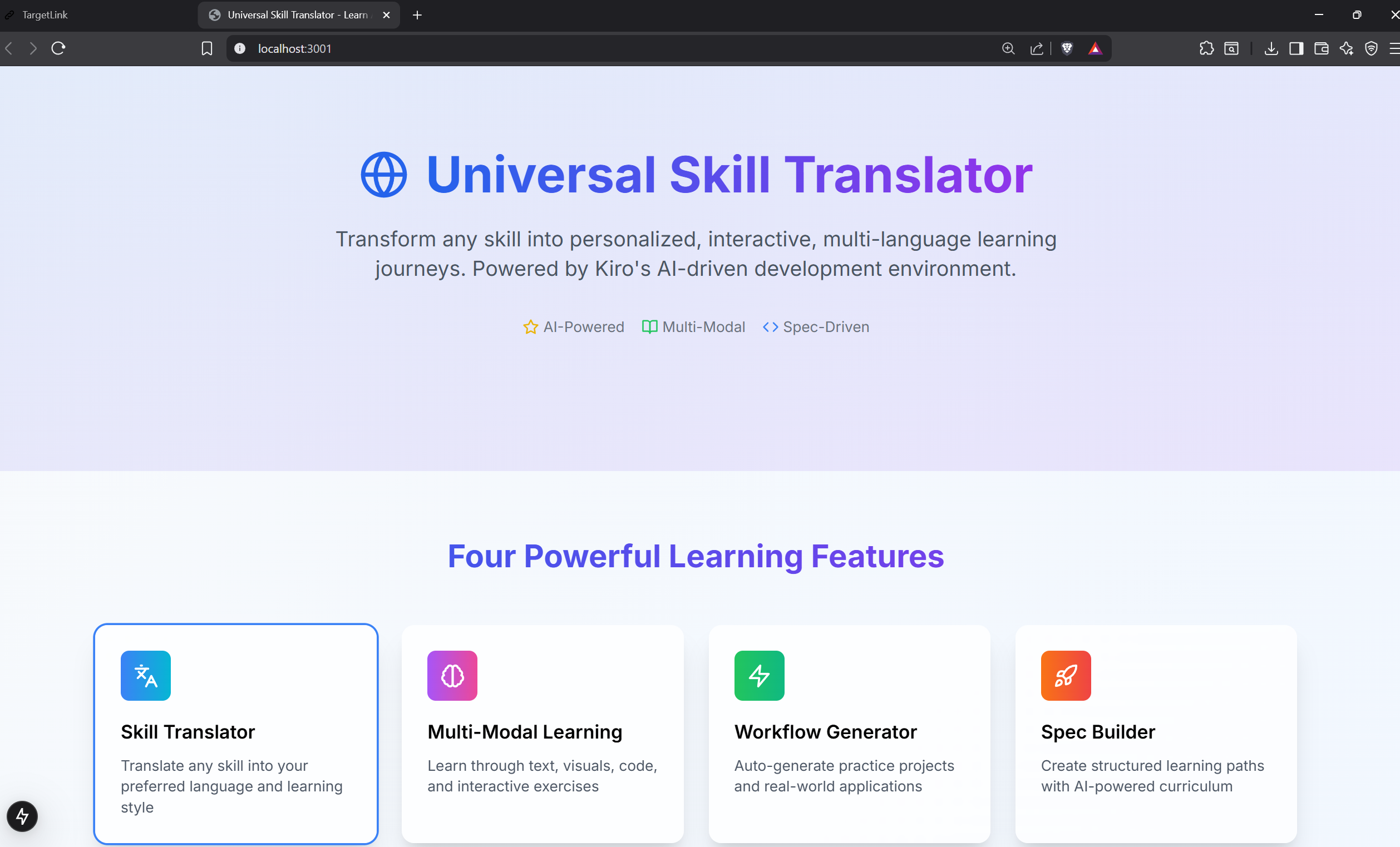
Universal Skill Translator (UST) lets anyone take a skill or workflow — like “teach me Git branching” — and instantly “translate” it into:
Your language (e.g., Hindi, Spanish, Arabic).
Your style (step-by-step text, visual diagram, or mini-quiz).
Your context (beginner, intermediate, expert).
UST uses Kiro’s spec-driven development to generate lessons, code challenges, and even practice environments. Every learning module can become:
A text tutorial.
An interactive coding challenge.
A visual flowchart.
A personalized quiz.
🛠 How we built it
Frontend: Next.js + Tailwind for an accessible, global-friendly UI.
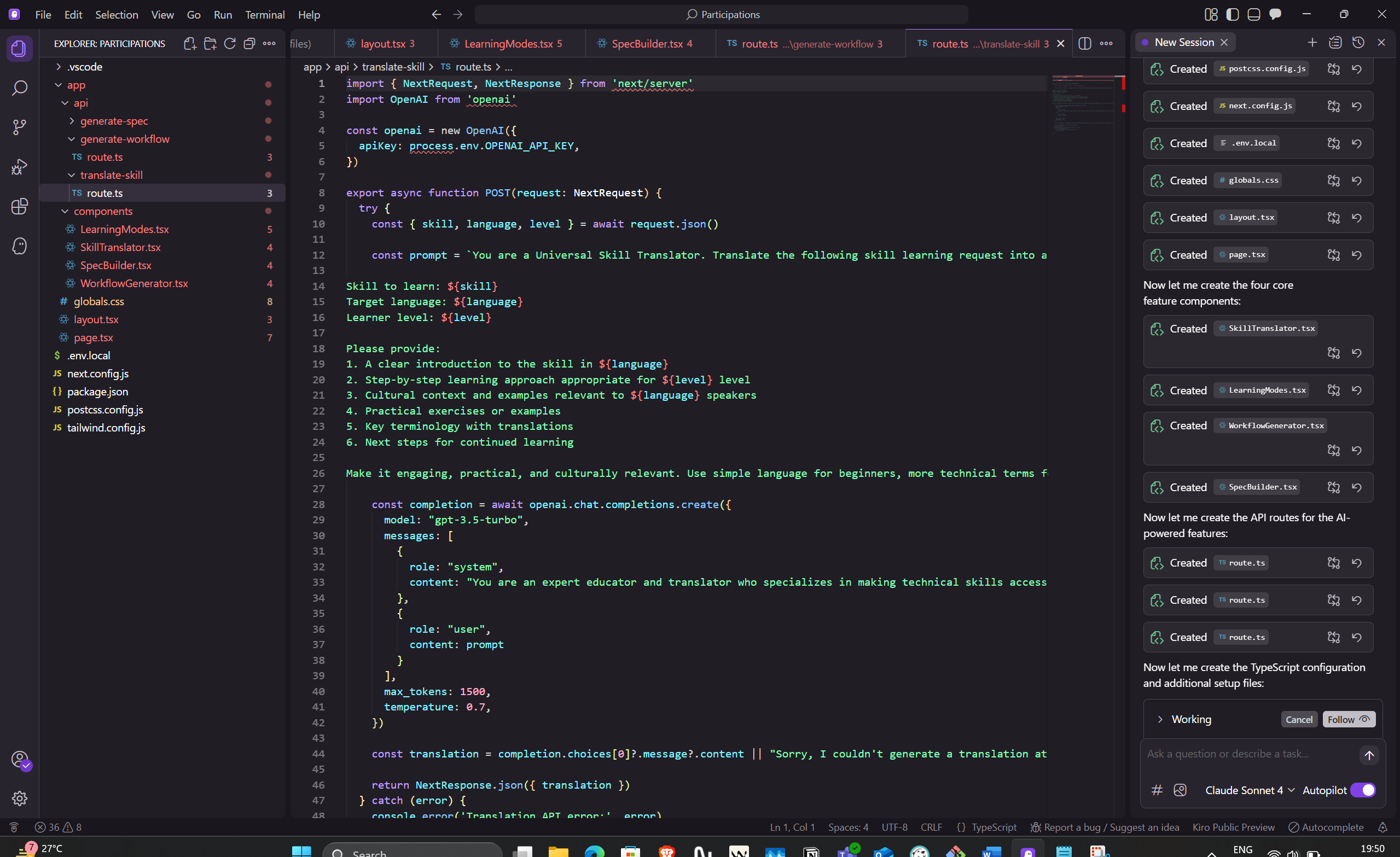
Serverless backend: API routes proxy requests to OpenAI, keeping the API key secure.
Kiro IDE:
.kiro/spec.yaml defines each skill module (objectives, level, format).
Hooks auto-generate quizzes and Git practice repos.
Inline coding used for rapid prototyping and iteration.
Deployment: Vercel with only OPENAI_API_KEY as environment variable.
⚡ Challenges we ran into
Designing a universal format for lessons that works across languages and skill levels.
Keeping the app lightweight and fast for users with low bandwidth.
Making Kiro’s spec-to-code pipeline practical for generating not just code but structured lessons and challenges.
Rate-limiting API usage so a public demo doesn’t drain the key.
🏅 Accomplishments that we're proud of
Built a working prototype that transforms a spec into a complete learning module (text + code + quiz).
Proved that Kiro can be more than an IDE — it can drive global education.
Designed with accessibility first: multilingual, mobile-friendly, text-only fallback.
Created an app that’s truly usable by anyone in the world with a browser.
📚 What we learned
Spec-driven development is powerful beyond software — it can define educational flows.
AI hooks can automate hands-on practice environments just as easily as they generate code.
The gap between idea → spec → production can be reduced to minutes with Kiro.
Accessibility and inclusivity aren’t add-ons — they have to be designed in from the start.
🔮 What’s next for Universal Skill Translator
Add voice input/output for learners who prefer listening/speaking over text.
Expand the lesson spec library so contributors can publish skill modules in .kiro/spec.yaml format.
Introduce community sharing — people can remix and localize each other’s lessons.
Explore offline mode where lessons can be downloaded once and reused without API calls.
Partner with NGOs and schools to bring UST into classrooms around the world.
Built With
- nextjs
- typescript

Log in or sign up for Devpost to join the conversation.