Inspiration
The inspiration for Universal Document Interpreter came from seeing how difficult and stressful it can be for people—especially migrants, travelers, and workers—to understand and manage important documents like passports, visas, and contracts. Missing a deadline or misunderstanding a clause can have serious consequences. We wanted to build a tool that makes document intelligence accessible, fast, and easy for everyone.
What it does
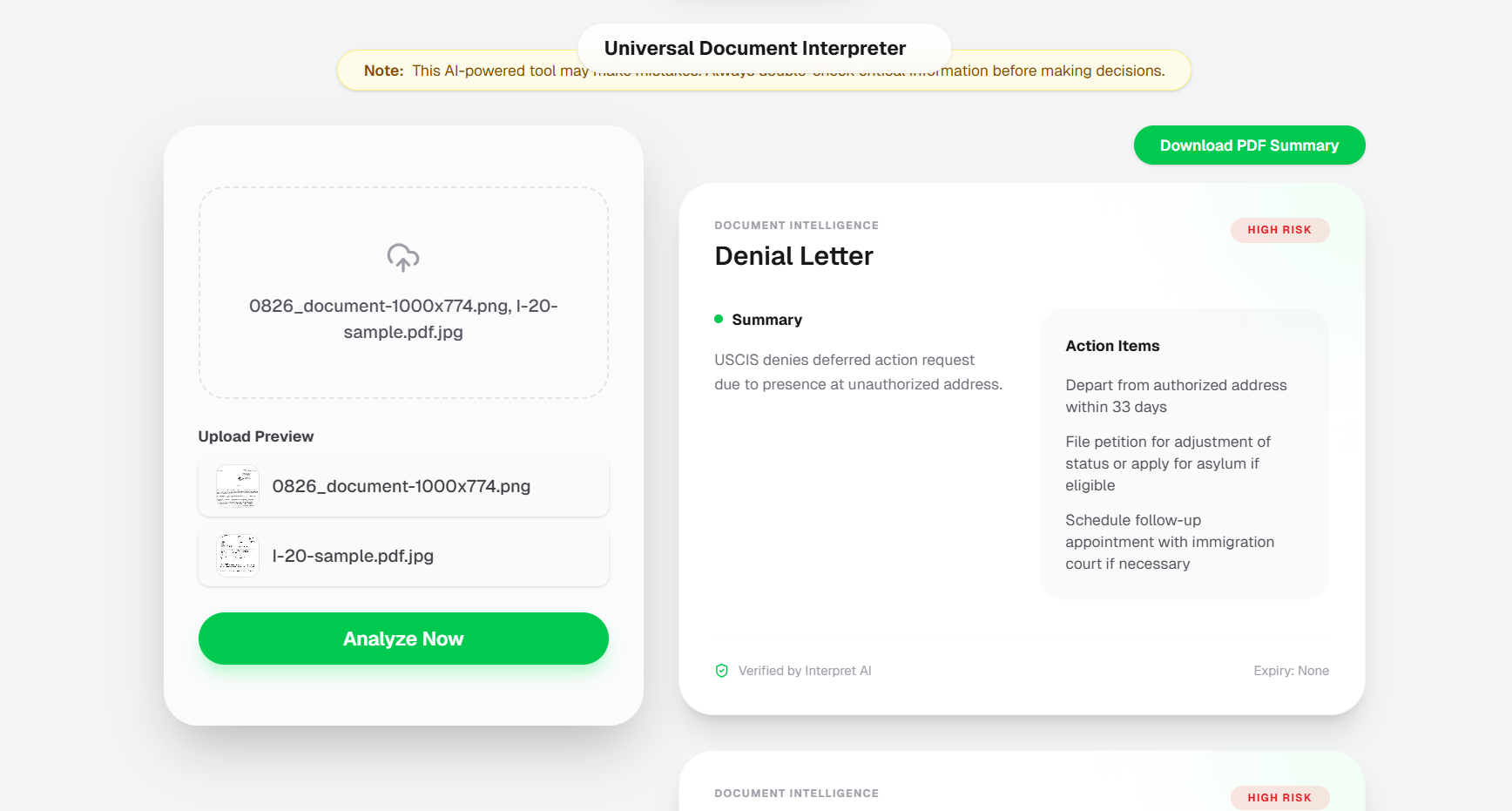
Universal Document Interpreter lets users upload one or two documents (PDF, DOCX, or images) and instantly receive:
- Plain-language summaries of the document’s content
- Risk analysis and urgency badges
- Action items and next steps
- Expiry timelines and visual progress bars
- Downloadable PDF summaries
- All with privacy-first, stateless processing
How we built it
- Frontend: Built with Next.js, Tailwind CSS, and shadcn/ui for a modern, glassmorphic dashboard. Features include drag-and-drop upload (react-dropzone), skeleton loaders, copy-to-clipboard, and PDF download (jsPDF).
- Backend: FastAPI (Python) handles file uploads, OCR conversion (Docling), PII redaction (Presidio), and AI analysis (Ollama running Llama3). Async background tasks ensure smooth UX, and multi-doc synthesis logic compares documents (e.g., passport + visa).
- AI Models: Uses local LLMs via Ollama for analysis, and supports multiple OCR backends for flexibility and speed.
Challenges we ran into
- Integrating multiple AI tools (OCR, PII redaction, LLM) into a seamless workflow
- Handling large, multi-page documents efficiently and reliably
- Ensuring privacy and statelessness while providing rich analysis
- Designing a UI that feels modern, professional, and easy to use for all audiences
- Managing asynchronous processing and real-time status updates between backend and frontend
- Less time spent on backend inference
What we learned
- How to orchestrate multiple AI and NLP tools for practical document intelligence
- The importance of clear, actionable UX for users dealing with high-stakes documents
- Best practices for privacy, stateless processing, and local inference
- How to design and build glassmorphic, high-tech UIs with Next.js and Tailwind CSS
- The value of rapid prototyping and iterative improvement in AI-powered products
What's next for Universal Document Interpreter
- Multi-language support for global accessibility
- Advanced document previews (PDF/image viewers)
- Mobile optimization for on-the-go use
- User accounts and history for secure, persistent access
- Cloud deployment for organizations and teams
- Customizable extraction workflows for different document types
- Integration APIs for HR, legal, and compliance systems
- Notifications and reminders for upcoming expiries or risks
- Accessibility enhancements for all users
- Continuous model updates to leverage the latest in AI and OCR
Built With
- ollama
- python
- tailwind-css
- tesseract
- typescript

Log in or sign up for Devpost to join the conversation.