-
-
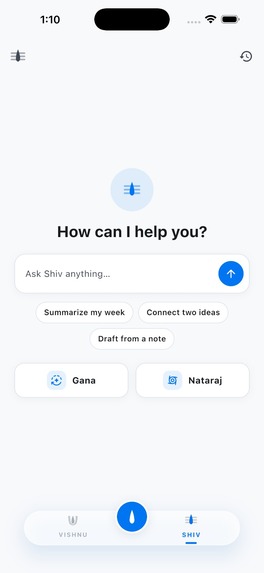
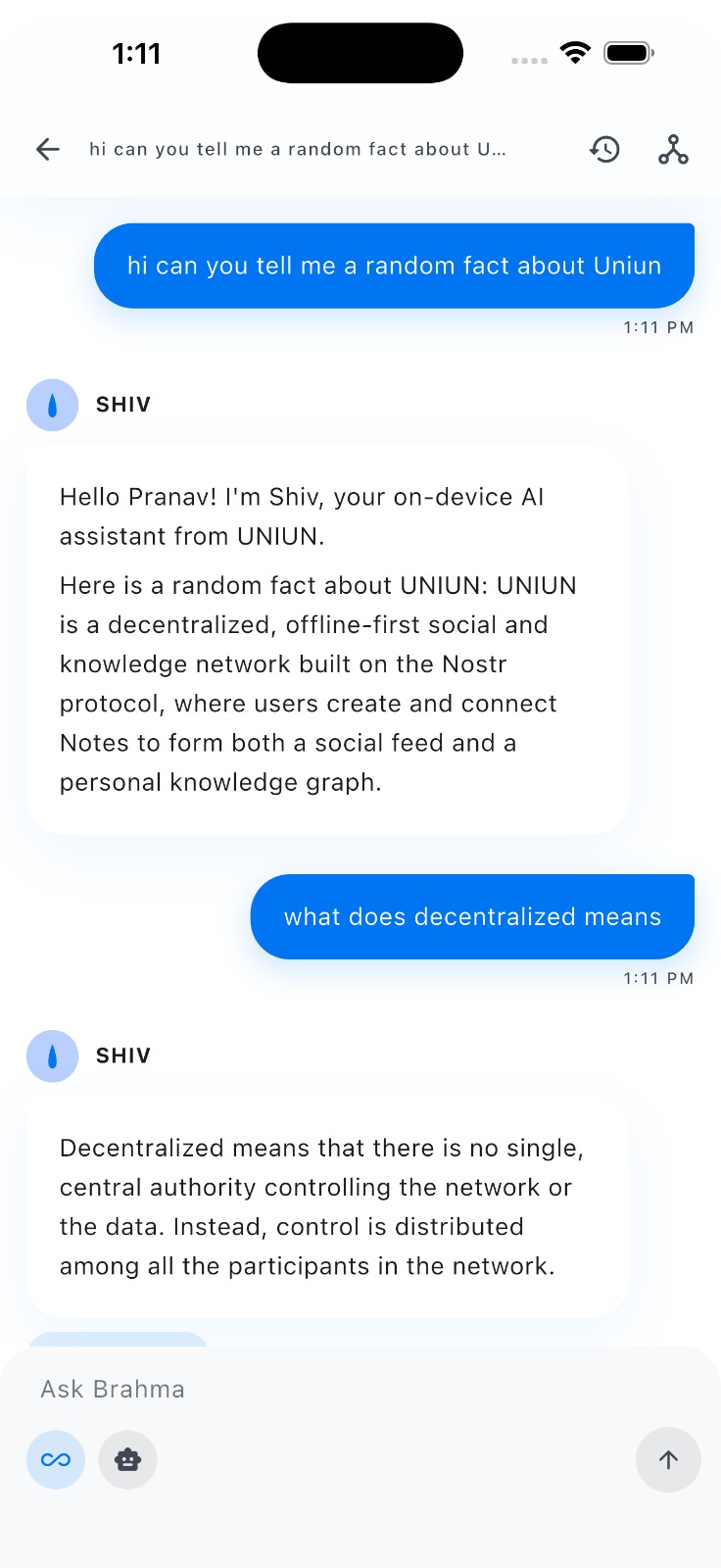
Shiv
-
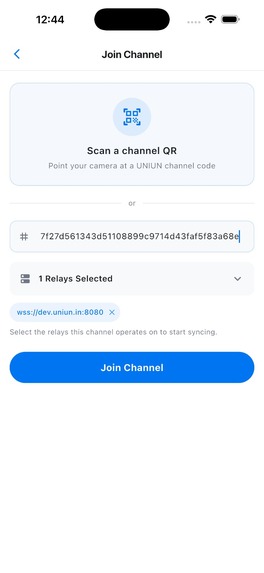
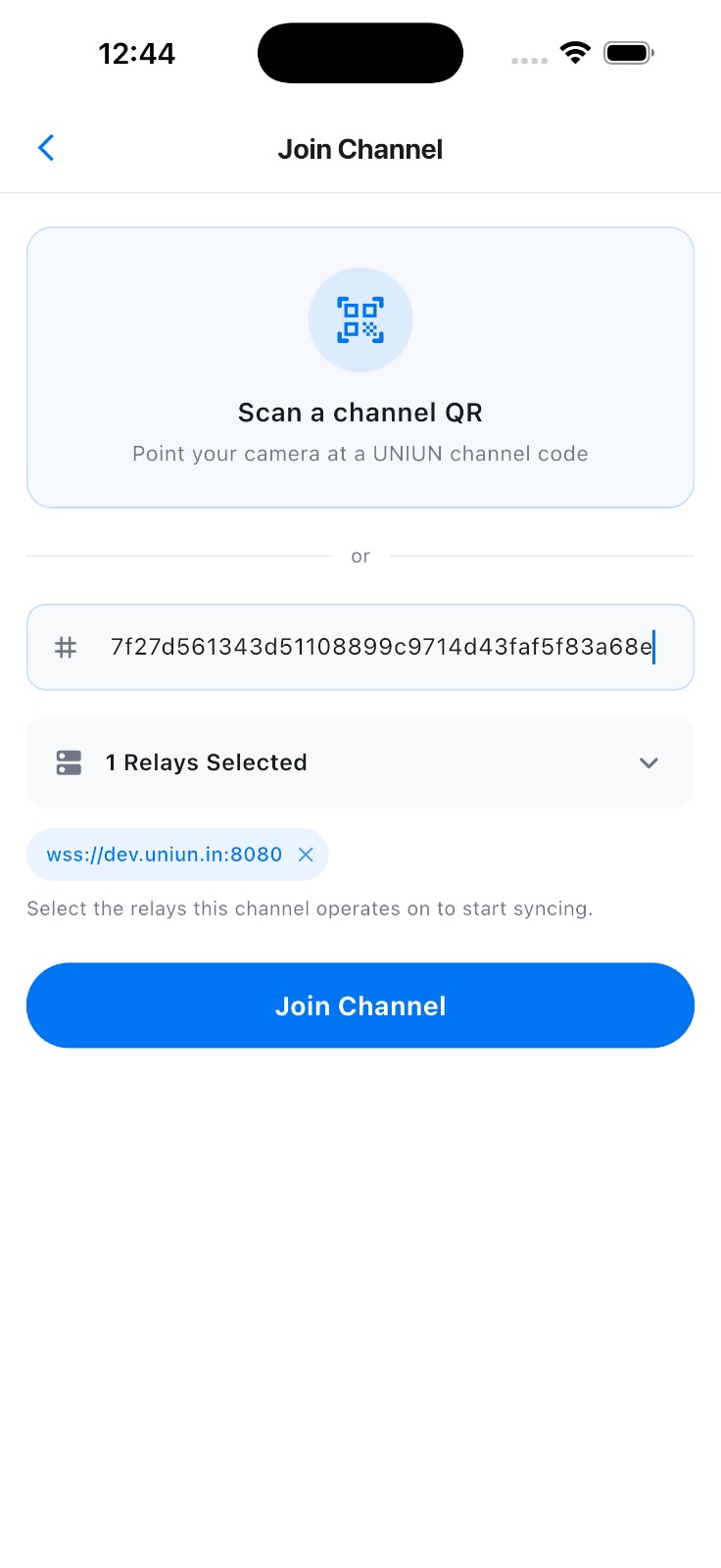
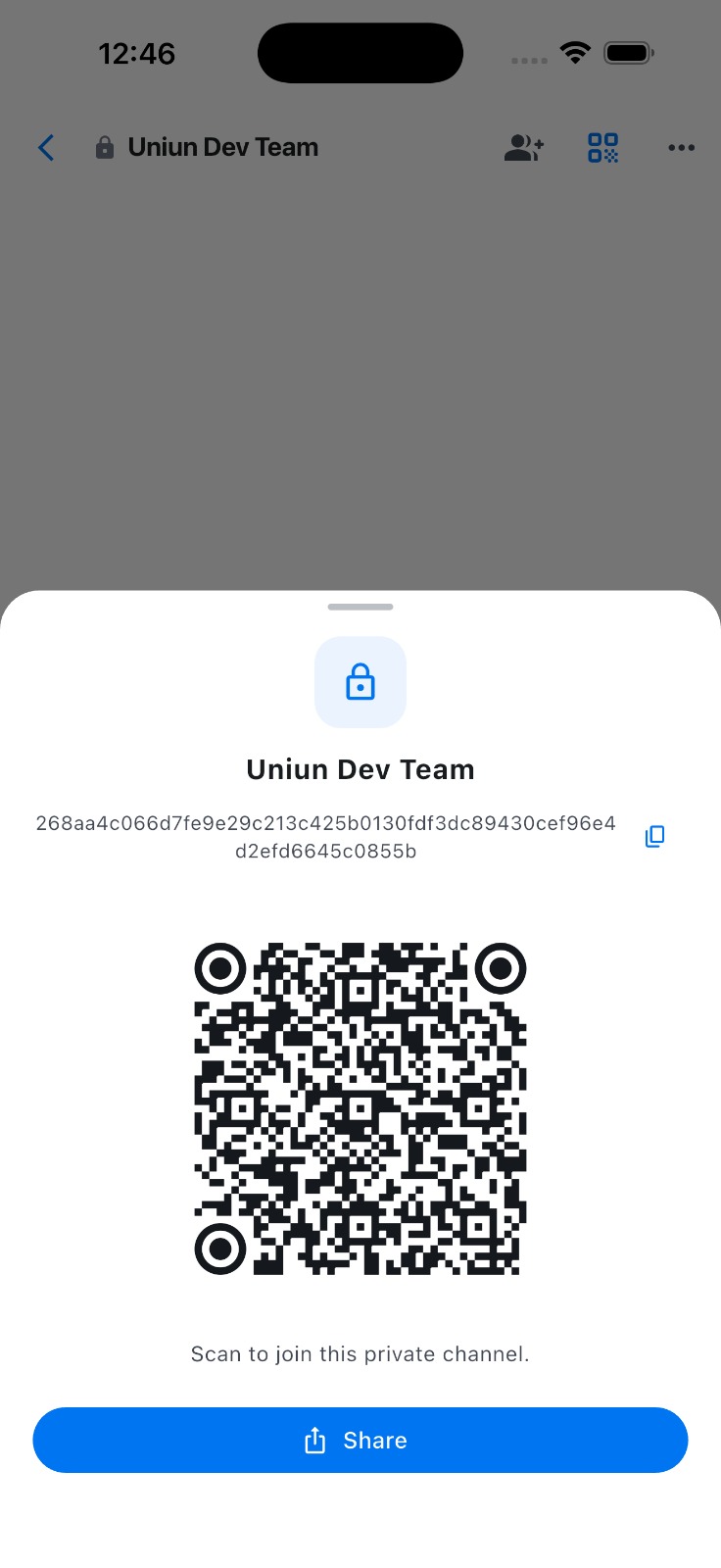
Join Group
-
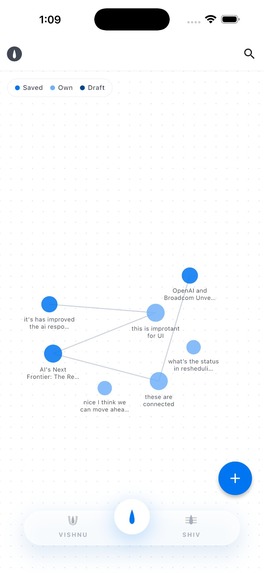
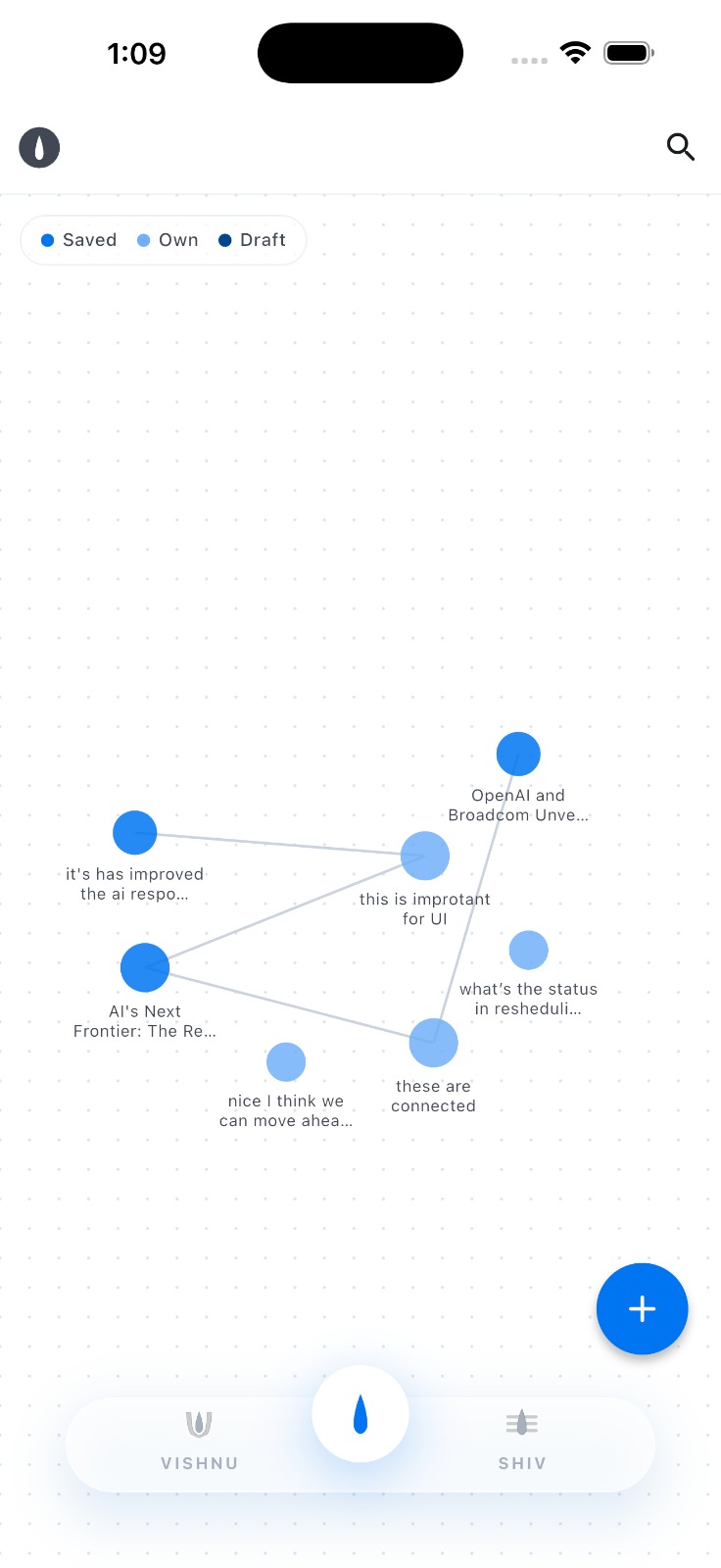
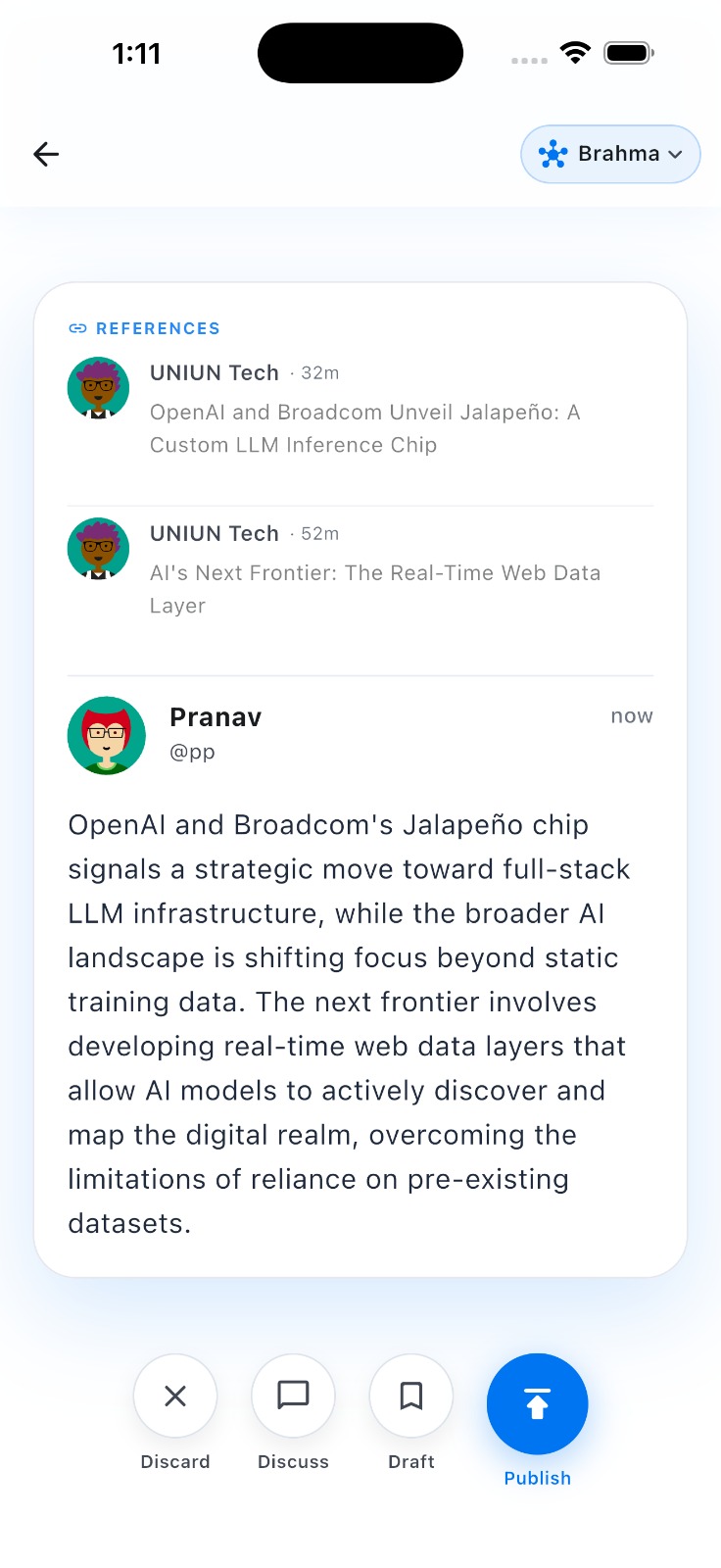
Brahma Graph
-
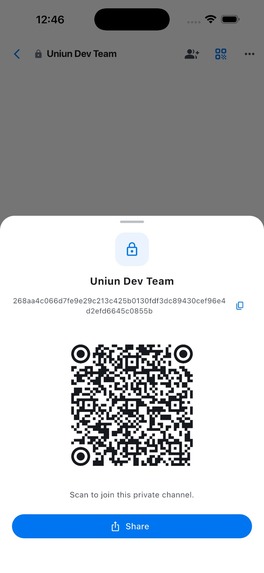
QR
-
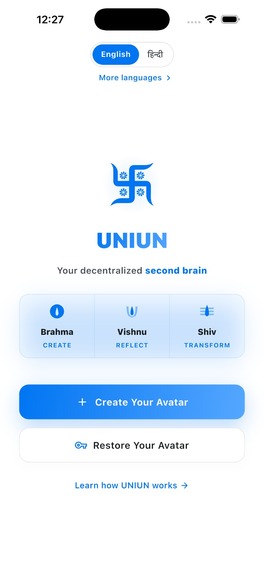
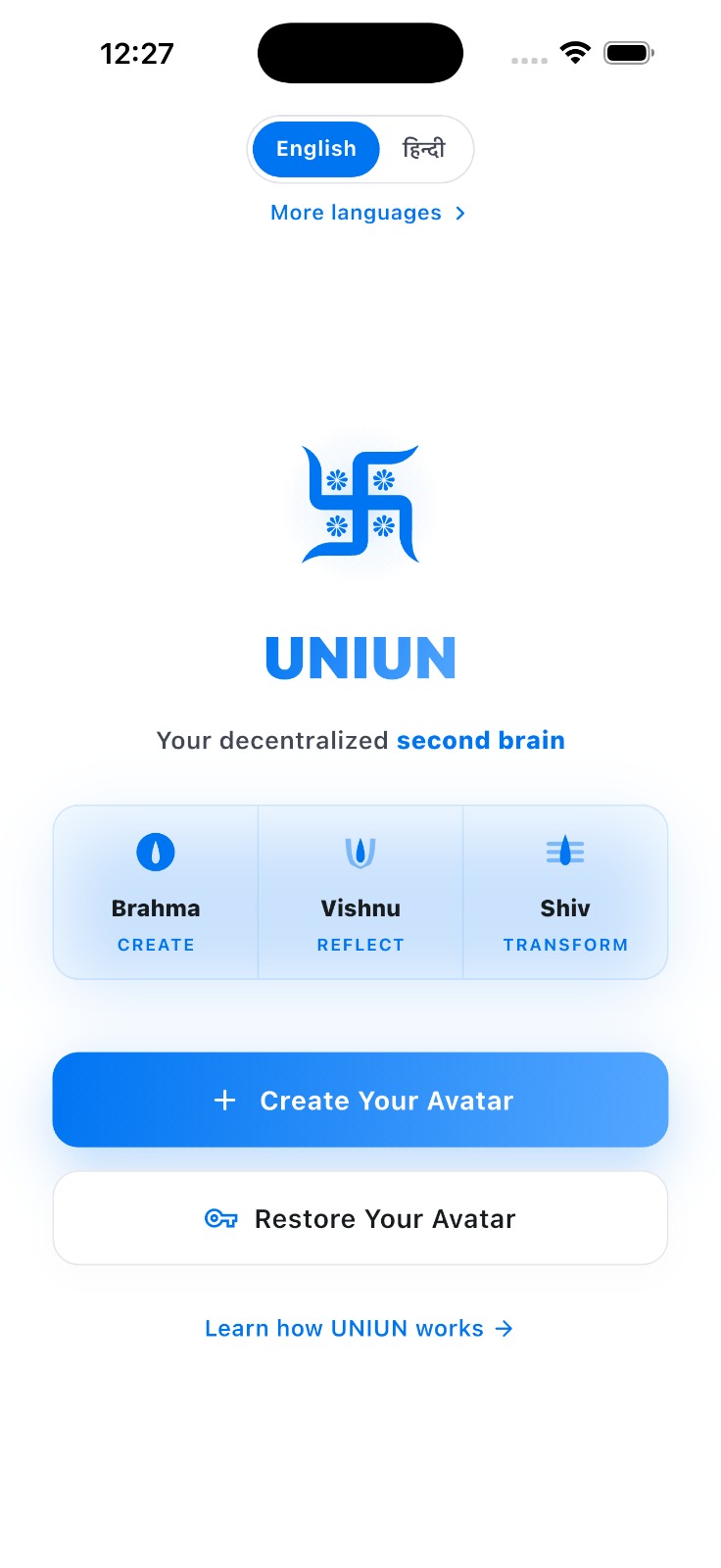
Welcome Page
-
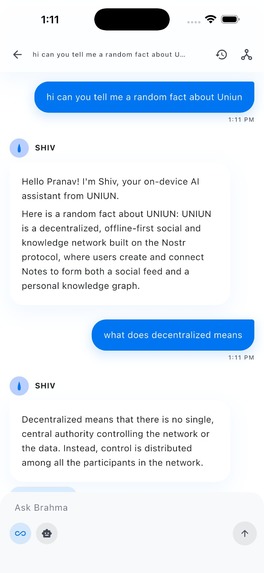
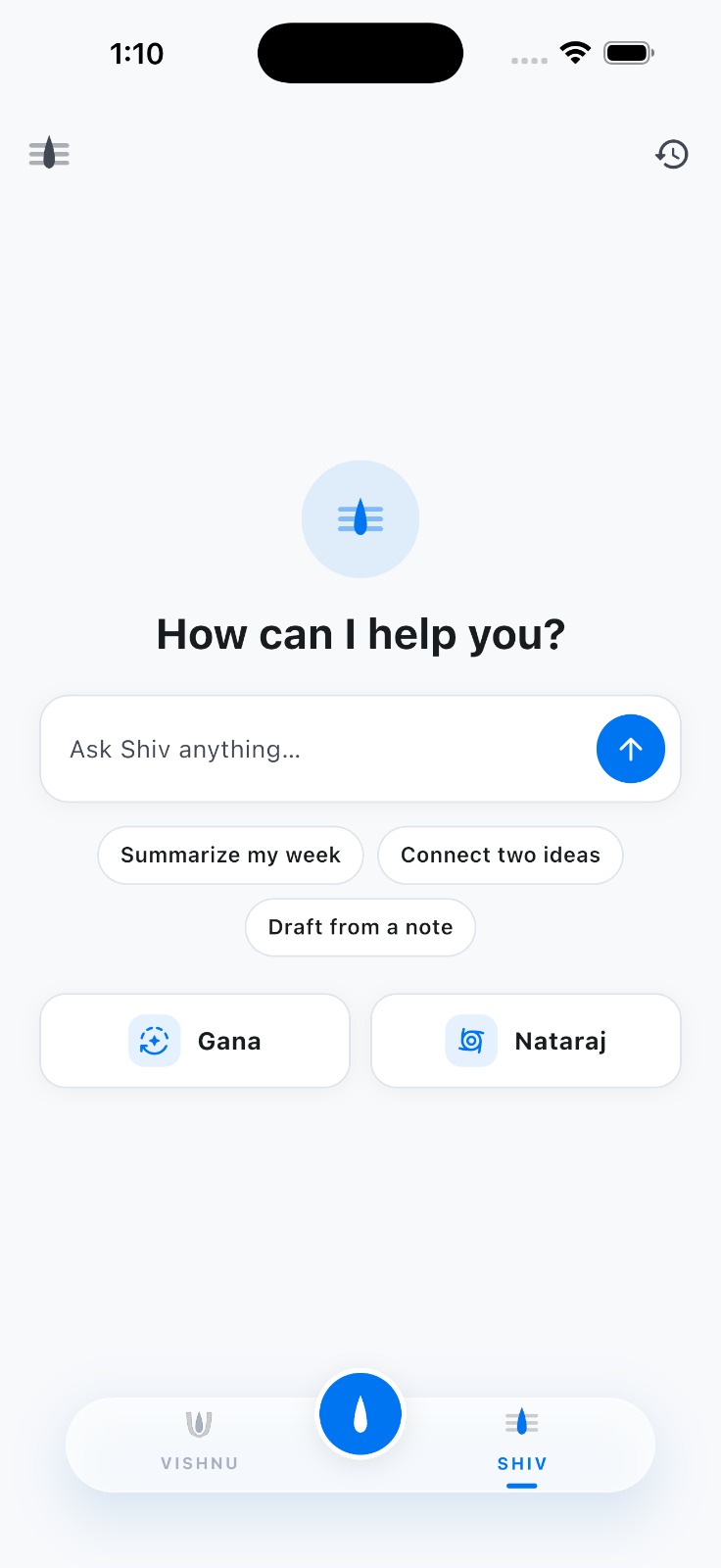
Shiv AI Chat
-
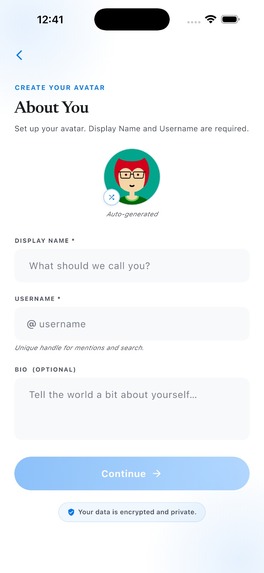
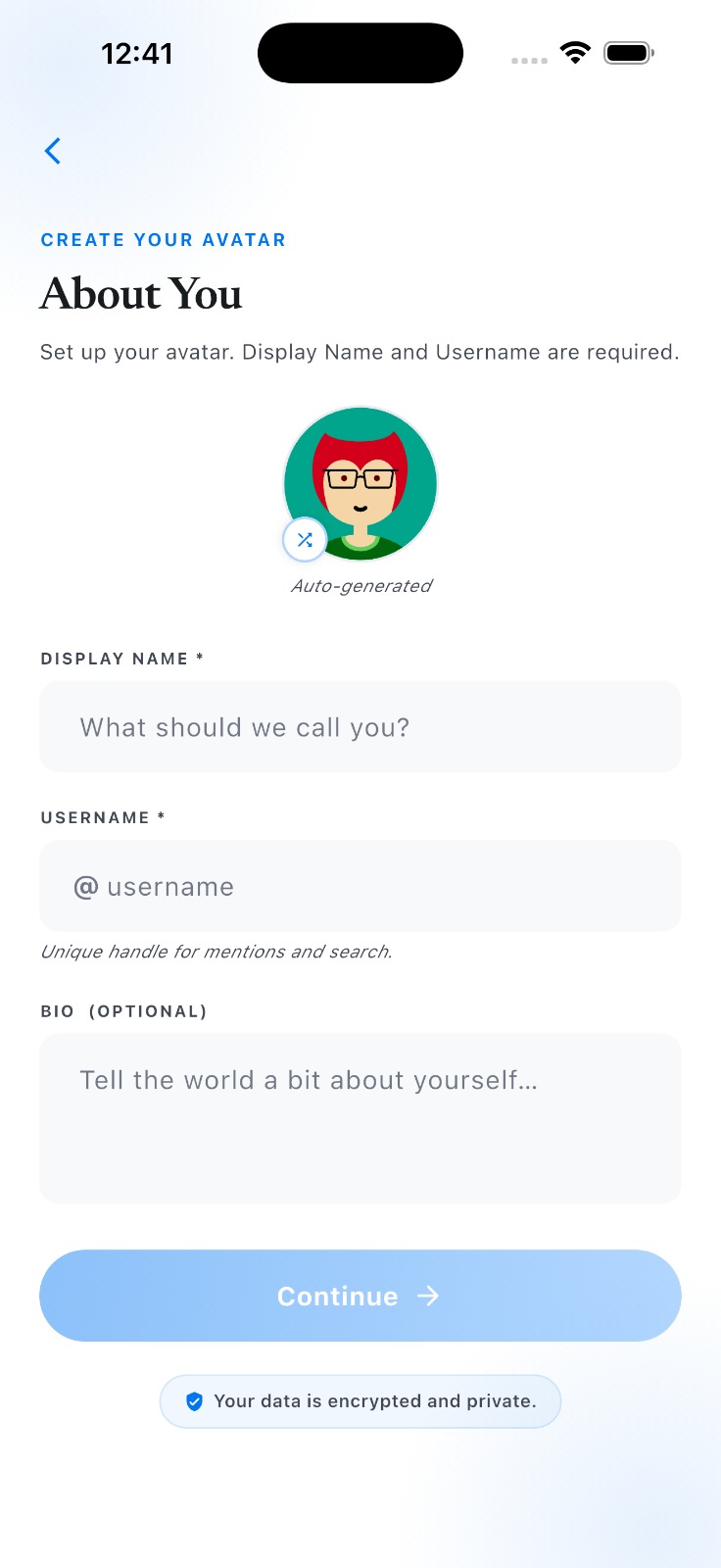
About you
-
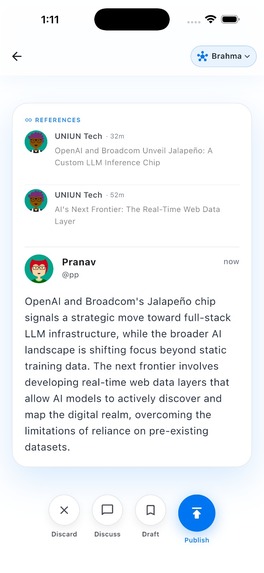
Natraj
-
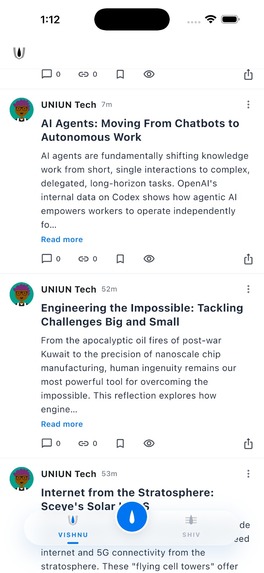
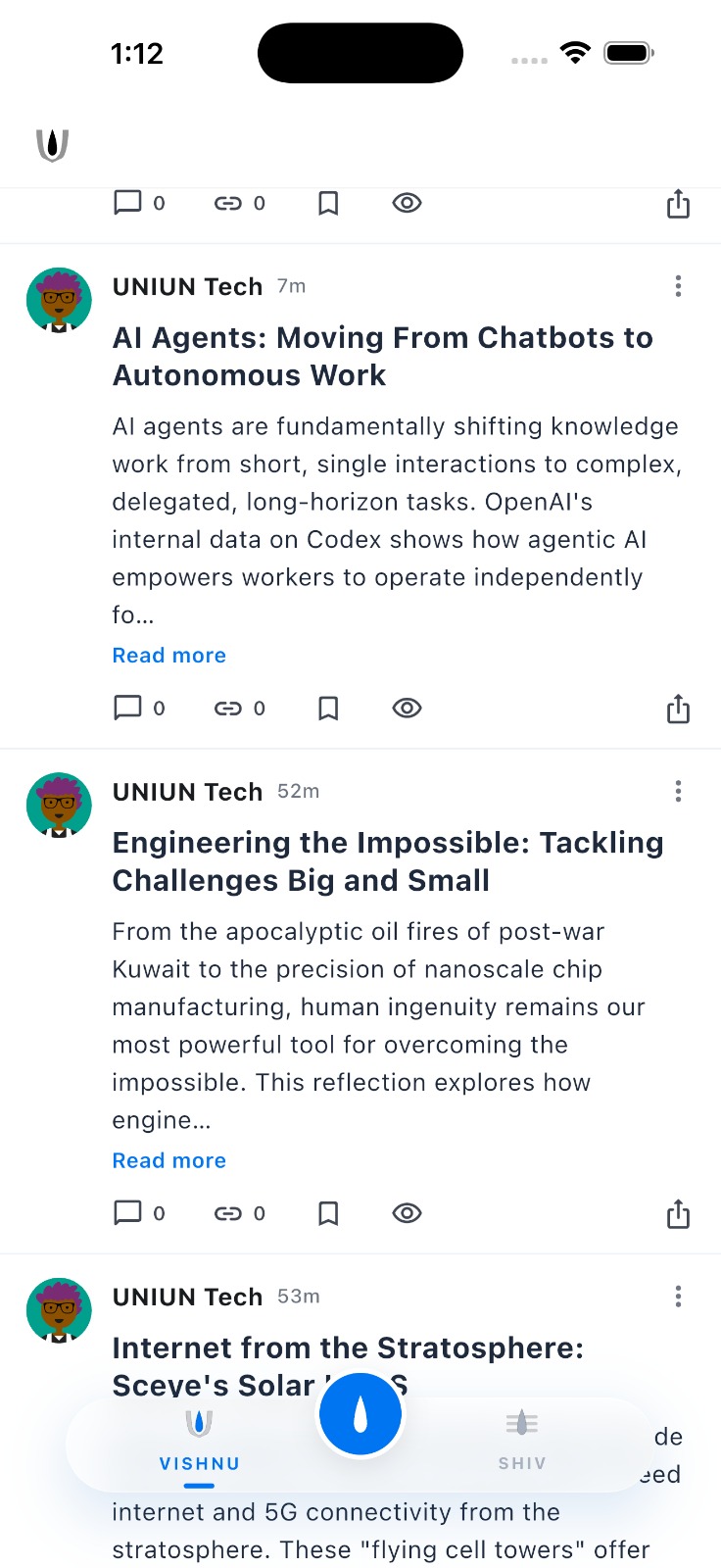
Vishnu Feed
-
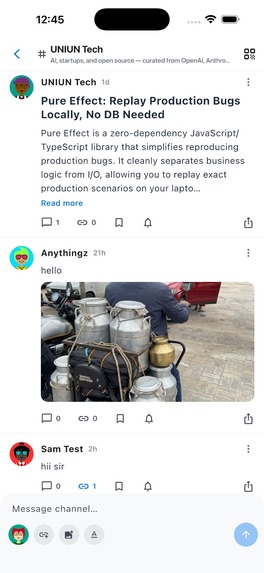
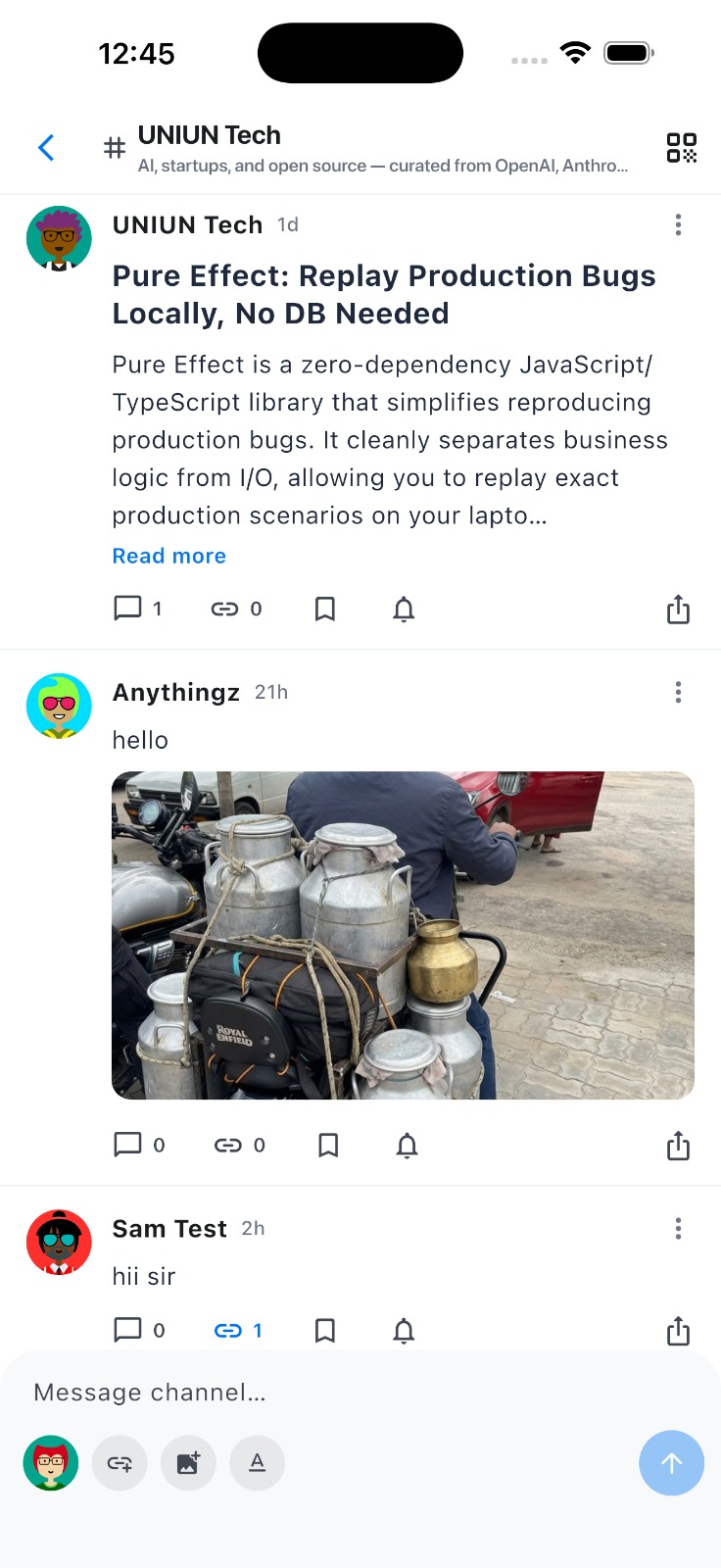
Group Feed
RFC: UNIUN a decentralized medium to exchange thoughts
There will be many ideas throughout this article that could spark new discussions. I encourage you to challenge them, build on them, and most importantly, tell me where I’m wrong.
The reason I’m writing this is simple: I’ve reached my human limits. And to go beyond, I need help from more people, more ideas, more criticism. One person proposing something is bound to be wrong. Only a diverse set of minds can make something truly meaningful.
That’s why I’m calling this RFC. RFC stands for Request for Comments.
I believe anyone can contribute to these ideas. It touches topics ranging from history to mathematics, from philosophy to neural networks.
All the ideas presented here are mine alone. They are not associated with any company, country, or cult. These ideas are fluid and open to change. If you disagree with them, that’s okay, two people can have different perspectives. That doesn’t mean the destination is different, it just means the paths are different. And the goal remains the same:
peace / god / moksha / enlightenment.
Why
To eliminate miscommunication, to understand each other, to become more empathetic, and to realize truth/God/enlightenment/moksha/Brahman/peace/light/love.
If you ask someone what the greatest inventions of human civilization are, you'll likely hear a wide range of answers. But most people will agree on these:
- Language or speech
- Writing / the printing press
- The internet
All of these are modes of communication and they grant us the most important power of all: the ability to understand ourselves.
A lot of discussion today focuses on how social media has changed the way we communicate. It has brought people and ideas closer than ever before, allowing us to connect across borders, cultures, and communities.
In my opinion, the rise in loneliness may also have something to do with increasing homogeneity. Deep connection isn’t formed by how much people have in common, but by how much difference they can embrace in one another. People from the same country might feel no kinship at home, but once abroad, they find a sudden sense of unity.
People crave identity, an urge to discover themselves and one way to do that is by understanding others and exploring new perspectives.
True free speech in my opinion, is about accepting that there can be multiple truths on multiple sides of the same coin. But canceled culture has risen, and dominant ideologies are now determined to suppress minority viewpoints.
There's endless debate about where to draw the line when it comes to censorship. But I believe the real question is: Why draw the line?
Whenever we talk about censorship, we’re inherently implying that people aren't smart enough to discern truth for themselves that someone else must do it for them. But who are we to decide what the truth is?
If we look at history, “truth” has changed time and again. All our models of how the world works are just theories. Perhaps it’s not particles and strings, maybe it’s a supernatural being behind it all.
Society needs the person who believes the Earth is flat and devotes their life to proving it not necessarily because they are right, but because humanity needs people willing to question what everyone else accepts as truth. It’s people who challenge accepted ideas against all odds who sometimes help us discover something new.
Time and again, every system designed to empower truth-seeking eventually becomes the very thing that suppresses it.
- Religion: Every religion began by challenging existing truths. At its core is a reminder to keep questioning.
- Science: The scientific method arose by questioning the Church. Now, it has become so deeply embedded in society that anything “unscientific” is mocked and publicly shamed even if it simply presents an alternative view.
This happens because people struggle to see beyond their own understanding. They can't let go of the need to be right to consider that someone else might be right, too. Instead of discovering new truths by embracing other perspectives, they cling to their own.
We’ve seen this happen with the internet, too, which started as a collection of forums where you could find others who believed in the same niche truths. It gave people an unprecedented ability to find communities around ideas, interests, and beliefs that may have been difficult to discover otherwise.
The great centralization of the internet has already happened and if you don’t believe it, just check your browser history. How many different websites have you visited in the past month?
After the internet, AI will be the next revolution in communication not because it can replace humans, but because of its ability to answer any question. It's an extension of your brain.
Imagine having another mind, one that knows everything humans have ever known, and communicates it to you in a way you understand.
“The way you understand” this is the most important part. Everyone perceives the world differently. If someone completely understands your worldview, they can make you believe in anything. That’s the essence of persuasion and manipulation.
Everything created is beautiful; you just have to develop the eyes to see it.
Every truth is valid, you just haven’t understood it yet.
With AI, people will now be able to express their truths in a way others can understand which means they’ll be able to convince others of anything.
That will make us more connected and more lonely at the same time. More internet fights. More empathy. More division.
If this sounds like a distant future, just scroll through your Instagram feed and ask yourself if AI already understands you.
With AI, people are discovering new mediums to express their truths in ways others can relate to. We’re already seeing this with AI-generated art. As the barriers to expression continue to disappear, more people will be able to create, communicate, and share ideas in ways that were previously impossible.
This is an attempt to create a new kind of space one that:
- Is more diverse
- Helps people discover perspectives they may never have encountered otherwise
- Helps people discover themselves through others and in turn, truly find themselves
What
Thought Graph
Social Graph
Almost all existing social media platforms operate on the principle of the social graph, people are nodes, and the connections between them represent relationships such as friends, followers, fans, etc.
The biggest shortcoming of this model is that these relationships are binary: either you follow someone, or you don’t. But human relationships are far more nuanced. There are people we relate to more, and people we relate to less. Sometimes, we resonate with certain aspects of a person and not with others.
Current AI algorithms try to infer the strength of these connections in the background, suggesting content based on your engagement. But these systems are opaque; no one really knows how they work.
This disconnect between what is shown to us and what we truly want to see creates a sense of detachment from social media.
TikTok and Instagram Reels are an evolved form of this idea. While they still use social connections (followers/following) as signals, they prioritize engagement metrics like time spent, likes, and comments to drive content suggestions. And you’d probably agree that those suggestions often feel more relevant than content on your "regular feed."
Introducing the Thought Graph
We propose a new way to represent human connection: the Thought Graph.
Instead of focusing on people-to-people connections (the social graph), we focus on thought-to-thought connections. There are multiple theories suggesting that human knowledge and consciousness can be represented as a graph: nodes for knowledge, edges for relationships.
Example:
[Isaac Newton](discovered)>[Gravity][Gravity](governs)>[Planetary Motion]
One compelling theory, Neural Network Theories of Consciousness, posits that conscious experience emerges from the structure and activity of neural networks which, again, are graphs.
You, as a person, can be represented as a graph of your thoughts. The structure of this network and how your thoughts connect is what defines you.
So, when you follow someone or call them a friend, what you're really connecting with are specific thoughts they have. The deeper your resonance with their thoughts, the stronger your connection.
You could put it like this:
- The more thought-connections you share with someone, the more you are influenced by them.
- The more aligned your thoughts are, the more you’re willing to listen to and understand them.
Monetization and Data
We believe that the only thing humans truly produce is thought whether abstract (ideas) or concrete (buildings). Thought is the only real value we generate.
And that idea is at the center of our monetization model. If there’s going to be any exchange, it should be thought of.
In computers, every thought or idea can be represented as a sequence of bits. But not all bits are created equal. A bit created by Newton likely has more value than one created by you or me.
So, we propose a system where each user has their own coin. This coin derives its value from:
- The content they produce
- Their influence on others.
Every thought carries influence as a byproduct, and we believe this coin can also act as a measure of that influence.
If data is the new oil, then attaching data to a digital currency may help us democratize the monetization of data.
AI and the Single Source of Thought
As the AI wave intensifies, we foresee the world moving toward a dangerous consolidation: a single source of truth. In that world, individuals may start to lose their identity.
Consider X (formerly Twitter), which is integrating Grok into its platform. Many users now turn to Grok for “the truth.”
Yes, Grok may reduce misinformation and improve the platform. But what happens when Grok becomes widespread and everyone accepts it as the source of truth?
Most human conflicts are complex and lack clear answers. Even the judicial system which relies on juries to bring diverse perspectives and community consensus into the interpretation of the law cannot always guarantee true justice.
So, can we really expect a system like Grok to remain unbiased and possess full domain understanding?
We believe the better path is personalized AI bots. Everyone should have their own AI that understands their unique context.
LLMs are resource-intensive today, so running a Grok-like model for everyone isn't feasible yet. But we believe in Moore’s Law and that hardware will eventually catch up. In the meantime, we propose building a system where everyone has their own personalized AI, instead of relying on a centralized truth provider.
Decentralization
The internet began as a U.S. military project, then spread to universities and eventually to hobbyists. Initially, it was a distributed system, each node was an independent server.
But that model was inefficient: both nodes had to be online at the same time. So, the concept of servers was introduced, always-on nodes that could store and forward messages.
Email is a great example of this. Messages sent to uniun@gmail.com go to Gmail’s mail server, where they sit in a queue until you come online to fetch them.
This client-server model made sense when we didn’t expect clients to be online 24/7.
Today, that has changed. Our smartphones are always online. So, the need for always-on centralized servers has diminished.
This is the spirit behind the Web3 movement returning the internet to a peer-to-peer, distributed system.
A central server also becomes the source of truth for the network. Blockchain technologies, especially Byzantine Fault Tolerance (BFT) consensus algorithms, have made it possible to decentralize even this aspect.
To make this truly decentralized and resilient, we have also decided to equip the application with Bluetooth Mesh and local LAN networking, allowing devices to communicate directly with one another even when an internet connection is unavailable. This means the network can continue to function in offline or disconnected environments, with information being shared locally between nearby nodes rather than depending entirely on centralized servers or the internet.
Censorship
Censorship is one of the most sensitive and debated topics in the digital age. Most people associate it with authoritarian control or content moderation. But we believe the most powerful form of censorship is ignorance of what we choose not to engage with.
Much of the hate and outrage on social media stems from people dishonoring or attacking one another over issues they can't personally influence. Instead of ignoring content that doesn't resonate with them, users are often pushed into reacting to out-fueling algorithms and outrage cycles.
We propose that censorship in a decentralized system should not be about removal, but about empowering users and nodes to ignore what they don’t care about.
Our system will be a distributed network, where there’s no central authority deciding what should be seen or hidden. Instead, each node or community can choose to:
- Forget content
- Delete it locally
- Or most importantly ignore it
Just like real life: you don’t need to argue with everyone, or try to fix everything. You can choose silence. You can choose not to care.
Ignorance isn’t always a weakness, it can be a form of wisdom.
Localization of Attention
We believe that one of the key problems with today is misaligned focus. We are constantly served by global crises and controversies. While these issues may be important, they often leave users feeling helpless, angry, and disconnected.
People are being asked to give their emotional energy to wars in foreign countries, political battles in distant lands, or disasters across the world. But what about their neighborhood, village, city, or family?
We believe the world would be a better place if people focused more on what they can improve:
- The pothole in front of their house
- The local school needing support
- The neighborhood park that could use volunteers
You only have a limited number of "f**ks to give" your attention is finite. Spending it on things you can’t change means ignoring what you can change.
Our system encourages localization of information and discussion:
- Prioritize content that’s geographically or contextually relevant to you
- Reconnect users with local communities
- Highlight ideas that you can act upon and that will impact your actual life
To enable this, we have decided to build the application primarily as a messaging and community platform, inspired by applications like WeChat and Telegram, but structured more like Slack. Users can participate in conversations, groups, and communities that are relevant to their actual lives.
The idea is to make communication intentional and contextual. A neighborhood can have its own space. A village can have its own community. A school, organization, workplace, or group of friends can have its own conversations. Information can therefore flow through the communities where it is actually useful, rather than being broadcast indiscriminately to everyone
In a world burning with information, we must first put out the fire next door before we try to save the world.
The goal is not to limit your worldview, but to ground your actions.
So we have decided to build this as a messaging platform.
Hinduism
Hinduism is often referred to as a polytheistic religion, but more accurately, it is philosophically pluralistic. It recognizes many paths to truth and liberation. Rather than insisting on a single worldview, Hinduism embraces multiple perspectives, accommodating a wide range of beliefs, practices, and metaphysical frameworks.
There are two main lenses through which Hindu philosophy can be approached:
- The Six Classical Schools (Ṣaḍdarśana) of Hindu Philosophy:
These schools explore the nature of reality, consciousness, and liberation:
- Nyāya – Logic and Epistemology
- Vaiśeṣika – Atomism and Metaphysics
- Sāṃkhya – Dualism of Purusha (consciousness) and Prakriti (matter)
- Yoga – Practical Path to Liberation
- Mīmāṃsā – Rituals and Dharma
- Vedānta – End of the Vedas; Metaphysical Inquiry
- The Trimūrti (Three Principal Deities) and their Philosophical Representations:
- Brahma – The Creator
- Vishnu – The Preserver
- Shiva – The Destroyer/Transformer
We will take inspiration from both frameworks to guide the design and architecture of our platform.
The Core Philosophy: Advaita Vedānta
The foundational inspiration for our platform is Advaita Vedānta, a non-dualistic school of thought revived and systematized by Adi Shankaracharya. His teachings form the metaphysical backbone of modern Hindu understanding.
At the heart of Advaita lies the concept of Brahman – the ultimate reality, the eternal truth, the source of all that exists.
Shankara distilled the essence of Vedantic wisdom into four Mahāvākyas (great utterances):
- Prajñānam Brahma – Consciousness is Brahman
- Aham Brahmāsmi – I am Brahman
- Tat Tvam Asi – You are That (Brahman)
- Ayam Ātmā Brahma – This Self is Brahman
He taught that liberation (moksha) is not attained through external rituals or blind belief, but through direct realization of the self as not separate from the ultimate truth. This realization comes through Atma-vichāra (self-inquiry) and internal clarity.
In the language of our platform, self-realization is akin to exploring your own Thought Graph tracing the connections between your thoughts, beliefs, experiences, and values until you reach the core of your identity, your Brahman.
The Thought Graph and Moksha
According to Hindu thought, truth is not something external to be acquired, it is already within us. The path to realization is not about adding something new, but about removing the layers that obscure the truth we already carry.
In our framework:
Each user has a Thought Graph, a dynamic, evolving map of ideas, beliefs, insights, and experiences.
Liberation, in this context, is the process of discovering deeper connections within that graph.
As you explore and refine this network, you begin to uncover universal truths, shared patterns, and spiritual clarity.
In a sense, all philosophies, religions, and moral frameworks point to the same reality. They are different languages trying to express the inexpressible.
The Trimūrti and the Platform Architecture
We map the three aspects of the Trimūrti to three major domains of user interaction on our platform. These domains are not separate apps but interconnected experiences.
1. Shiva – The Inner Seeker (Content Transformer)
This domain is about self-discovery, introspection, and refinement. It reflects the idea that the truth is already within you, and by exploring and connecting your thoughts, you can uncover your own Brahman.
Shiva represents transformation, and within the platform:
- You reflect on your ideas.
- You reorganize and transform existing content into insights.
- You evolve your Thought Graph by removing clutter.
2. Vishnu – The Empathic Explorer (Content Consumer)
Vishnu is about understanding others and preserving harmony. In this domain, you interact with other user’s Brahman learning from their thoughts, content, and experiences.
In terms of the Thought Graph:
- You expand your graph by importing new ideas from others.
- You explore different perspectives to enrich your understanding.
- You practice empathy and curiosity as spiritual acts.
3. Brahma – The Creative Source (Content Creator)
Brahma is the creative forcethe one who creates new abstractions from fundamental truths. This domain allows users to express original thought, synthesize experiences, and build new paradigms.
In the platform:
- You create new nodes in your Thought Graph.
- You publish ideas, stories, theories, and philosophies.
- You contribute to the collective evolution of consciousness.
A Fluid, Interconnected System
Just like Hinduism embraces paradoxes, contradictions, and complementary truths, our platform will not silo users into rigid roles. Instead, all three domains Shiva, Vishnu, and Brahma will interweave naturally:
- As you reflect (Shiva), you gain clarity.
- As you explore (Vishnu), you gain perspective.
- As you create (Brahma), you contribute meaning.
This structure allows every user to build their own unique Brahmana self-evolving, personalized representation of their consciousness, rooted in both ancient wisdom and modern insight.
How
Contribute - https://github.com/basictechorg/uniun/
Android - https://play.google.com/store/apps/details?id=in.uniun.app&hl=en_IN
ios - https://apps.apple.com/in/app/uniun/id6778077321
Built With
- flutter
- gemma

Log in or sign up for Devpost to join the conversation.