UNISON — Different tastes. One great plan.
A Qloo-powered agent that helps groups find fair, explainable plans.
Inspiration
Making plans with friends or family should bring people together, but it often becomes a negotiation where the loudest preference wins. Traditional recommendation systems focus on individual preferences or popularity, leaving some group members overlooked.
We created UNISON to solve this problem through cultural intelligence, transparent decision-making, and fairness.
What it does
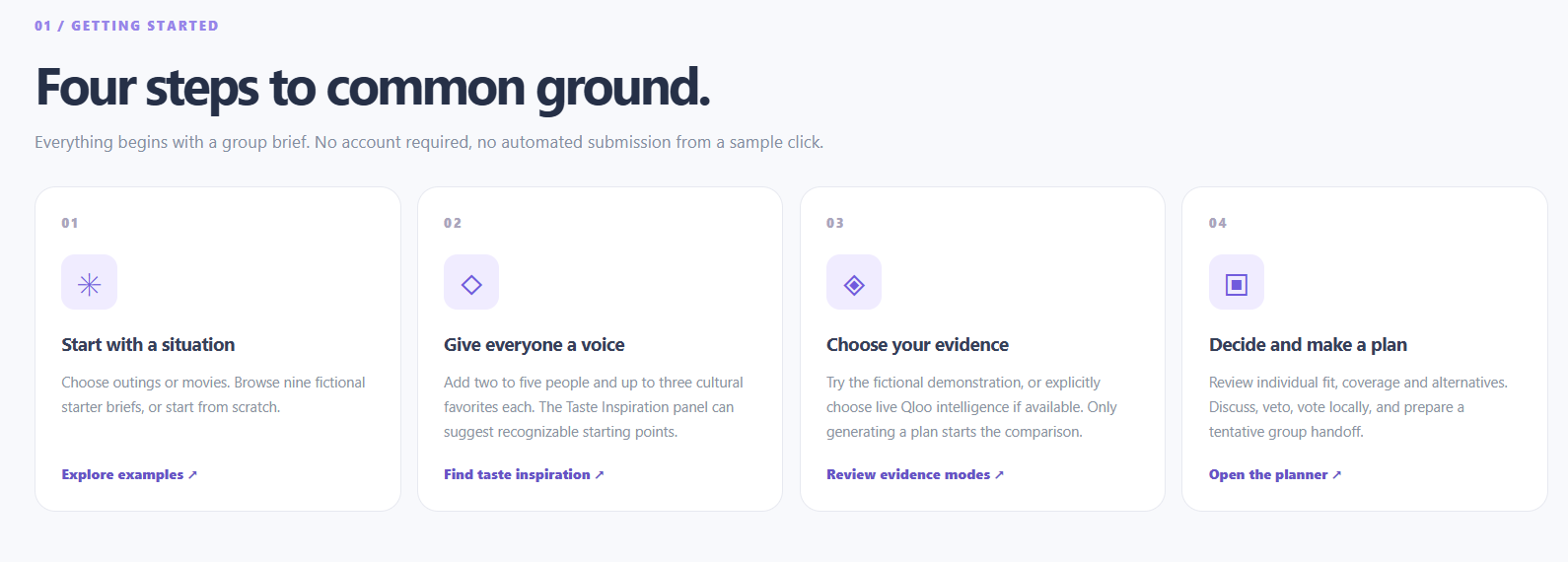
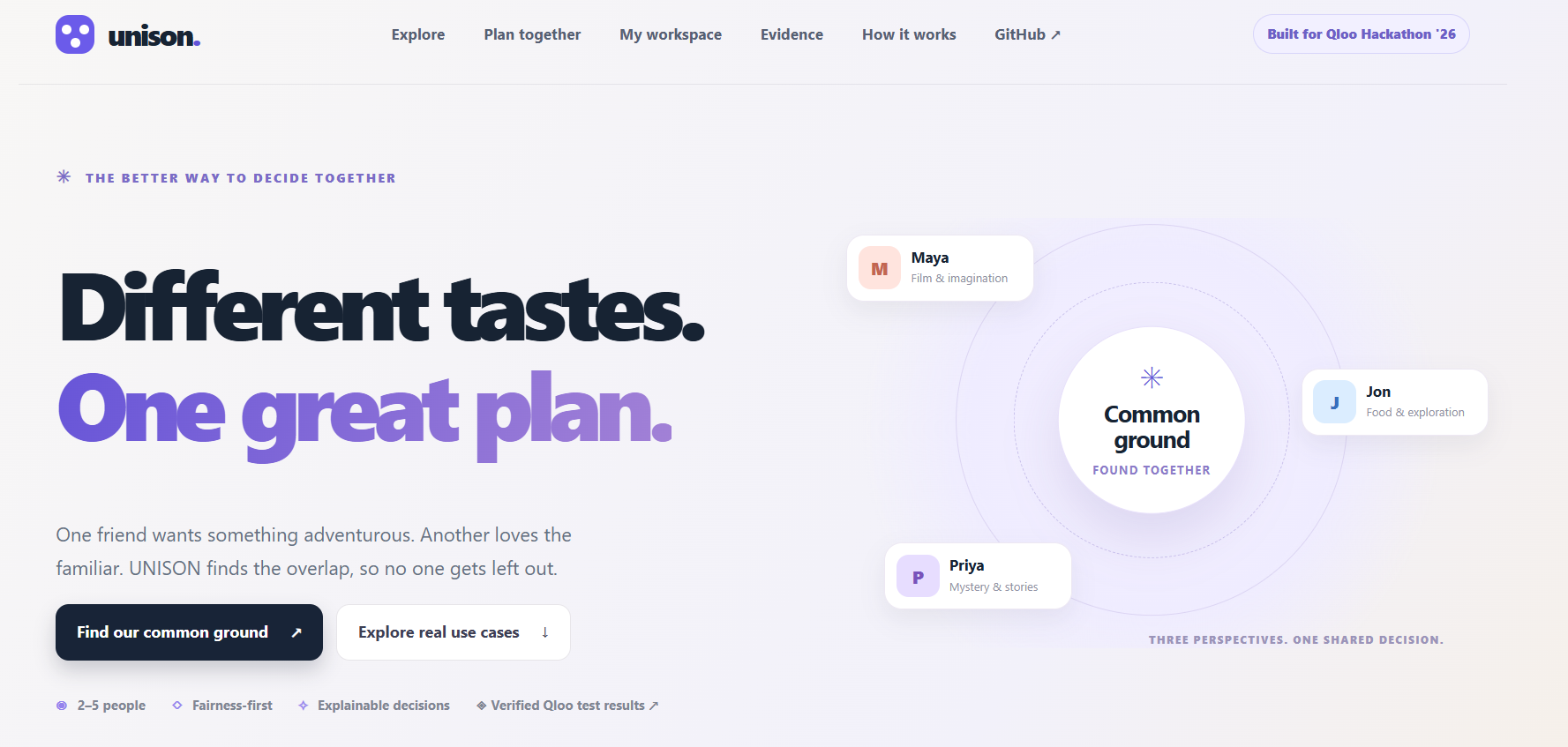
UNISON is an AI-powered group decision platform for two to five people, helping them discover outings and movies based on their individual cultural tastes.
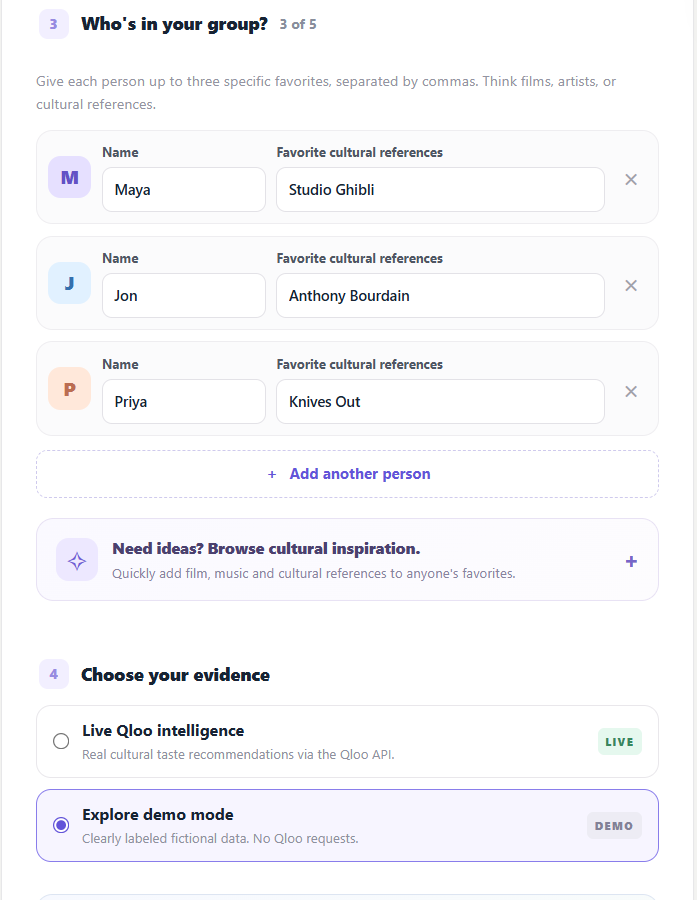
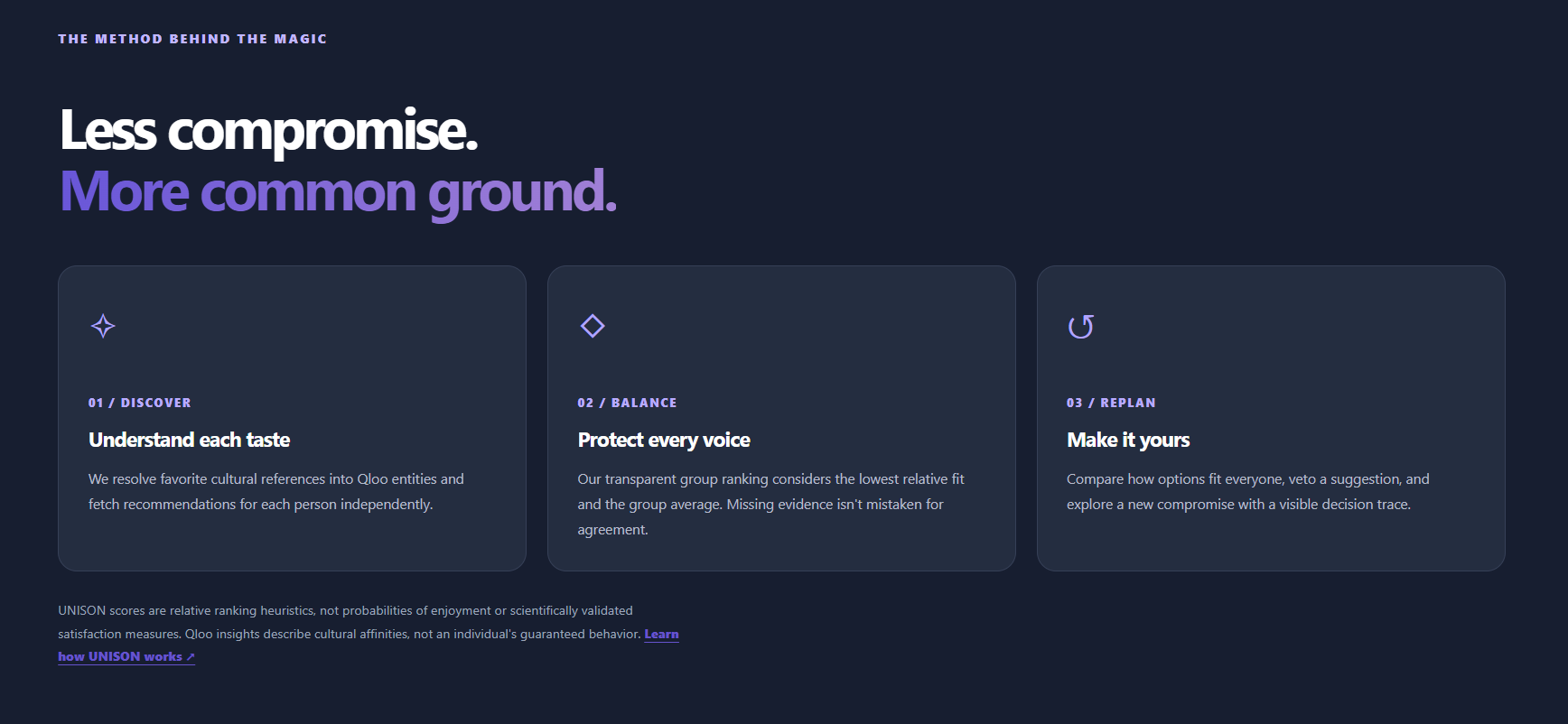
Each participant enters favorite films, artists, or other cultural references. UNISON uses Qloo's Taste AI to discover relevant recommendations, compare how each option fits the group, and identify the strongest supported compromise.
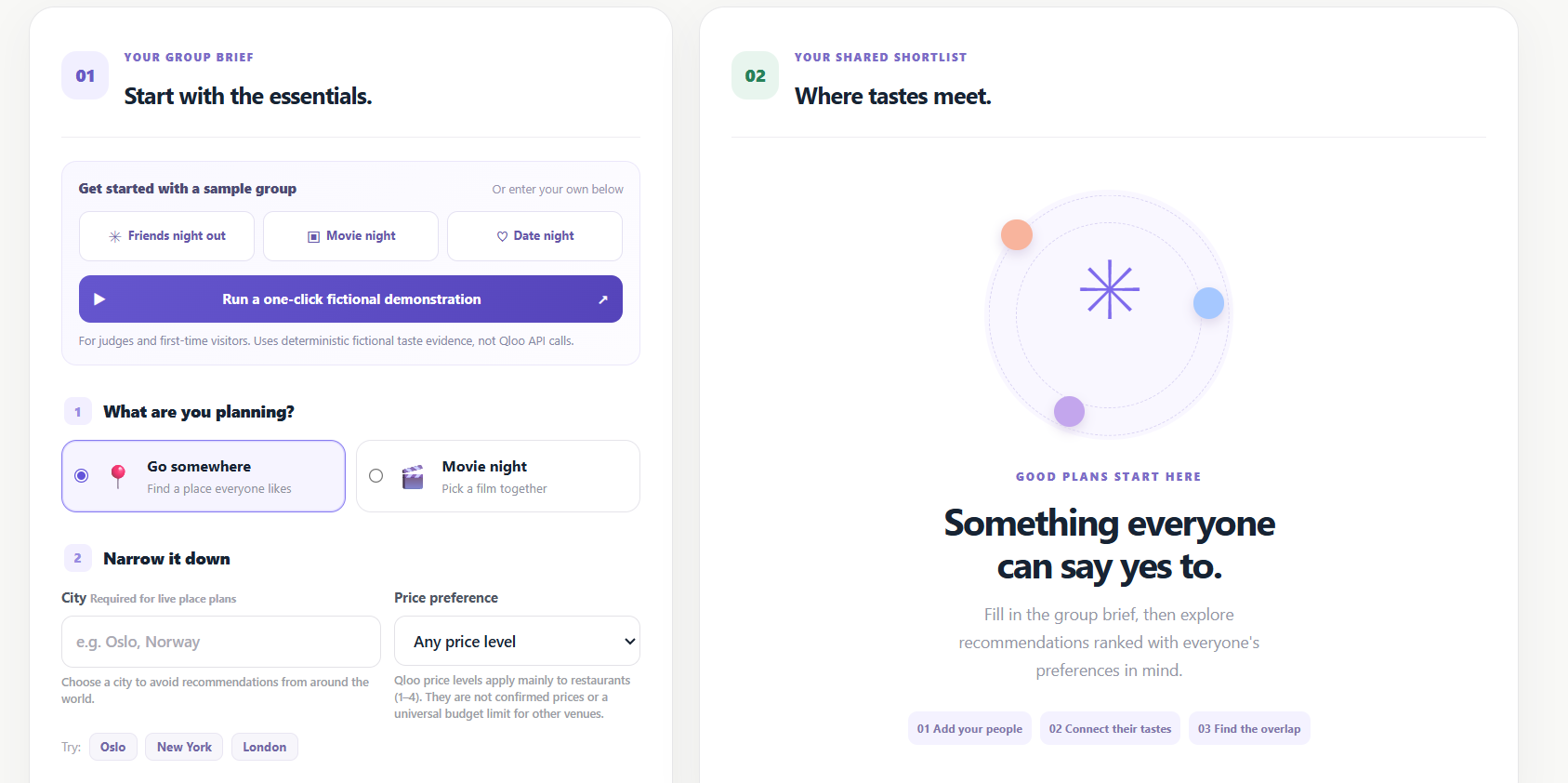
Users can explore personalized recommendations, inspect individual taste evidence, adjust fairness priorities, compare alternatives, veto suggestions, vote together, save decisions, and prepare tentative plans.
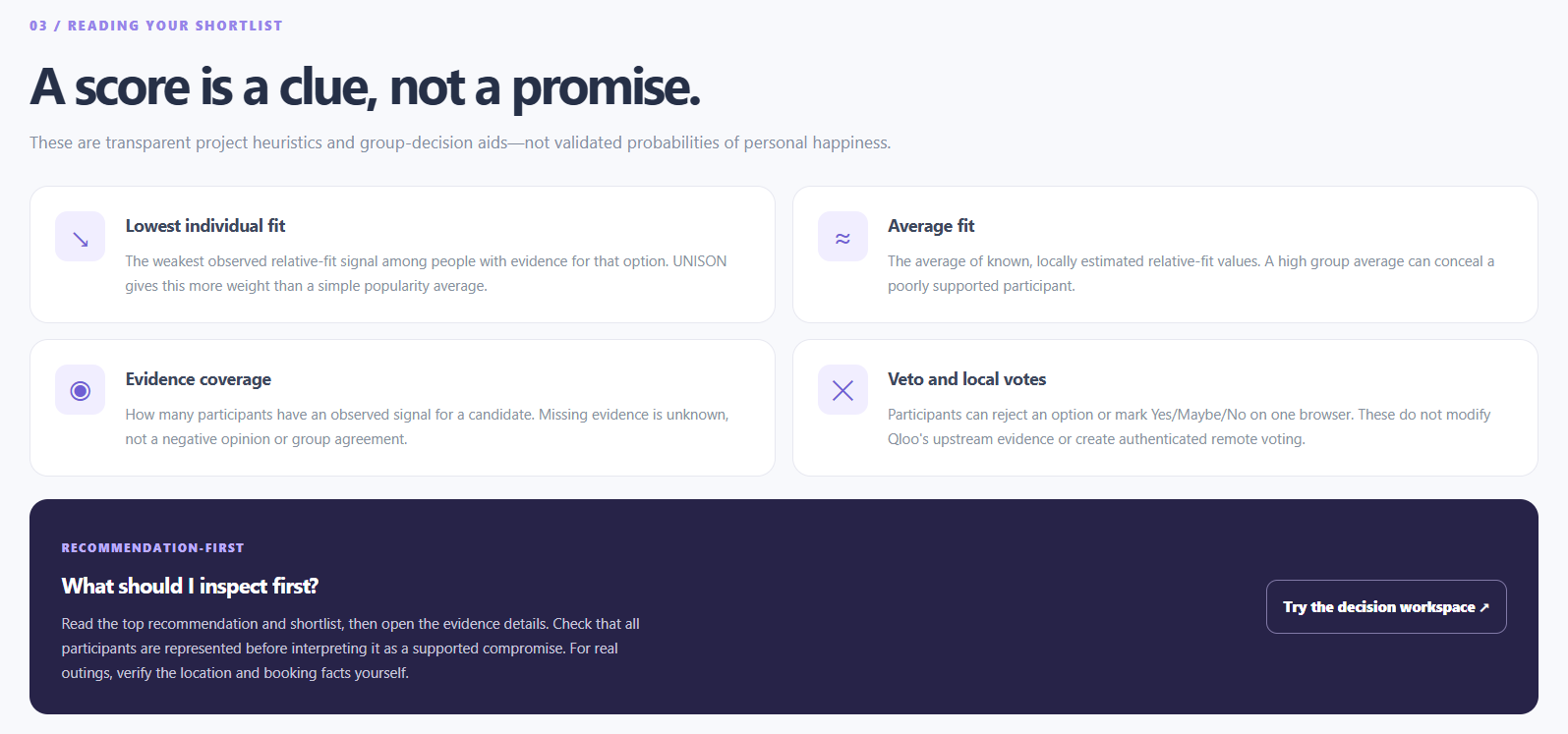
Unlike traditional recommendation tools, UNISON considers the lowest individual relative fit alongside group averages. Missing evidence is never treated as agreement.
How we built it
We developed UNISON as a responsive web platform using JavaScript, HTML, CSS, and Node.js.
The backend orchestrates a multi-step Qloo workflow:
- Resolve cultural references through Qloo Search.
- Discover recommendations independently for each participant through Qloo Insights.
- Build a shared candidate shortlist.
- Re-evaluate those candidates against every participant's cultural signals.
- Apply transparent fairness-aware ranking and evidence-coverage rules.
- Let participants refine and approve their decision.
The application includes server-side API security, request limiting, caching, candidate validation, source tracing, and error recovery.
We deployed UNISON using Render and GitHub, with automated unit, integration, and Chromium browser tests.
Challenges we ran into
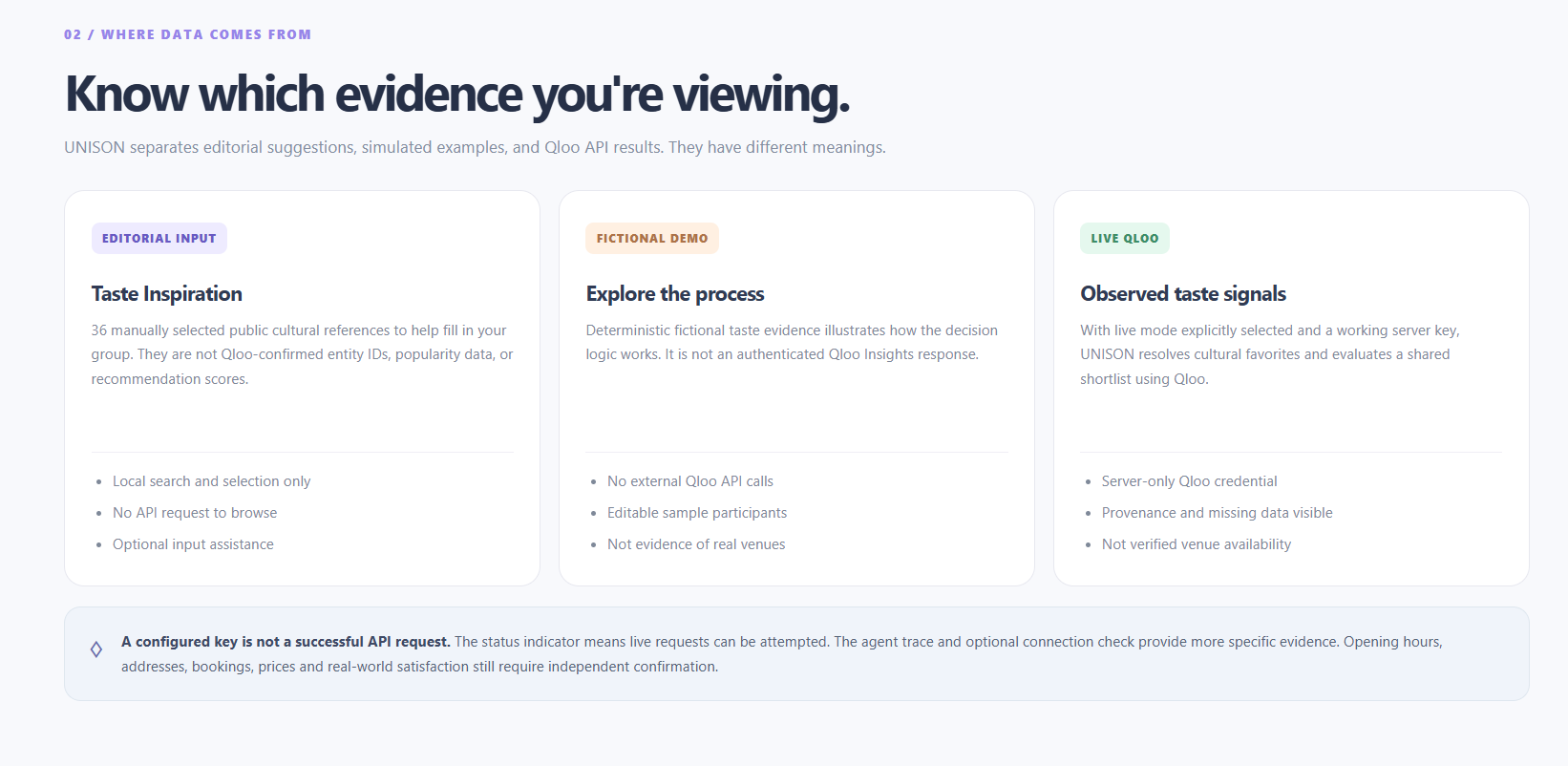
One of our biggest challenges was distinguishing real Qloo evidence from locally calculated scores. Cultural affinity does not equal a scientifically validated prediction of satisfaction.
We solved this by explicitly separating observed Qloo information, our own relative-fit heuristics, and human group decisions.
Other challenges included ambiguous cultural references, incomplete person-level evidence, API rate limits, geographic restrictions, and designing a powerful but understandable interface.
Accomplishments we're proud of
We built a complete, publicly accessible group-planning platform rather than a standalone recommendation demo.
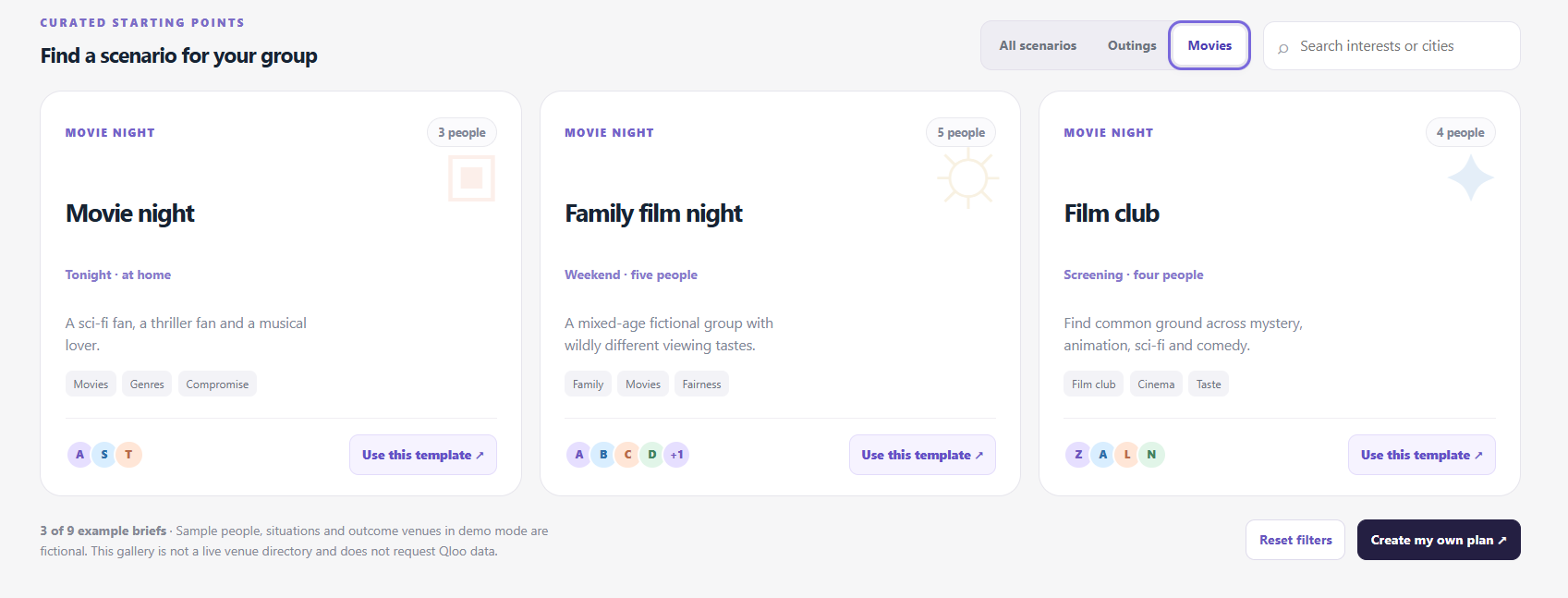
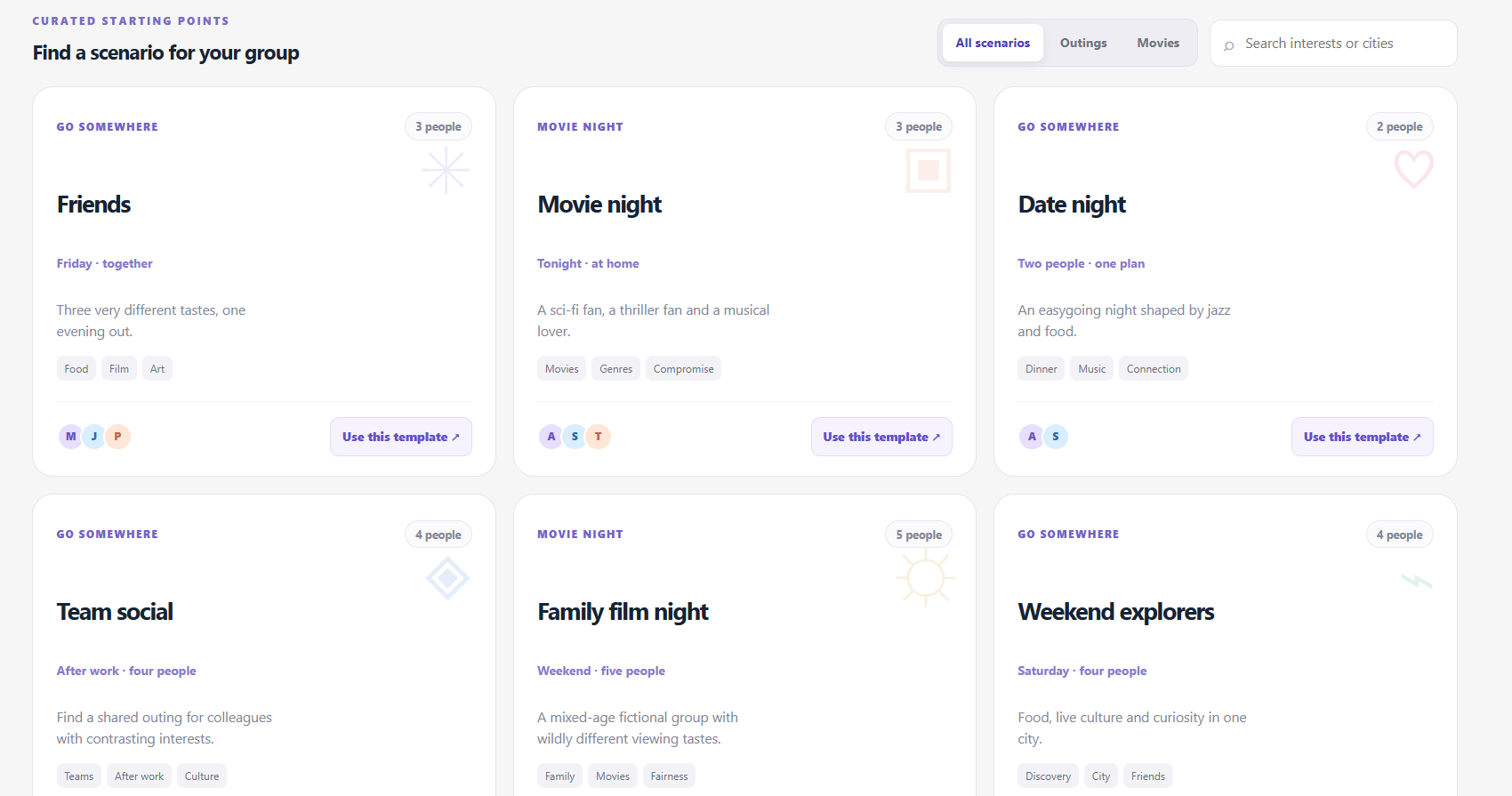
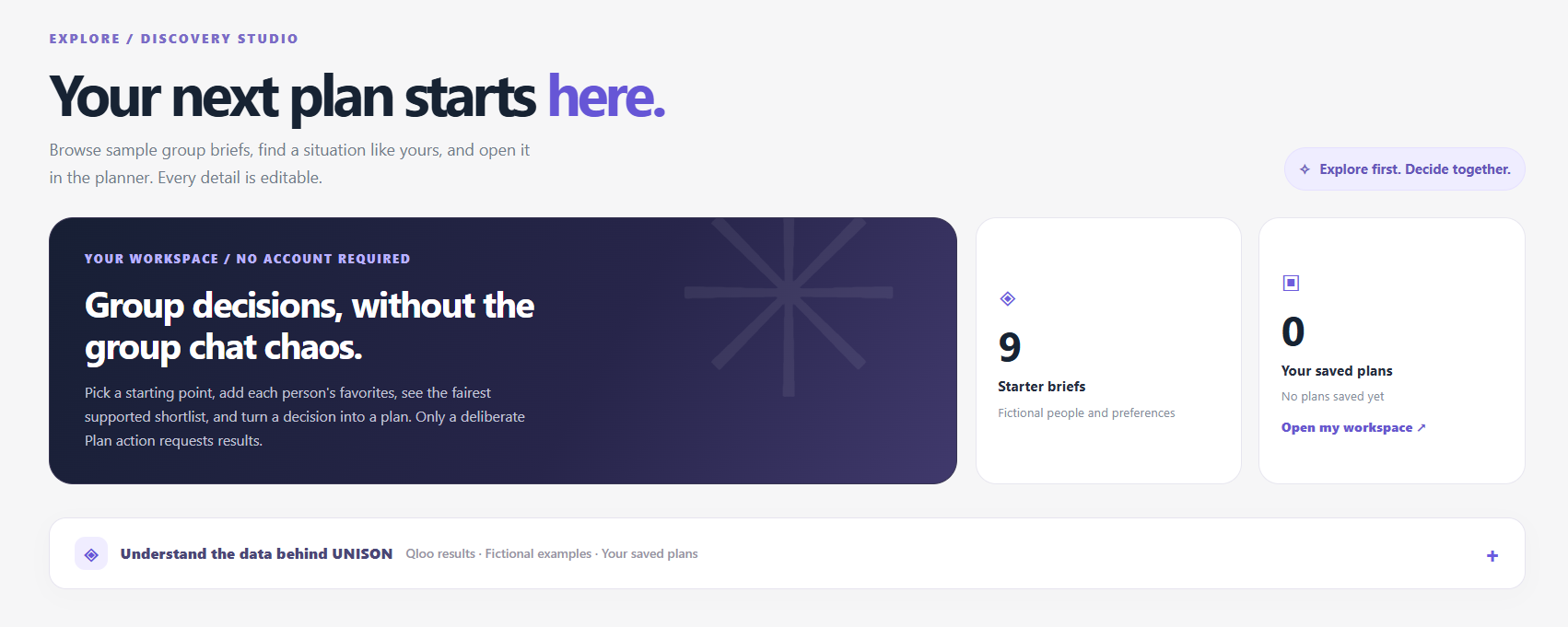
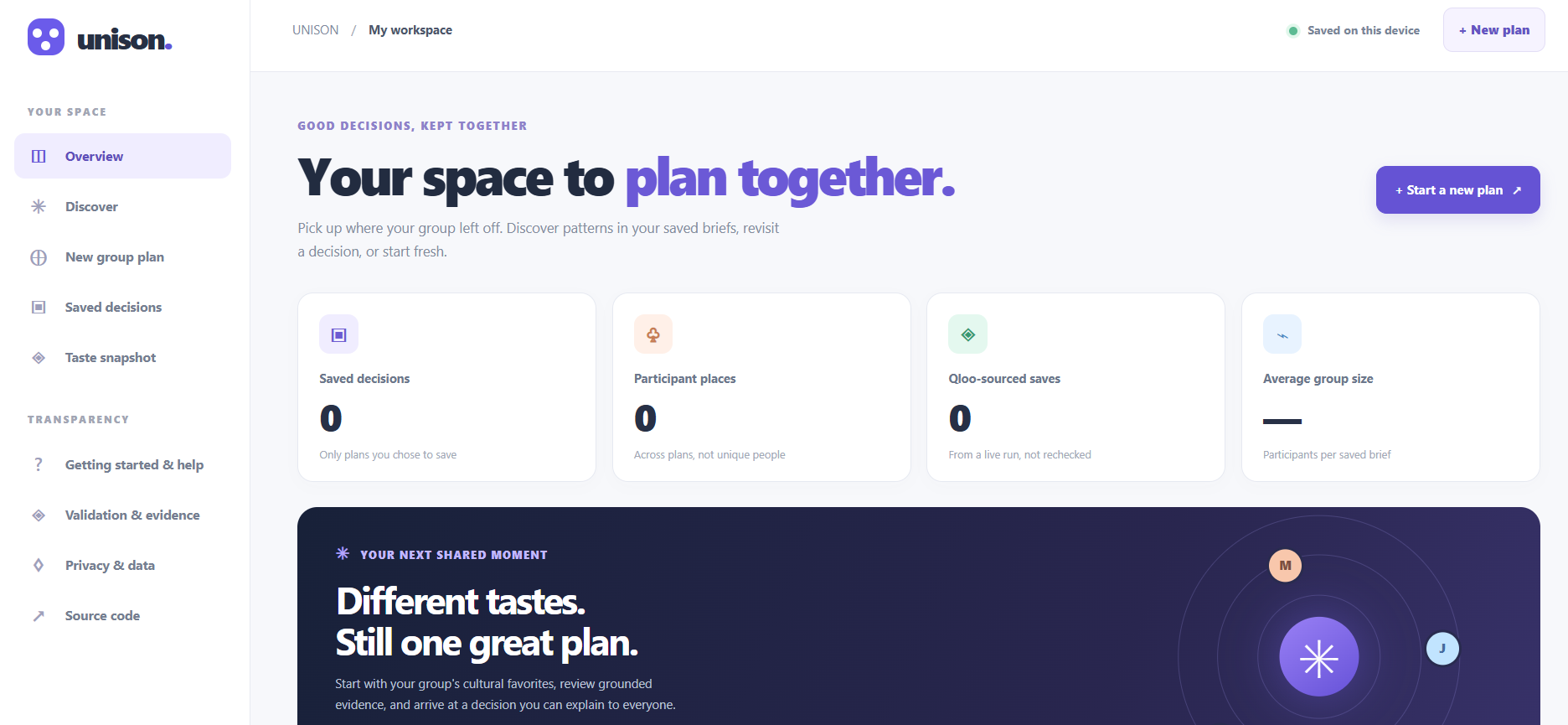
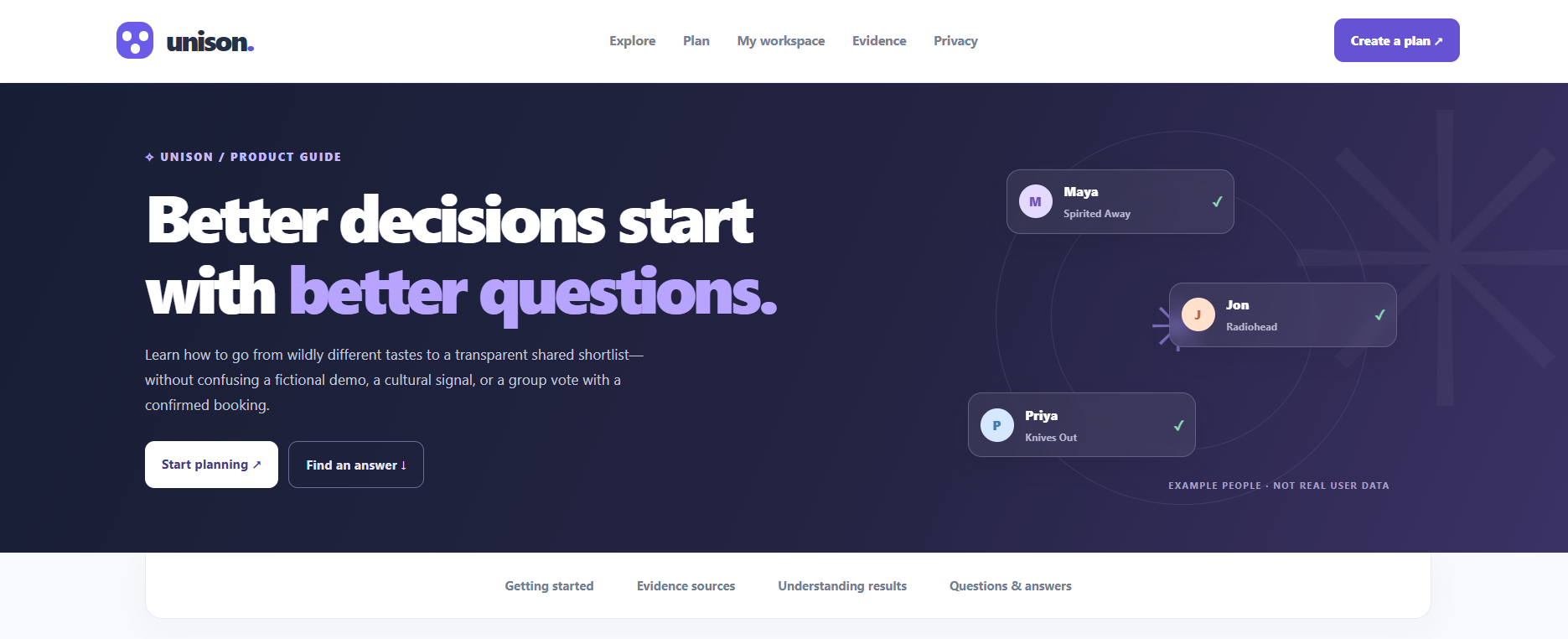
UNISON includes an interactive planner, Discovery Studio, Taste Inspiration Library, private planning workspace, evidence audits, fairness controls, human voting, decision exports, and a dedicated Product Guide.
Most importantly, we successfully tested real authenticated Qloo workflows for selected movie and outing scenarios, including groups of two, three, and five participants.
Our public Evidence Studio links directly to the corresponding GitHub Actions verification runs.
What we learned
We learned that cultural intelligence becomes especially valuable when it connects different domains and multiple people.
We also learned that trustworthy AI products need to explain what their data supports, where evidence is missing, and which decisions belong to humans.
What's next
Our next priorities include real-user testing, independent venue verification, expanded cultural coverage, and optional secure multi-device collaboration.
We want to evolve UNISON into a dependable group-planning product while preserving transparent recommendations, privacy, and human control.
Built With
- chatgpt
- codex
- css
- github
- html
- javascript
- node.js
- qloo
- render


Log in or sign up for Devpost to join the conversation.