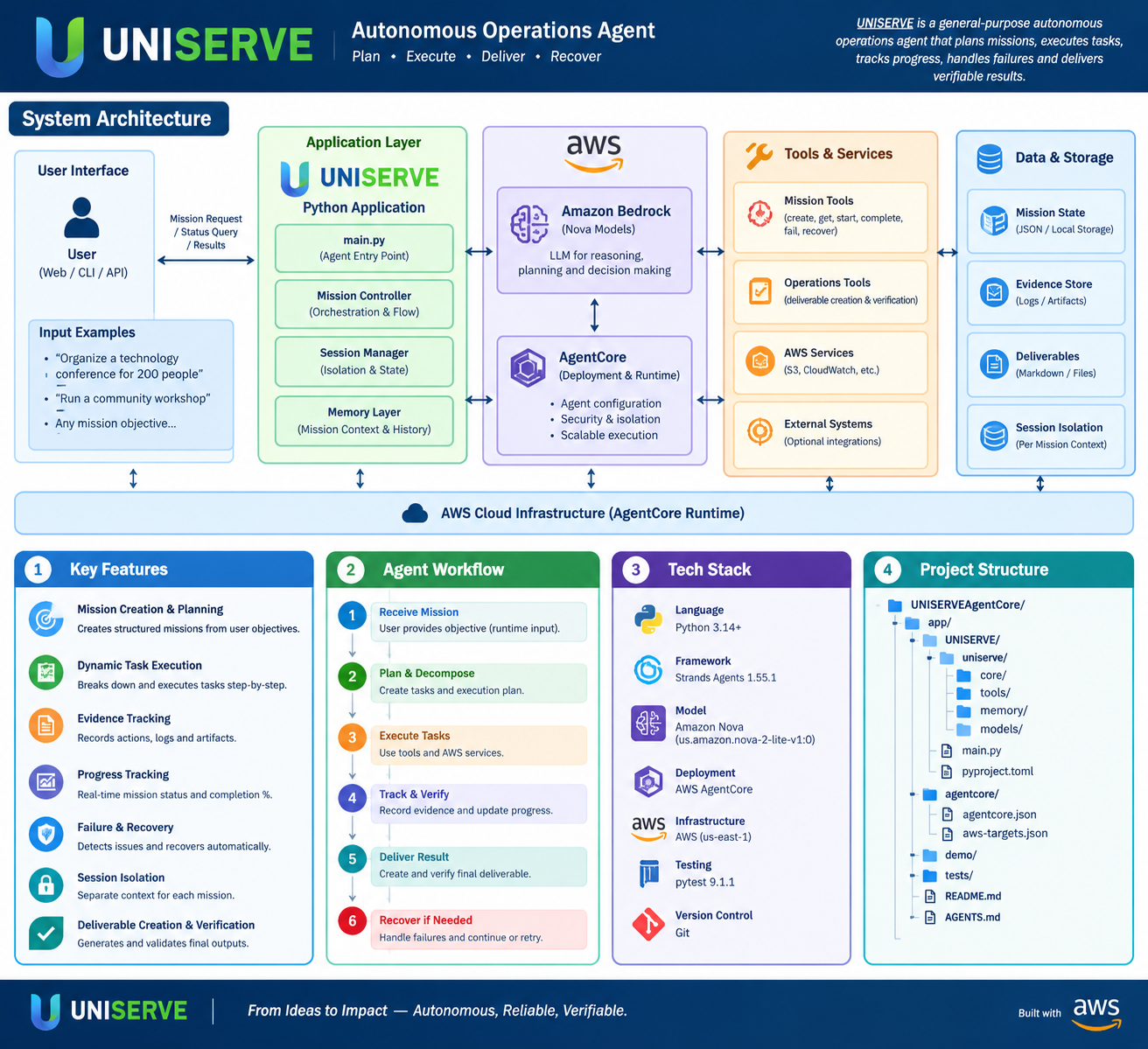
UNISERVE — Autonomous Operations Agent
What inspired us
Many real-world assignments are not simply a sequence of predefined successful steps. When something changes or fails, a human often has to stop, analyze the situation, decide what to do next, and restart the workflow.
UNISERVE was built around a simple question:
What if an operations agent could receive a human assignment, execute it as a mission, recognize failure, recover, and verify the final result?
That idea led to UNISERVE — an autonomous general-purpose operations agent designed to move beyond simple task execution.
What UNISERVE does
A human provides an assignment. UNISERVE turns that assignment into an executable mission.
The agent can:
- Create a mission from a human objective
- Break the objective into tasks
- Track mission and task state
- Execute tasks through operational tools
- Detect and record failures
- Analyze whether a failure is recoverable
- Execute a recovery strategy
- Continue the mission after recovery
- Record evidence and mission state
- Create a final deliverable
- Verify the deliverable
Demonstration
The demonstration assignment is:
"Organize a technology conference for 200 people."
UNISERVE creates three tasks:
- Define requirements
- Find suitable venue
- Arrange speakers
During execution, the original venue becomes unavailable.
Instead of pretending that the task succeeded, UNISERVE records the failure and changes the mission state to RECOVERY_REQUIRED.
The recovery engine determines that the failure is recoverable and selects an alternative_resource strategy. The recovery is executed, the mission returns to execution, and the remaining task is completed.
The final result is:
- 100% mission progress
- 3 completed tasks
- 0 failed tasks
- Mission completed
- Verified deliverable
The demonstration therefore shows:
Human assignment → Mission → Execution → Failure → Recovery → Evidence → Completion → Verified deliverable
How we built it
UNISERVE was built in Python using AWS Strands Agents and Amazon Bedrock AgentCore.
The implementation separates the agent runtime from the mission controller, recovery engine, operational tools, model loading, and deliverable verification.
The project includes:
- Strands Agent integration
- AgentCore Runtime application
- Dynamic assignment support
- Mission creation and task lifecycle
- Mission progress tracking
- Failure detection
- Recovery handling and execution
- Evidence recording
- Session-isolated mission state
- Deliverable creation and verification
The application was also validated with the AgentCore validation tooling and the complete mission lifecycle was demonstrated locally.
What we learned
Building UNISERVE reinforced that useful agentic systems need more than a model that can produce an answer.
An operational agent needs explicit state, tools, failure handling, recovery logic, evidence, and verification.
The most important design principle was:
Do not pretend success when execution fails. Detect the failure, reason about recovery, execute the recovery, and verify the final state.
Challenges
One of the major challenges was designing the mission lifecycle so that failure did not terminate the entire operation.
We therefore separated mission state from individual task execution and introduced explicit recovery states and recovery strategies. This allowed UNISERVE to continue a mission after a recoverable failure while maintaining an auditable state.
Another challenge was preparing the system for AgentCore while keeping the local demonstration deterministic and easy to understand.
Why it matters
UNISERVE is intended to help people delegate multi-step operational work to an agent while retaining visibility into what the agent is doing.
Rather than only answering a request, UNISERVE is designed to plan, act, adapt, recover, and verify.
The long-term vision is an operations agent that can accept a wide range of human assignments and reliably turn them into completed, evidence-backed outcomes.
Built With
- agentcore
- agentic
- python
- strands


Log in or sign up for Devpost to join the conversation.