Inspiration
International applicants have to combine admissions requirements, tuition, scholarships, deadlines, program details, and other university information across many university, government, ranking, and community sources. AI can make that faster, but conventional AI answers often hide where a claim came from or present stale, conflicting, missing, or incomplete information too confidently.
UniProof was built around a different rule: if a claim matters, users should be able to inspect where it came from, and uncertainty should remain visible instead of being guessed away.
What it does
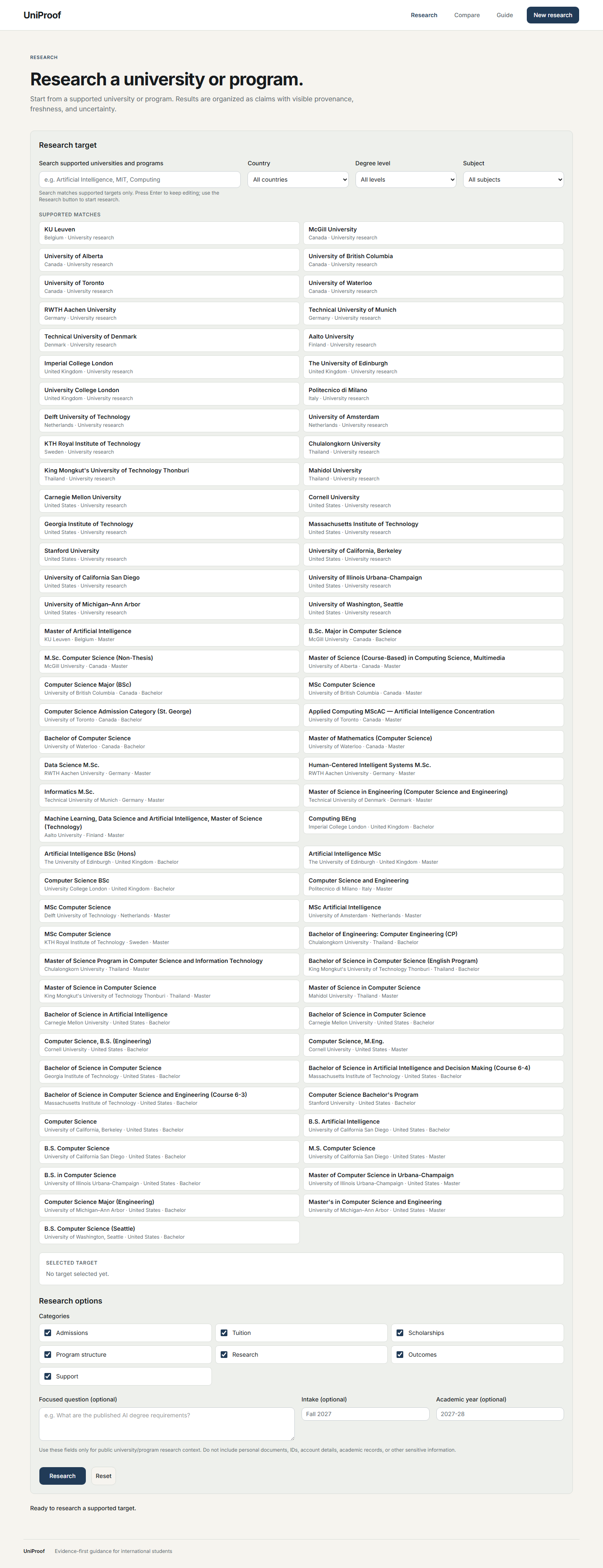
UniProof is an evidence-first AI university research, comparison, and application-guidance application for international students. Its checked-in catalog currently covers 30 universities and 45 computing programs across 11 country codes.
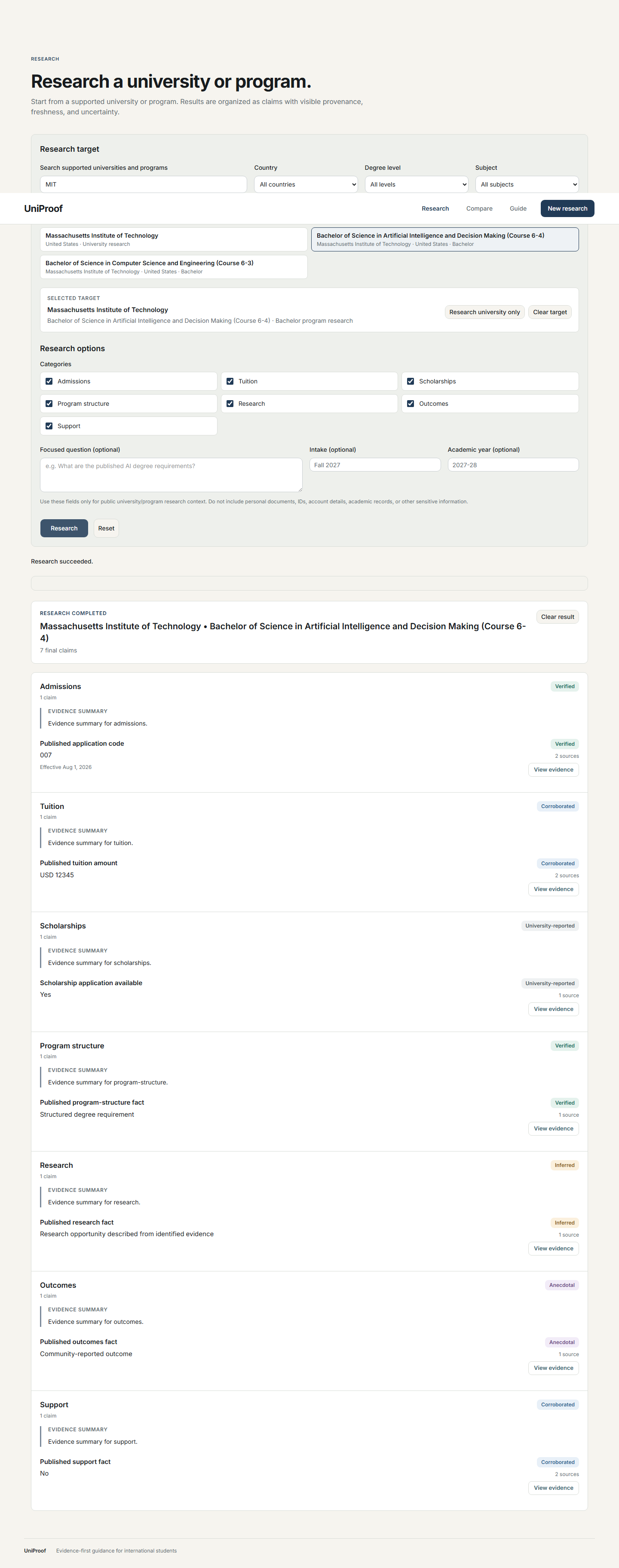
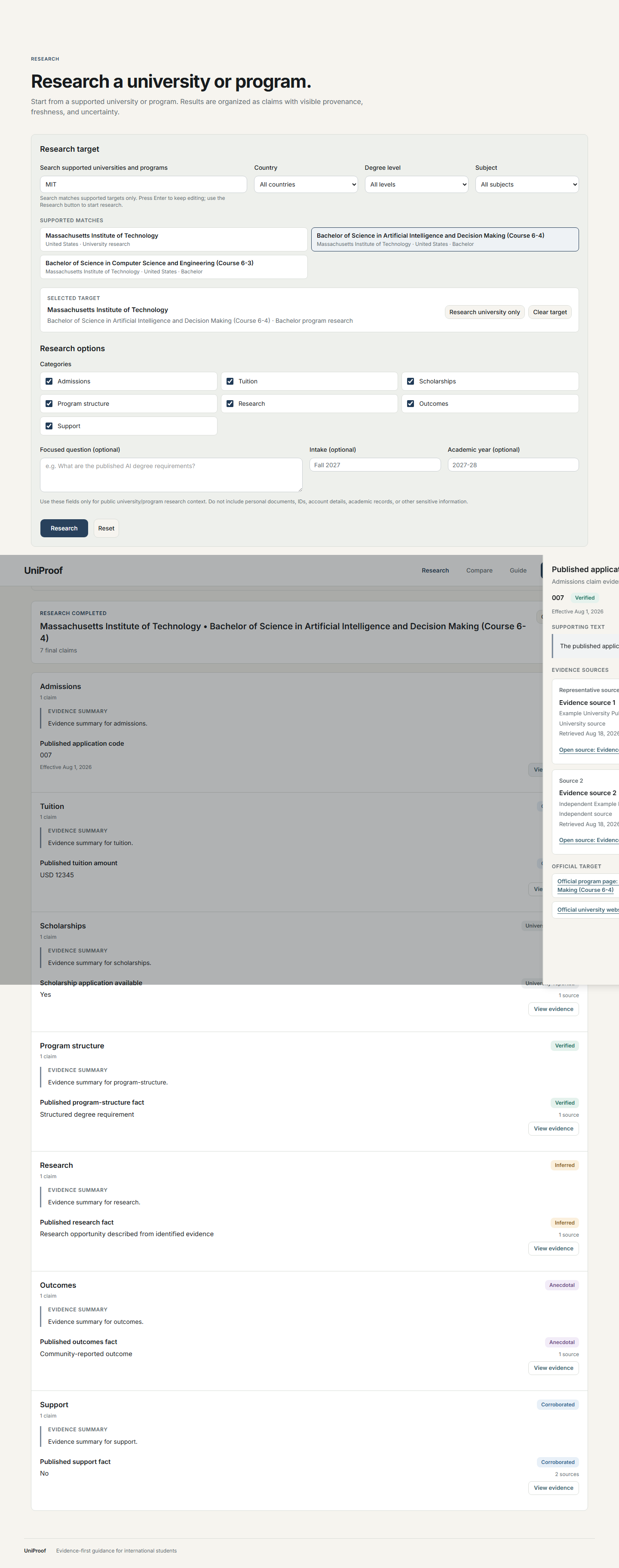
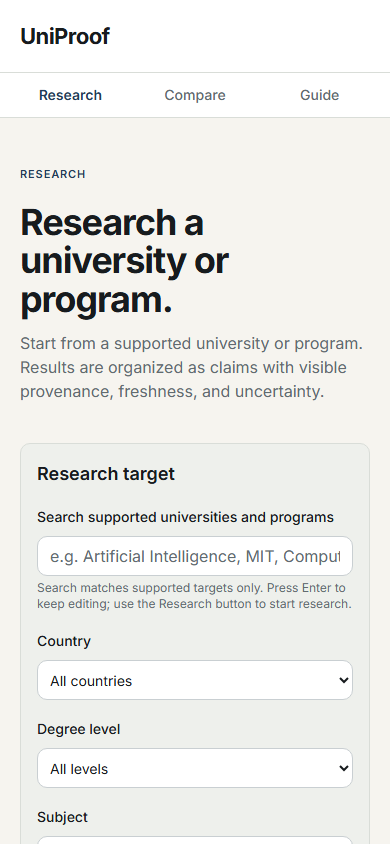
- Research creates structured university/program dossiers with source links, evidence state, supporting evidence, academic context, conflicts, unknowns, and operationally incomplete states.
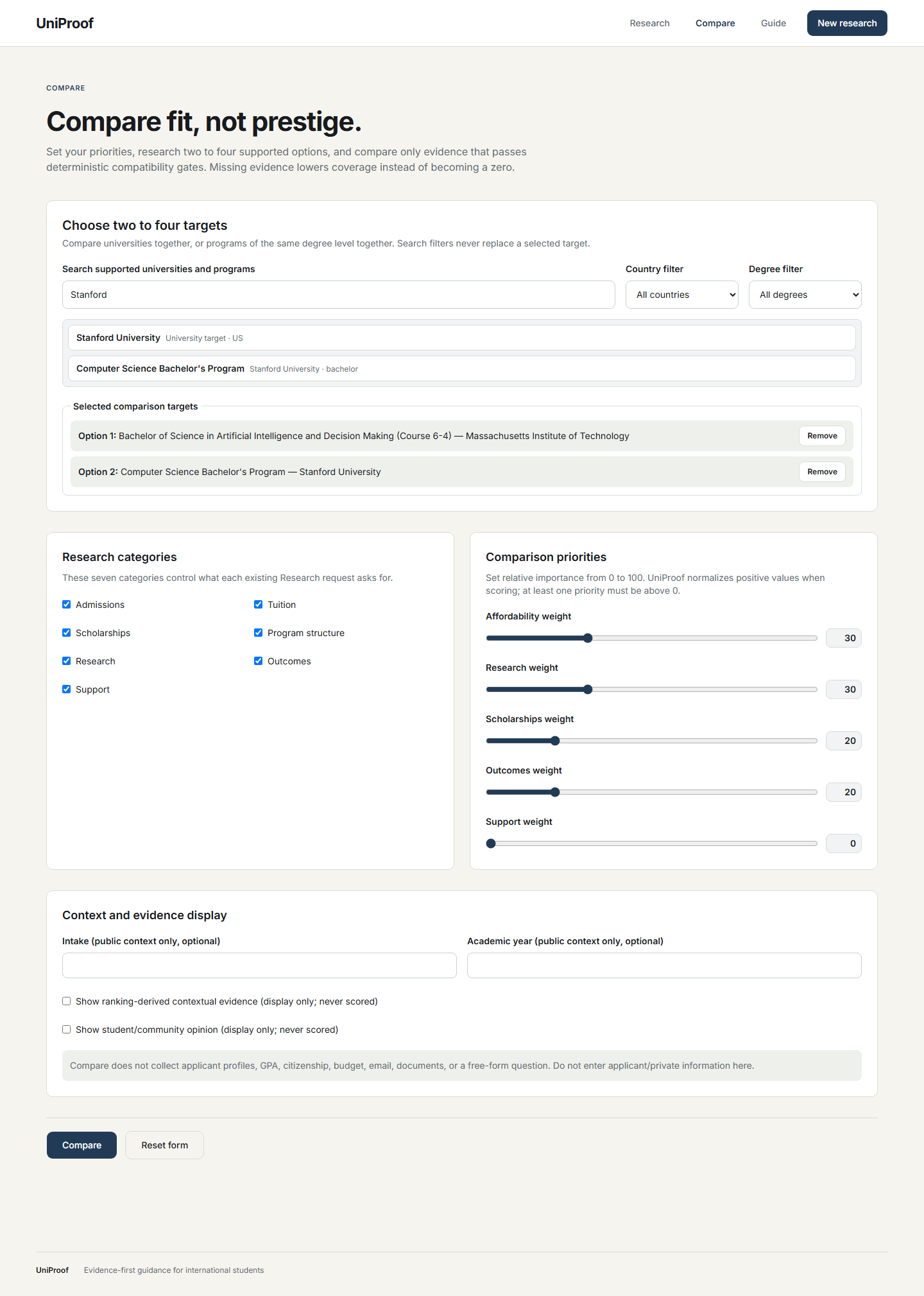
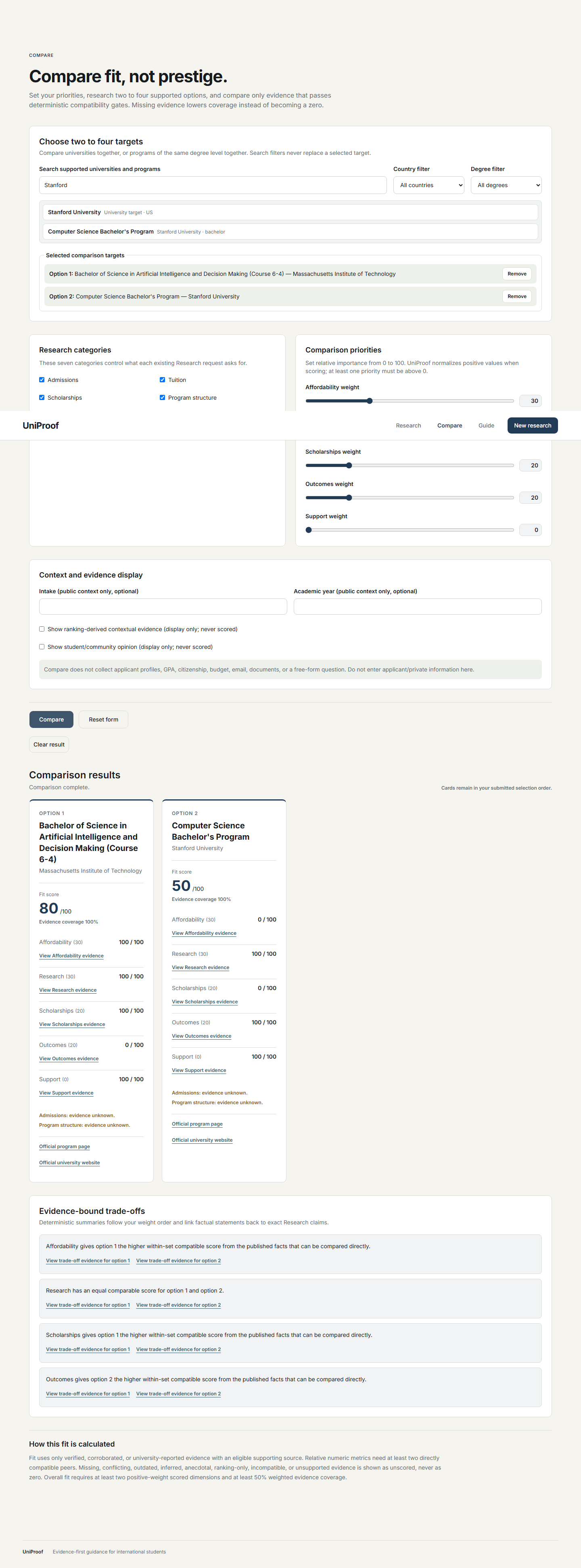
- Compare researches 2–4 compatible programs and applies deterministic, user-controlled priorities. Missing or ineligible evidence lowers visible coverage instead of becoming a fabricated zero or arbitrary ranking.
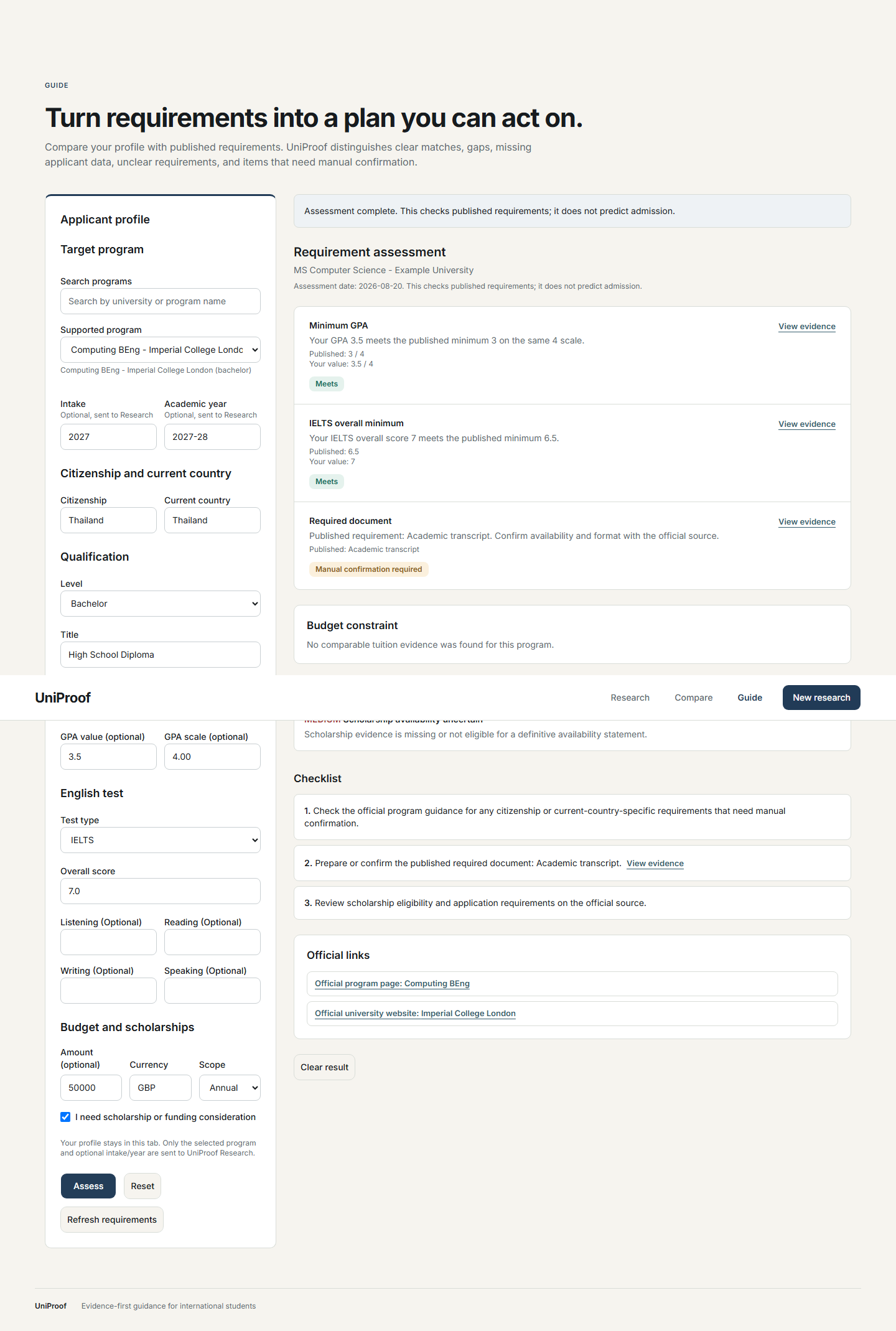
- Guide maps an applicant profile against published requirements and produces deterministic assessments, risks, checklist items, deadlines, and official next steps. Applicant academic and financial profile values stay out of the public Research/AI provider request.
The core product rule is simple: important factual claims keep their evidence and provenance. Missing, conflicting, stale, inferred, anecdotal, or incomplete evidence stays visible.
How we built it
UniProof is built with Next.js 16, React 19, TypeScript, Zod, and Tailwind CSS, deployed on Vercel. Optional Supabase authentication and saved snapshots are implemented, but the public hackathon release intentionally keeps the main Research, Compare, and Guide workflows anonymous because production account email delivery is not enabled.
The Research pipeline is:
- Select a supported university/program and evidence categories.
- Discover public sources with Tavily and Brave Search fallback.
- Retrieve sources through a bounded, SSRF-resistant transport.
- Normalize and segment public documents.
- Use structured AI extraction/reconciliation through Groq with OpenRouter fallback.
- Apply deterministic application-owned evidence rules for identity, provenance, source authority, scope, academic period, freshness, conflicts, and operational completeness.
- Feed the validated dossier into Research, Compare, and Guide.
The central technical idea is: AI proposes structured meaning; deterministic evidence policy decides what the product is allowed to assert.
AI integration
AI performs semantic extraction and reconciliation of candidate facts from retrieved public university and program material. AI is deliberately not the final authority.
Application-owned deterministic validation decides whether information can be presented as verified, corroborated, conflicting, inferred, outdated, anecdotal, unknown, or operationally incomplete. Compare and Guide then consume that validated evidence instead of asking an LLM to invent rankings, fit scores, university winners, or admission probabilities.
Challenges
The hardest engineering work was keeping evidence trustworthy through real failure cases: changing or unreliable web sources, conflicting official pages, different academic years/scopes/currencies/units, provider failures and timeouts, partial source failures, cancellation and race conditions, and preserving provenance through downstream Compare and Guide logic.
We also had to make sure incomplete evidence never silently became a confident conclusion. If one selected source fails while another supports a claim, UniProof can preserve the supported evidence while showing a source-gap warning and preventing downstream logic from treating the category as definitive.
Accomplishments
- Evidence provenance survives from retrieval through the user interface.
- Missing, conflicting, stale, inferred, anecdotal, and operationally incomplete evidence remains explicit.
- Compare combines deterministic user-priority scoring with visible evidence coverage rather than a prestige ranking.
- Guide does not predict admission probability and keeps applicant profile values outside the public Research/provider chain.
- Production uses a request-nonce Content Security Policy, private/no-store application responses, bounded provider/request execution, and a deployment-layer WAF rate limit scoped to the Research endpoint.
- The hardened release passed extensive unit, browser, security, persistence/database, type, lint, build, and production verification before deployment.
What we learned
Trustworthy AI research requires more than model quality. Identity binding, source ownership, temporal context, retrieval security, provenance, deterministic evidence eligibility, cancellation ownership, privacy boundaries, and explicit uncertainty are product features.
Sometimes unknown or incomplete is a better answer than an unjustified prediction.
What's next
- Expand supported universities and programs while preserving catalog identity and evidence rules.
- Improve live-source resilience and provider observability without exposing provider payloads or private data.
- Add carefully reviewed semantic aliases only where deterministic interpretation remains safe.
- Enable production account email delivery before exposing hosted saved snapshots.
- Extend evidence-aware application planning while preserving the same provenance and uncertainty boundaries.
Links and license
- Live project: https://uniproof-beta.vercel.app
- Public source: https://github.com/PracticalSwan/UniProof
- License: MIT License (
LICENSEin the repository)
Judging alignment
- Originality: evidence-first AI research with deterministic authority and uncertainty boundaries instead of one opaque generated answer.
- Design: Research, Compare, and Guide share one evidence language and let users inspect supporting material.
- Potential Impact: helps international applicants avoid acting on unsupported, stale, or context-mismatched university information.
- Technological Implementation: bounded multi-provider research, SSRF-resistant retrieval, strict runtime contracts, deterministic evidence/scoring/assessment layers, privacy separation, CSP, WAF, and extensive automated verification.
Built With
- brave-search
- groq
- next.js
- node.js
- openrouter
- playwright
- react
- supabase
- tailwind-css
- tavily
- typescript
- vercel
- vitest
- zod