Inspiration
Across the world, labor is undergoing a revolution. Sometimes quiet, when legislators and federal judges are pushed towards supporting employees’ rights in the workplace, and sometimes loud, with protests against the draconian working conditions enforced by profiteering corporations. Unions have long been the average worker’s answer to the ultra-powerful conglomerates, leading to higher average wages, better health, and higher overall job satisfaction. However, according to the Bureau of Labor Statistics, labor union density as a function of population has dropped by half over the last 35 years. It’s no coincidence that the United States’ Gini Coefficient, a statistic representing the overall wealth inequality in a nation, has been steadily rising as well. In fact, in terms of wealth inequality, the United States is 6th to last out of the 38 member countries of the Organization for Economic Cooperation and Development. The COVID-19 pandemic has only exacerbated the issue, resulting in dramatic blue-collar job losses across the board - only now without the security of unions to back many of the workers up.
So why have unions been on the decline? It’s a complex problem resulting from multiple compounding factors, but foremost among them has been the rise of union-busting tactics in modern corporations, such as strike-breaking and illegal threats of losing one’s job. It’s a problem that continues to rear its head even today, as evidenced by the controversy surrounding Amazon’s treatment of factory workers, and cheap outsourced (sometimes child) labor by most major manufacturing firms.
In doing preliminary research, we discovered that there were some resources in place for workers to address poor working conditions, such as the National Labor Relations Bureau, but the resources were poorly maintained and difficult to access. In fact, the official NLRB government website was down for the entire period of the hackathon with no updates or information regarding when it would be back. We decided it would be a worthwhile and effective endeavor to modernize the solutions for worker empowerment currently available, while also working to preserve the unions that have empowered Americans since the 19th century.
What it does
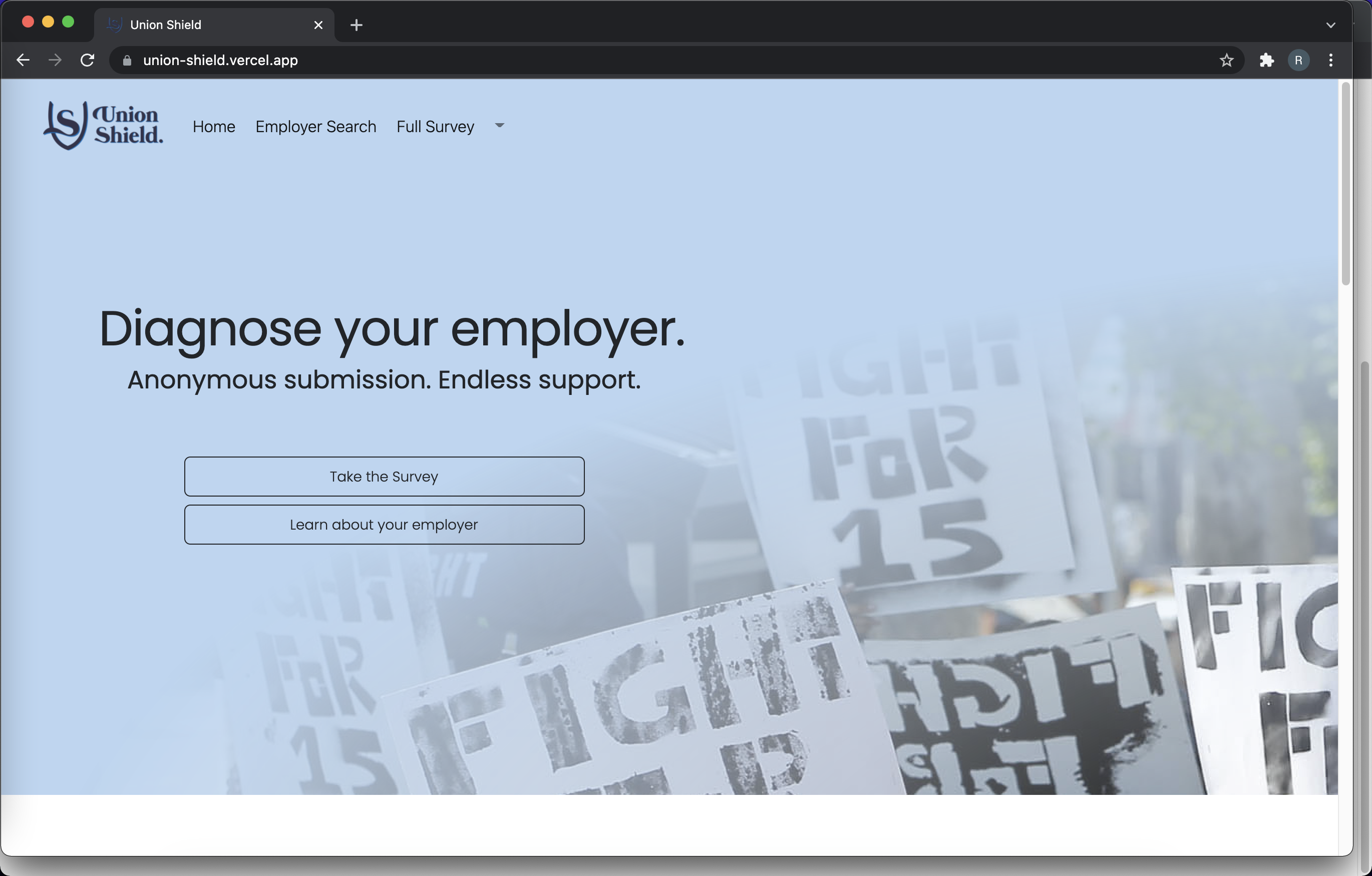
Our website will inform workers who are unsure of unionizing the benefits of doing so and how they can get involved. In addition, our website enables laborers to essentially review their employer and visualize how well the employer-employee relationship is at that company.
The website can be broken down into three major sections - Education, Workplace Reporting, and Employer Search.
The Education section of the website is purely informational - it provides users with explanations of unions, their benefits, and your rights as a worker. We also included information about legislative initiatives to expand workers’ and unions’ rights. This information is typically obscured or heavily buried in difficult-to-navigate government websites, so we decided to make the facts known clearly and simply right on our homepage.
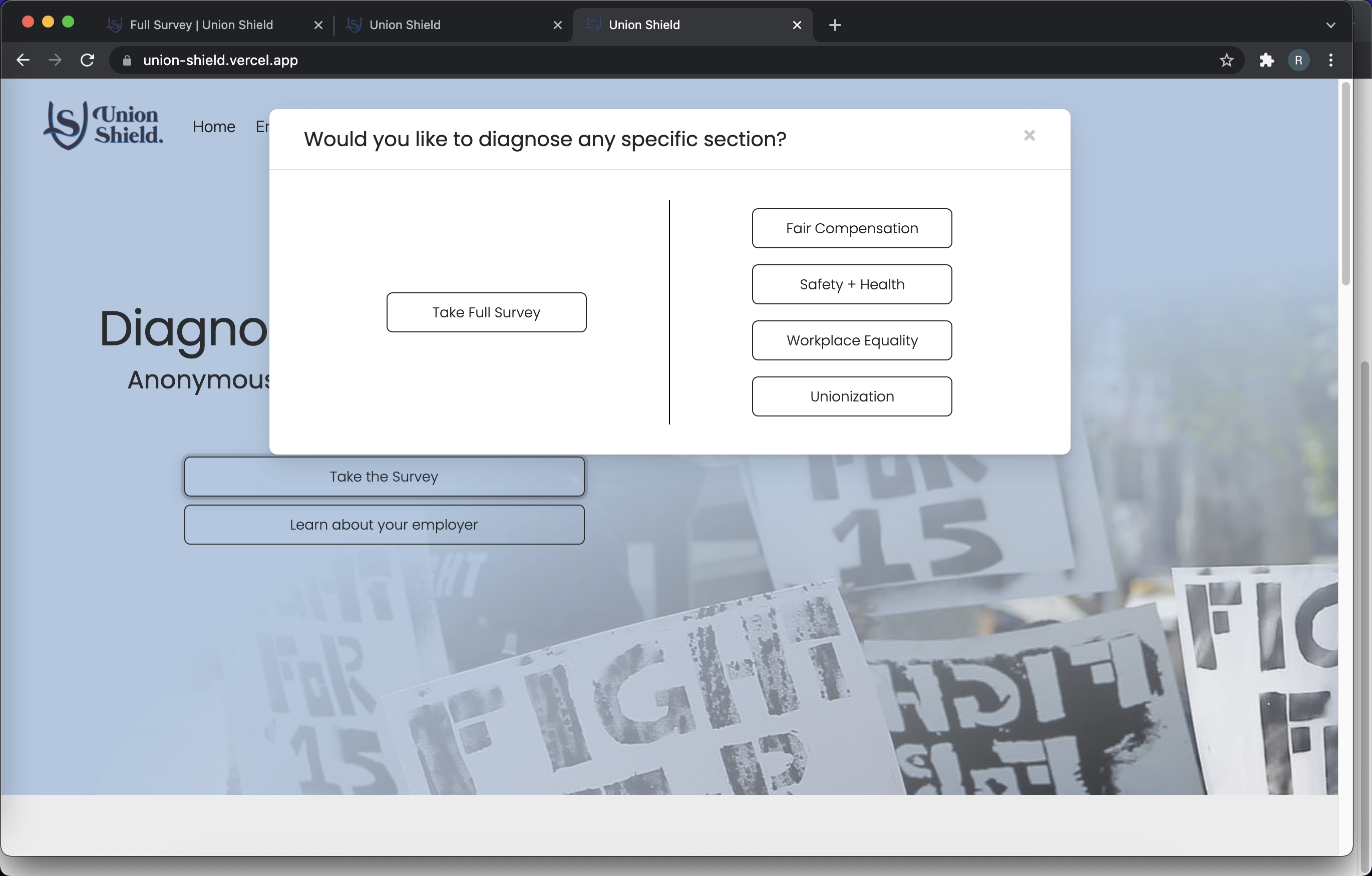
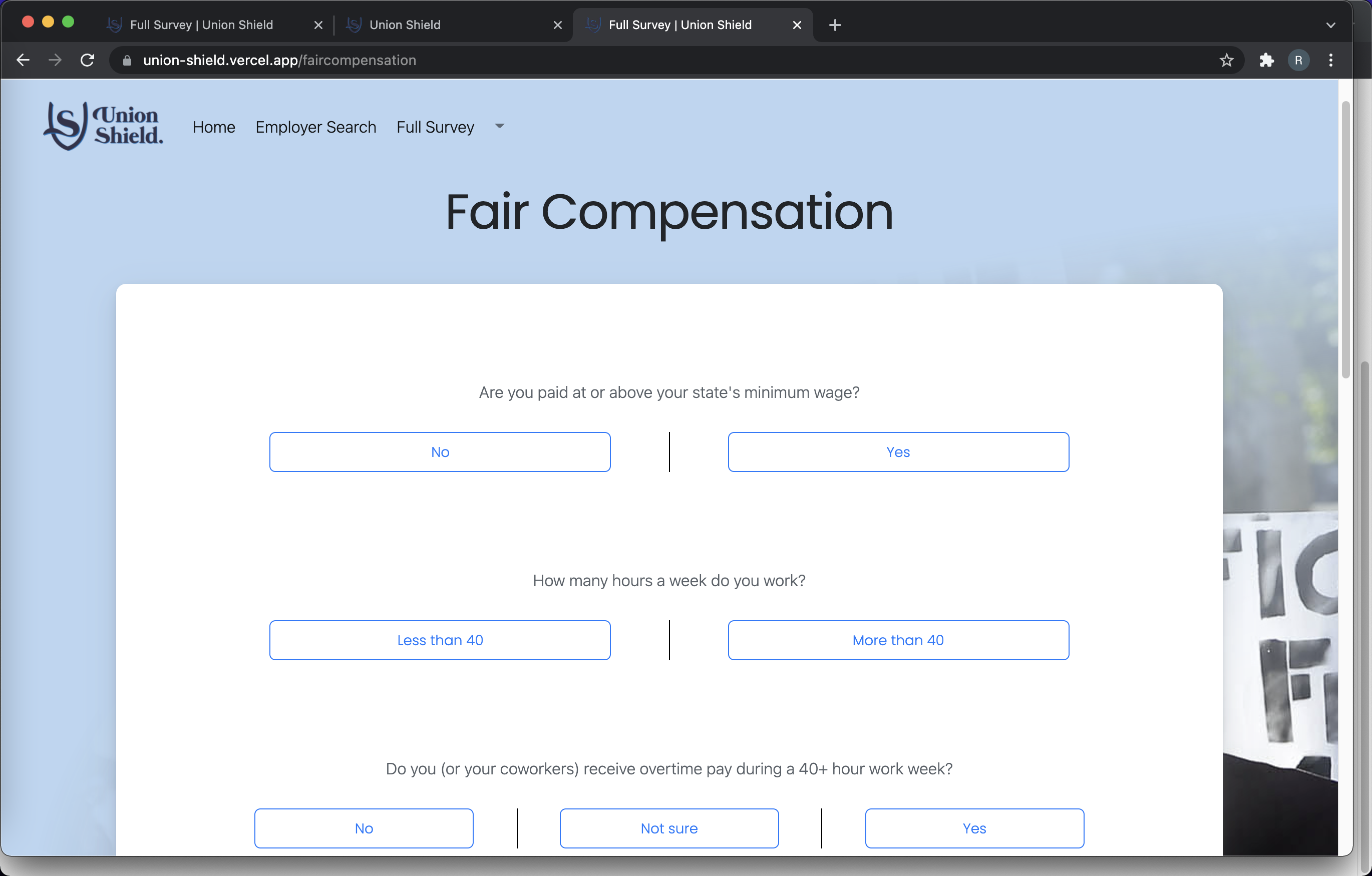
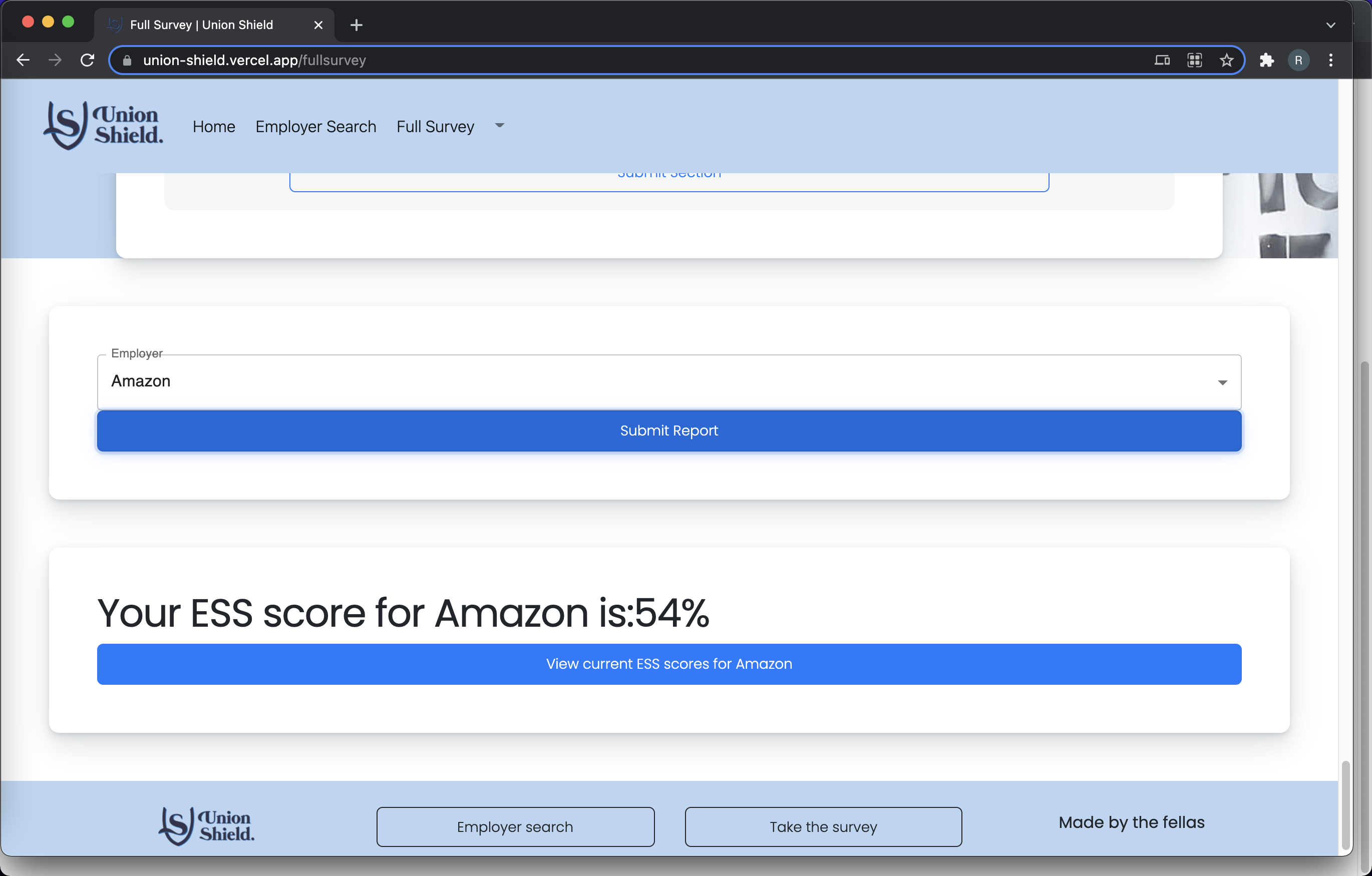
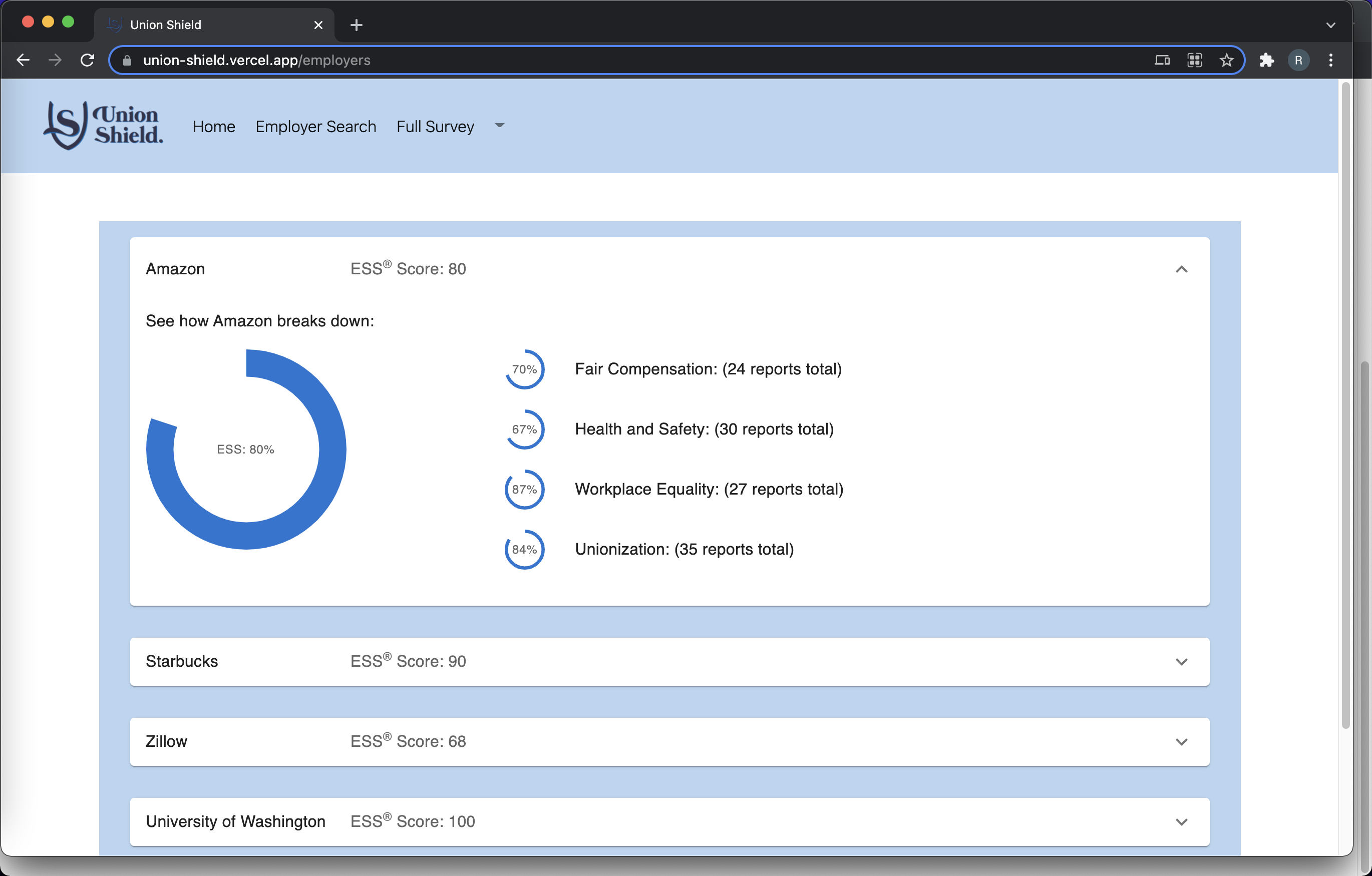
The Workplace Reporting section is the cornerstone of our service’s functionality. We constructed a series of questionnaires revolving around the 4 core worker’s rights as delineated by the National Labor Relations Bureau: the right to fair compensation, health and safety, workplace equality, and unionization. Site visitors have the option to complete a workplace report revolving around one of the four core rights - an especially useful functionality if a user believes his company has committed infractions regarding one of the core rights and wants quick answers regarding the extent of the issues. Each of the 4 core right questionnaires returns a percentage score when complete, with lower percentages indicating greater infractions of the core workers’ rights. Users also have the option to perform a Full Survey, which acts as a combination of all four Core Rights questionnaires and returns a numerical aggregate score known as the Employee Support Score, or ESS. A high ESS signifies that a company has demonstrated significant employee support, whereas a low ESS means the opposite.
The Employer Search part of the website goes hand-in-hand with the Workplace Reporting feature, as it lets users look up a wide variety of companies and their respective Employee Support Scores, along with the company’s ratings on the four cornerstone metrics mentioned previously. The ESS displayed is an average of the employee ratings of a company submitted to our service through the Workplace Reporting functionality. This section of the website allows users to discover supportive workplaces and avoid unsupportive ones, helping them successfully navigate a job environment that is increasingly hostile to the individual worker.
How we built it
First, we set everyone up with the necessary tools for our project; everybody installed node.js and set up npm within powershell to run our website locally. Then we divided up the initial tasks, having two of us work on the initial website framework, deciding the color scheme, and designing the logo, and the other two researched the specifics and statistics behind unionization and developed the Employee Support Score (ESS) metric. Once we had all the building blocks set up, all of us began programming. Two of us worked on the backend to develop the framework for the survey and the database integration, while the other two worked on the front end to display all the statistics and information we desired. At midnight, integration hell struck: putting together the separate pieces of a project is never easy, however we knew that going into this entire ordeal and took the time to design around each other's needs. After a couple of hours of debugging, poking, prodding, breaking, and fixing, the website was finished. Finally, we all worked together to finish our deliverables, from scripting, animating, and narrating the video to composing this DevPost.
Challenges we ran into
The main challenge we faced was working with completely new objects and programming languages. We primarily worked with Next React JavaScript which, to us, was basically an odd combination of HTML and CSS. Only one of us had experience with this language, the learning curve was incredibly steep but we pushed through. Using Next React JS enabled us to use the Shards and Material UI packages which led to a very clean website design. However, both the package and the language itself had minimal documentation and support - sifting through it to find how to even center an image was a challenge, there was no guarantee you would even find the right line of code. However, we all still have a good foundation in computer science so we decided to put that to good use, essentially coding using our intuition to guess exactly how different things would be implemented or how we should construct the architecture of the entire website to avoid certain problems, like redundant code between .js files, from the get go.
Alongside the client side application, this was the first time any of us had touched mongoDB. We knew that to save this data we would have to use some sort of storage - this was actually the very first thing we even tackled, the backend. The first thing implemented onto the website was simply accessing a test database of movie titles. That list was also the last thing we removed from the file, it became an indicator that everything’s connected and working as planned. Writing to the database, due to our architecture, was also exceptionally difficult seeing as at times we display different amounts of questions on our survey page. This means that the data you add into the database each submission also changes. However, after some time trying different things and debugging, we jumped that hurdle as well.
Accomplishments that we're proud of
Adaptability is key in the realm of computer science, a fact that we were forced to come to terms with today when we began the process of learning Next ReactJS. As a conglomeration of several programming languages, the debugging process was made incredibly arduous, and the lack of documentation simply compounded matters. The immense challenge made our eventual victory all the more sweet, as once we had learned the intricate tips, tricks, and syntaxes of the complex language, we were able to tease our project bit-by-bit into reality.
Developing the visual style of our product was always something that was especially important to us, and we’re thrilled with the end result. Through careful blending of palettes and minimalistic modern aesthetics, our website was transformed beyond simply a database interface into an elegant tool, one that would remain easy to use for anyone who picked it up. The visual aspect permeated all stages of the design process - since we were developing an online service, and not just a complex algorithm, we needed to make sure that we excelled in the field of UX. Whether that was designing a distinguished yet modern logo or building smooth transitions between our website elements, we ended up with a product that we knew we could be proud of.
What we learned
This project provided an avenue into understanding some of the systemic problems members of our society’s working class face, such as analyzing different forms of employer misconduct and anti-union practices. We gained an intricate understanding of a worker’s rights and legal options, which were broken down into four core categories: the rights to fair pay, health and safety, equality, and unionization. Gaining an understanding of these rights proved crucial when developing our employee support score (ESS) metric, as companies with a higher ESS inherently demonstrated better support of their employees’ fundamental rights. We also encountered many federal resources for the first time, such as the OSHA guidelines on workplace hazards and state minimum wage databases, and learned to navigate them and understand their uses.
On the technical side, this project served as a deep dive into enterprise-level web development architecture, incorporating both JavaScript interactive functionality and mongoDB integration. Since we used a wide variety of programming packages and services in our end product, they often interacted in confusing or unpredictable ways. It was imperative that we properly learned how to manage the integration of the disparate languages, and we dedicated a significant portion of our hackathon time towards achieving mastery over it. Traversing the snarls of code gave us a newfound appreciation for backend code developers, as even relatively simple UI elements could end up referencing classes incredibly deep in the file structure.
What's next for Union Shield
We ran out of time to implement the functionality where users can add new companies to the database. Currently, users can only choose from our limited list of companies, and there are a few bugs that we need to iron out in selecting a workplace. Regardless, there are many future directions for Union Shield. We were thinking about using the ESS to help identify companies that are extremely mistreating their employees and anonymously reporting them to the NLRB for investigation. Since many dissatisfied workers are also probably looking for other jobs, we were thinking of adding a job searching aspect to our website where workers can search for new jobs based on work environment-related criteria. In addition, we could also add a forum to allow other discontent workers to unionize, thereby elevating Union Shield into a tool directly facilitating positive social change.
Built With
- collections
- command-prompt
- databases
- javascript
- material-ui
- mongodb
- next
- node.js
- npm
- react
- shards-react

Log in or sign up for Devpost to join the conversation.