Inspiration
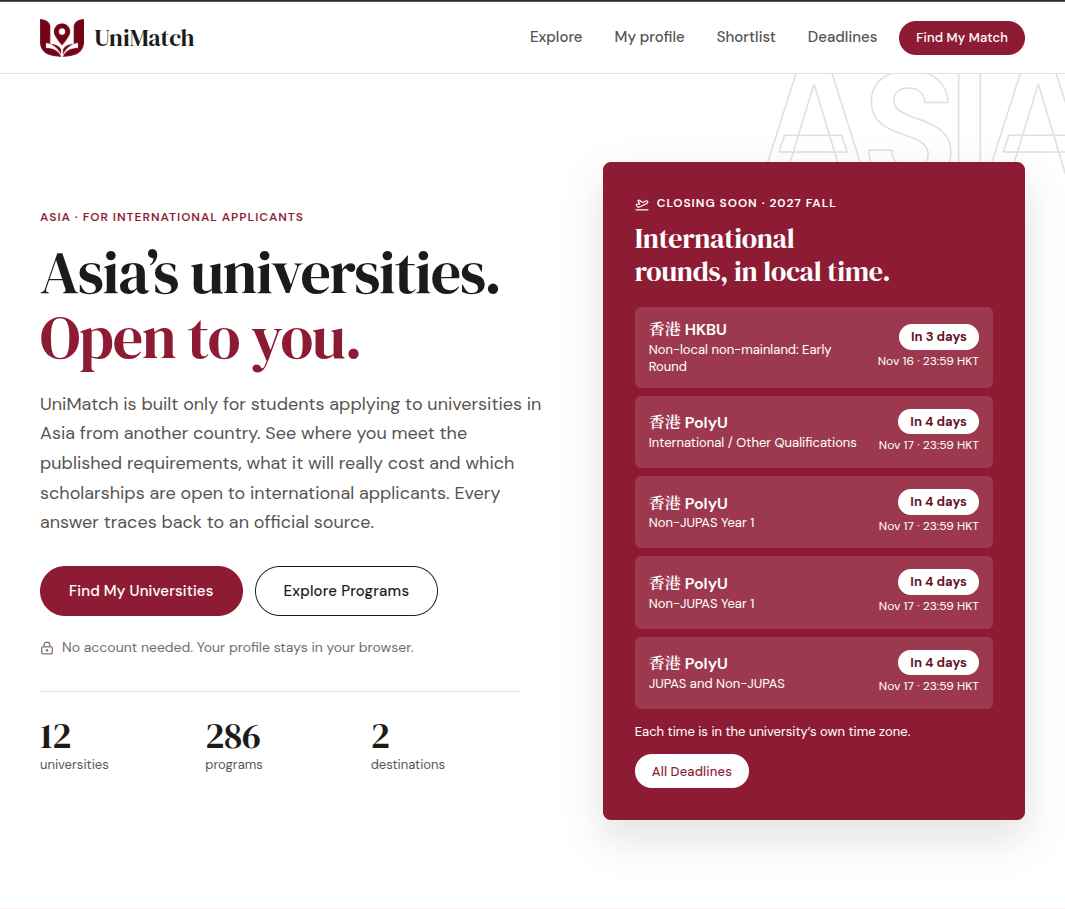
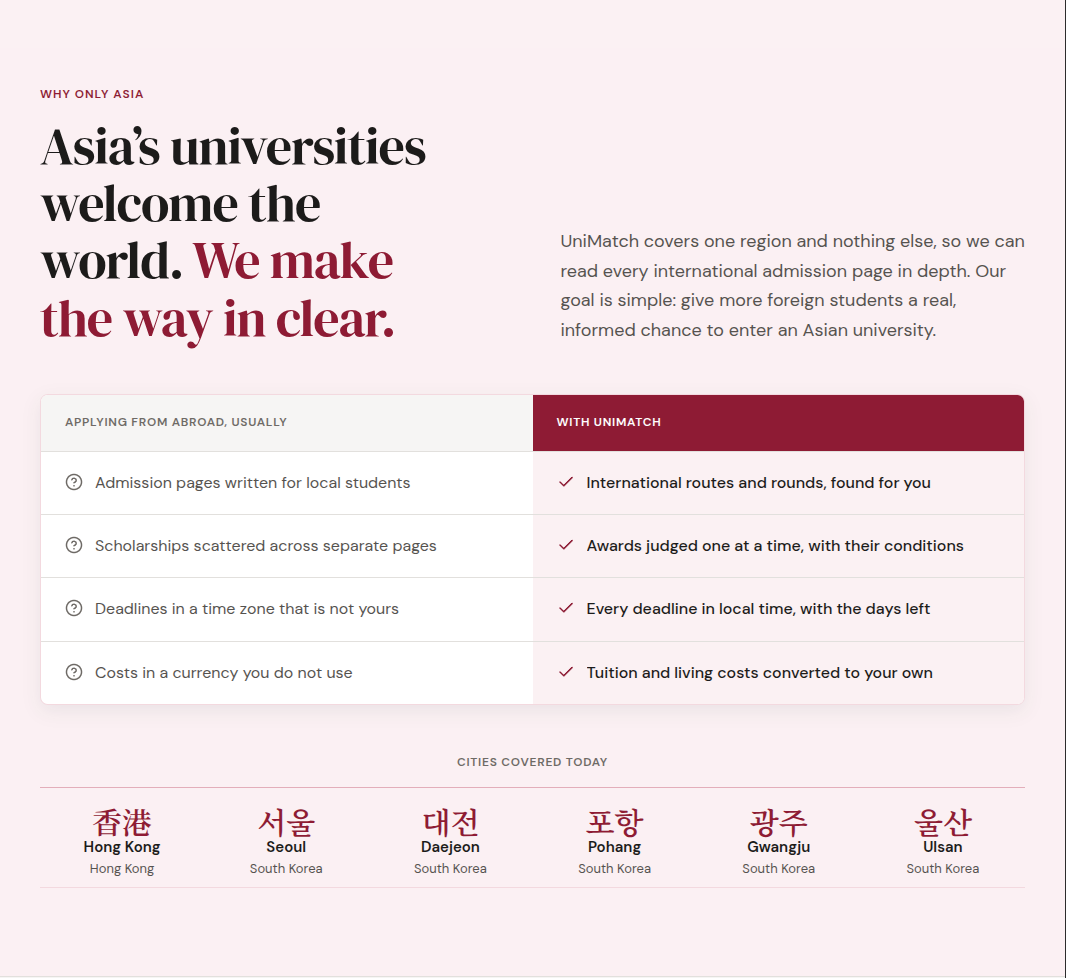
In Ukraine, most students aim for the US or Europe. Europe often expects you to learn French or German to get a scholarship, and in the US scholarships are very hard to win. I only discovered Asia recently, too late to apply myself. Yet there are many English-taught programs and excellent education here. In the West, tools like Common App put everything in one place. Asian universities are independent, so applying as an international student is much harder. UniMatch exists to make Asia more visible and accessible.
What it does
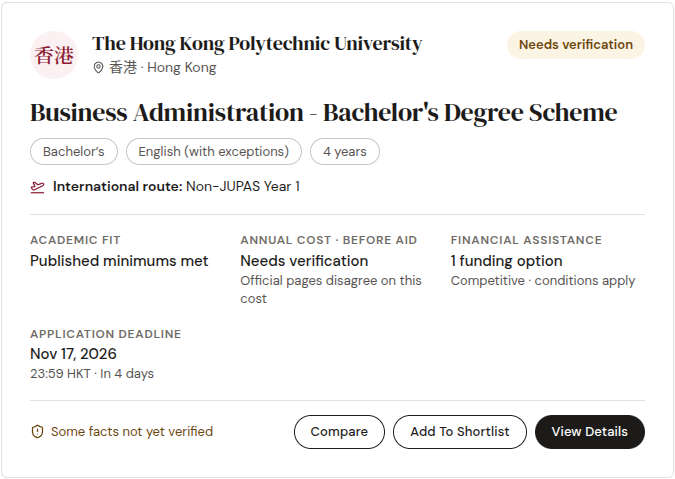
UniMatch helps international students find and compare university programs in Hong Kong and South Korea. A student builds a profile in three steps: where they're from, their qualifications and English scores, and their budget. For every program, UniMatch answers three questions separately: academic fit, application eligibility, and financial feasibility. There's no admission probability and no opaque score. Each check is Pass, Fail or Unknown, and missing data is never treated as a pass. Every fact links to an exact quote from an official university page. The profile stays in the browser, with no uploads and no account needed.
How I built it
I built UniMatch solo, using Claude Code as my main development partner. The app runs on Next.js with React and TypeScript, backed by PostgreSQL through Prisma, with Redis and BullMQ for background jobs. A guarded crawler collects pages from approved official university sites, and OpenAI's gpt-5.4-mini extracts requirements, deadlines, costs and scholarships as strict JSON. That output is only a candidate: I review and approve every record before students see it. Matching itself is deterministic and runs in the browser, using three-valued logic so missing evidence becomes Unknown, never a silent pass.
Challenges I ran into
The hardest part was the data. Each university describes the same qualifications, programs and requirements in its own terms, so there is no common format to rely on. Pulling facts from hundreds of programs across so many separate pages was slow and messy, and some key details sat behind JavaScript selectors or inside images. I also had to make sure AI extraction never invented anything. Every claim must match a verbatim quote on the official page, and anything unsupported is pruned before I review it.
Accomplishments that I'm proud of
I'm proud that UniMatch went from an idea to a working, genuinely useful tool, built solo in a very short time. The catalog now holds 286 first-year bachelor's programmes at 12 universities in Hong Kong and South Korea, each fact tied to a verbatim quote from an official page. A red-team spot check of 141 facts across 15 programmes found zero wrong values. Four sample students show the whole flow, from a strong IB applicant to one with missing scores, and automated tests fail if any of those stories stops holding.
What I learned
The biggest lesson was how to get reliable data off the internet. I learned how crawlers work, how to respect robots.txt and crawl politely, and how to turn messy university pages into a structured knowledge base. I also learned that AI extraction is only trustworthy with guardrails: verbatim quotes, automatic pruning of unsupported claims, and human review. Finally, I learned to treat "unknown" as an honest answer instead of guessing.
What's next for UniMatch
First, a public launch so students can actually use it, along with finishing the gaps in the current catalog, like Korean requirements and missing costs. Then I want to grow in two directions. One is depth: adding master's programs, which the matching engine already supports. The other is breadth: expanding beyond Hong Kong and South Korea to Singapore, Japan, Thailand, Taiwan, and eventually almost every Asian country that offers international education. The goal is to make Asia as easy to explore and apply to as the US or UK are today.
Built With
- cloudecode
- crawlee
- nextjs
- openaiapi
- playwrigh
- postgresql
- prisma
- python
- react
- typescrip
