Inspiration
Education today piles responsibilities onto students until the system outpaces what any one person can manage. Globally, 1.5+ billion learners navigate crowded curricula and life obligations. About 260 million are in tertiary education, and roughly 30% of university students leave before getting a degree. Almost 1 in 4 drop out during the first year. In the U.S. alone, 43 million adults hold "Some College, No Degree."
These students aren't failing from lack of ability — they're failing because life and study collide:
- 60%+ of students work while studying — shifting schedules break plans
- 6.9 million international students face harsher stakes: a single GPA drop can mean lost scholarships, visa cancellation, or forced withdrawal
- When overload hits, students don't open planners or chatbots — they freeze, panic, or fall silent
That moment is the Prompt Gap: when a student most needs help but lacks the clarity or capacity to request it. Existing tools assume the user can still act. They wait for prompts. But the exact people who most need support are the ones who can't prompt.
The real failure is not content delivery — it's the absence of continuous, proactive executive support: a system that understands classes, work, fatigue, deadlines, and finances, and steps in before short-term overload becomes a permanent loss.
Every college and university student faces this intersection:
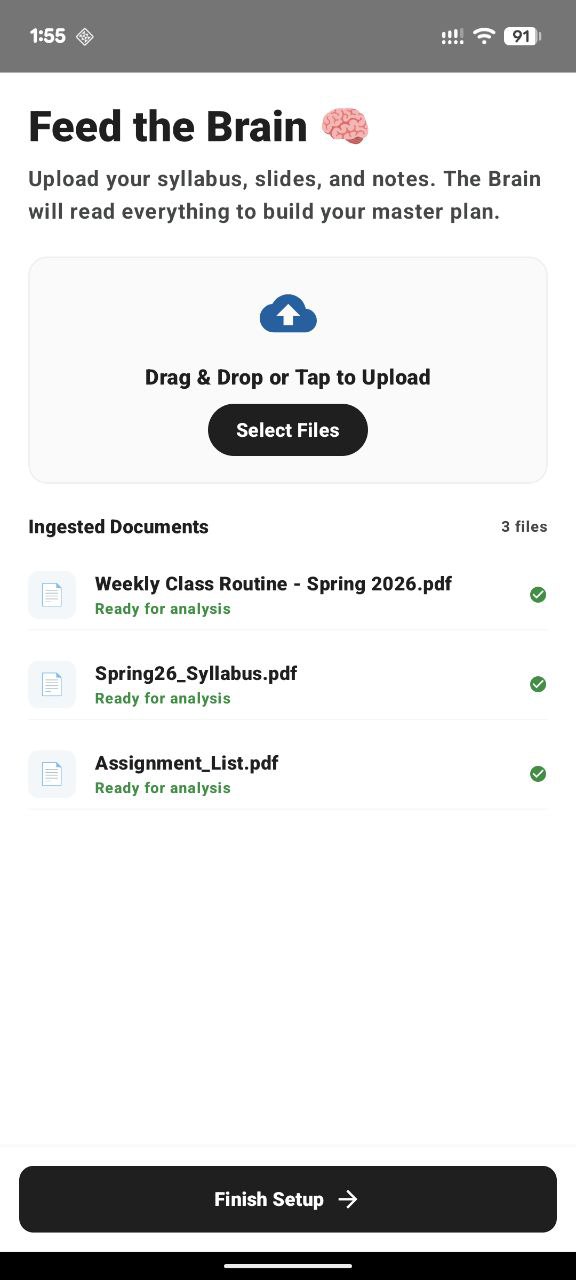
- Study (exams, assignments, focus management, resource ingestion)
- Survive (budgets, meals, emergency funds, financial runway)
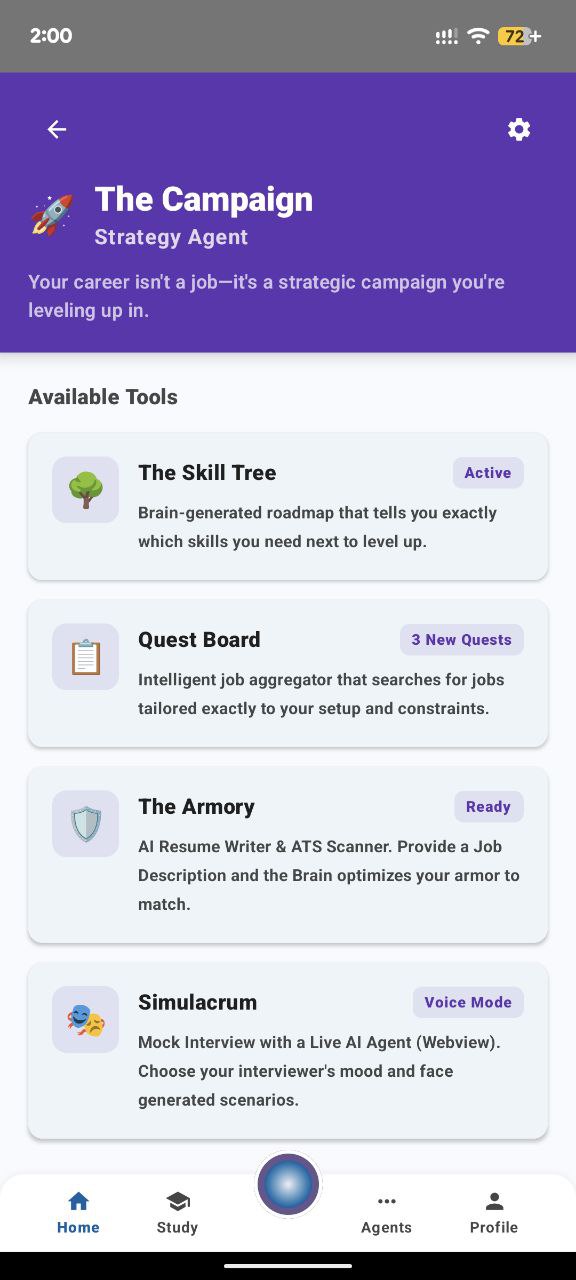
- Find work (ATS-optimized resumes, mock interviews, skill trees, job scanning)
- Navigate life (culture shock for internationals, schedule conflicts, life events, exhaustion)
No single prompt can solve this. No chatbot can sustain it. This requires an autonomous marathon agent — one that wakes you up with a morning briefing, plans your meals around your budget, detects when your focus drops mid-study, rewrites your resume when a job posting matches your skills, and steps in during the Prompt Gap. All without you asking.
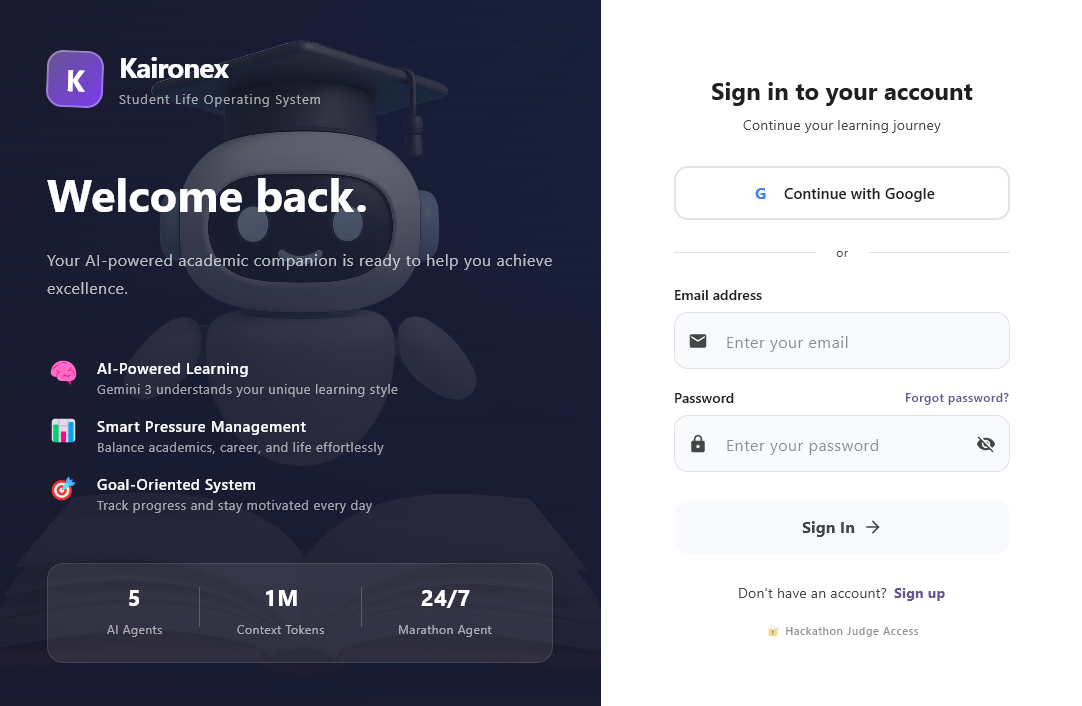
Kaironex is that agent — built for every student, from first-year freshman to international PhD candidate.
What It Does
I coudnt explain in the video .The main Engineering is in the Backend.I will explain it here.. Kaironex is a Student Life Operating System (OS) powered by a "Marathon Agent" — an AI that runs continuously in the background to manage the collision between study, survival, and career.
Unlike a chatbot that waits for you to type "Help me," Kaironex:
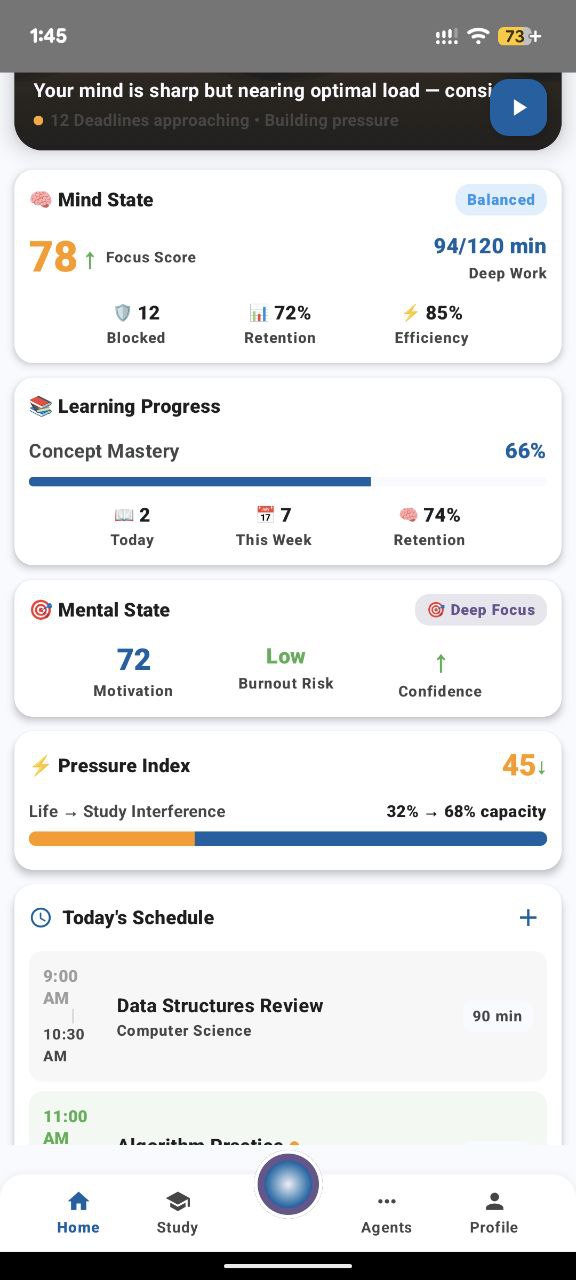
- Proactively Optimizes: It wakes you up with a briefing on your day, finances, and assignments.
- Intervenes in Real-Time: Walk into a grocery store, and it calls you with a budget-safe shopping list based on your fridge's current inventory.
- Coaches You: Before a job interview, it calls you to roleplay the specific hiring manager persona for that company.
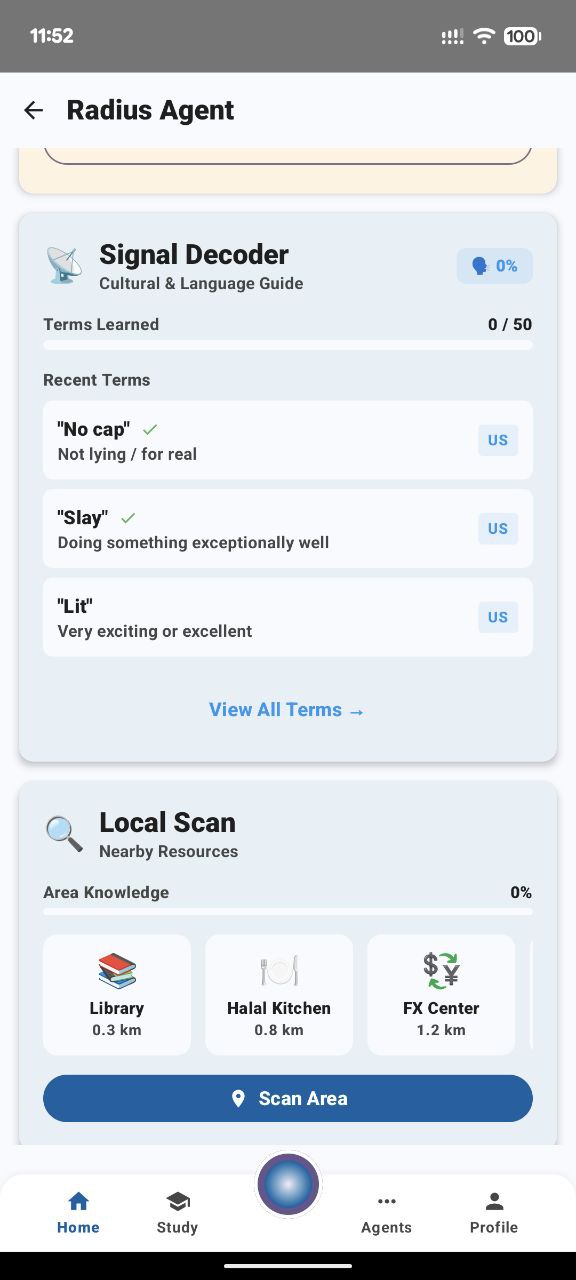
- Bridges Cultures: For international students, it provides real-time cultural context and language practice when they enter new environments.
It closes the Prompt Gap by acting when you can't or forget to ask. It doesn't just answer questions; it drives outcomes. It uses the Financial DEFCON System to actively adjust your food plan based on your real-time bank balance, ensuring you don't run out of money before finals.
- It Hunts Opportunities: It doesn't wait for you to search for jobs. The Campaign Agent continuously scans the market, analyzing your skills against live listings, and rewriting your resume while you study for chemistry.
It is the first AI agent designed to close the Prompt Gap by acting when you cannot. It wakes you up, feeds you, plans your day, and lands you a job — all as a single, cohesive, long-running process.
How We Built It
We built a Three-Brain Architecture primarily on Gemini 3, utilizing Gemini 2.5 for real-time voice, mimicking human cognitive layers to balance instant reflexes with deep, long-horizon reasoning.
1. The Bicameral Engine
At the core is our Bicameral Engine, which routes tasks between two modes of Gemini 3 Flash Preview:
- Reflex Brain (<500ms): Handles instant UI responses, chat, and quick decisions.
- Deep Brain (High Reasoning): Handles complex, multi-step reasoning tasks like scheduling a whole semester or analyzing a resume against a job description.
2. Five Autonomous Specialist Agents
We orchestrated 5 specialized "brains" that communicate via an event bus:
- Study Agent: Uses deep reasoning to generate semester-long academic strategies and daily tactical plans in a single pass.
- Vitality Agent: Manages life logistics using the Financial DEFCON System. It uses Gemini Vision to scan fridges and generate budget-compliant meal plans.
- Campaign Agent: A career strategist that uses Structured Outputs to build skill trees and Google Search Grounding to find relevant jobs.
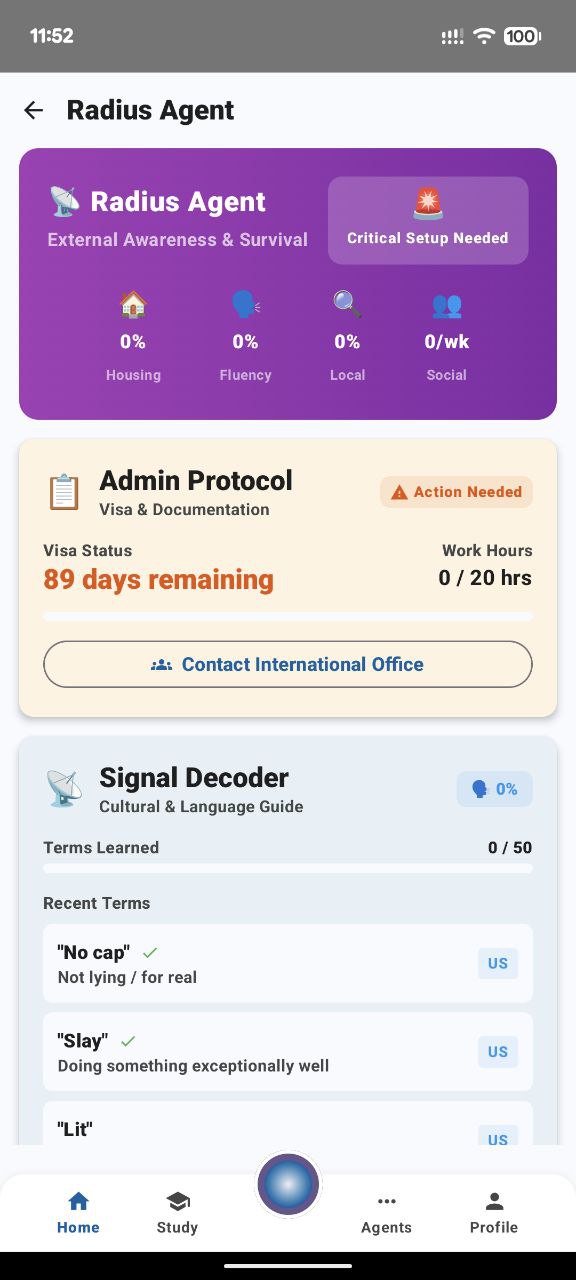
- Radius Agent: A cultural survival engine for international students.
- Supervisor Agent: A meta-controller that monitors the health of other agents and resolves conflicts.
3. Marathon Continuity with Thought Signatures
To enable continuous operation across days, we implemented Thought Signatures. Every reasoning step Gemini takes is cryptographically signed and chained to the previous one. This gives the agent a persistent "stream of consciousness," allowing it to remember why it made a decision 6 hours ago, even across server restarts.
4. The Director-Actor Architecture
We solved the "Latency vs. Intelligence" trade-off by treating Gemini 3 as the Director and Gemini 2.5 as the Actor.
- The Director (Gemini 3): Runs on the backend with a massive 65k+ token budget. It analyzes the student's entire life state (grades, finances, cultural shock, career goals) and writes a precise System Instruction Script.
- The Actor (Gemini 2.5): Runs on the mobile device via the Live API. It receives this script and "inhabits" the persona instantly—whether it's a tough interviewer, a gentle cultural coach, or a military-style financial advisor. This allows Kaironex to have the depth of a reasoning model with the speed of a real-time voice model. The backend literally "directs" the frontend's personality in real-time.
Challenges We Ran Into
- Context Window Management: Coordinating 5 agents, each running at 65,536 thinking tokens, required careful state machine design. We couldn't just dump everything into context; we had to build a retrieval system that injected only the relevant "Thought Signatures" for the current task.
- The "Schizophrenic Agent" Problem: Early versions had agents that didn't talk to each other. The Study Agent would schedule a 4-hour exam prep block during a time when the Vitality Agent knew the student had $0 for food. We solved this by building a Cross-Agent Event Bus so financial fatigue directly impacts study scheduling.
- Marathon State Recovery: Long-running tasks (like a 30-day interview prep) would break if the server restarted. We had to invent Thought Signatures — a cryptographic chain of reasoning that allows the agent to "wake up" after a crash, read its own diary, and resume exactly where it left off.
- Real-Time Latency vs. Depth: Balancing the user's need for instant (<500ms) UI feedback with the model's need for deep reasoning (8-10 seconds) required us to build the Bicameral Engine, splitting traffic between a "Reflex Brain" and a "Deep Brain".
Accomplishments That We're Proud Of
- Built a True Marathon Agent: It actually works. You can leave it running, and it will autonomously manage a simulated student's life for days without a single prompt.
- The Financial DEFCON System: We built a survival engine that actually helps broke students. It doesn't just track spending; it changes your behavior (e.g., suggesting cheaper meals, canceling subscriptions) as you approach bankruptcy ($0).
- <500ms Reflexes with 65k Token Reasoning: We successfully implemented a dual-path architecture where the user feels instant responsiveness, while the backend is doing heavy-lifting cognitive work in the background.
- 20-Collection Holistic Database: We designed a schema that captures the entire student state — capable of answering "Can I afford pizza if I skip my shift to study for Physics?" (The answer is usually no).
What We Learned
- Thinking Tokens Are Everything: The difference between 8k and 65k tokens isn't just length — it's depth. At 65k, the model stopped hallucinating generic advice and started producing genuinely strategic, highly specific plans that accounted for subtle constraints like energy levels and prayer times.
- Agents Must Talk: Isolated agents create fragmented, annoying experiences. The magic happens when the "Study Brain" knows you're broke (via Vitality Brain) and suggests free resources instead of paid textbooks.
- The Prompt Gap Is Real: Building for the moments when users can't ask for help requires a fundamental shift in design thinking. You can't rely on the user to drive the loop; the loop must drive itself.
- Marathon > Sprint: Students don't need a sprinter who runs fast for 10 seconds (a chatbot). They need a marathon runner who stays with them for 4 years.
What's Next for Kaironex
- University LMS Integration: Direct hooks into Canvas/Blackboard to auto-ingest assignments.
- Predictive Burnout Modeling: Using historical metadata to intervene before a mental health crisis, not just after focus drops.
- Community "Safe Houses": Connecting international students with verified local communities for safe housing and support.
Gemini Integration: Technical Deep Dive
Kaironex demonstrates the full spectrum of Gemini 3 Flash Preview capabilities, proving that one model can handle both sub-second reflexes and minute-long deep reasoning.
1. Extended Thinking & Reasoning We utilize Gemini 3's Extended Thinking capabilities to power our Marathon Agent architecture. Instead of simple request-response, our agents engage in multi-step reasoning chains. The Study Agent consumes a student's entire syllabus and constraints to generate a hierarchical semester plan (monthly strategy + daily tactics) in a single reasoning pass. This depth allows the model to "hold" the entire semester in its mind while optimizing daily slots, something impossible with standard LLMs.
2. Orchestration via Function Calling We defined over 15 complex tools that Gemini orchestrates autonomously. The Supervisor Agent uses function calling to route tasks between the Study, Vitality, and Campaign agents, effectively "hiring" the right sub-brain for the job. This turns Gemini into an executive controller, capable of managing a 20-collection database and executing real-world actions like scraping job posts or calculating financial runway.
3. Vision & Multimodal Input The Vitality Agent leverages Gemini's multimodal capabilities for the Survival Protocol. Students snap a photo of their fridge, and Gemini identifies ingredients, estimates expiration, cross-references with the student's Financial DEFCON level, and generates a meal plan that prevents starvation — literally turning pixels into survival strategy.
4. Google Search Grounding To prevent hallucinations in critical career and cultural advice, we implemented Google Search Grounding. The Radius Agent uses this to find real, verified local resources for international students, while the Campaign Agent scans for live job market data to ensure resume tailoring is based on current market realities.
5. Native Audio (Gemini 2.5 Live API & Director Pattern) We use the Gemini 2.5 Live API not just as a voice interface, but as a dynamic "Actor" controlled by the Gemini 3 "Deep Brain."
- Campaign Agent (Director): Reads a job description and resumes -> Scripts a "Hiring Manager" persona for Gemini 2.5 -> Real-time Mock Interview.
- Radius Agent (Director): Analyzes current location and cultural context -> Scripts a "Local Guide" persona -> Real-time Cultural Coaching.
- Vitality Agent (Director): Checks financial DEFCON level and fridge status -> Scripts a "Tactical Logistics Officer" -> Real-time Morning Briefing. This Director-Actor Pattern ensures that every voice interaction is deeply grounded in the user's long-term state, preventing the "amnesia" common in standalone voice bots.
Built With
- aistudio
- antigravity
- appwrite
- javascript
- kotlin
- python
- react


Log in or sign up for Devpost to join the conversation.