Inspiration
We noticed that in most companies, critical operational decisions — like detecting machine failures or stockout risks — still depend on manual monitoring, scattered spreadsheets, and delayed human responses. This leads to unnecessary downtime, lost revenue, and slow action. We were inspired to build a system that could identify risks early, recommend the right actions, and even execute them automatically. The goal was simple: turn raw data into real decisions.
What it does
- How to design a full AI pipeline: ingestion → prediction → reasoning → action.
- Using AI agents to break complex tasks into modular steps.
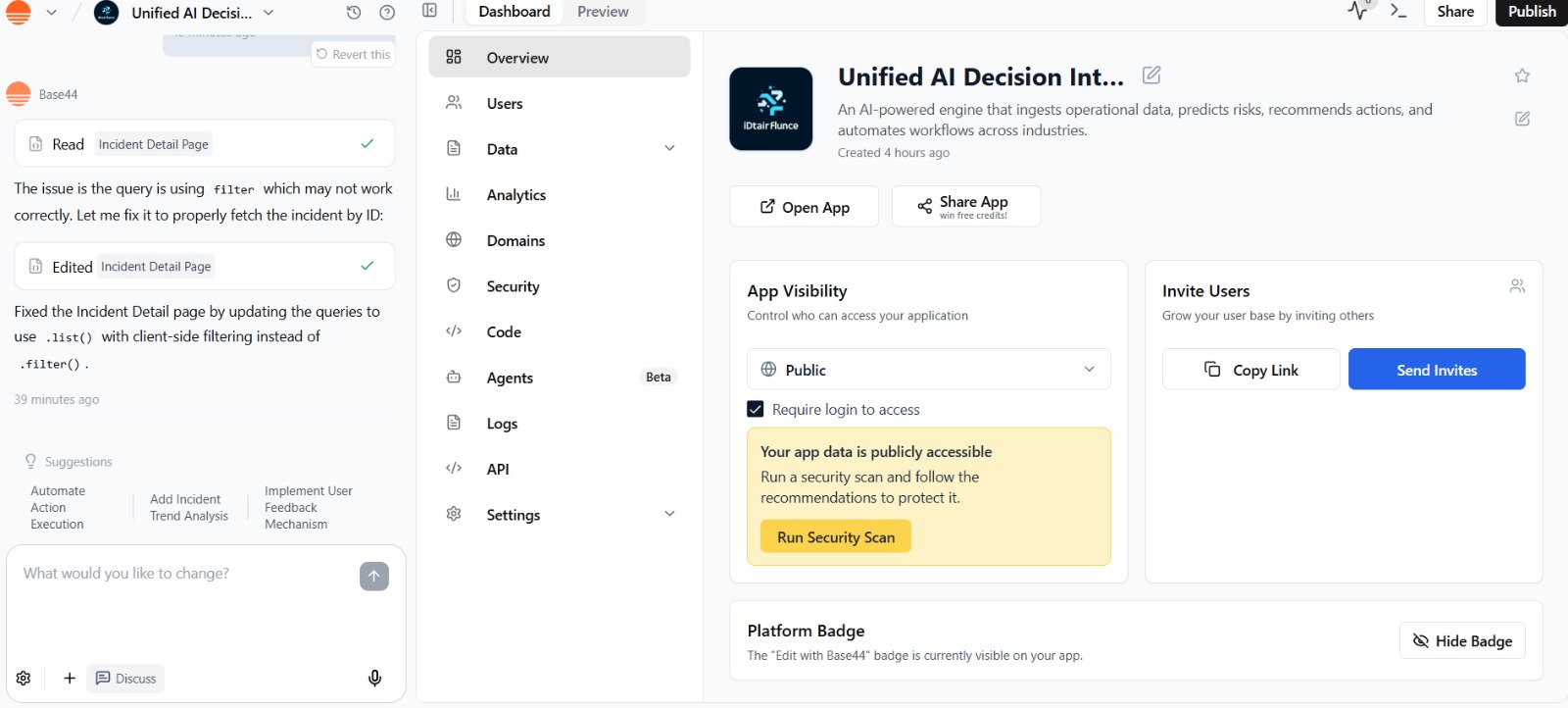
- Building end-to-end automation using Base44 (data tables, triggers, workflows).
- How risk scoring models work, including basic ML heuristics and feature engineering.
- The importance of auditability, logging, and orchestrating multi-step actions.
How we built it
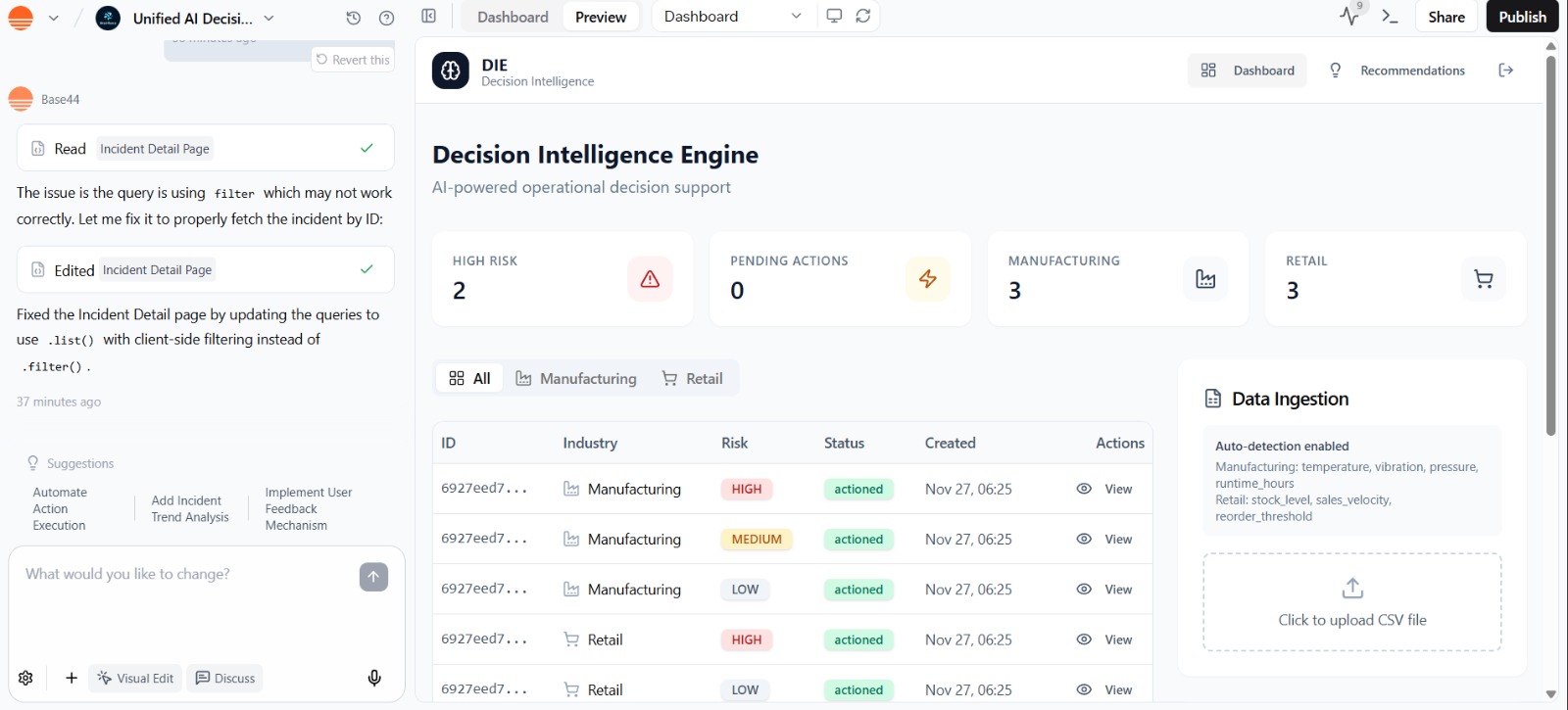
- Created a data ingestion module to upload CSVs and convert rows into Incidents.
- Built preprocessing steps to clean data and compute features like [ \text{days_of_supply} = \frac{\text{stock_level}}{\text{sales_velocity}} ]
- Designed a Prediction Agent that assigns Low/Medium/High risk.
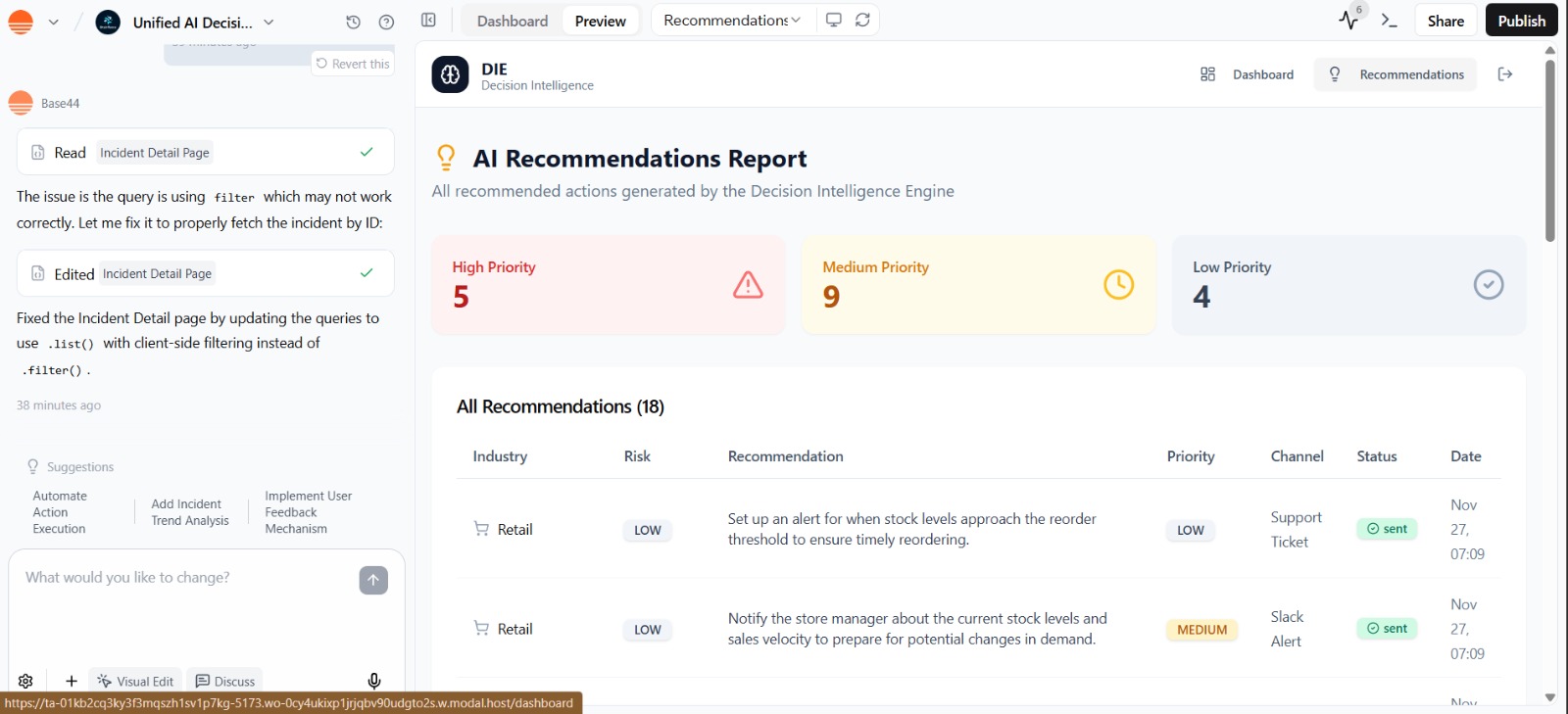
- Added a Reasoning Agent (LLM-based) that generates three prioritized actions per incident.
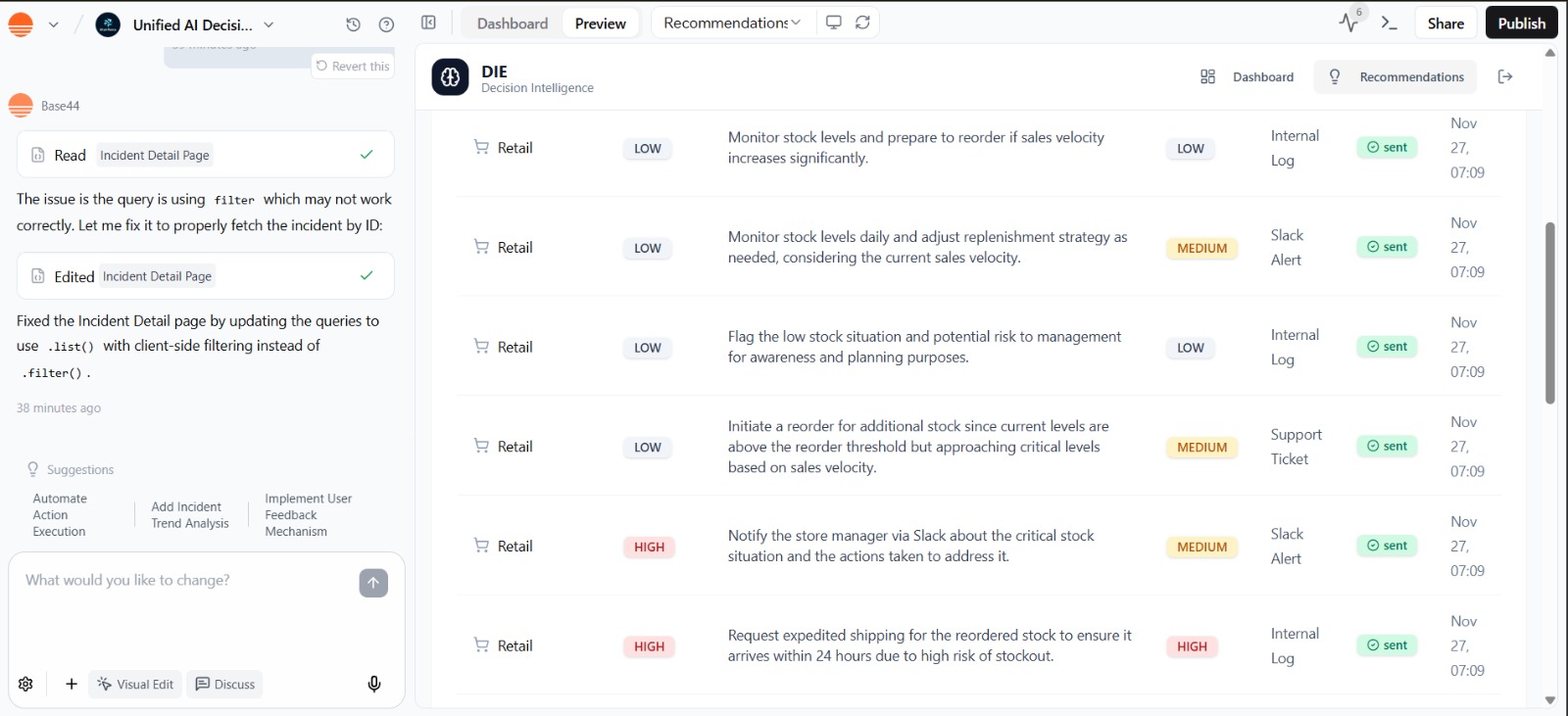
- Implemented an Orchestrator that sends alerts, creates tickets, and logs everything.
- Connected all components into a single flow: Incident → Prediction → Actions → Ticket → Logs
Challenges we ran into
- Finding a clean structure to organize multiple AI agents in the right order.
- Ensuring predictions were meaningful even with simple CSV data.
- Designing actions that were both accurate and safe to automate.
- Handling edge cases like missing values, inconsistent columns, and noisy data.
- Keeping the demo simple while showing real end-to-end automation.
Accomplishments that we're proud of
- Built a complete end-to-end AI decision engine in a short time.
- Successfully automated the full flow: CSV → Incident → Risk Prediction → Action Generation → Ticket/Alert Execution.
- Created a system that works for multiple domains (manufacturing + retail).
- Designed a clear, auditable structure with linked tables for all steps.
- Achieved smooth orchestration across AI agents without breaking the flow.
- Made the demo intuitive: upload data and see real-time actions in seconds.
What we learned
- How to break complex workflows into modular AI agents (prediction, reasoning, orchestration).
- The importance of data preprocessing, feature engineering, and consistent schema.
- How real-world operations rely on fast, consistent decision-making.
- Designing action recommendations that balance safety, clarity, and automation.
- Building scalable pipelines using Base44 components (tables, triggers, workflows).
- How to maintain a clean audit trail and ensure traceability across all steps.
What's next for Unified AI Decision Intelligence Engine (DIE)
- Adding real-time streaming instead of manual CSV uploads.
- Improving the prediction model using historical outcomes (auto-retraining).
- Adding integrations with tools like SAP, Jira, Zoho, Slack, and email systems.
- Creating a visual dashboard for trends, anomaly detection, and risk heatmaps.
- Introducing a human-in-the-loop approval system for sensitive actions.
- Expanding DIE to support more industries: logistics, healthcare, telecom, finance.
- Building a simulation mode to predict future failures or stockouts using [ \text{forecast}(t) = f(\text{trend}, \text{seasonality}, \text{risk}) ]

Log in or sign up for Devpost to join the conversation.