Inspiration
- University life can be overwhelming and isolating, especially for new students
- Students often miss out on events, opportunities, and connections that would enhance their college experience
- Information about campus activities, courses, and societies is scattered across many platforms
- Traditional social media mixes university content with unrelated posts, creating information overload
- Many students feel disconnected from campus life, particularly those with niche interests
- First-year and international students struggle to navigate the complex social landscape
- We've experienced these challenges ourselves and wanted to create a solution
- Our goal was to build a platform that brings together all aspects of university life in one place
What it does
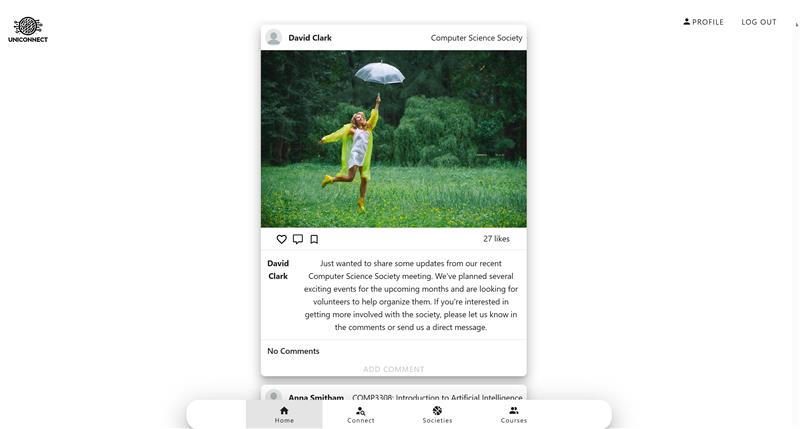
- Creates virtual communities for both courses and societies where students can find their people
- Provides course-specific discussion spaces where students can ask questions, share notes, and organize study groups
- Allows societies to promote events, recruit members, and maintain continuity between leadership changes
- Highlights upcoming campus events with automated email reminders so students don't miss out
- Generates a personalized "For You" feed based on each student's courses, interests, and society memberships
- Verifies university email addresses to create a trusted community of actual university members
- Enables students to build profiles showing their academic interests, skills, and activities
- Makes it easy to discover new societies and courses related to your interests
- Provides a unified platform where academic and social aspects of university life can connect
How we built it
- Backend: ASP.NET Core 9.0 with Entity Framework Core for reliable API performance
- Database: SQLite for development with an easy path to SQL Server for production
- Frontend: Vue.js creating a responsive interface that works well on laptops and phones
- Authentication: OAuth with email verification specifically for university domains
- Architecture: Repository pattern and service-oriented design to keep our code clean and maintainable
- Data modeling: Created flexible models that work for different types of university communities
- Notifications: Background service sending event reminders via email
- Tagging system: Implemented tags for content categorization and recommendations
- Testing: Used TDD principles to maintain quality while developing quickly
- Team coordination: Regular check-ins and clear task assignments to keep everyone in sync
Challenges we ran into
- Creating an algorithm for the "For You" page that shows relevant content without creating filter bubbles
- Designing a verification system for university emails that feels secure but not annoying
- Balancing the distinct needs of course communities versus society communities
- Visual Studio caused some frustrating issues with team members accidentally breaking the master branch
- Deciding which features to prioritize given our limited hackathon timeframe
- Making our interface intuitive despite the diverse functionality we wanted to include
- Ensuring notifications would be helpful without becoming overwhelming
- Designing database queries that could generate feeds quickly even with lots of users
- Working through the night to fix last-minute bugs before the submission deadline
- Finding the right balance between academic tools and social features
Accomplishments that we're proud of
- Built a working platform that addresses real problems we've faced as students
- Created a system where academic and social aspects of university life can finally connect
- Designed an interface that makes all features accessible without feeling cluttered
- Implemented a tag-based recommendation system that gets better as users engage with it
- Developed a dual-community structure that works well for both courses and societies
- Successfully created a functional prototype with realistic university content in just 48 hours
- Made something we genuinely want to use ourselves as students
- Designed a solution that scales from small clubs to large courses without feeling awkward
- Built an architecture that can grow with increasing user numbers without performance issues
- Maintained good code quality despite the time pressure of the hackathon
What we learned
- The importance of user-centered design when building tools for students
- Test-Driven Development saves time in the long run even when deadlines are tight
- Deployment configuration should be set up early rather than as a last-minute task
- Clear communication is essential when building complex, interconnected systems
- Data models need flexibility to evolve as requirements change over time
- Every feature must be evaluated based on its real value to users, not just because it seems cool
- University communities have unique needs that general social networks don't address
- Personal experiences as students helped us identify problems others might miss
- Working with a diverse team brings different perspectives that improve the final product
What's next for UniConnect
- Mobile app development to provide push notifications and on-the-go access
- Integration with university learning management systems like Canvas and Blackboard
- Analytics tools for society leaders to understand member engagement
- Resource sharing for study materials with version tracking and organization
- Mentorship program matching junior students with seniors in their field of study
- Expanded verification for university staff and society executives
- Interactive campus map showing event locations and popular study spots
- Calendar sync with Google and Outlook for seamless scheduling
- API for student developers to create custom tools for specific needs
- Support for multiple languages to better serve international student communities
- Rich media tools for more engaging posts and discussions
- Offline access to previously viewed content for studying without internet
Built With
- asp.net
- c#
- dotnet
- oauth
- sqlite
- sqlserver
- typescript
- vue


Log in or sign up for Devpost to join the conversation.