-
-
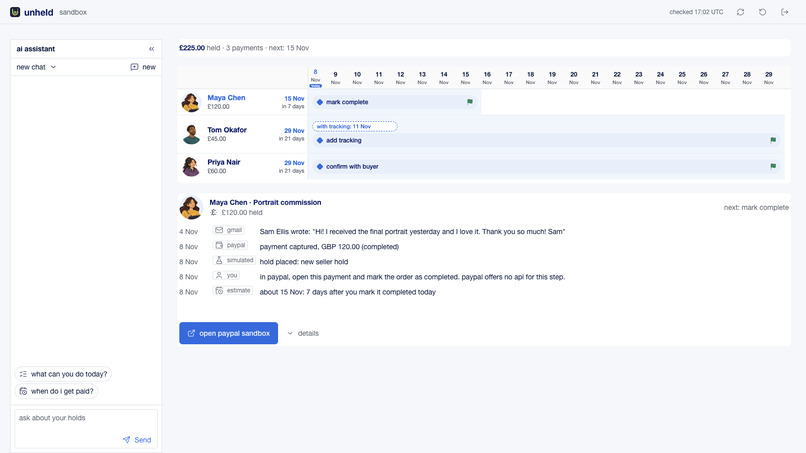
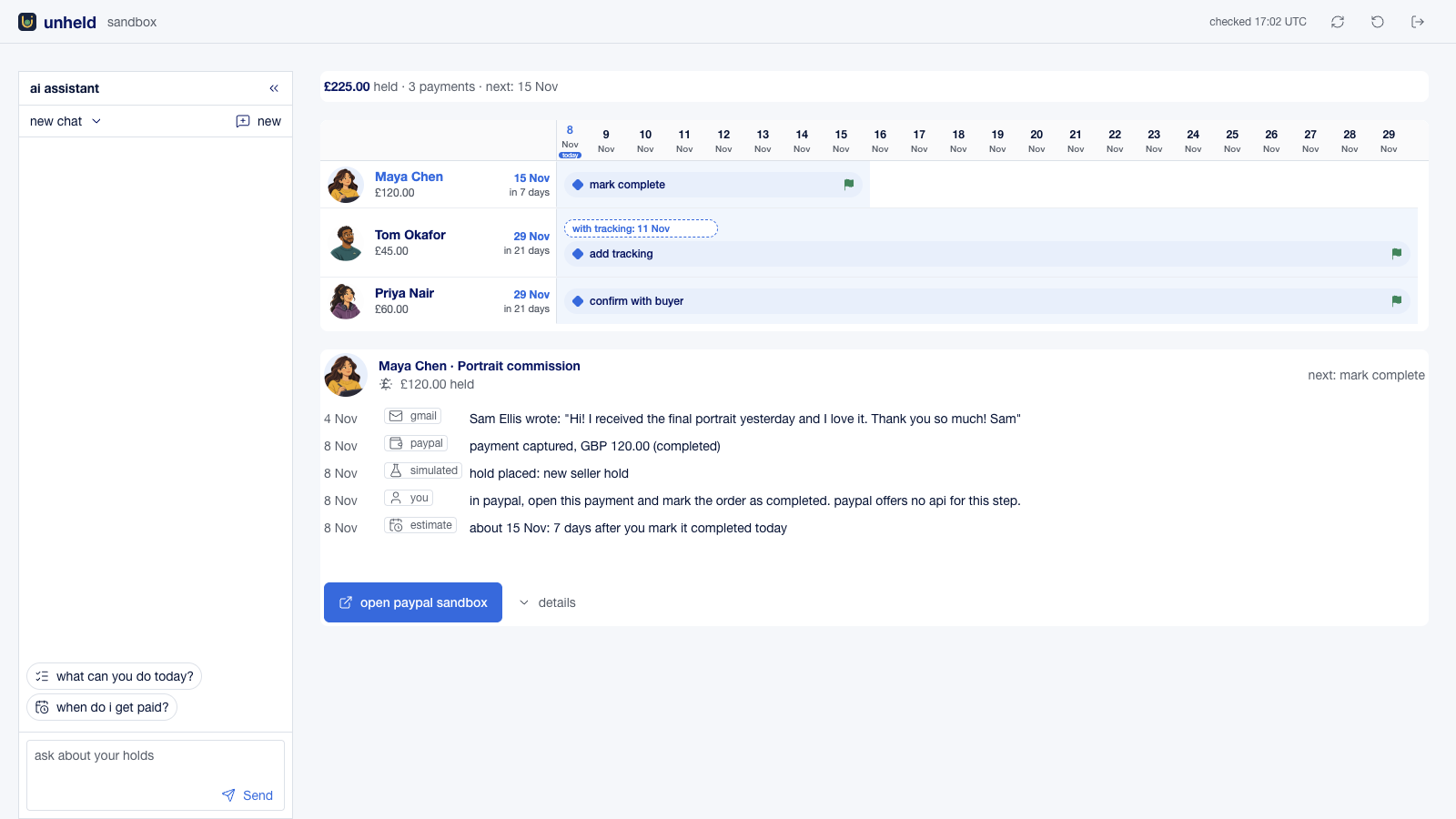
Calendar-gantt of three held payments, with Maya's evidence timeline below
-
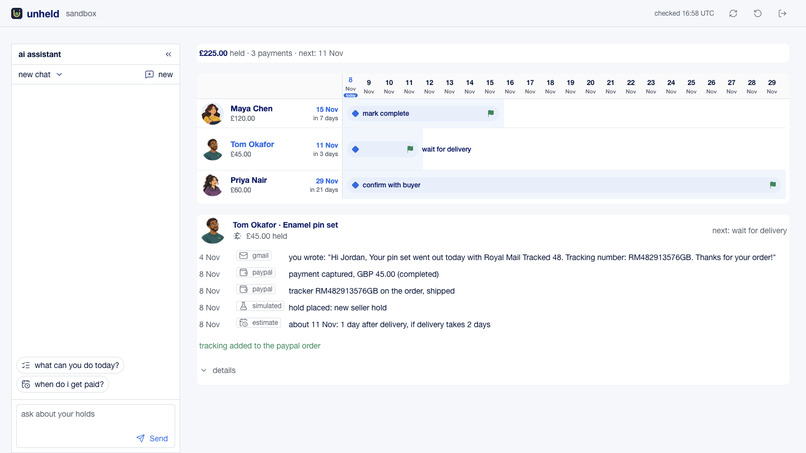
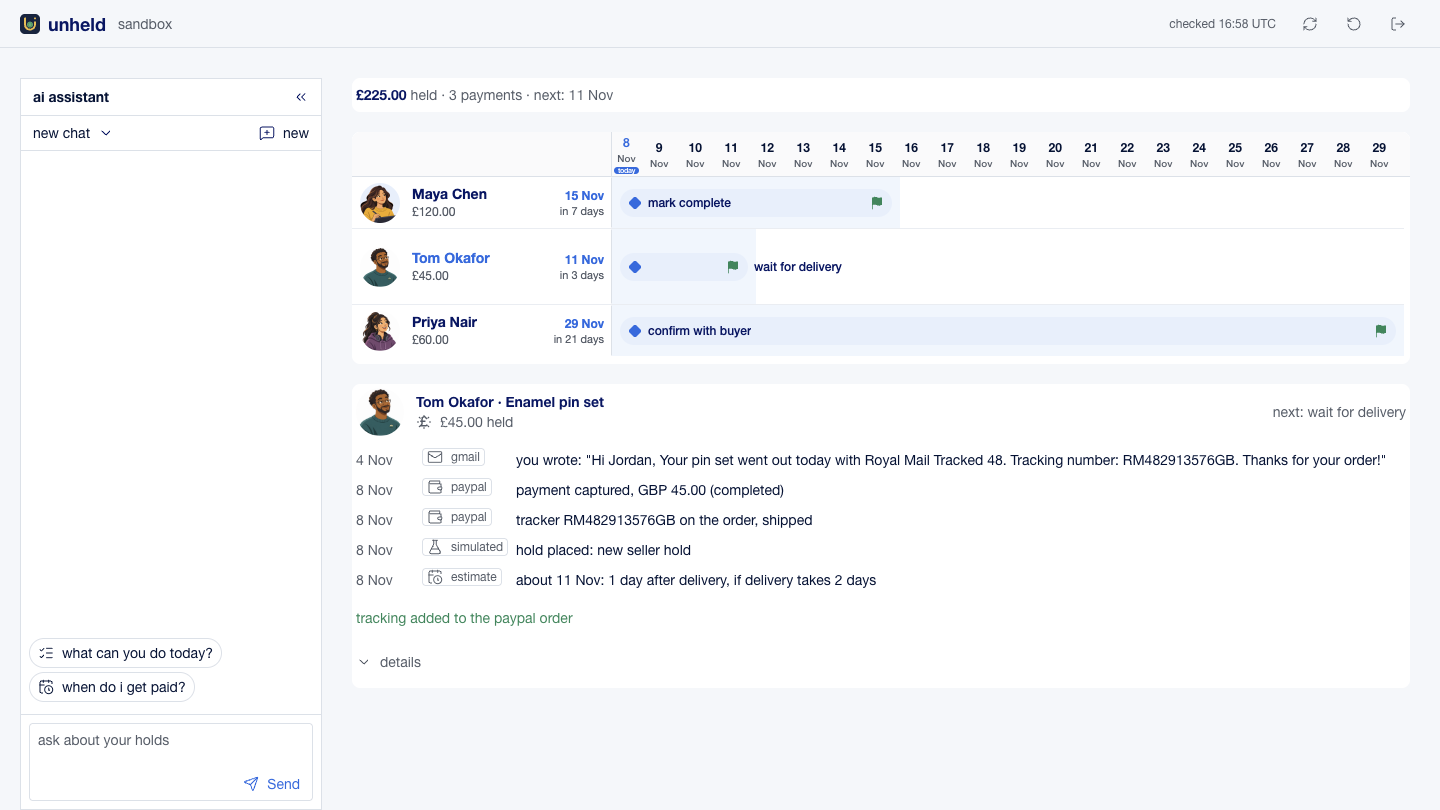
Tom's tracking number is written to the sandbox order, moving his estimate to about 11 Nov
-
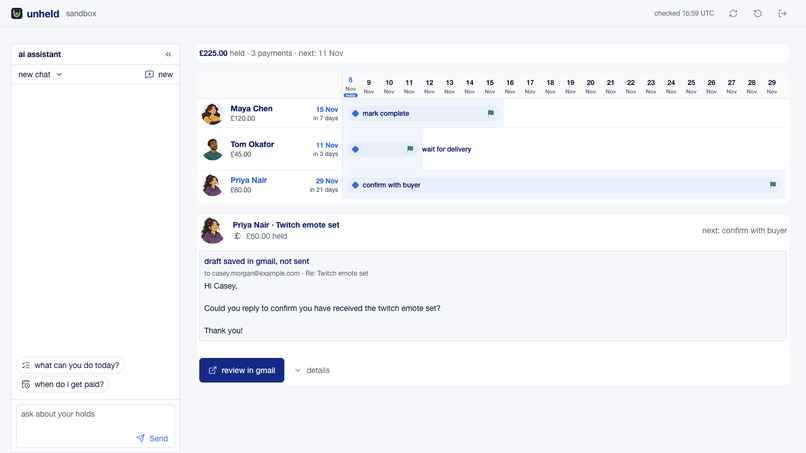
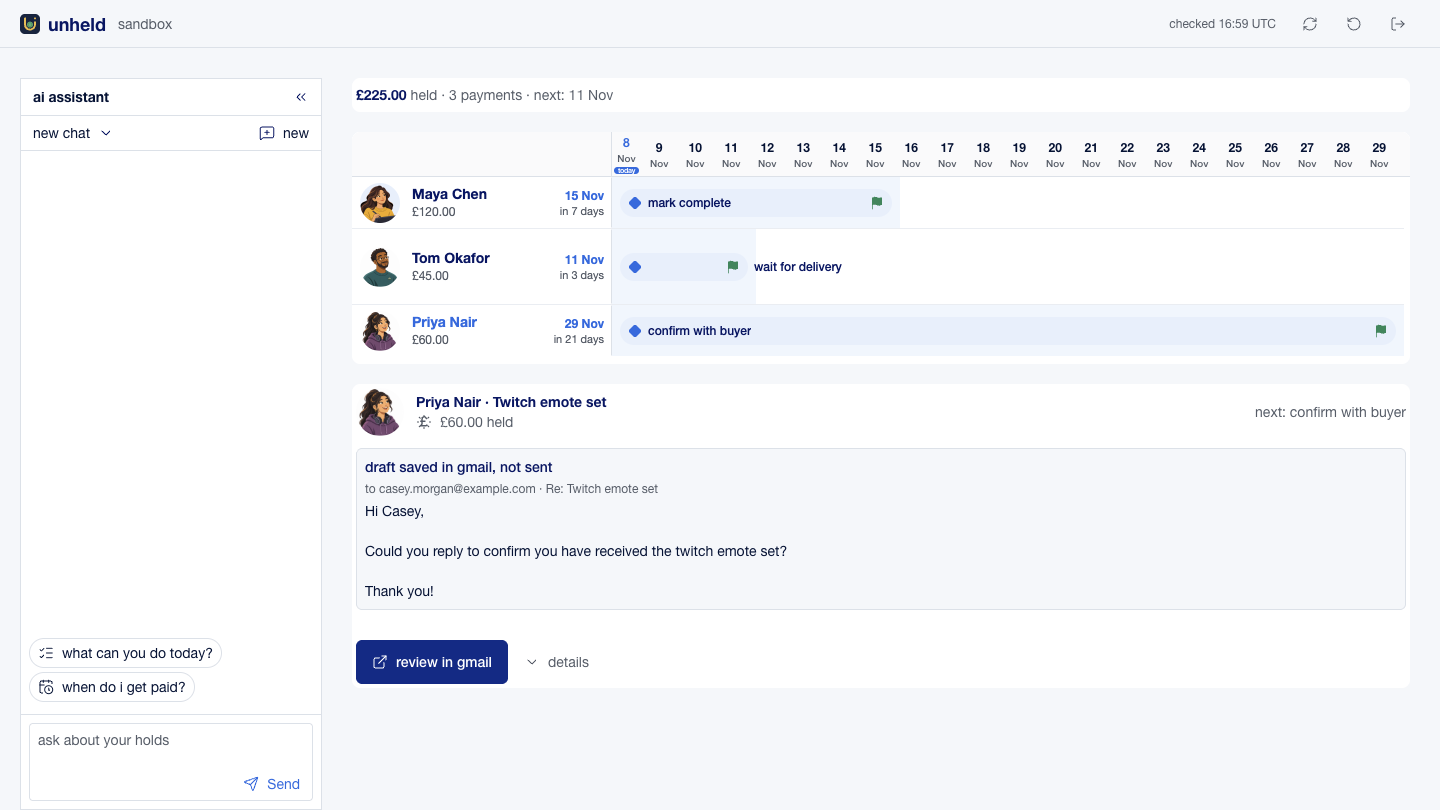
Priya's confirmation request saved as an unsent Gmail draft
-
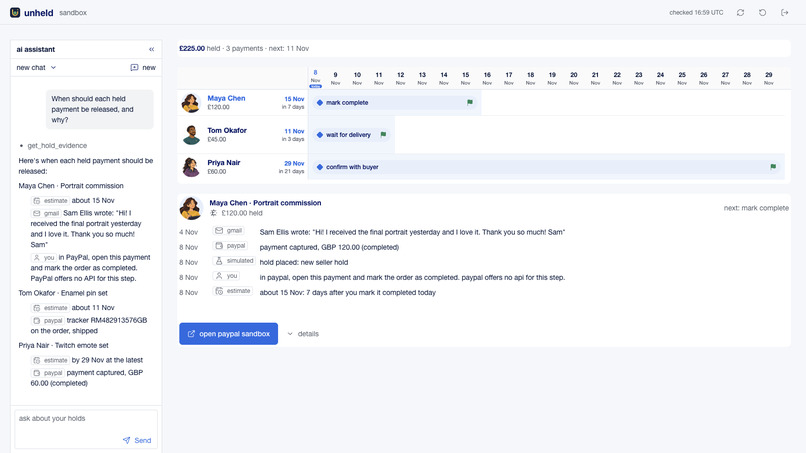
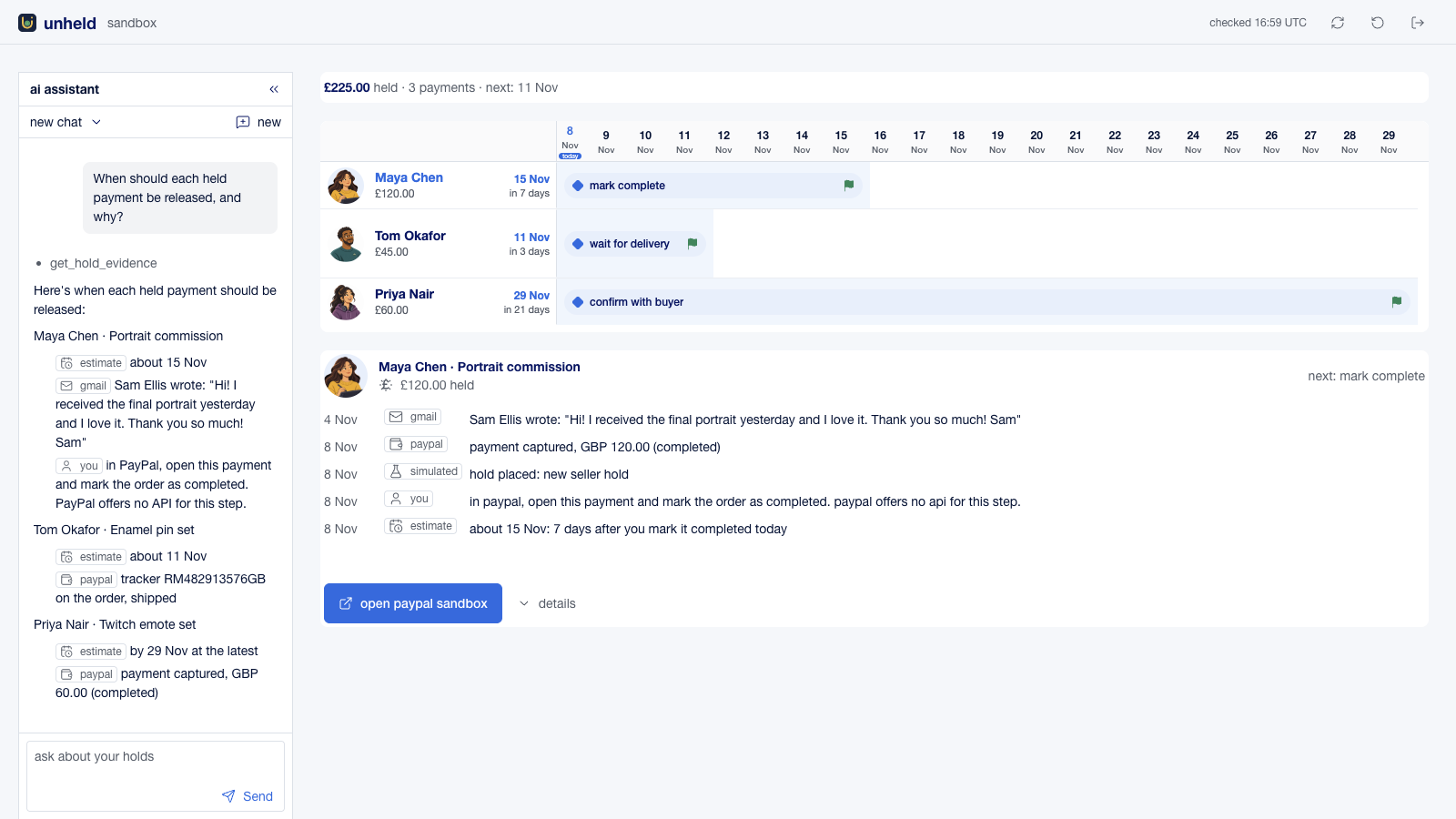
The assistant gives each creator's estimate with the evidence behind it
Inspiration
I read 3,655 public posts about money problems. Of those, 268 came from sellers whose PayPal payment was held, mostly on Bluesky and Reddit. The four bars in the demo show temporary hold only (111), limited or banned (78), support unreachable (38), and needs it for rent, food or bills (21). Only 23 posts say it was fixed. The rest report no fix or never followed up, so some may have been resolved without saying so. I built unheld for the question underneath it all, "when does the creator get paid?"
What it does
unheld watches a seller's held PayPal payments in an AG Studio dashboard. Its calendar-gantt view pairs each creator's avatar, amount and estimated paid-by date with a bar spanning the hold. A dashed "with tracking" bar previews the shorter estimate for Tom. Selecting a creator opens an evidence timeline below the calendar. On phones, the calendar becomes a days-left list.
Release estimates follow three rules used in the demo, a day after delivery is confirmed, seven days after the creator marks a digital service complete, or 21 days at the latest. The live app computes these estimated dates from today's date.
For physical goods, it writes a found tracking number to the sandbox order and recalculates the release estimate. For digital services, it reads Gmail for the buyer's own confirmation. Only the creator can mark the service complete in PayPal to start the seven-day clock.
In the accepted video, Tom's estimate shows 9 Nov after tracking, about three days away in the recording. Maya's buyer has confirmed receipt. Maya still has to take her PayPal step to start the clock behind her 13 Nov estimate.
For Priya in the accepted video, the agent saves a confirmation request as an unsent Gmail draft. Only she decides when to send it. Her next step stays "confirm with buyer" until the buyer replies, and her estimate remains 27 Nov at the latest.
Each evidence item is labelled paypal, simulated, gmail, you, or estimate. Studio's built-in assistant answers "when does the creator get paid?" per payment, behind an access code.
How I built it
I started from the official paypaldev/hackathon-paypal-ag-grid-boilerplate and added three hold fixtures on sandbox card captures, a custom calendar-gantt widget built with AG Grid, an evidence timeline with source badges and a crossfade between payments, a Gmail integration that reads messages and saves unsent drafts, three custom AI tools in AG Studio's built-in assistant, and an access-code gate with a model allowlist, output cap and daily spend cap.
Challenges
The sandbox never withholds a payment for real, so every hold is simulated and labelled, while the tracking write and the Gmail read and draft stay real. A Testing-status Gmail app's refresh token expires in 7 days, so I moved the consent screen to production the same day. AG Studio 3.0's built-in grid widget does not expose the column spans, custom day headers and row heights the calendar needs, so I registered a raw AG Grid as a custom Studio widget. One bug read an unsent draft back as the buyer's own message, wrongly marking a payment confirmed. Excluding drafts fixed it.
Accomplishments
The accepted video demonstrates a tracking write to a sandbox order, a read of the buyer's Gmail evidence and a confirmation request saved without sending it. In that recording, the assistant gives three distinct estimates grounded in that evidence, Maya on 13 Nov after her PayPal step, Tom about 9 Nov after tracking is added, and Priya on 27 Nov at the latest. It also keeps clear which next steps belong to the creator.
What I learned
Reading real posts beat inventing a mechanism first. A restricted Google OAuth scope behaves very differently between Testing and production status, with a real 7-day deadline. A polished library like AG Studio can still need a custom widget for a calendar layout, and evidence needs to distinguish a buyer's words from the seller's unsent draft.
What's next
Carrier tracking beyond Royal Mail, and the "limited or banned" category (78 of the 268 posts), untouched by this version. Moving from seeded fixtures to a live hold detector once a real account exposes hold states to read.
How it uses AG Studio
I built the calendar-gantt widget in app/studio/gantt-widget.tsx with a pinned creator column, daily columns, hold bars, release flags and the dashed tracking preview. It uses AG Grid inside a custom AG Studio widget. The evidence widget in app/studio/evidence-widget.tsx sits below it, with dated source badges and a crossfade between payments. I fed our own Tailwind tokens into Studio's theme in app/studio/theme.ts, so both widgets match the rest of the app. I wired three custom tools into Studio's built-in assistant in app/studio/ai.ts, get_hold_evidence, add_tracking, and draft_buyer_reply. The assistant uses them to answer "when does the creator get paid?" per payment, grounded in PayPal sandbox and Gmail evidence. This is the Studio Agent Framework path the sponsor page asks for, a custom agent talking to Studio's own built-in agents.
Built With
- ag-grid
- ag-studio
- gemini
- gmail-api
- nextjs
- openrouter
- paypal
- render
- tailwindcss
- typescript
