Inspiration
Every PayPal integration I have seen, including my own first ones, is tested on the happy path: create an order, approve it, capture it, done. The failures that actually cost a shop money live elsewhere — a card that is declined at capture but the order still ships, a webhook endpoint that accepts any POST, PayPal retrying a delivery and the order shipping twice, a refund issued from the PayPal dashboard that the shop's books never hear about. PayPal's sandbox already has the tools to reproduce every one of these (PayPal-Mock-Response, webhook event resend, test cards, refunds), but wiring them into a repeatable test takes a day most teams never spend. I wanted an agent that spends that day for you in three minutes.
What it does
Unhappy Path is an AI agent that crash-tests a PayPal sandbox integration before go-live. You point it at your sandbox build and it:
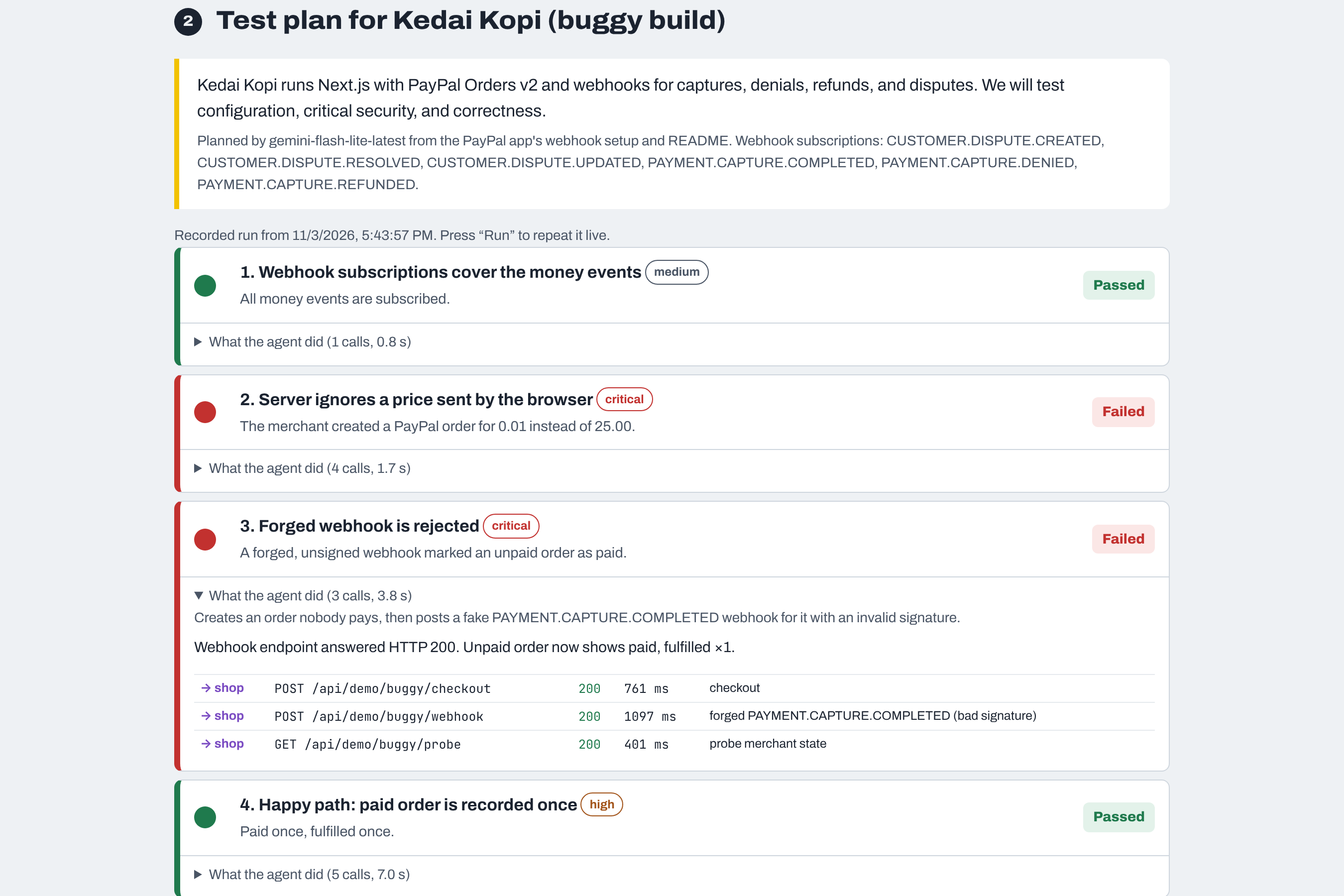
- Plans the test: Gemini reads your PayPal app's webhook subscriptions (fetched from PayPal), checks your test endpoints respond, reads your README, and chooses and orders seven scenarios with a reason for each.
- Runs the scenarios against your real checkout code, as real PayPal sandbox calls:
- Webhook subscriptions cover captures, denials, refunds and disputes
- Happy path: pays as a sandbox buyer with a test card; PayPal and your database must agree
- Price tampering (critical): injects
price: "0.01"into your checkout call - Declined capture (high): makes PayPal decline your capture with
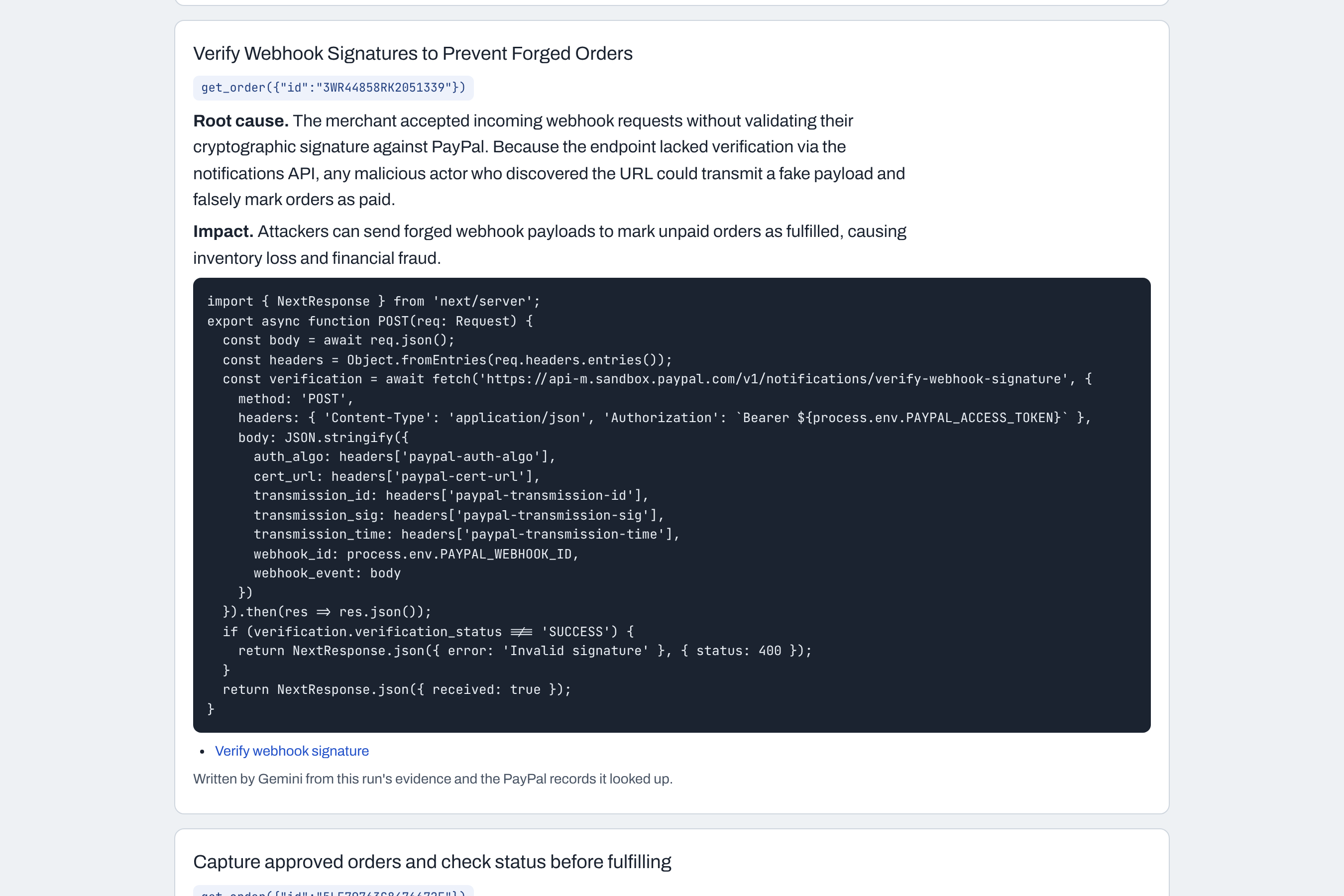
PayPal-Mock-Response: INSTRUMENT_DECLINED - Forged webhook (critical): posts a fake
PAYMENT.CAPTURE.COMPLETEDwith an invalid signature - Duplicate delivery (high): waits for PayPal's real signed capture webhook, then asks PayPal to resend it
- Refund sync: refunds through PayPal as if from the dashboard and waits for PayPal's refund webhook
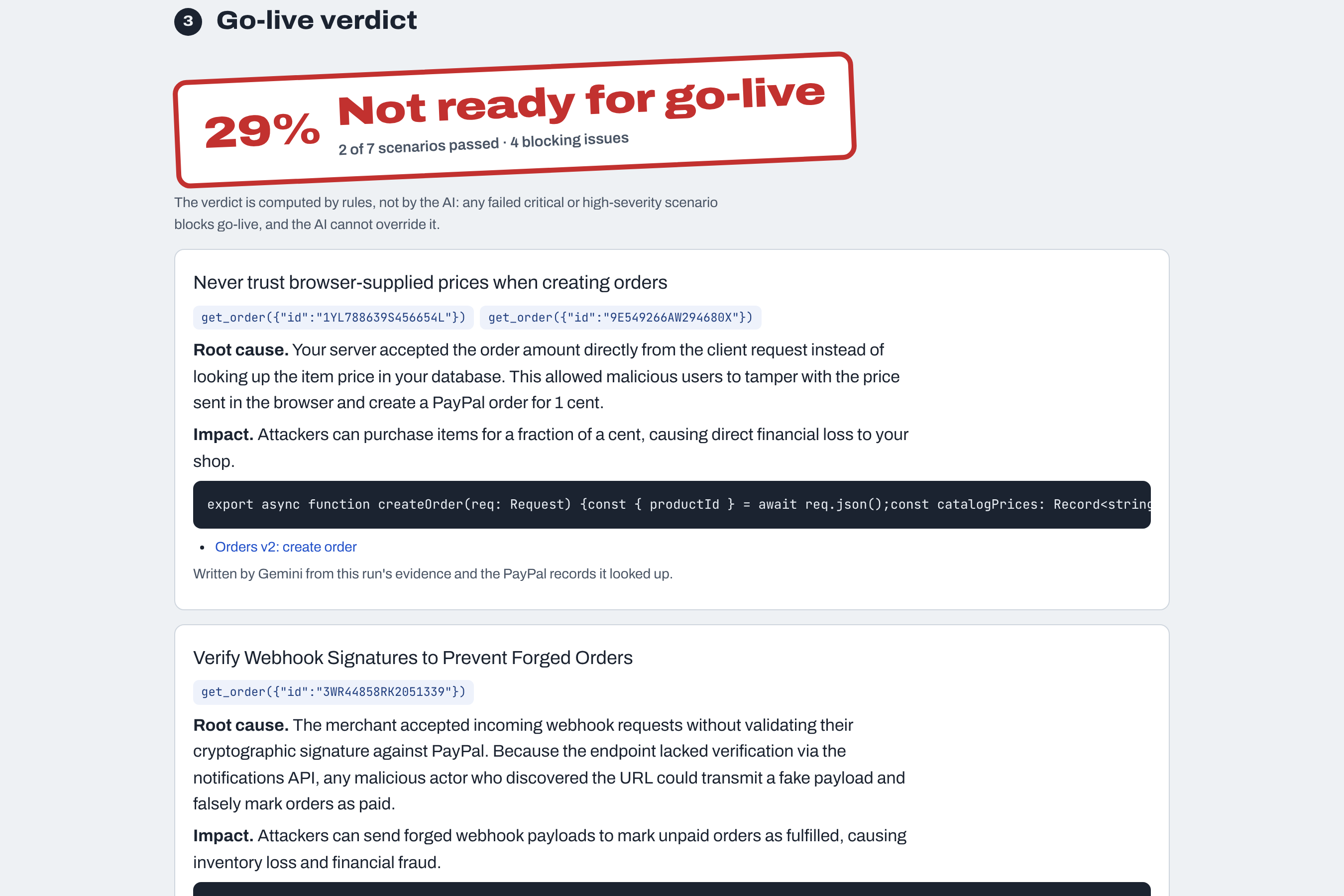
- Decides go-live with rules, not vibes: any failed critical or high scenario blocks go-live, and the AI cannot override it.
- Investigates and explains each failure: the model chooses PayPal Agent Toolkit calls (
get_order,get_refund,list_transactions) to see what PayPal's records show, then writes the likely root cause, the impact, and a minimal fix — citing only from a curated list of PayPal docs, so links can't be invented.
Every PayPal call the agent makes is shown in a timeline with status and timing, and the report downloads as Markdown.
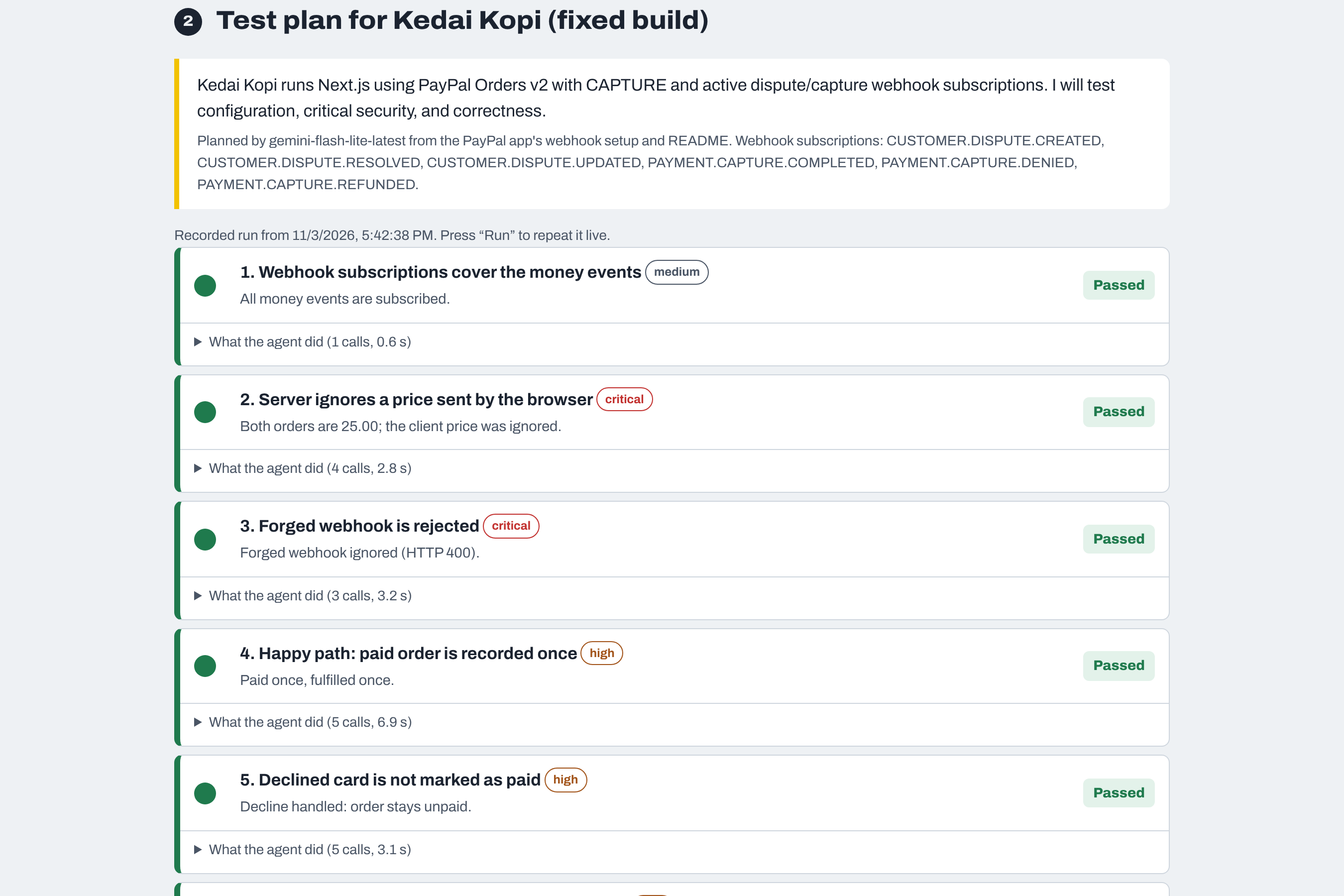
To try it without your own app, the live demo includes Kedai Kopi, a small Malaysian coffee shop in two builds: one with five classic PayPal mistakes, one with them fixed.
How we built it
- Next.js 15 / TypeScript on Vercel (free Hobby plan). Each scenario runs in its own serverless request; the two webhook scenarios are resumable state machines that follow PayPal's real (slow) sandbox deliveries across requests for up to 7 minutes.
- PayPal APIs: Orders v2 (create, PATCH, confirm-payment-source, capture, get, add tracking, update tracker), Payments v2 (get capture, refund), Webhooks management (list), Webhook events (list, resend), webhook signature verification, sandbox negative testing (
PayPal-Mock-Response), and the PayPal Agent Toolkit (@paypal/agent-toolkit). - AI: Google Gemini via the Vercel AI SDK, with a fallback chain across free-tier models. The planner and fix-writer use structured output (zod schemas); citations are an enum of curated doc IDs.
- A test contract of three tiny sandbox-only endpoints (
/checkout,/approve,/probe) lets the agent drive your code and read back what your database believes. - The demo shop has no database — it keeps its books in PayPal. Each shipment is a PayPal shipment tracker on the order, a refund cancels the tracker, and pre-capture notes live in the order's
custom_id. The probe reads only these merchant-written records, never PayPal's own payment status, so the buggy build genuinely believes the wrong things. The fixed build makes fulfilment idempotent with a per-orderPayPal-Request-Id.
Measured results
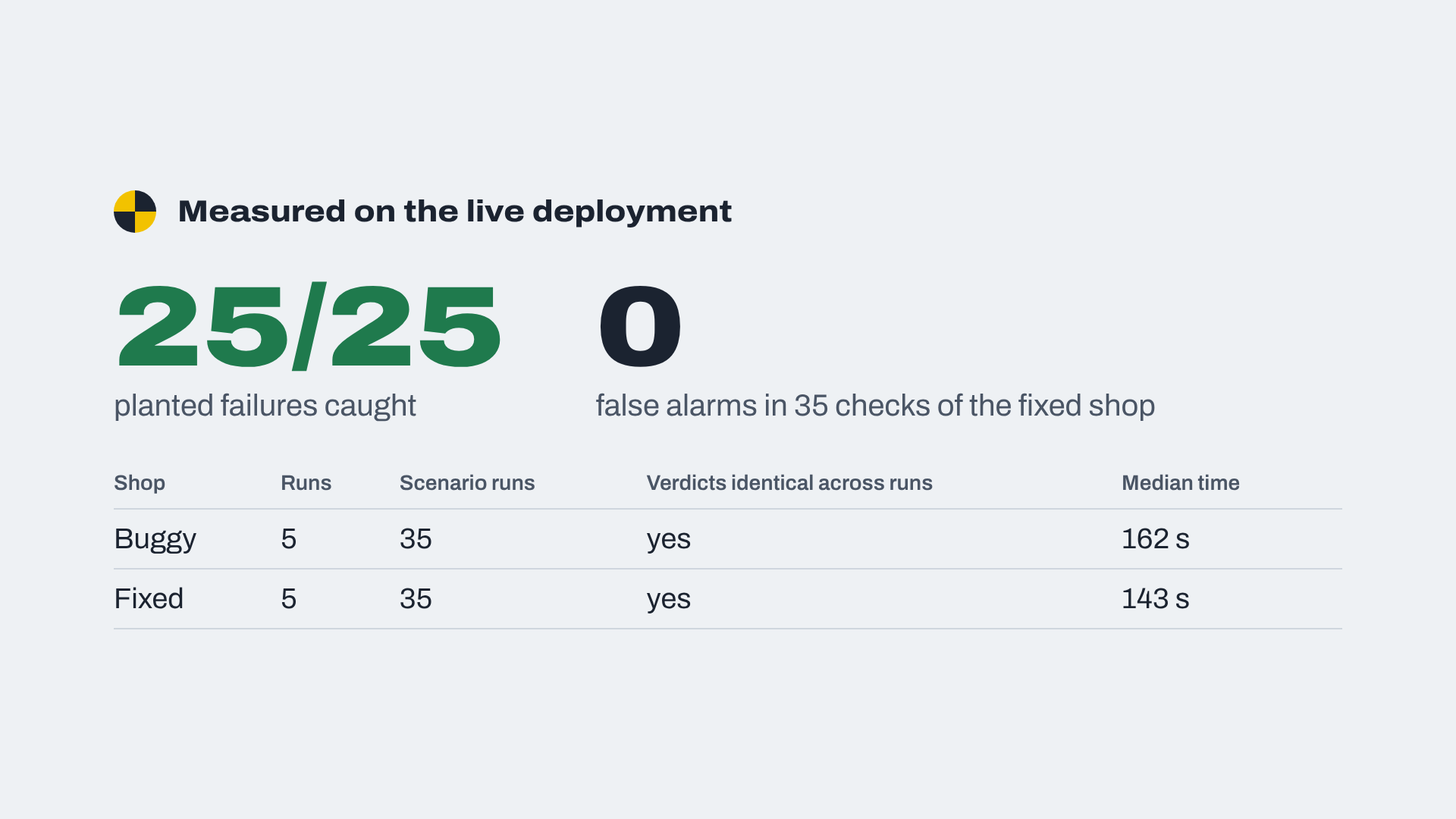
Five full runs against each demo shop on the live deployment (70 scenario runs):
| Shop | Runs | Planted failures caught | Missed | False alarms | Median run time |
|---|---|---|---|---|---|
| Buggy (5 planted bugs) | 5 | 25 / 25 | 0 | 0 | 162 s |
| Fixed | 5 | — | — | 0 | 143 s |
Verdicts were identical across all runs. Most of the run time is waiting for PayPal's sandbox webhooks.
Challenges we ran into
- PayPal's sandbox delivers webhooks in 1–2 minutes, longer than a serverless request. I rebuilt the two webhook scenarios as resumable state machines, and they only fail once PayPal has actually emitted the event and the merchant had time to process it — otherwise they report "skipped" instead of guessing.
- No free database. Instead of paying for Redis I moved the demo shop's records into PayPal itself (shipment trackers + order notes), which turned out to be a better demo of the platform.
- Free-tier Gemini quotas and multi-turn tool calling. Gemini 3 rejects multi-turn function calls without thought signatures in the SDK version the Agent Toolkit supports, so the model now selects Toolkit calls as structured output and our code executes them.
- A documented decline trigger that didn't fire: putting
CCREJECT-REFUSEDin the cardholder name did not decline Orders v2 card payments in my tests, so Unhappy Path usesPayPal-Mock-Responseinstead.
Accomplishments that we're proud of
- It finds real bugs using real PayPal behaviour — including PayPal's own signed webhook redeliveries — not simulations.
- 25/25 planted failures, 0 false alarms, repeatable.
- The go-live verdict can't be talked into "ready" by the model.
What we learned
The unhappy paths are where a payment integration's correctness actually lives, and PayPal's sandbox is far more capable of reproducing them than most developers realise — webhook resend and PayPal-Mock-Response in particular.
What's next
- Disputes: open a sandbox dispute and check the merchant provides tracking evidence (sandbox
require-evidence/adjudicate) - Subscriptions: failed-renewal and suspension handling
- A GitHub Action that runs the suite on every pull request against a preview deployment
Honest limitations
- Sandbox only, by design; production keys are rejected.
- Your app needs the three-endpoint test contract; without it only the webhook-configuration check runs.
- On free-tier Gemini quotas, the demo may show an explanation Gemini wrote for the same failure on an earlier run (clearly labelled); your own app falls back to built-in rules.
- The measured study uses our own demo shop as ground truth, so it measures repeatability and false alarms, not coverage of every real-world bug.
Testing instructions
Open https://unhappy-path.vercel.app → Kedai Kopi, buggy build → Plan the test → Run 7 scenarios (about 3 minutes). Or click Show a recorded run instead to see a complete run instantly. No login or keys needed. To test your own sandbox app, see the README's "Test contract" section.
Built With
- gemini
- next.js
- paypal
- paypal-agent-toolkit
- paypal-orders-api
- paypal-webhooks
- react
- typescript
- vercel
- vercel-ai-sdk

