Inspiration
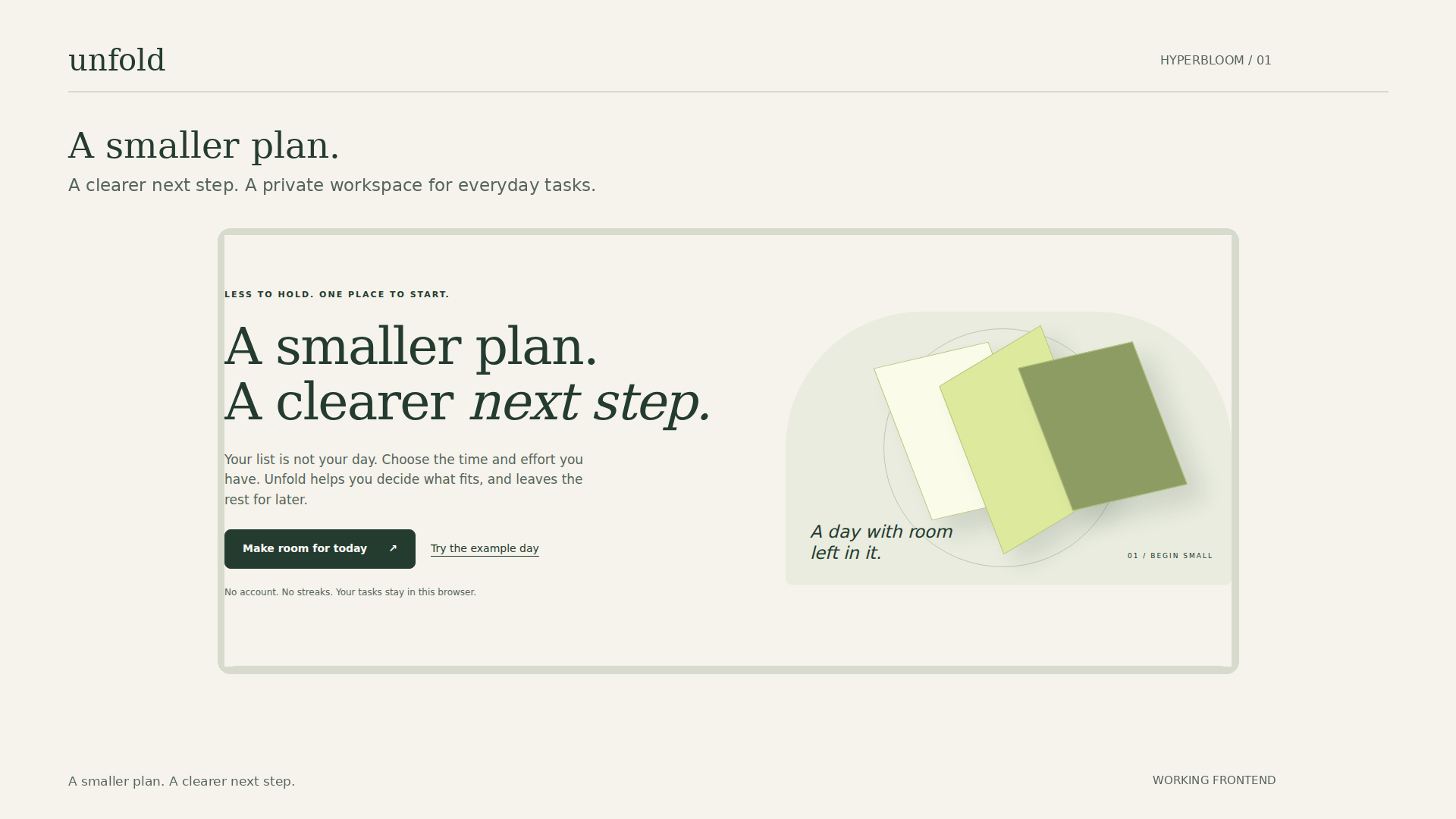
A long list records everything left to do. It does not explain what fits into the next half hour. We chose a small everyday problem: deciding where to begin when time and attention are limited. Unfold starts with available capacity, then makes a bounded plan with a clear next action.
We developed this new project for HyperBloom October.
What it does
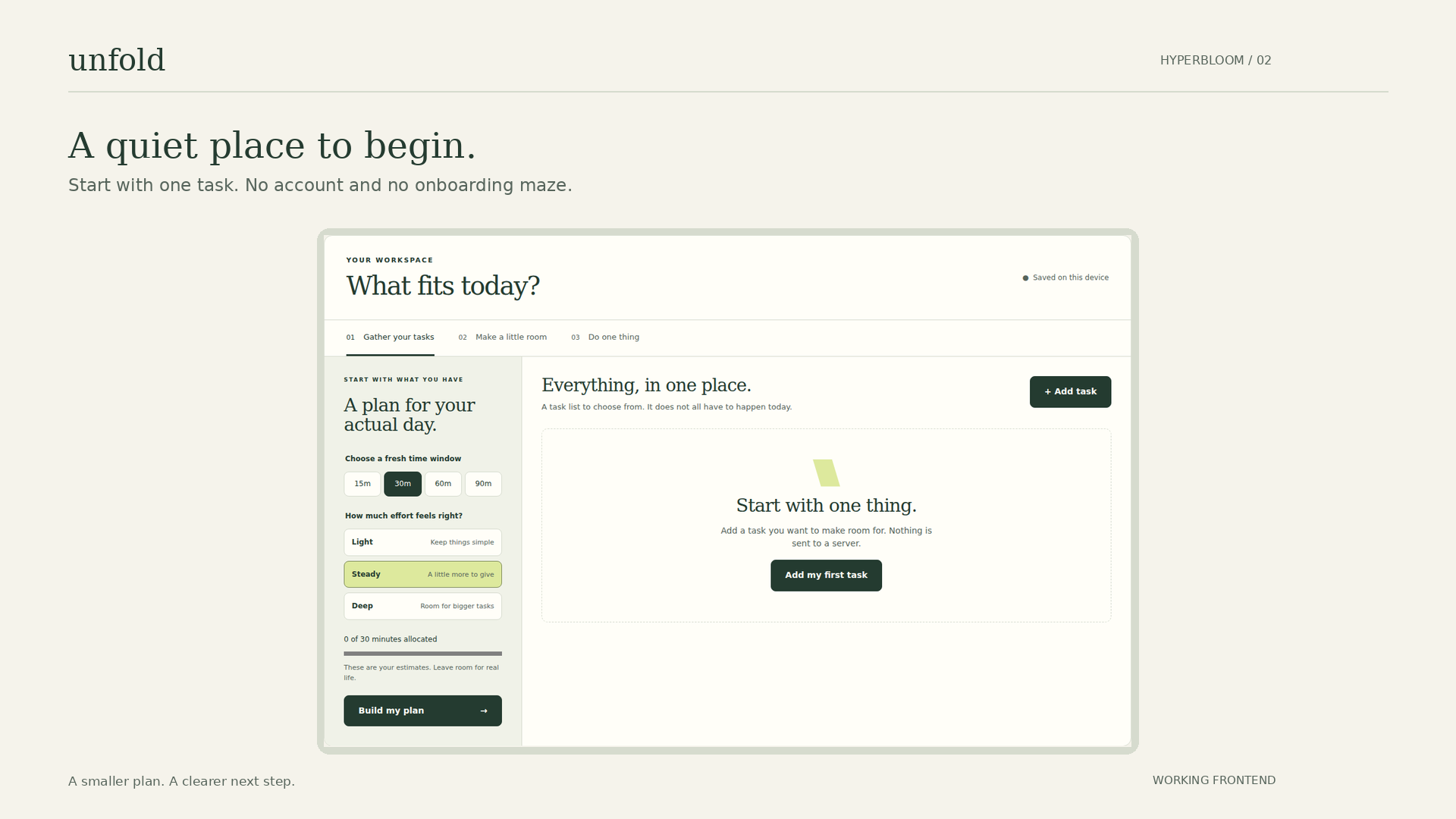
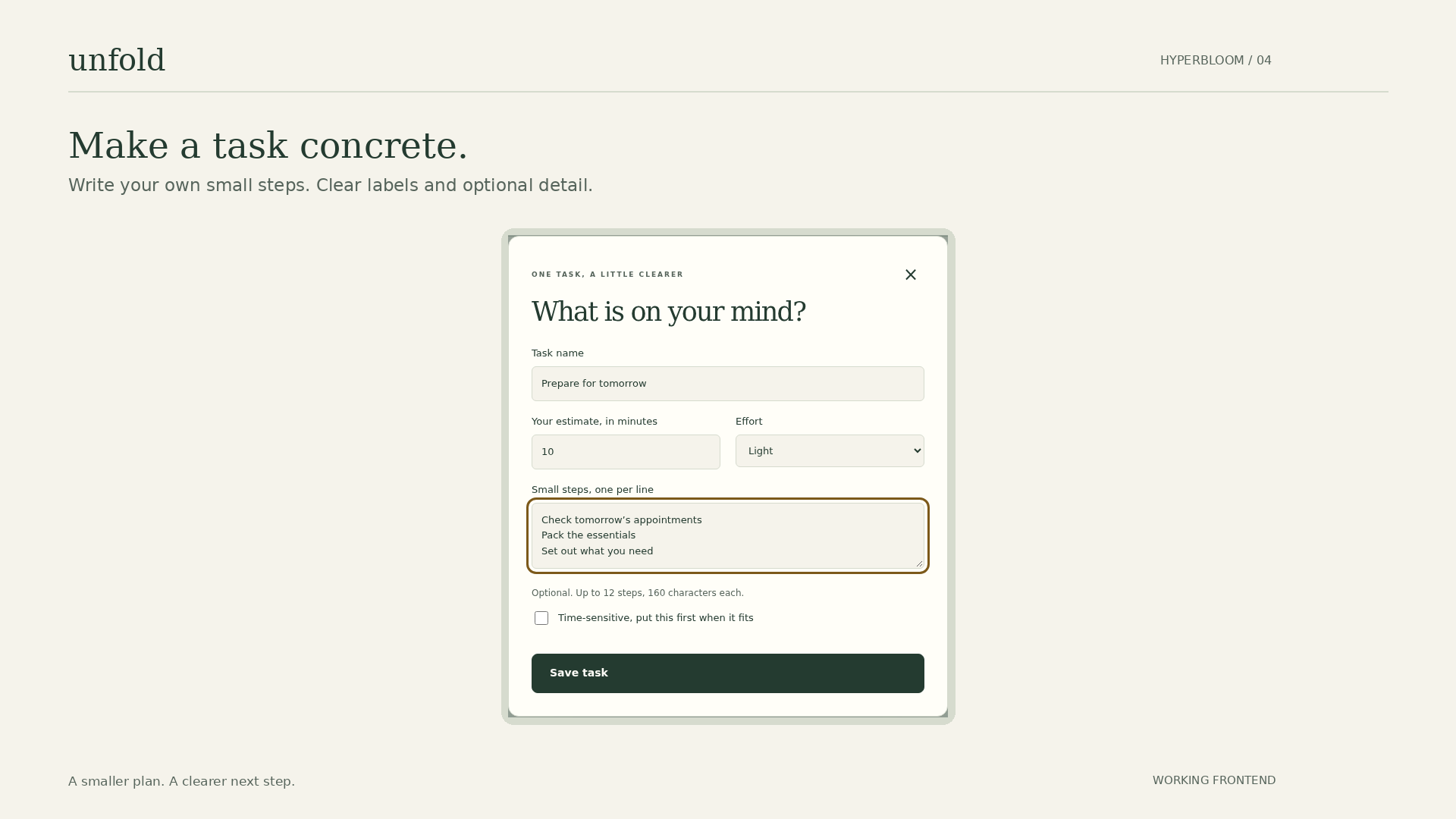
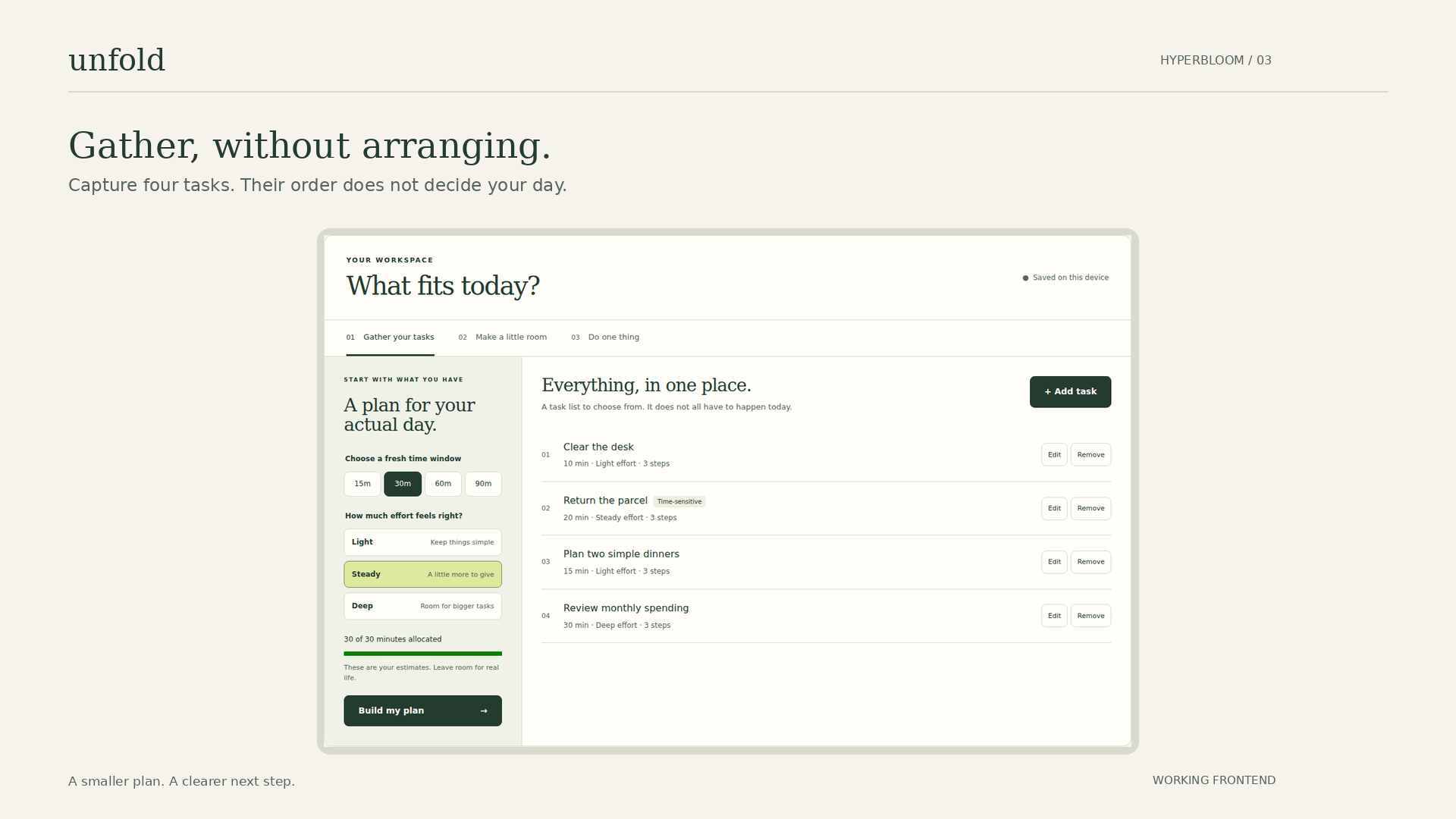
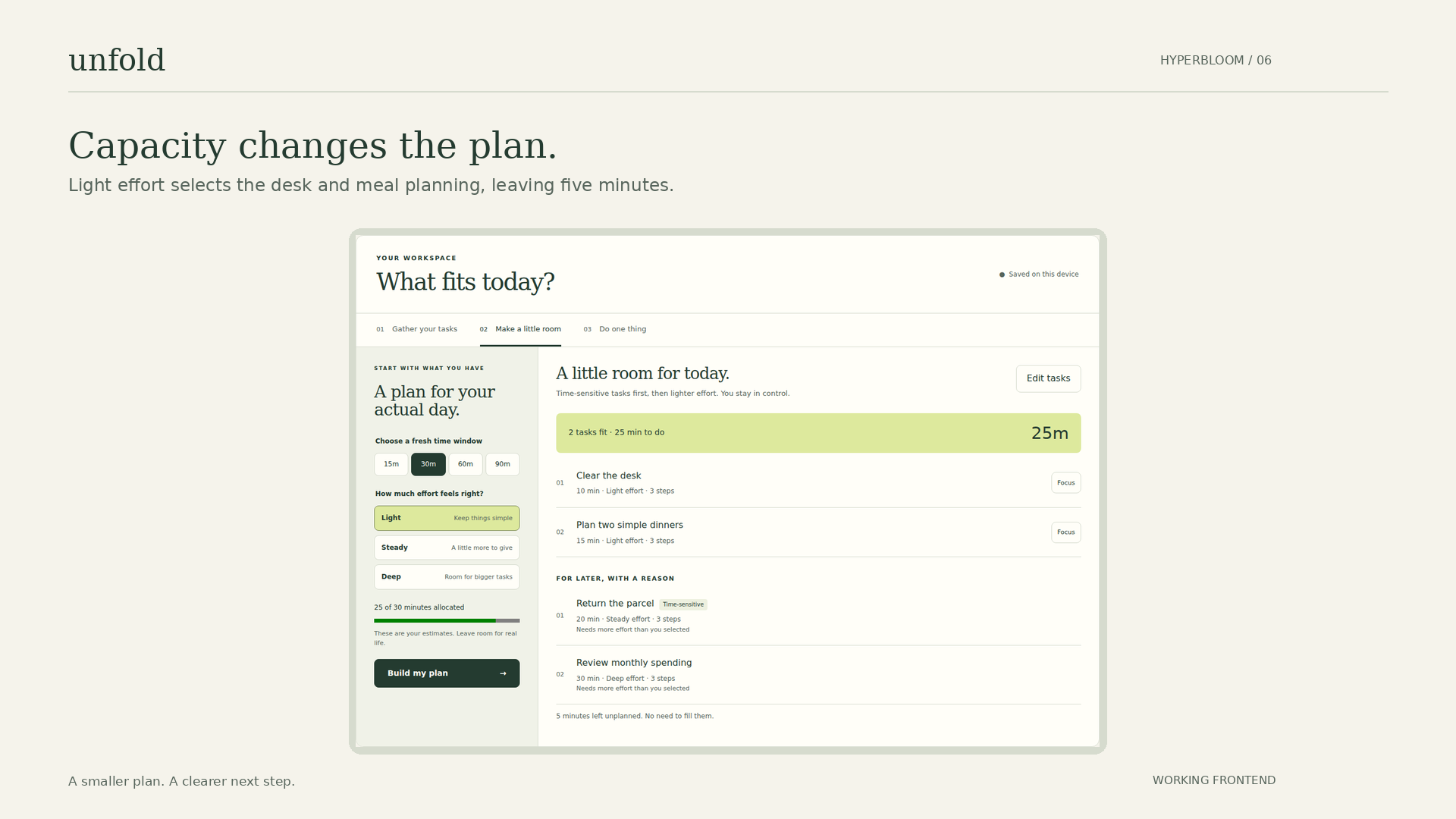
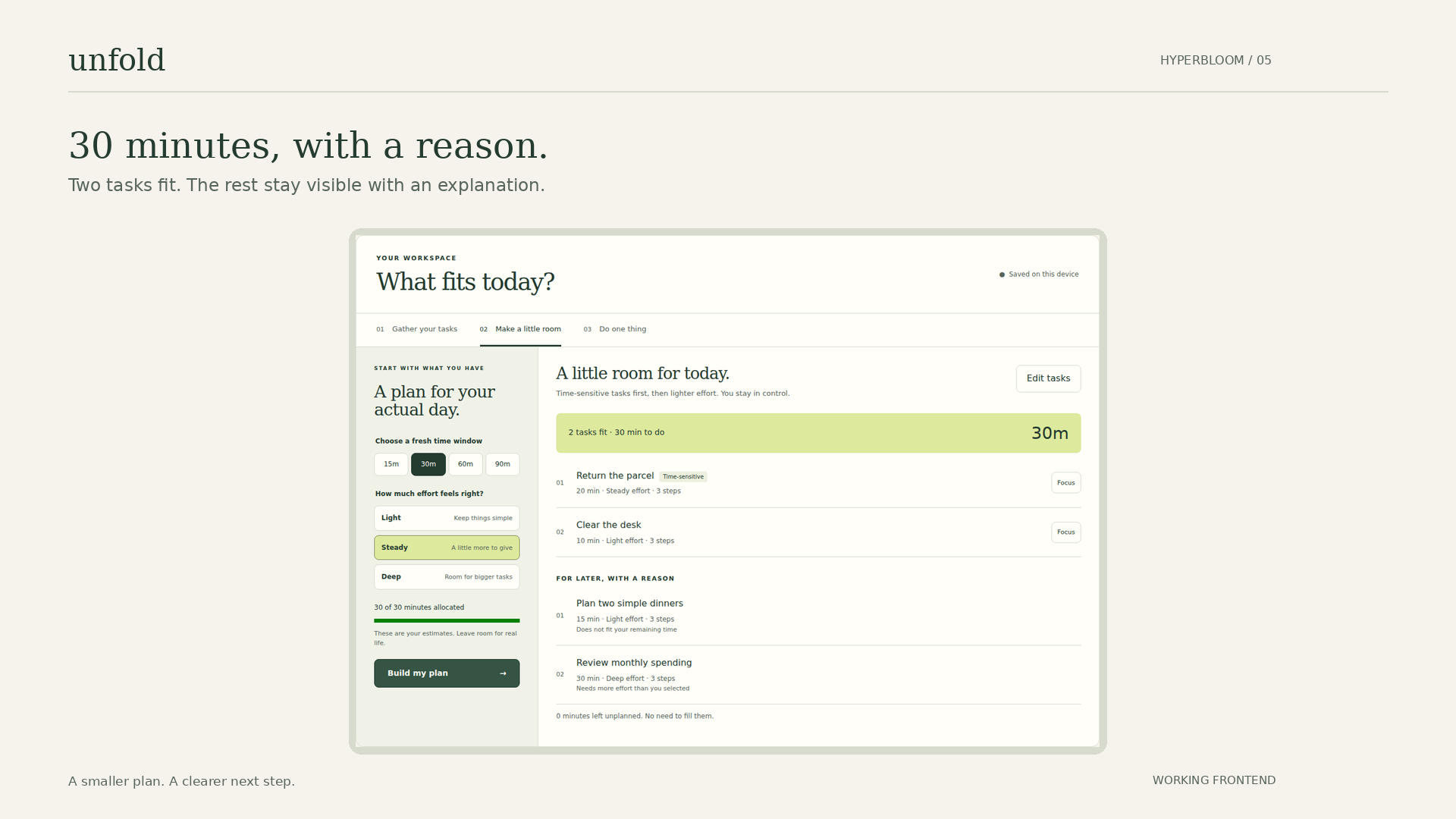
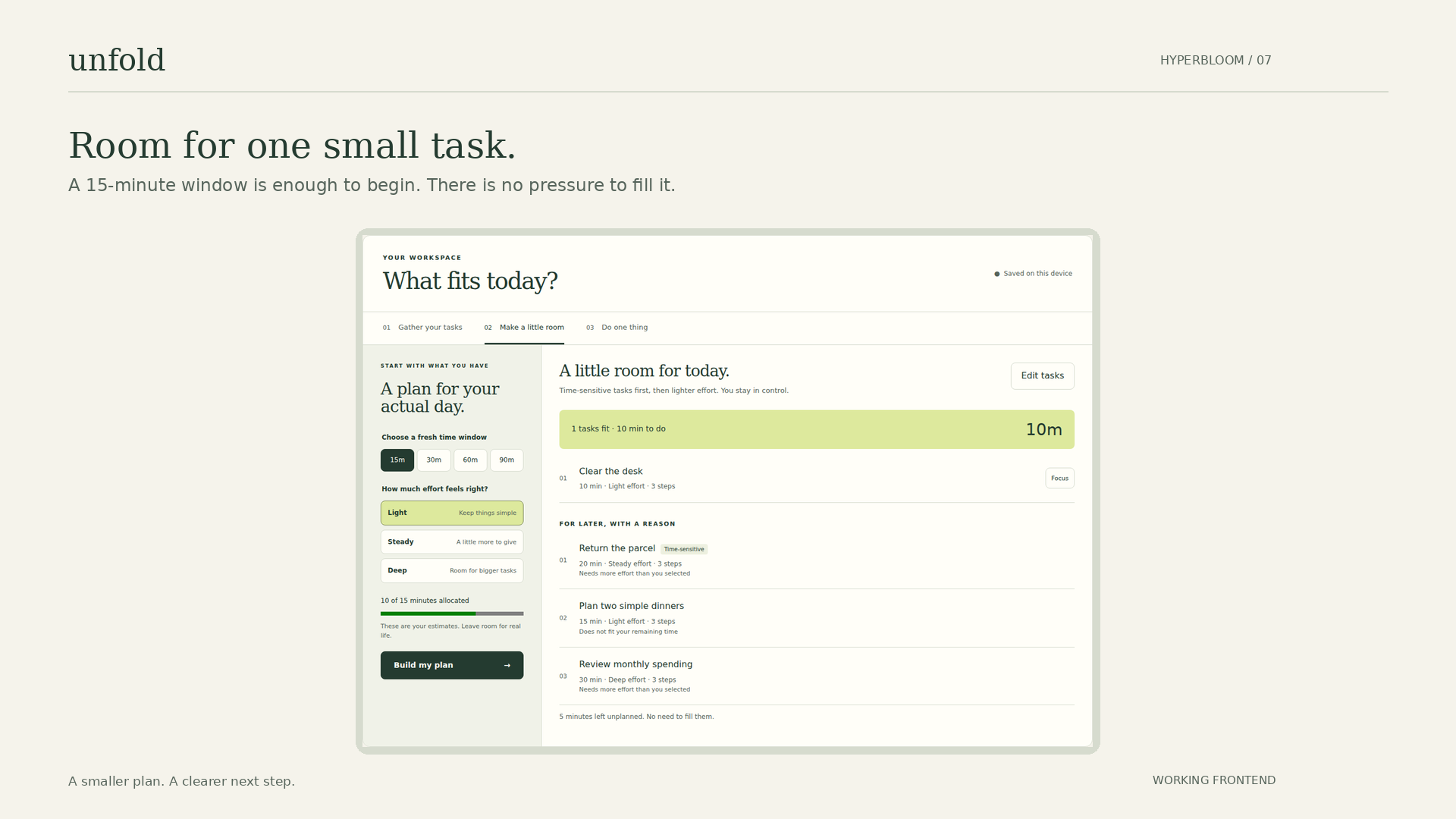
Gather everyday tasks, estimate their duration and choose their effort level. Add your own small steps and mark time-sensitive work. Select 15, 30, 60 or 90 minutes, then light, steady or deep effort.
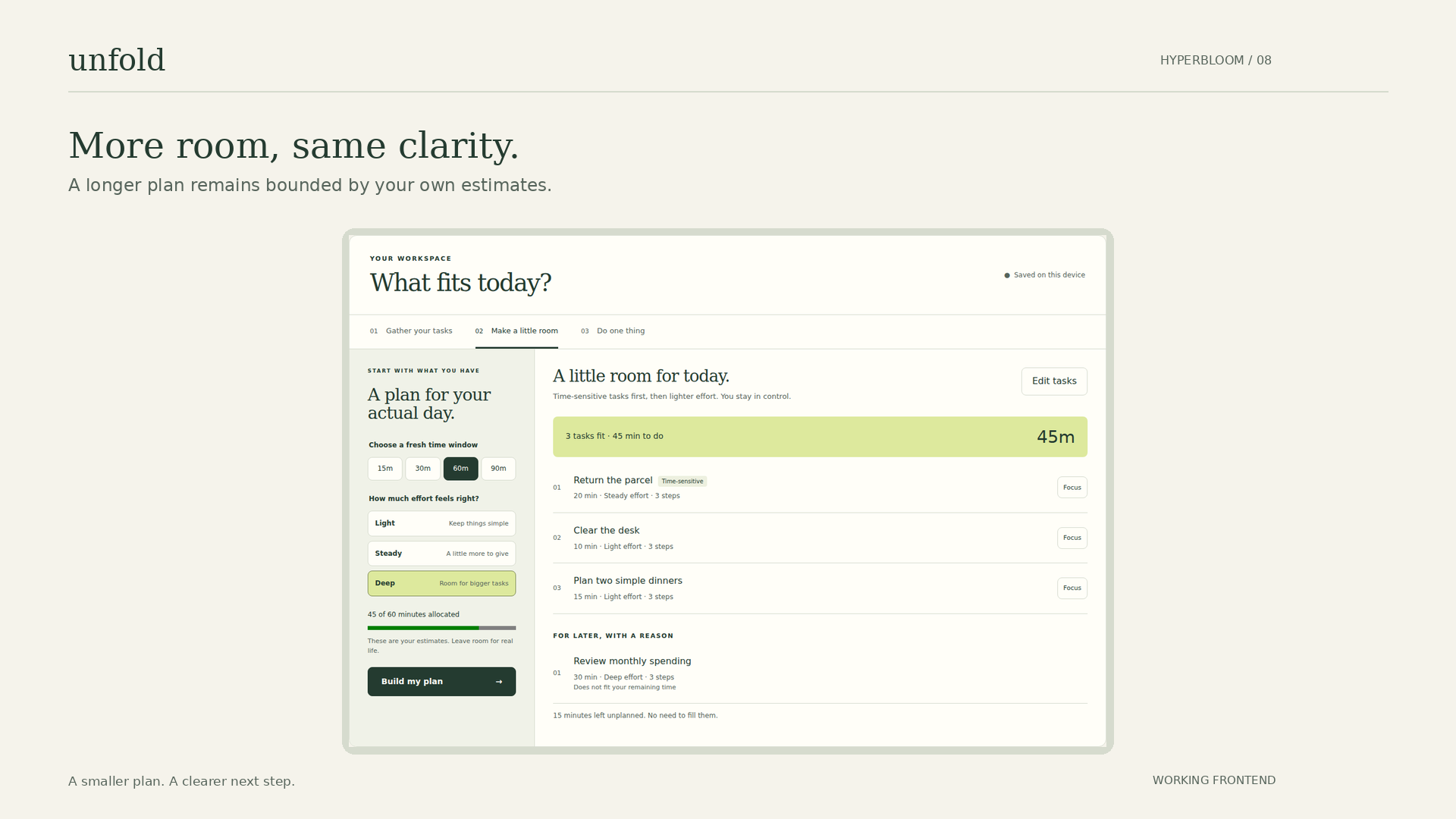
Completed-task estimates consume the current window. Selecting a time button starts a fresh window. Unfold considers time-sensitive tasks first, then lighter effort, preserving entry order for ties. It chooses whole tasks within the selected time and effort. Tasks left out remain visible with a plain explanation. This is an explainable planning rule, not a claim of optimal scheduling.
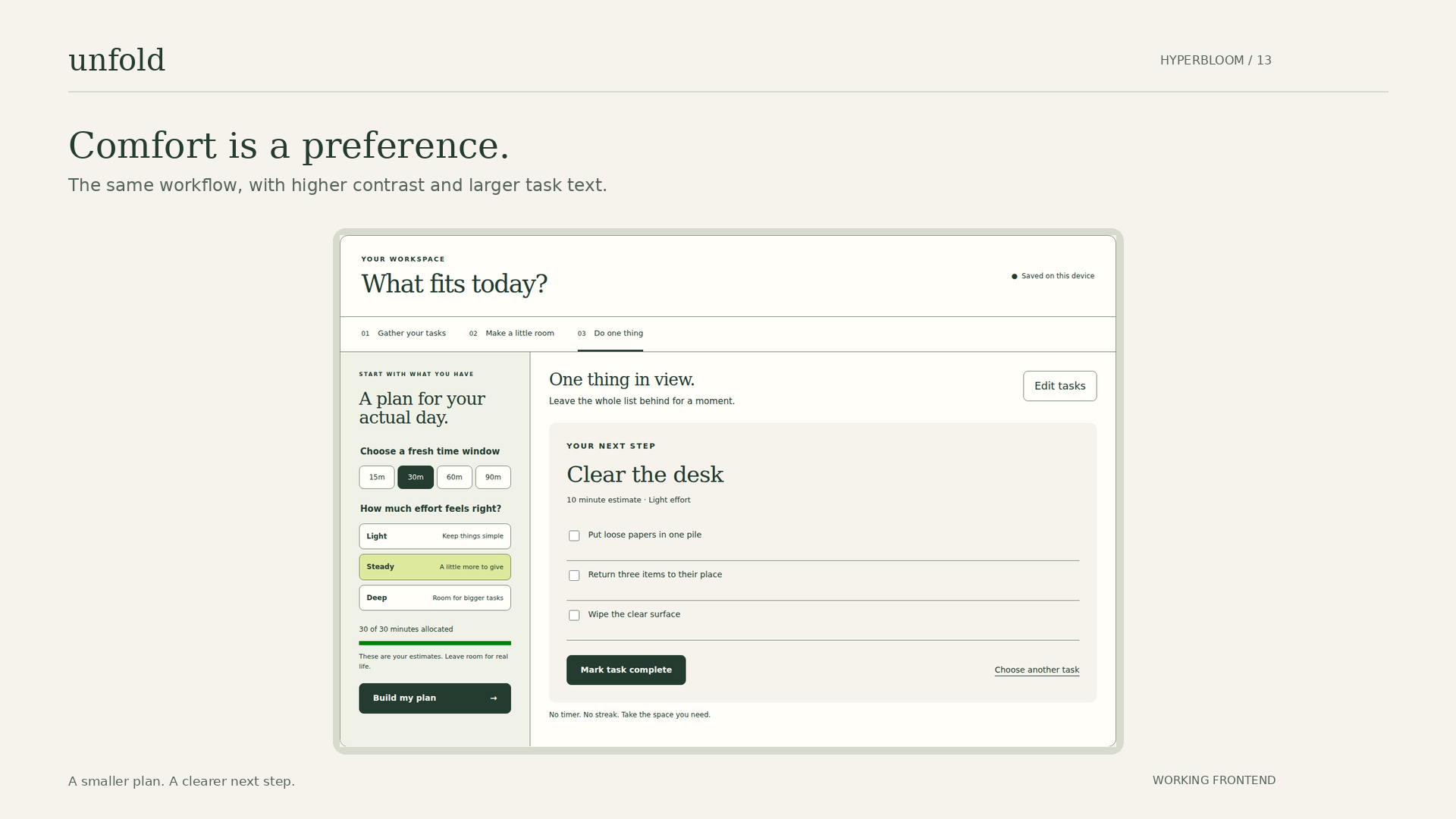
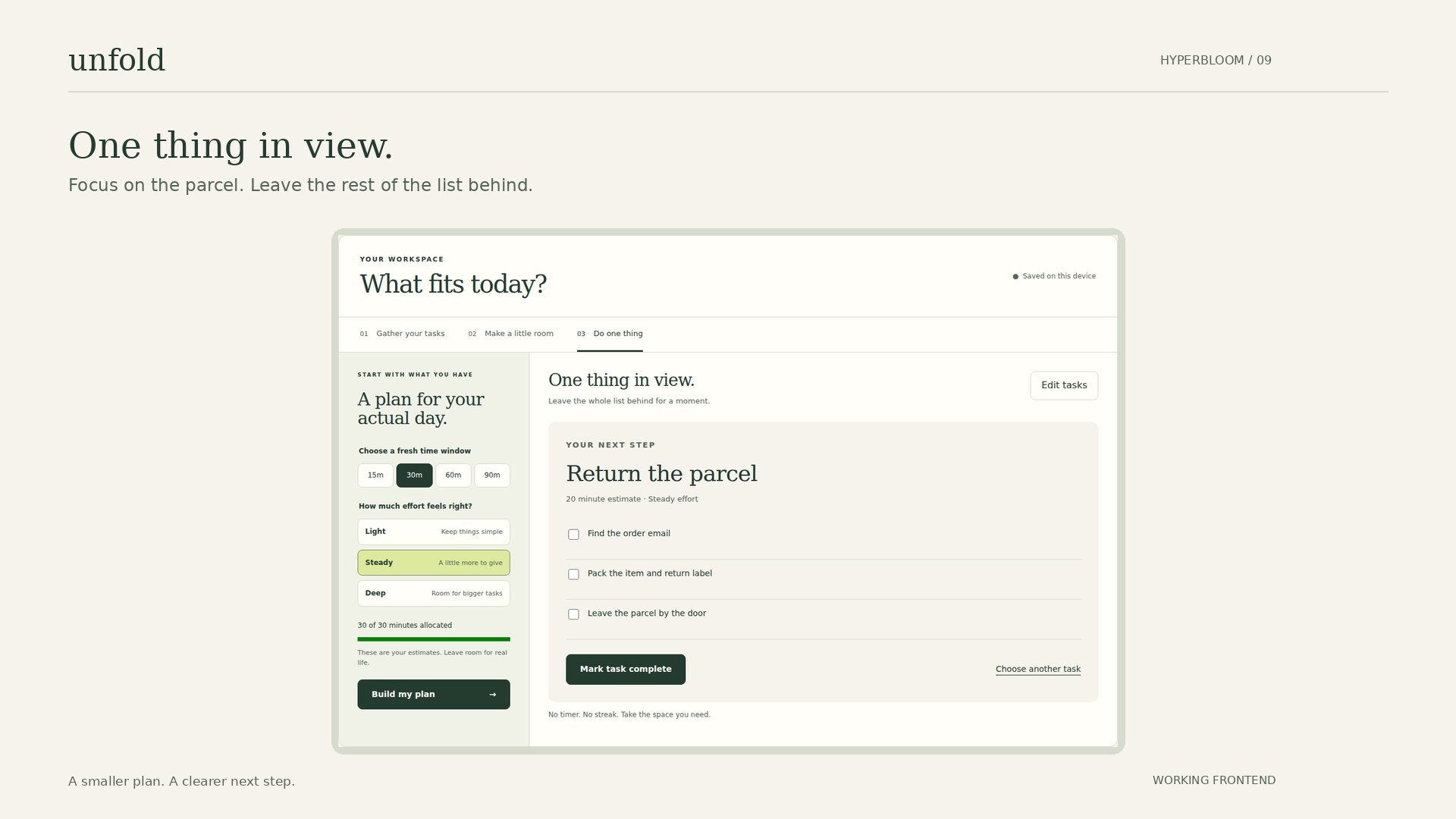
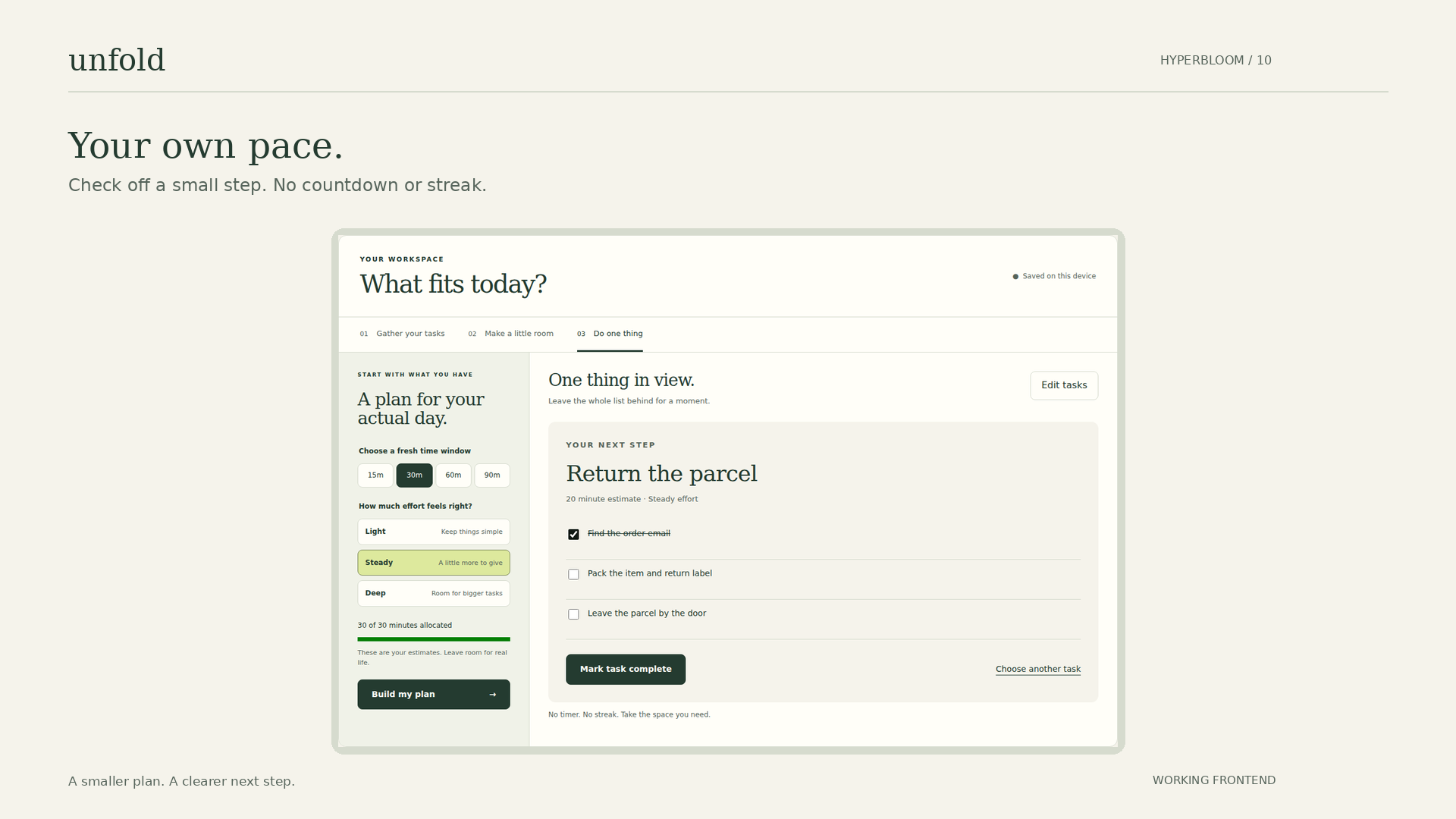
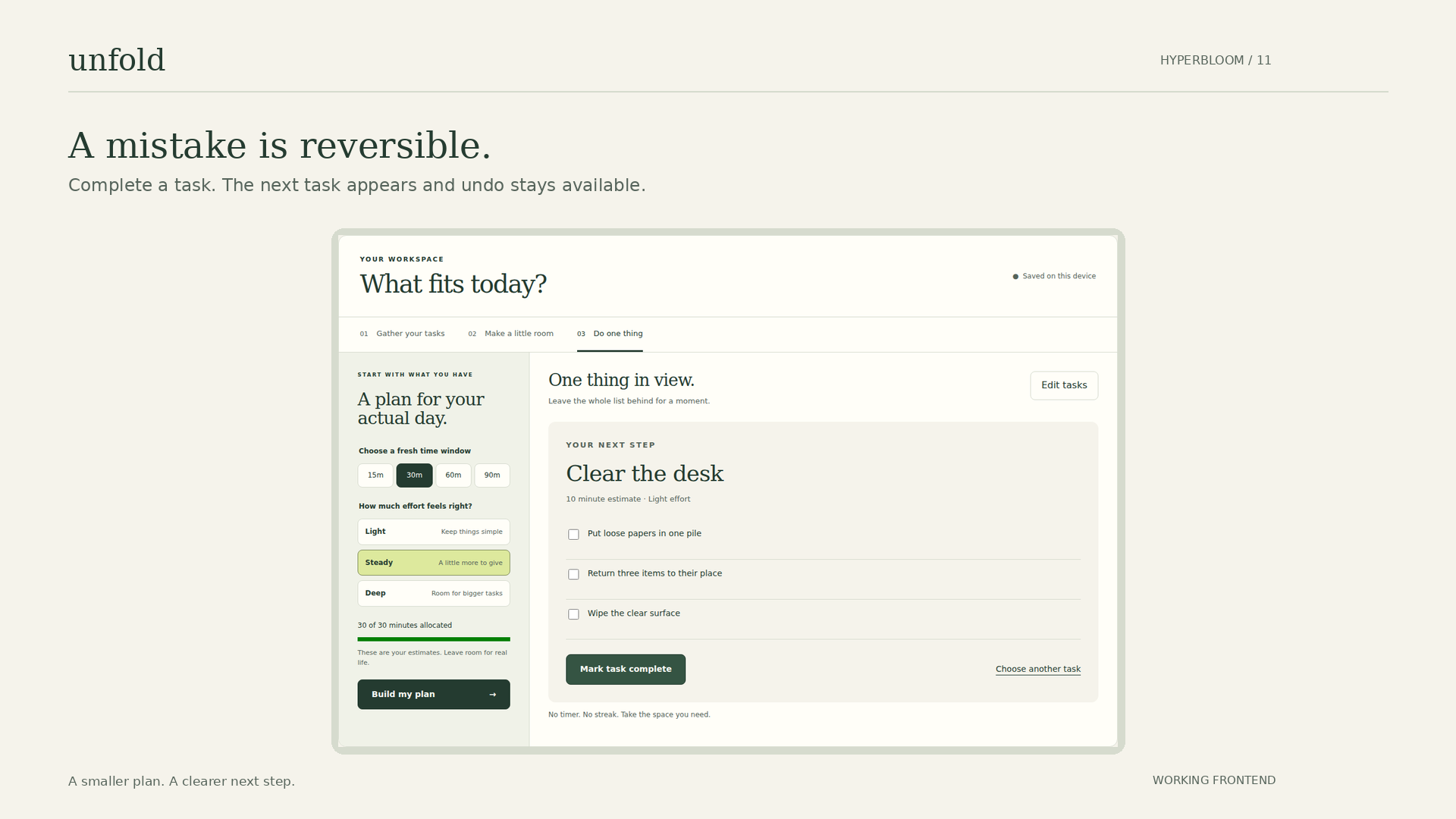
Focus mode shows one task and its small steps. Complete it, undo a mistake, or choose another task. Completed tasks are retained and can be reopened. There is no countdown, streak, leaderboard or forced account creation.
How we designed it
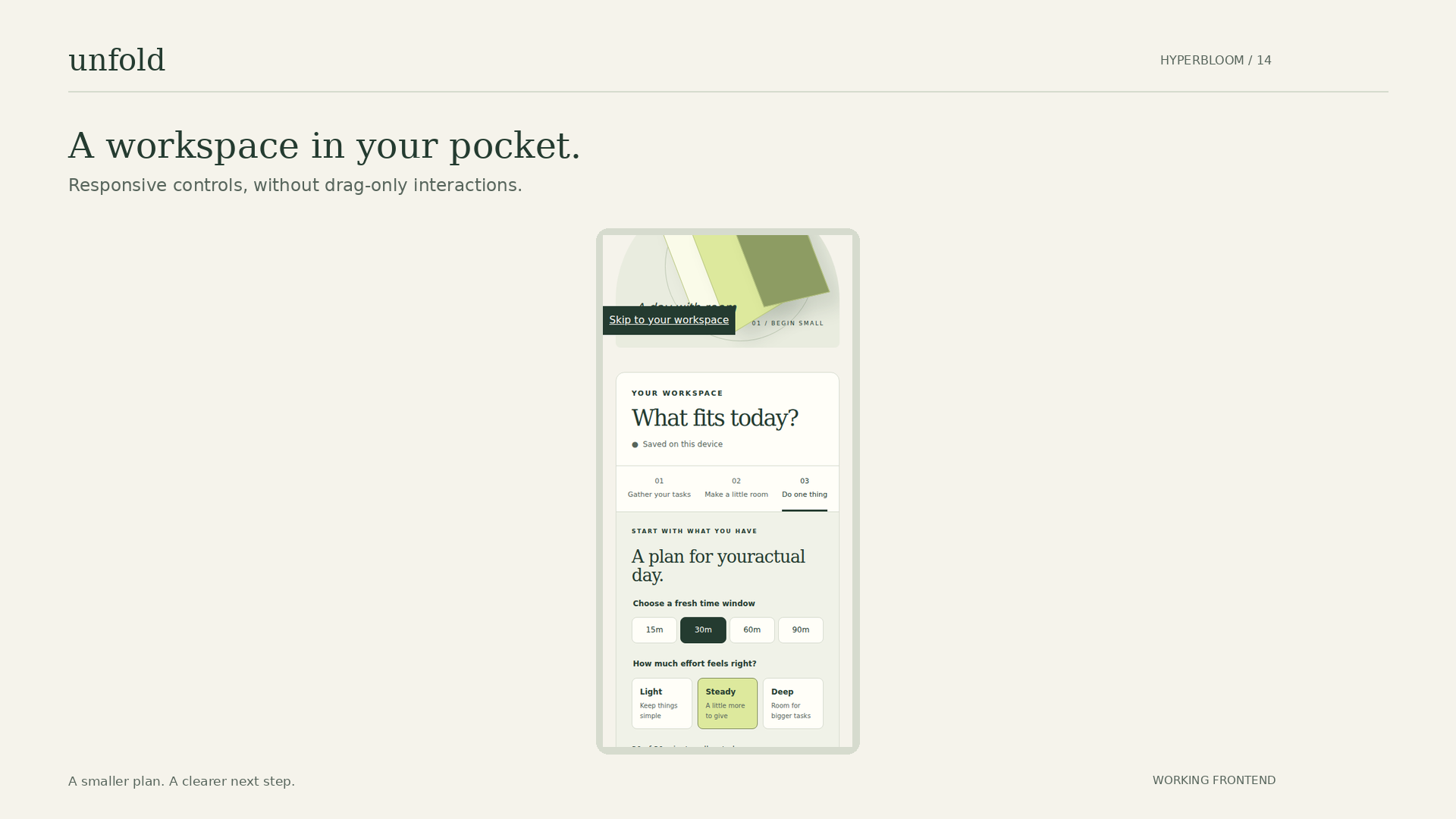
Three numbered stages organize the experience: gather, make room, do one thing. Warm paper, forest ink, restrained lime and editorial typography create a clear hierarchy. Folded-paper geometry belongs to the landing page, while task work stays quiet.
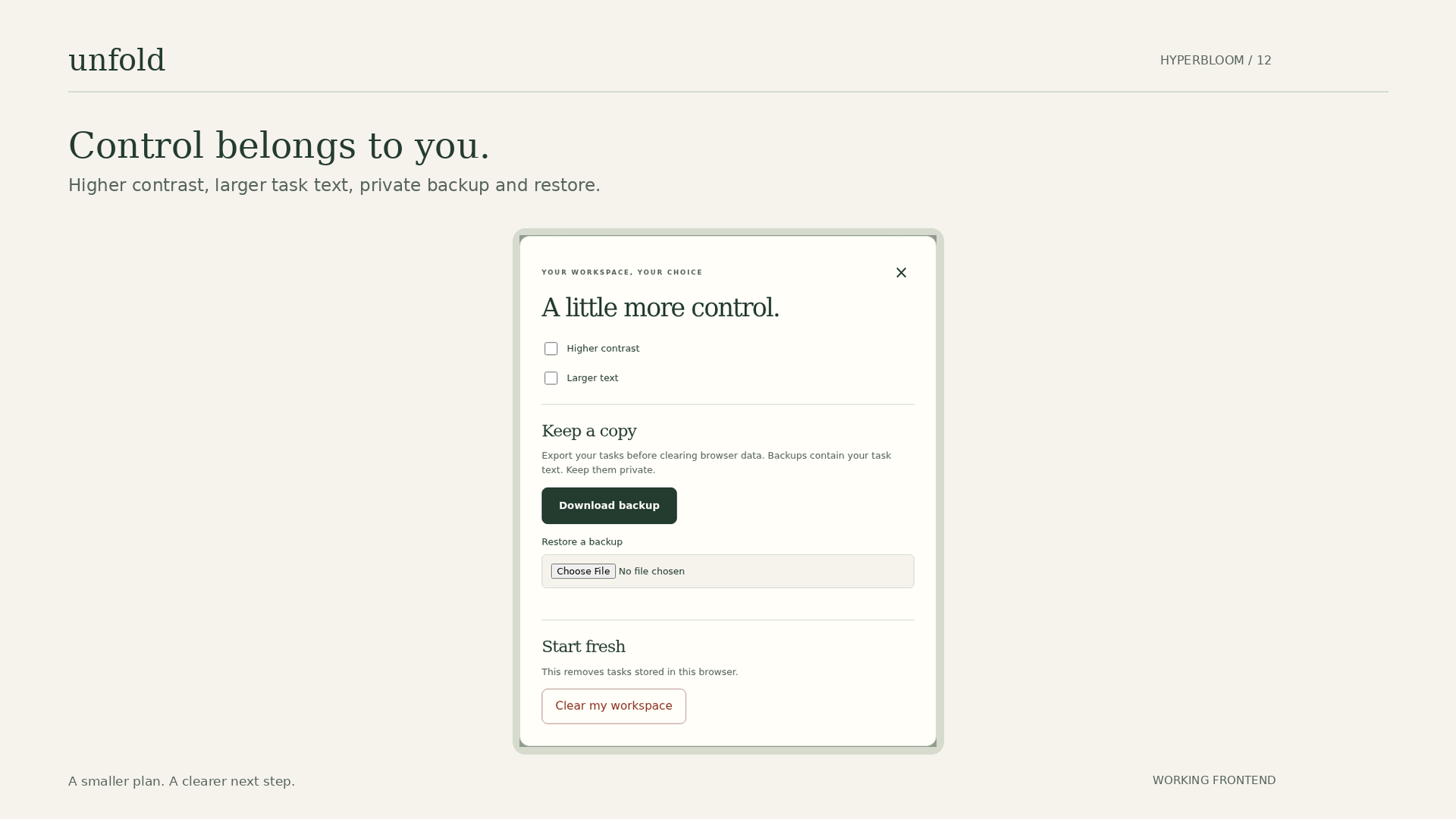
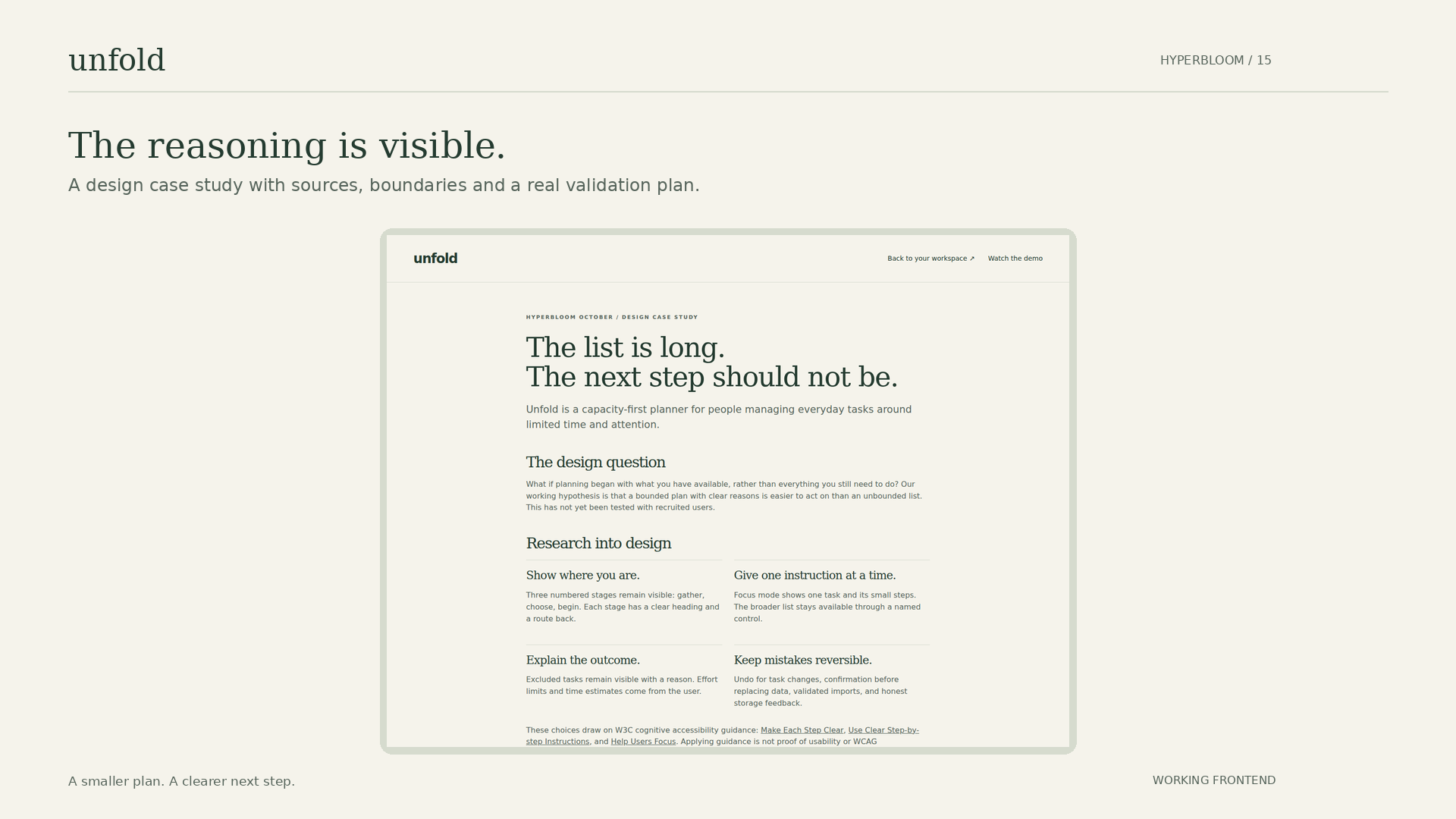
W3C cognitive accessibility guidance informed the use of clear steps, adjacent instructions, predictable controls and fewer distractions. Higher contrast and larger task text are user preferences. Reduced motion is respected. Semantic controls and native dialogs support keyboard interaction. No important interaction requires dragging.
Sources:
- https://www.w3.org/WAI/WCAG2/supplemental/patterns/o1p04-clear-steps/
- https://www.w3.org/WAI/WCAG2/supplemental/patterns/o4p07-step-instructions/
- https://www.w3.org/WAI/WCAG2/supplemental/objectives/o5-user-focus/
How we built it
The working frontend uses native JavaScript modules, HTML and CSS. Its deterministic planner and backup validator are isolated from the interface. User-entered text is rendered as text, never inserted as HTML. The application does not send task data to a server.
Tasks are stored in this browser. A private JSON backup supports export and validated restore. Replace and clear actions require confirmation and support undo. Storage failures are disclosed instead of being reported as saved. Browser storage is not encrypted and does not sync across devices. Small-step checkbox progress is session-only.
The site is deployed on Vercel with a restrictive Content Security Policy, MIME sniffing protection and disabled camera, microphone and location permissions. Runtime assets are self-hosted.
Challenges
The smallest useful plan needs a transparent reason for everything omitted. We kept deferred tasks visible rather than hiding them. We also treated recovery states as part of the design: empty workspace, no matching tasks, invalid backups, storage failure, accidental completion and destructive replacement.
ElevenLabs estimated a credit charge, so no paid generation was run. The demo instead uses free local Kokoro narration, code-rendered HyperFrames composition and actual interface captures. No paid video generator was used.
What we learned and verified
Ten logic tests cover capacity allocation, urgency ordering, completed tasks, empty plans and invalid backups. Twenty-four browser and recovery checks cover task flows, persistence, undo, text injection, invalid imports, data replacement, reduced motion, narrow layouts and storage failures. An axe-core audit found a visible-label mismatch in the logo link, which was corrected. Automated checks are engineering evidence, not proof of full accessibility conformance.
This is a functional frontend prototype. We have not recruited research participants or measured real-world outcomes. It is not a health intervention. Accessibility guidance is a design input, not a clinical claim.
Team responsibilities
Proposed ownership, pending teammate review:
- Adeel Falak Sher: product direction, frontend implementation and release review.
- Raouf Khalid: interaction design, accessibility review and demo storytelling.
These responsibilities do not claim unverified individual contributions. AI-assisted implementation and media tooling were used.
What is next
Run moderated studies with 5–8 participants, including keyboard and screen-reader users. Ask them to capture a task, explain a thirty-minute plan, recover a mistaken completion and restore a backup. Record task completion, mistakes and whether participants understand the reasons for deferred work. Test whether the bounded plan supports clearer decisions before adding reminders, sync or integrations.
Demo Video:
Built With
- axe-core
- css3
- gsap
- html5
- hyperframes
- javascript
- kokoro
- playwright
- vercel



Log in or sign up for Devpost to join the conversation.