Inspiration
Our inspiration was to find a novel way to integrate the emerging use of AI agents to benefit job seekers and recruiters alike. We wanted to bridge the gap between candidates and employers by offering a data-driven, AI-powered solution that enhances the hiring process. With the increasing reliance on AI tools in recruitment, our goal was to empower job seekers with actionable insights while providing recruiters with a deeper understanding of candidates’ capabilities—ensuring better hiring decisions with minimal effort.
What it does
This AI-powered job-seeker assistant is an intelligent agent that helps candidates refine their resumes and prepare for job applications like never before. With long-term memory, the system creates a candidate persona that mirrors the user's professional and academic journey. Leveraging AI roleplay, it conducts simulated job interviews by generating expert analysts tailored to the job posting, providing detailed feedback on strengths and weaknesses. Through human-in-the-loop capabilities, users can fine-tune the analysts’ focus to address specific career aspects, ensuring personalized improvements.
For recruiters, this workflow offers an effortless way to gain deep insights into candidates' potential, providing comprehensive evaluations with minimal effort. Whether you're a job seeker looking to stand out or a recruiter aiming to identify the best fit, our AI agent makes the process smarter, faster, and more insightful.
How we built it
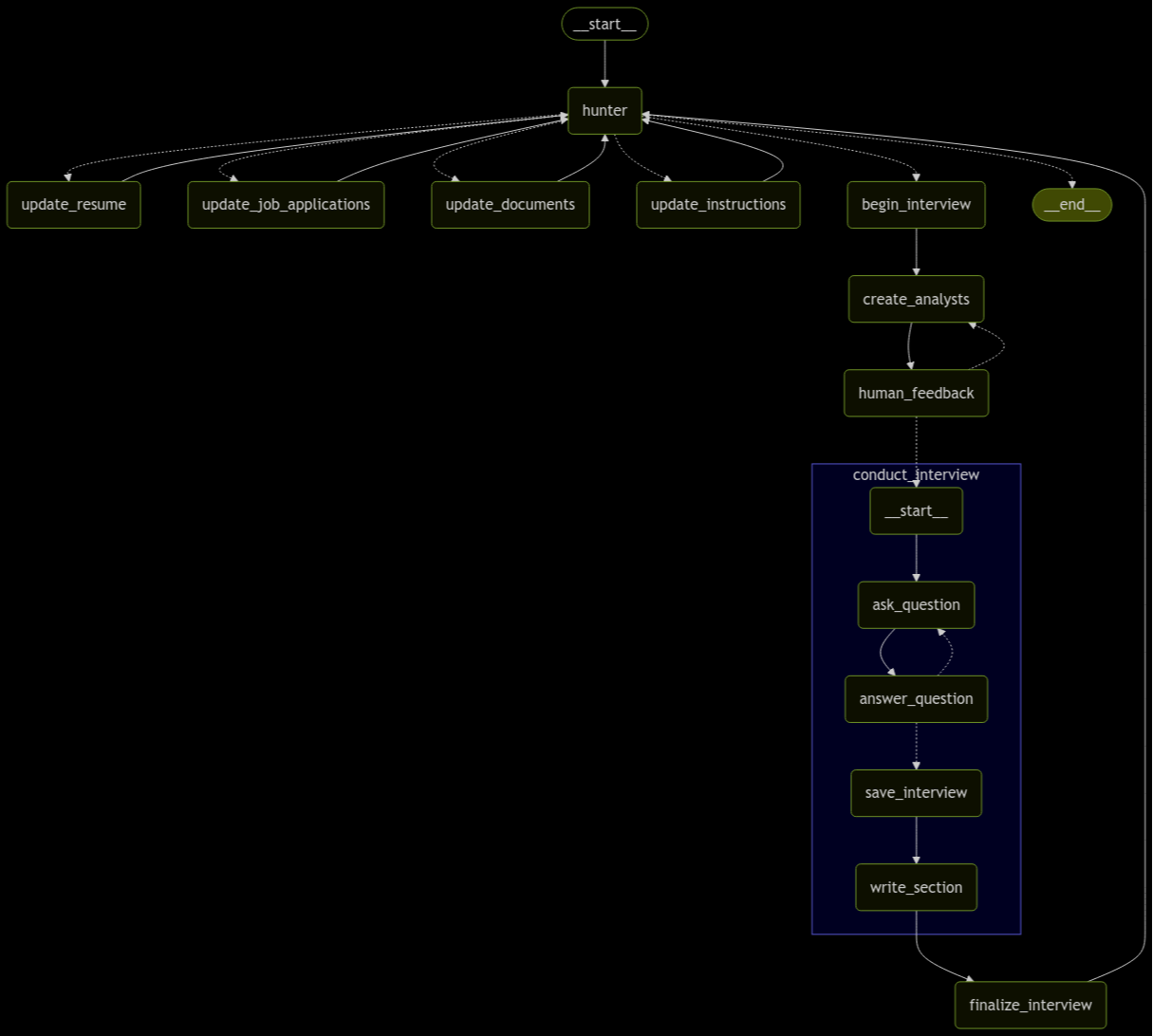
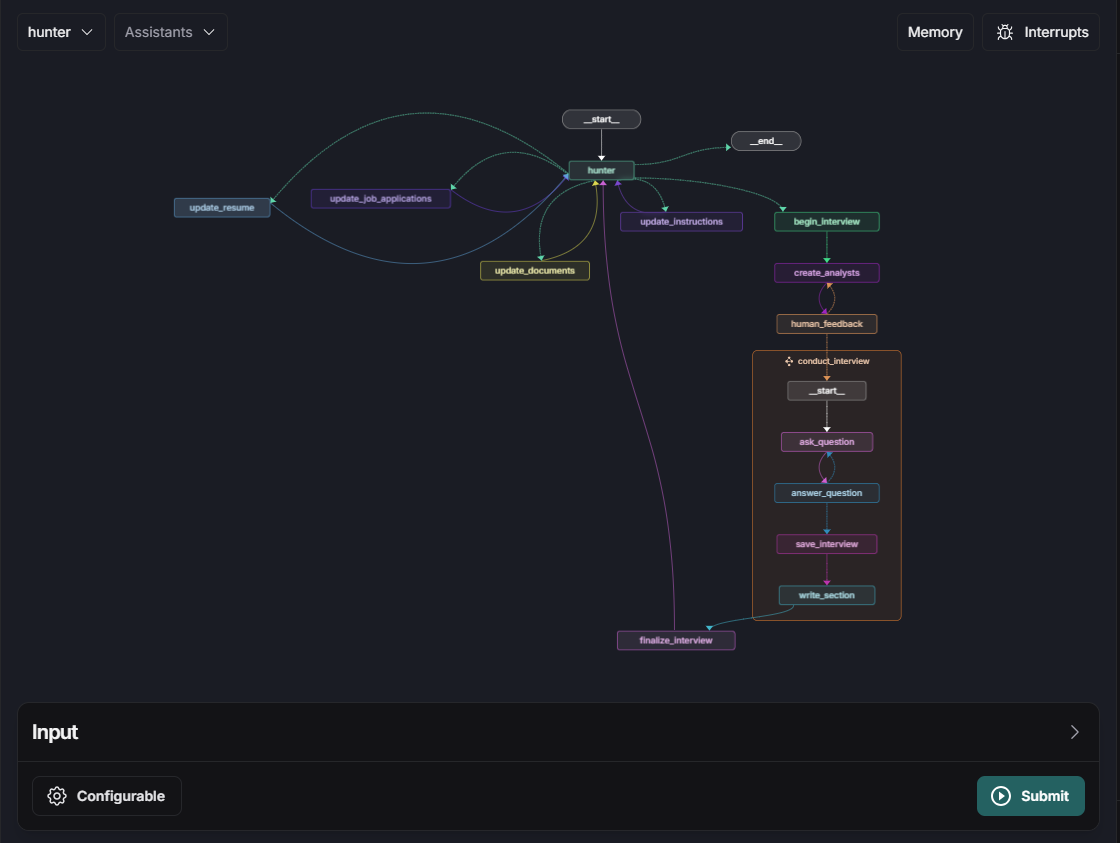
We used LangGraph to construct the agentic workflow, allowing us to efficiently manage interactions between various sub-agents and the user's data. We used PostgreSQL and Redis to store long-term memory, enabling the system to track the user's career history and improvements over time.
Additionally, we used Trustcall for JSON patching to manage updates to the user's long-term memory efficiently, while Pydantic was used for data validation to maintain data integrity and consistency across interactions.
We built a quick prototype frontend using Streamlit, which can in the future provides an intuitive interface for job seekers to interact with the AI assistant, update their resumes, and initiate interviews seamlessly.
Challenges we ran into
Some of the key challenges we faced included:
- Agent Subgraph Complexity: Setting up the subgraph for agents to handle multiple concurrent interview sessions and interactions was challenging, requiring fine-tuning of the agent orchestration.
- Long-term Memory Management: Updating and modifying large blobs of memory stored in PostgreSQL posed performance and data consistency challenges. We overcame this by leveraging - Trustcall for efficient JSON patching.
- Data Validation: Ensuring the integrity and consistency of dynamic resume data and interview feedback was a challenge, which we addressed using Pydantic for robust schema validation.
Accomplishments that we're proud of
- Successfully integrating multiple AI agents that simulate realistic interviews.
- Implementing an efficient memory management system that allows users to track and refine their career journey over multiple sessions.
- Achieving a functional prototype that delivers actionable insights for both job seekers and recruiters.
What we learned
Throughout the project, we learned the importance of:
- Agent Collaboration: Designing modular AI agents that can work together to achieve complex tasks like resume analysis and interview simulation.
- Efficient Data Handling: How to leverage tools like Trustcall and Pydantic to manage and validate large blobs of information.
- User Experience Matters: Creating an intuitive UI/UX is crucial for adoption, and Streamlit provided a great way to quickly prototype and iterate on the design.
What's next for UnemployeesVS
We plan to:
- Improve long-term memory efficiency by integrating vector databases for better retrieval and matching.
- Expand the platform to support real-time interview coaching with voice capabilities.
- Develop recruiter-focused dashboards to provide more granular insights into candidate strengths and weaknesses.
Built With
- langgraph
- postgresql
- redis
- streamlit

Log in or sign up for Devpost to join the conversation.