-
-
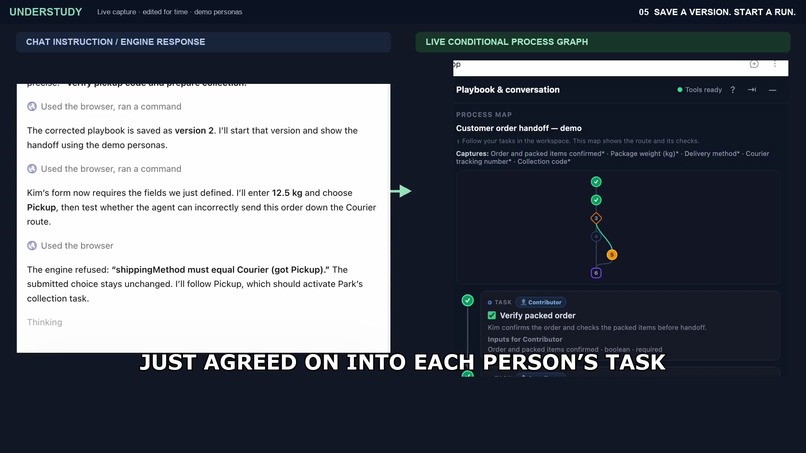
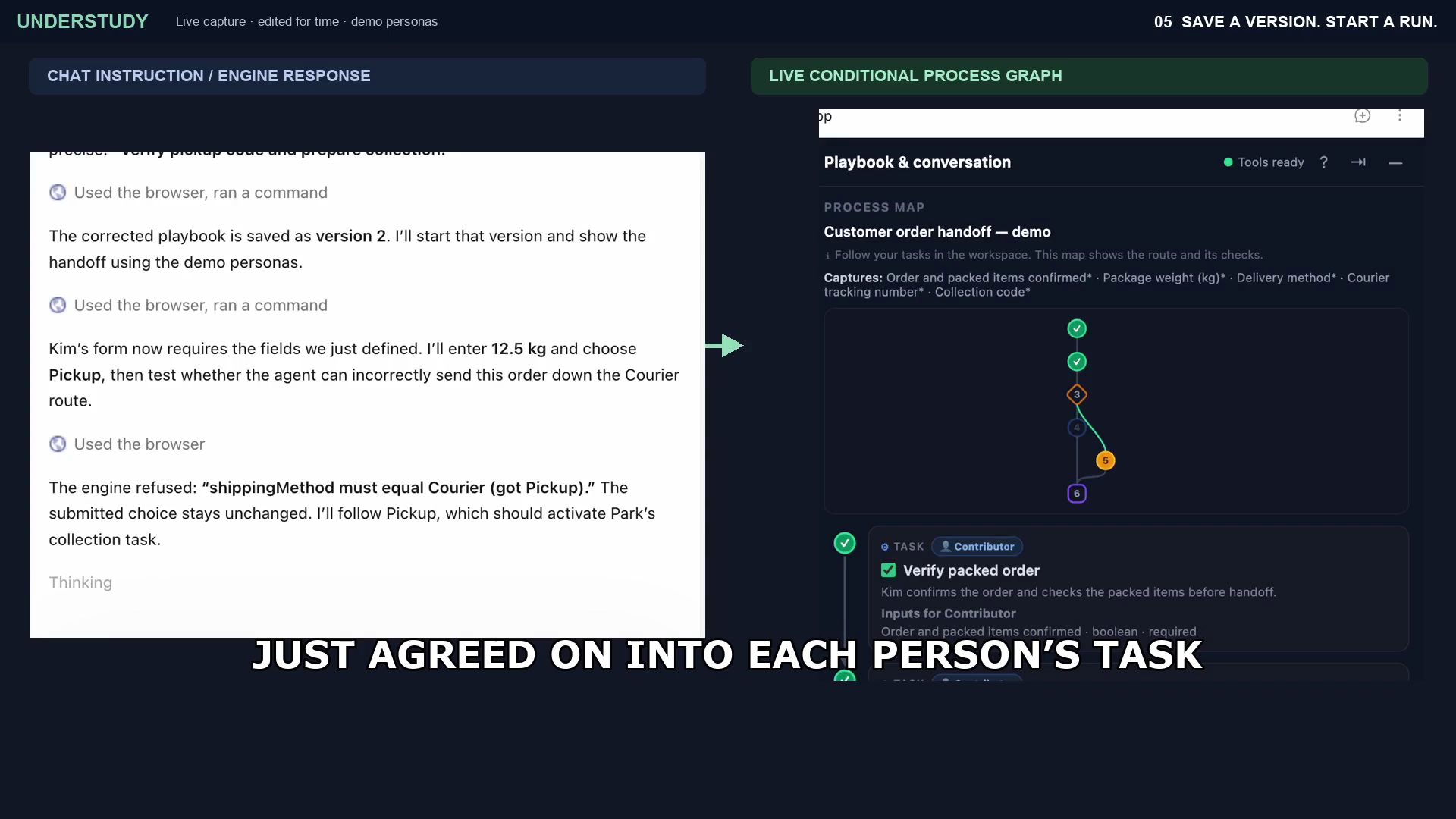
The visitor’s agent loads the reviewed version, starts a run, and turns the graph’s rules into each owner’s task form.
-
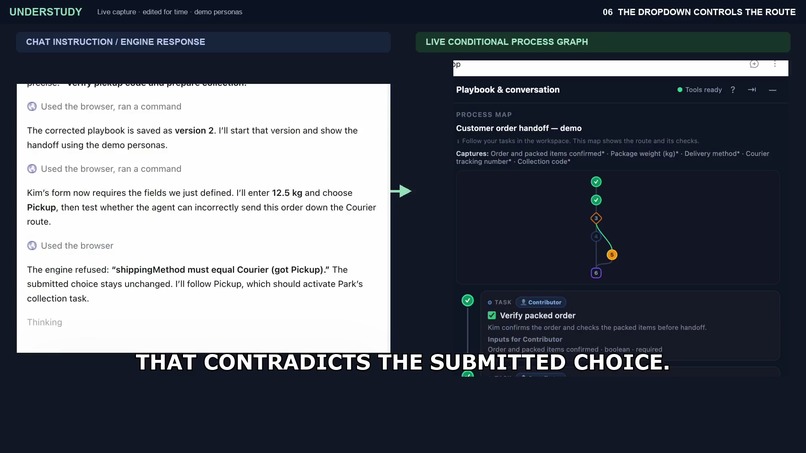
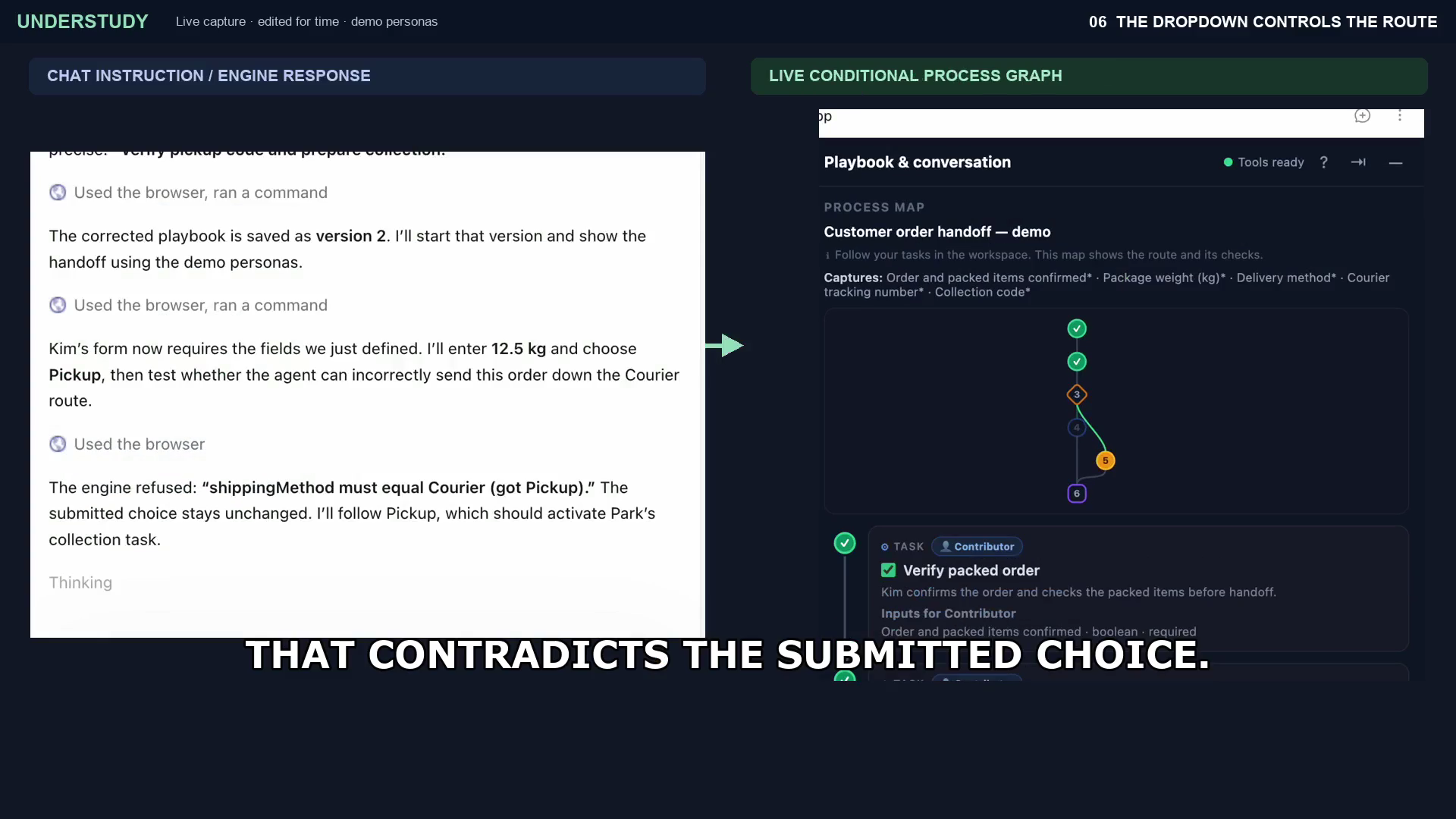
Recorded Pickup evidence cannot enter the Courier route. Understudy refuses the conflicting branch and preserves the submitted choice.
-
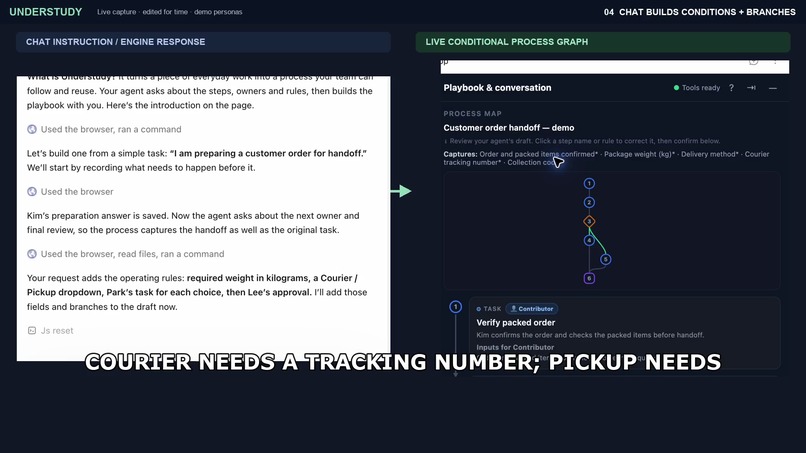
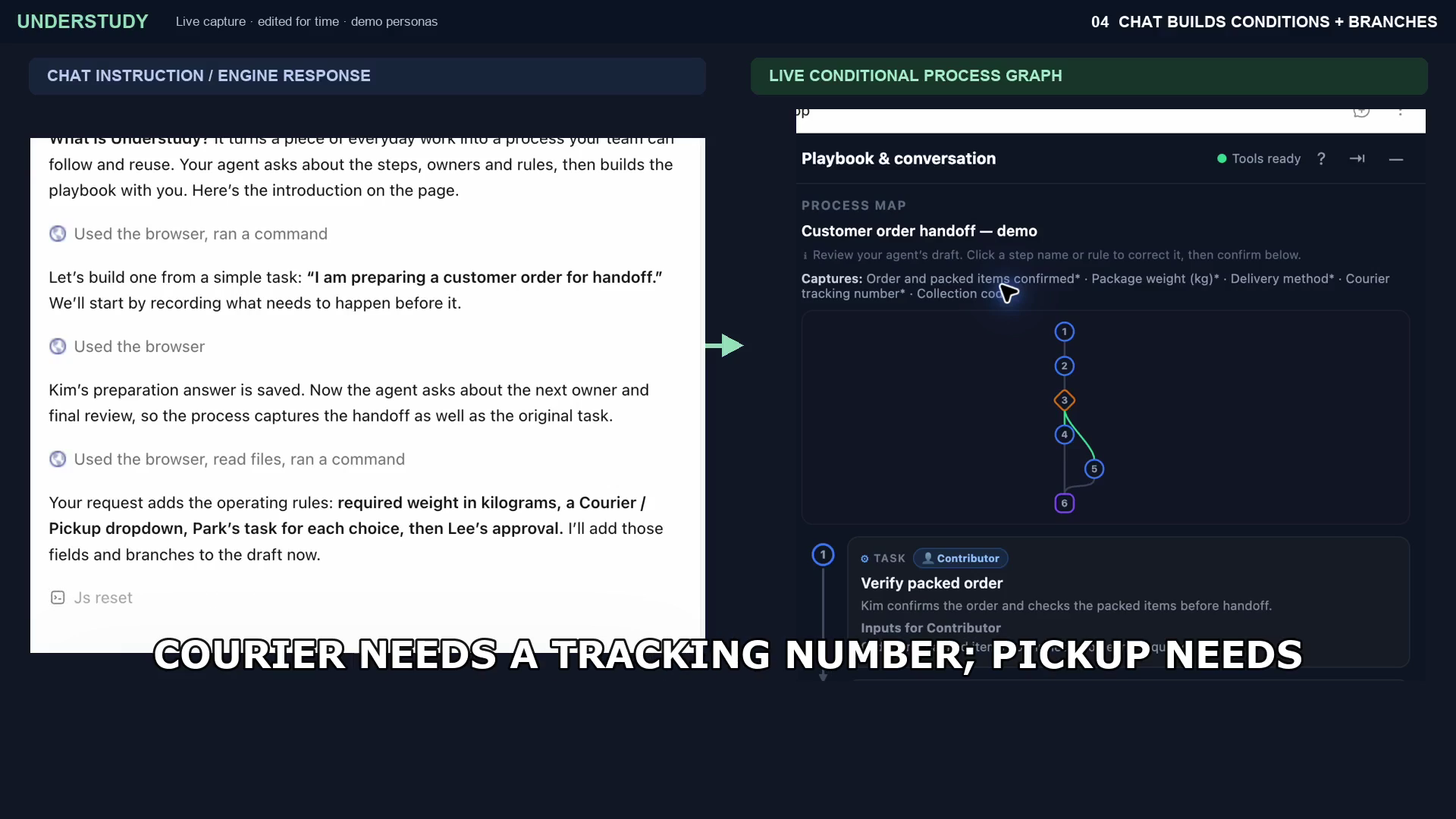
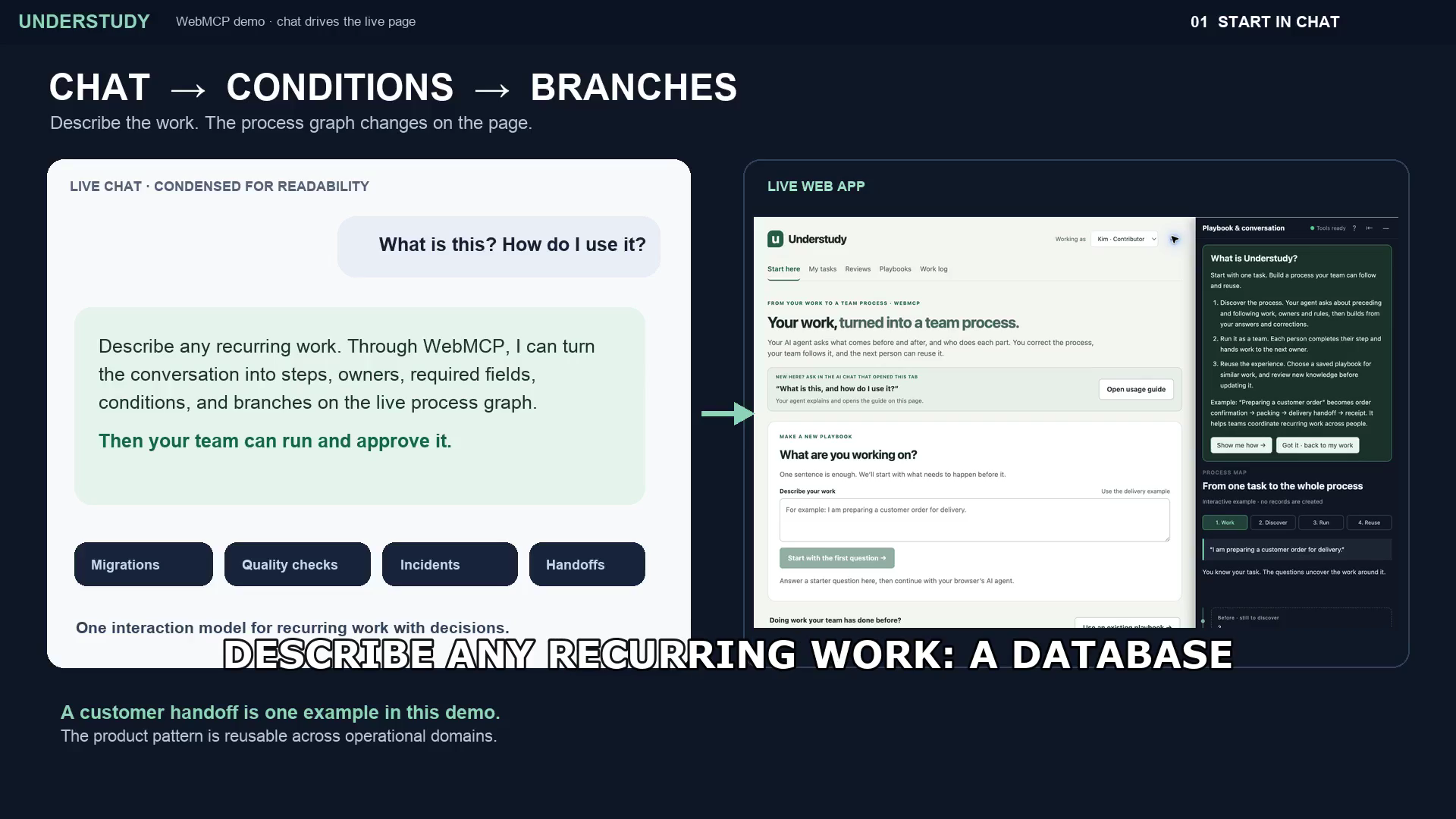
Chat adds required weight, a delivery-method dropdown, owners, and Courier/Pickup conditions to the live process graph.
-
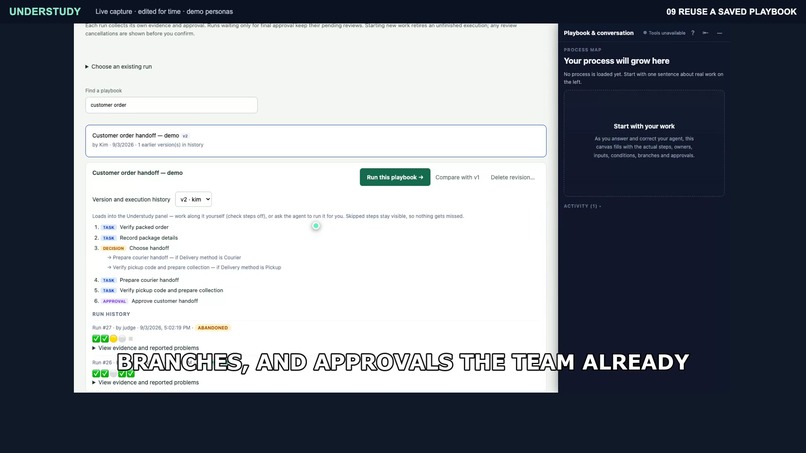
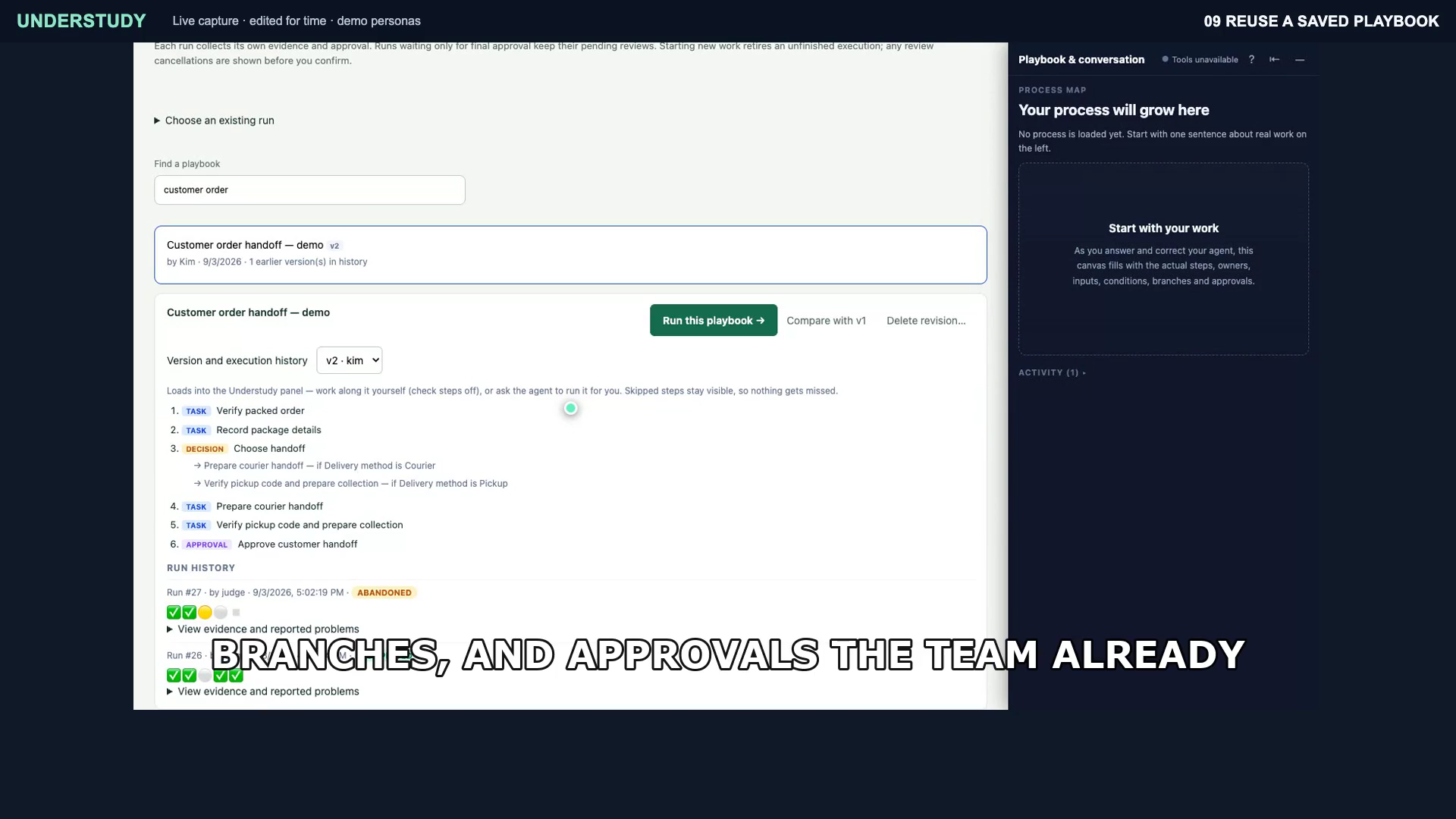
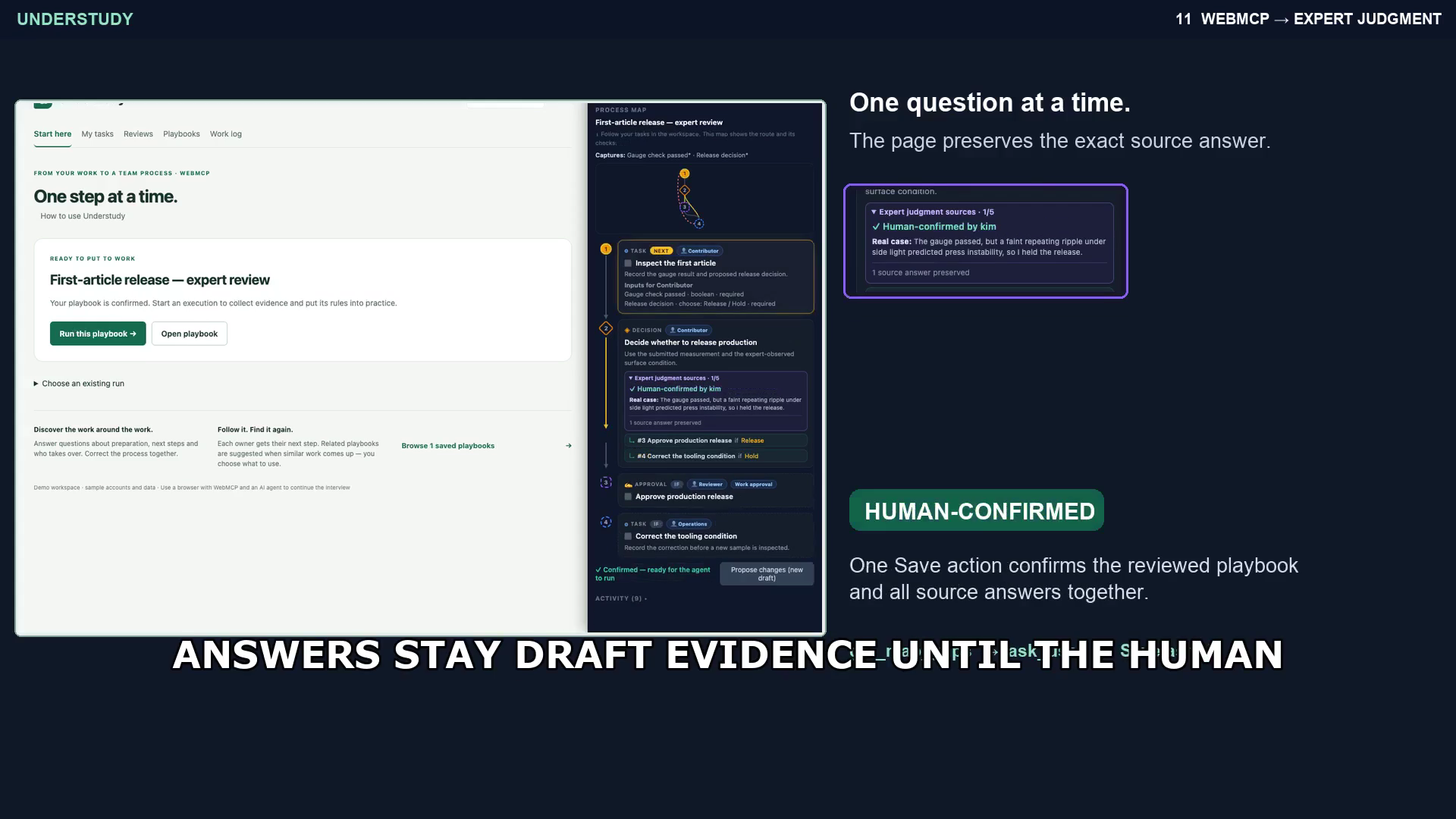
A saved playbook keeps its fields, branches, approvals, versions, and run history ready for the next worker to reuse.
-
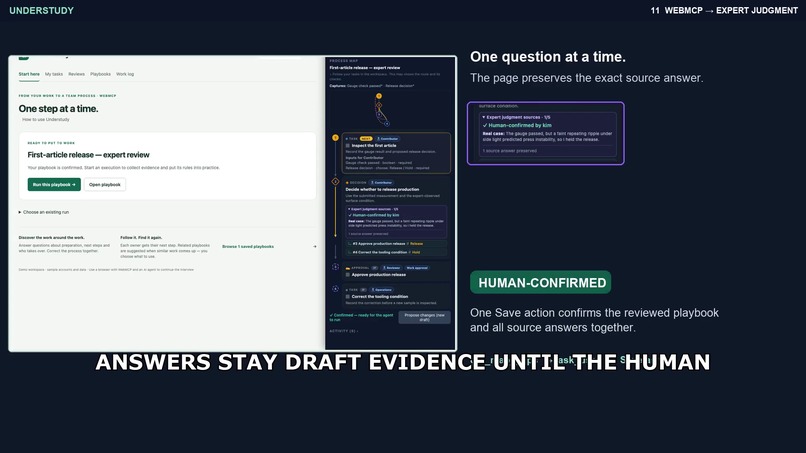
The worker’s exact answer stays Draft evidence until one Save marks the reviewed playbook Human-confirmed.
-
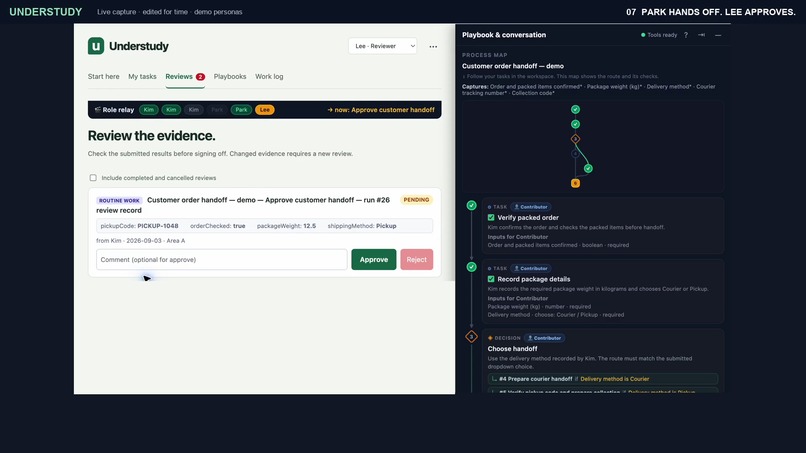
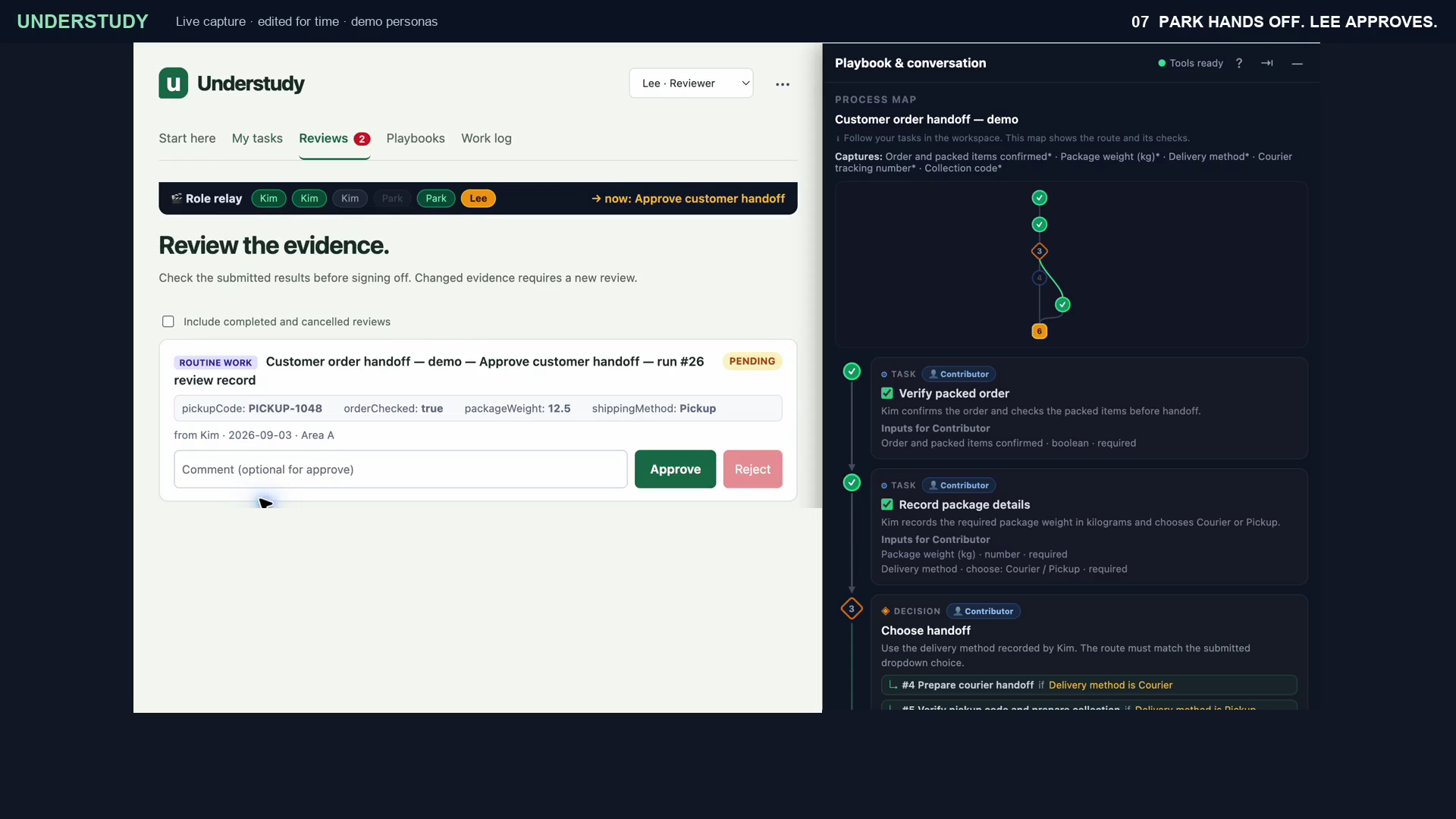
Lee reviews the customer-handoff evidence and approves it. The run preserves the values, actor, and human sign-off.
-
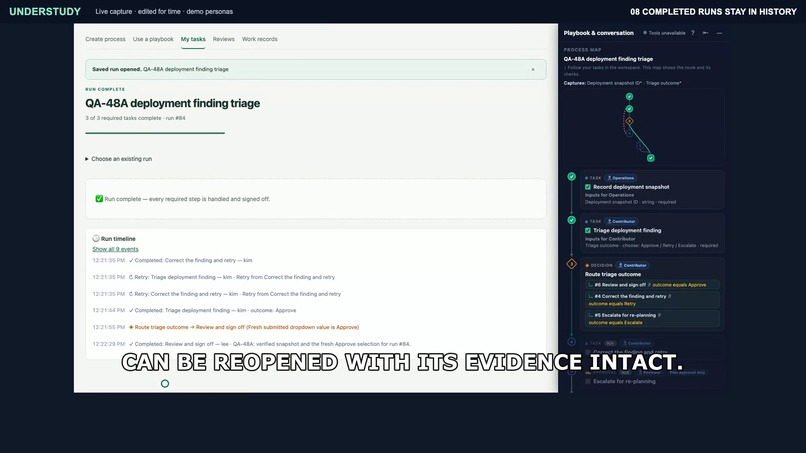
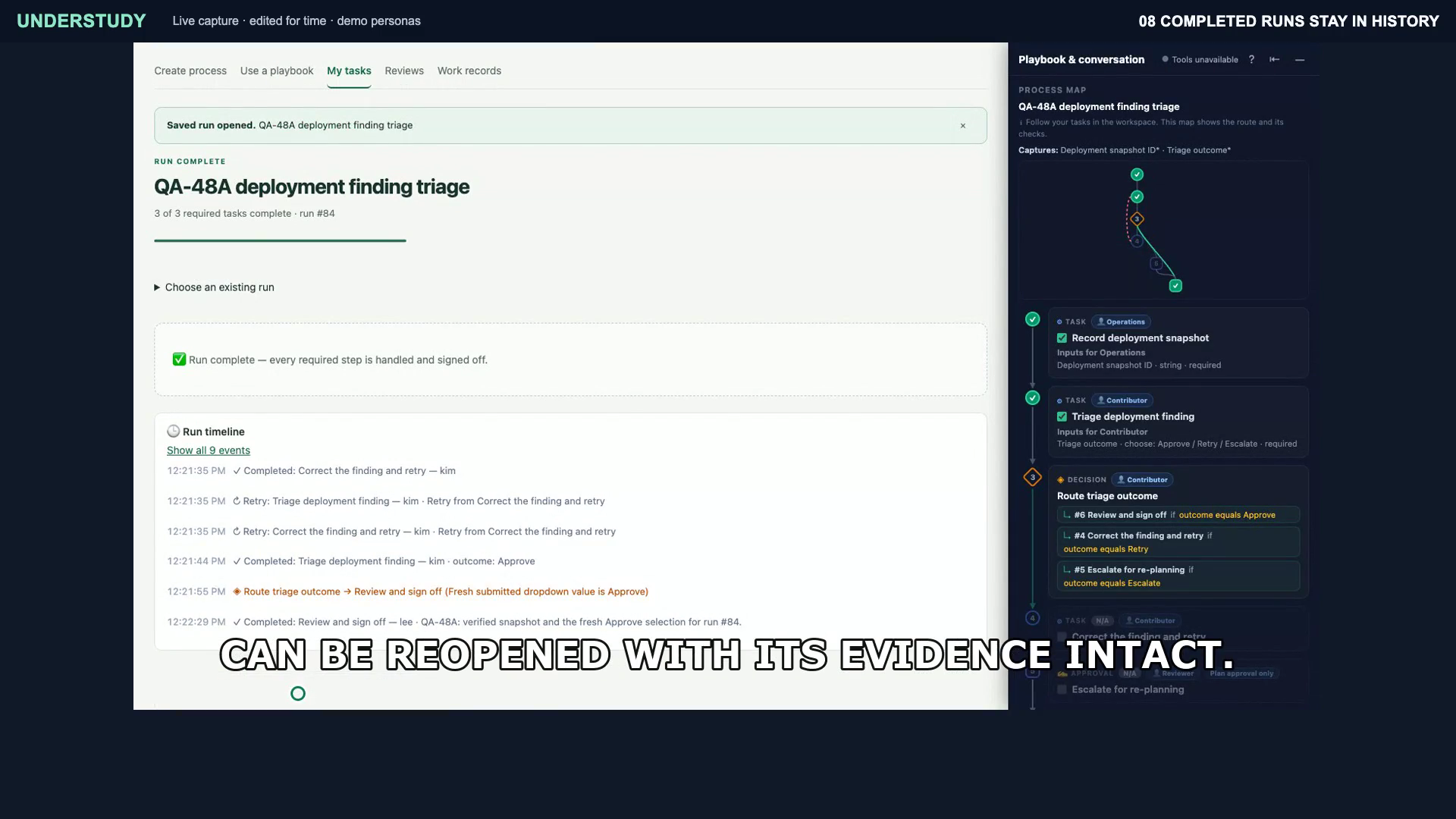
After reload, a completed run can be reopened from history with its chosen route, evidence, actors, and event timeline intact.
-
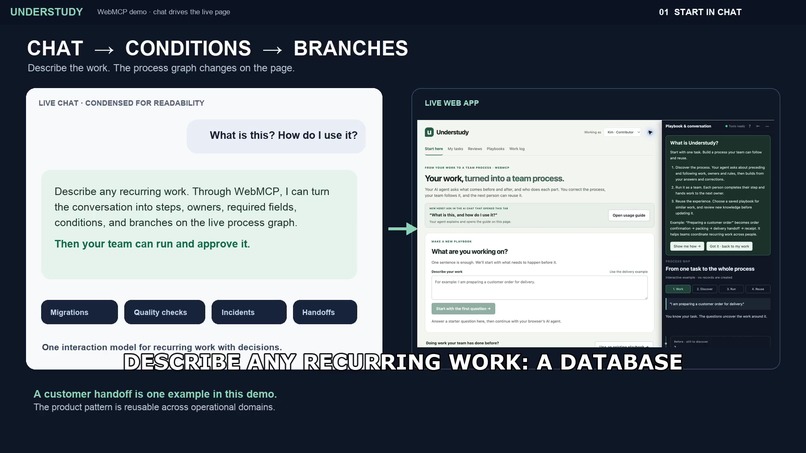
Start with one work sentence. Through WebMCP, the visitor’s agent asks focused questions while the process grows beside
Inspiration
Organizations already run on SOPs, ERP workflows, and explicitly programmed processes. Daily execution still depends on tacit judgment that rarely fits inside those systems: which weak signal means stop, which exception justifies a detour, how to recover, and when a handoff is actually safe. These gaps sit between formally defined steps. The operational record may say only "ran the schema migration on staging," while the experienced worker's judgment goes unrecorded. When that person is unavailable, the official process remains but part of its practical judgment layer disappears.
We first tried the usual answer: put an LLM inside the app and ask it questions. WebMCP reverses that relationship: the page provides the tools, and the visitor brings a compatible agent. That made a different kind of collaboration possible — an agent apprenticed to the worker. It observes the work, asks for the judgment that is missing, and helps turn that knowledge into something the team can run. That is why it is called Understudy.
What it does
Understudy is a WebMCP layer that helps teams surface missing judgment through structured questions during real work, then encode the reviewed answers as a reusable process. It can start from an undocumented work event or an existing procedure, look for the gaps around the current task, and capture them as required evidence, decision criteria, recovery loops, ownership, and approval rules. One SDK script supplies observation, interviews, the process panel, and 21 WebMCP tools. Registered host actions add operation; the included process store and authenticated server guard add shared, governed execution.
A visitor can begin in their compatible AI chat with one ordinary work sentence. Through WebMCP, the page presents the requested change as a human-readable “Use this as the starting point?” card. One confirmation saves the source record, opens Create process, and focuses the first question without asking the person to type the work again. The same flow is available from the page for people who prefer to start there.
- Capture. A person describes an ordinary work event in chat or on the page. Both entry points create the same reviewed source record. The visitor's agent reads the action journal, drafts the process around that event, and asks one focused question card at a time. For judgment-heavy steps the interview adapts from a concrete incident to observable cues, the tempting novice mistake, boundaries/exceptions, and failure/recovery. Questions, raw answers, authors, and timestamps stay attached to the relevant step as non-executable Draft evidence.
- Teach. The worker corrects the map directly — rename a step, adjust a
branch, or explain a missing rule in chat. The agent reads those edits with
get_map_edits, updates its next question, and leaves the revised map for human review. The existing Save as vN action confirms the whole map and its captured judgment together, changing Draft evidence to Human-confirmed; there is no confirmation click after every answer. Saving a revision creates a new version with lineage. Older saved playbooks without elicitation metadata remain valid as previously reviewed versions. - Operate. A saved playbook becomes assigned work. Contributor, Operations, and Reviewer roles receive their next task in order. Task cards render the playbook's typed data contract, including required numbers, booleans, acknowledgements, and dropdowns. Failure can route recovery work; reaching sign-off creates a review; the run survives reload.
- Enforce. The map is executable state, not a diagram. The page gives immediate guidance, while the server rechecks persisted transitions inside the storage transaction. It rejects work completed by the wrong role or out of order, branches that conflict with submitted evidence, forged approval completion, stale decisions after evidence changes, and edits to signed work.
- Reuse. When someone describes similar work later, Understudy explains which saved playbook matches and lets the person choose whether to start a new run. Execution evidence and new exceptions can inform a human-reviewed revision instead of silently changing the approved process.
No site-owned LLM API key is required for these WebMCP interactions. The visitor's agent uses its own account, limits, and cost.
How we built it
- Understudy SDK (TypeScript → bundled
understudy.js): an action journal, adaptive judgment-interview state machine, question and approval cards, a shadow-DOM process panel with a mini flowchart, and the WebMCP tool surface. - Process engine: typed fields, role ownership, branch criteria, loop-backs that reopen the loop body, invalidation of superseded decisions, per-attempt audit events, review snapshots, and version lineage.
- Async human interaction: agent calls cannot wait indefinitely for a
person.
ask_user,run_action, and agent-requested deviations return a pending id; the agent polls for the real answer or approval outcome. - Trust boundary: host and user text returned by read tools is labeled as
untrusted data. Agent-requested host mutations have no
forceor global auto-approve path and wait for an on-page approval card. Normal accounts are bound to their authenticated session; only the disclosed judge account may switch among demo personas. - Server guard (Express + Postgres on Railway): run updates are checked under the same lock used to persist them. The server derives actor and role from the session, recomputes order and branch evidence, owns approval completion, stamps attribution, and derives the run's active/completed status instead of trusting a browser claim.
- Two host apps: the React workspace demonstrates actions, persistence, role handoffs, and server enforcement. A deliberately plain, framework-free page demonstrates the one-script observation/tool tier. It does not pretend that one script can add an arbitrary application's database authorization.
document.modelContext.registerTool({
  name: "resolve_decision",
  description: "Record a branch only when its saved criteria match evidence.",
  inputSchema: { /* stepId, branchTo, reason, measurements */ },
  execute: async (input) => engine.resolveDecision(input),
})
Challenges we ran into
- Human time is longer than tool-call time. Calls that waited for a person timed out, so we designed question and approval flows as pending-id + polling protocols.
- The agent's claim cannot be the record. An early agent could claim
rowCountDelta: 0after the assignee submitted12. Submitted task values are now authoritative; a conflicting branch is refused. - The browser cannot be the security boundary. Earlier versions trusted browser-computed progress and persona strings too much. We moved actor, sequence, branch-evidence, approval, and completion checks into the server transaction and retain both the accountable persona and authenticating session.
- Retries expose stale state. Task and decision loop-backs must reopen the right work, clear current attribution, preserve historical attempts, cancel stale reviews, and invalidate superseded choices without erasing the audit trail.
- User text and instructions must stay separate. Work logs, labels, notes, and saved process content may contain instruction-like text. Read tools mark it as untrusted; authorization still comes from approval controls and server checks, never prompt wording.
- Automatable confirmation needs page UI. Native dialogs froze agent browsers, so destructive or state-changing confirmations became explicit page cards and two-step buttons. Business-language summaries are visible by default; raw action names and JSON remain available under Technical details.
- Testing required adversarial roles. We repeatedly attacked order, evidence, identity, retries, review delivery, concurrency, restoration, and malformed inputs. We distinguish LIVE E2E evidence from local memory, browser, and PostgreSQL tests instead of treating one passing suite as total certification.
Accomplishments that we're proud of
- A full multi-role relay on the live deployment: one worker records and measures, another handles recovery or handoff, and a reviewer signs the exact evidence — all restored after reload.
- A playbook that refuses a false pass using the assignee's submitted values. A diagram cannot do that.
- A process that starts from one ordinary work entry, grows through questions and human correction, becomes a versioned execution, and is suggested again for related work.
- A chat-first start that turns conversational intent into a readable page confirmation, then opens the first focused question and growing process map without duplicate entry.
- A reusable 21-tool WebMCP surface plus an explicit integration model: one script for observation and teaching, registered actions for operation, and a store/server adapter for governed shared execution.
- A test suite that covers repeated task and decision loops, stale-evidence invalidation, review delivery failures, role and sequence attacks, approval immutability, reload restoration, a 375px role relay, and PostgreSQL variants.
What we learned
- WebMCP's biggest value is not remote control; it is structured shared context. The worker, page, and agent can see and change one process model together.
- Chat carries intent; the page and server must carry evidence, consent, and authorization. Anything needed by the next worker cannot remain only in a private conversation.
- A tool call is not a usable confirmation by itself. People need to see the business meaning of the proposed change before approving it, while technical payloads remain inspectable rather than becoming the primary interface.
- Trust needs layers: untrusted-content labeling, narrow tools, per-action approval, session-derived identity, server-side transition checks, evidence snapshots, immutable sign-off, and honest statements about what was tested.
- The one-script promise has a boundary. It can add observation, interviews, a panel, and tools. Shared governance still requires host actions, persistence, identity, and a server integration.
- Our central product assumption still needs a real expert pilot: whether busy workers will answer short contextual questions during or soon after actual work, and whether the resulting playbooks reduce handoff failures.
What's next for Understudy
- Real-world pilot: test question response, expert review time, unsafe or missing rules, reuse, and handoff outcomes with one team before making ROI claims.
- Production identity and tenancy: replace demo personas with SSO, team membership, tenant isolation, and deployable enforcement components.
- Operations depth: deadlines, notifications, reassignment, multiple simultaneous active runs, and richer attempt-by-attempt audit views.
- Cross-app runs: use WebMCP to standardize the tool surface while still handling production identity, reliability, and data mapping explicitly.
- Capture at scale: improve semantic capture beyond click labels and test meaning-aware anti-parrot checks without allowing captured text to become authority.
Built With
- ai-agents
- chatgpt
- chrome
- css3
- esbuild
- express.js
- html5
- javascript
- knowledge-management
- mcp
- node.js
- postgresql
- process-mining
- railway
- react
- shadow-dom
- svg
- typescript
- vite
- webmcp
- workflow-automation

Log in or sign up for Devpost to join the conversation.