-
-
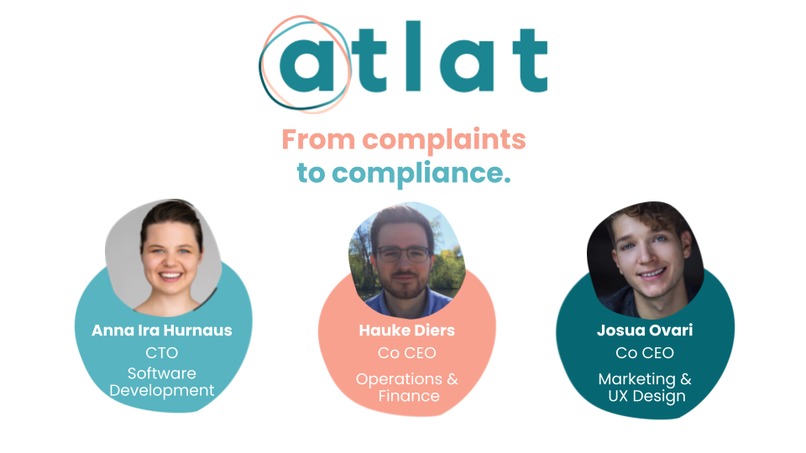
The atlat team behind this project.
-
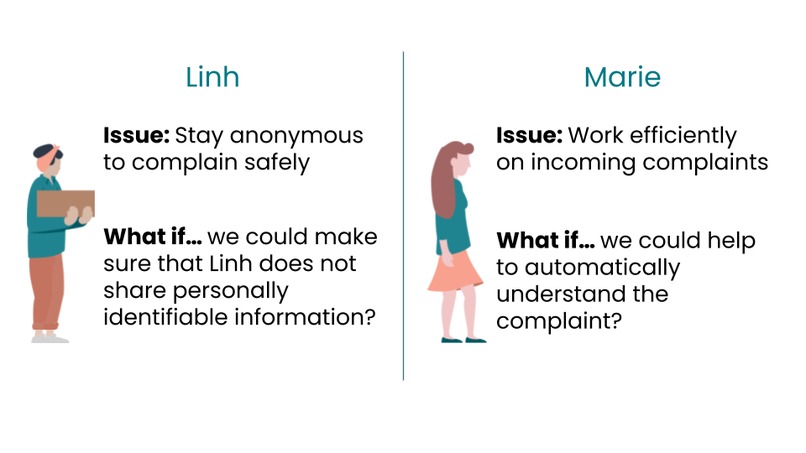
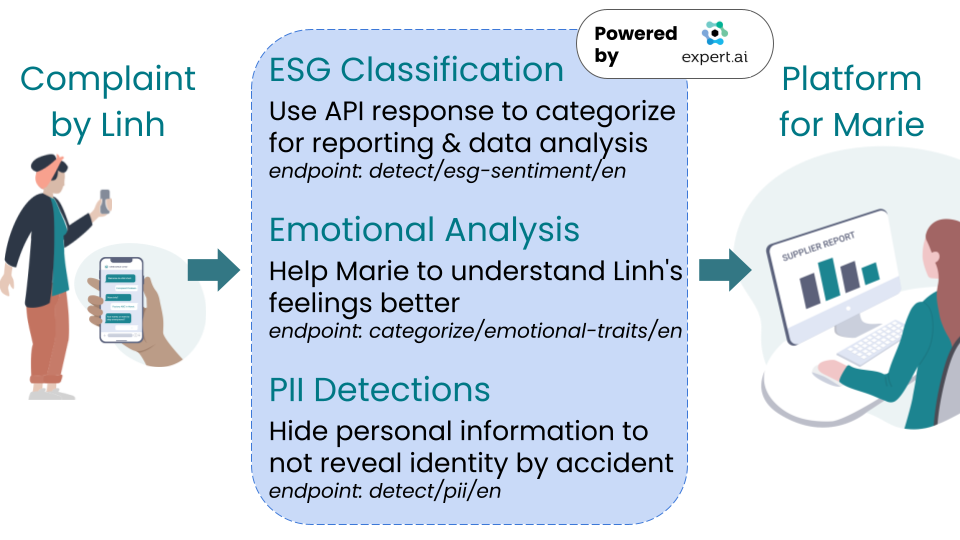
Linh from the supplier in Vietnam wants to file a complaint. Marie from the CSR department in Germany receives the complaints.
-
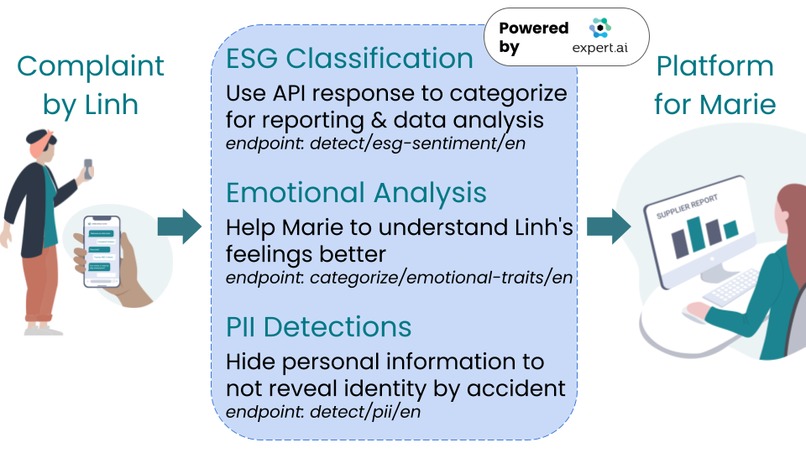
Linh files a complaint that reaches Marie from CSR. This project uses three endpoints of the expert.ai NLP API to enable Marie to help Linh.
-
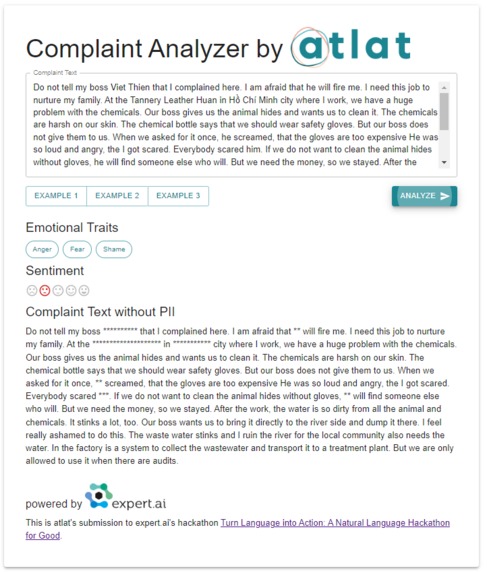
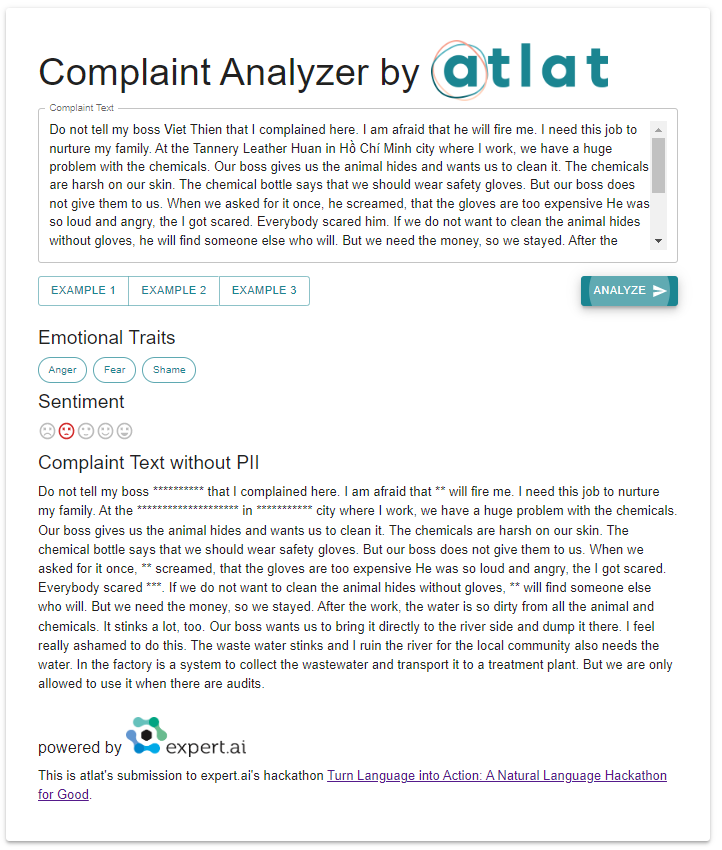
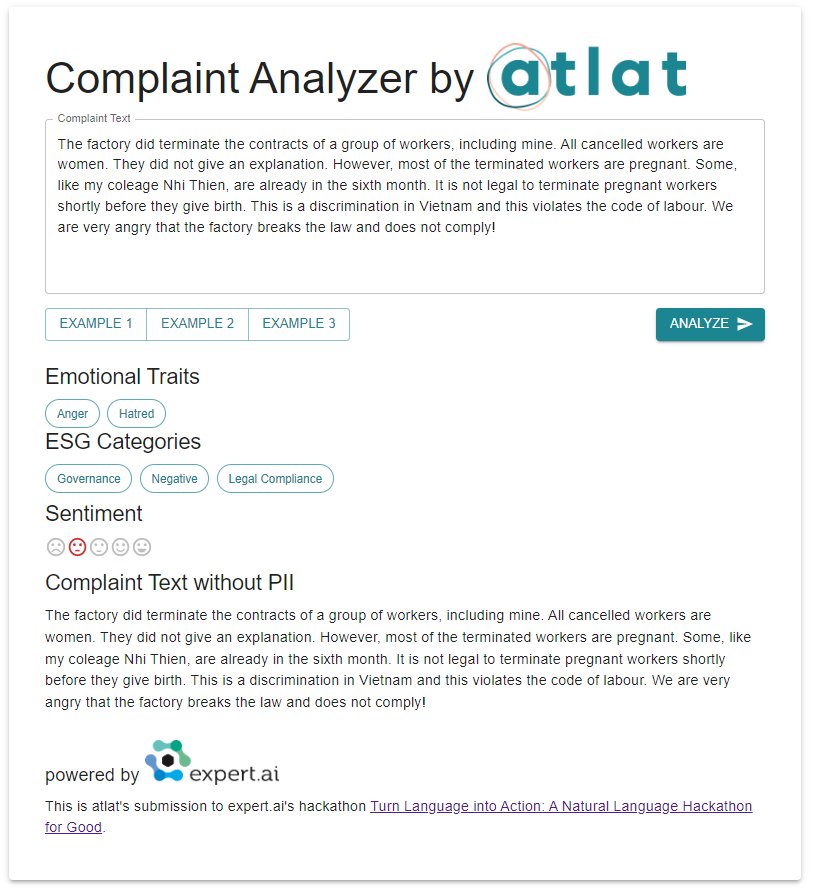
Screenshot of the Complaint Analyzer Frontend: You can see e.g. how the PII was used to hide information with *.
-
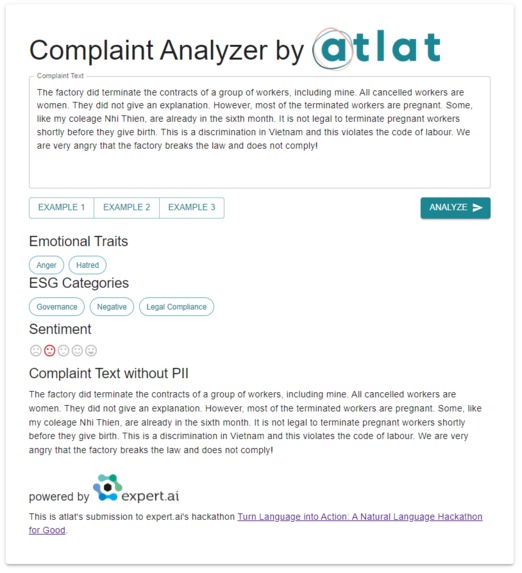
Screenshot of the Complaint Analyzer Frontend: The ESG API correctly detected the category "legal compliance" as the topic of the complaint
-
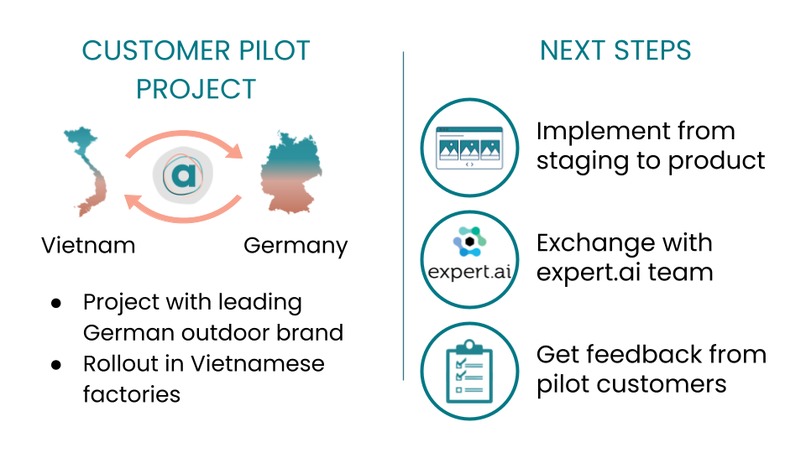
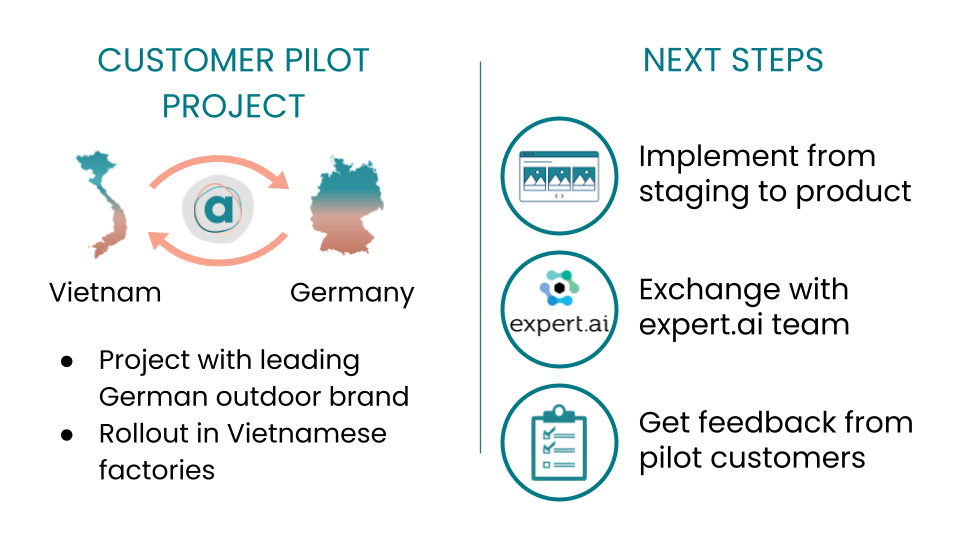
We are currently rolling out our core product in Vietnam. We want to make the expert.ai features part of the product for our customer.


Inspiration
It is the vision of atlat to strengthen the rights of workers globally. For this purpose we build a digital grievance system. If the right of a worker at a supplier site is violated, they can complain digitally directly to the brand they produce for. The CSR team of the brand then follows up the complaint and can solve the issue for the worker.

This is what atlat is working on so far. Hence, there are many complaints filed with our system. However, we are facing two issues, that are the inspiration for this hackathon project:
- The worker (Linh) is afraid of retaliation by the factory owner, if the owner would know who complained. Hence, the worker wants to complain anonymously. How can we make sure that not even by accident the identity of the worker is somehow leaked?
- The CSR team (Marie) at the brand needs to work on several complaints. How can we support them by understanding the complaints?

What it does
And that is where the NLP of expert.ai supports us. We use three API endpoints to fulfill the following tasks:
- ESG Analysis: We pass the text of the complaint to the
detect/esg-sentiment/enendpoint. We use the returned detection to classify to which ESG goals the complaint belongs. We visualize the classification to our user in the CSR department. - Emotional Analysis: We pass the translated complaint text to the endpoint
categorize/emotional-traits/en?features=extradata. The returned result helps to understand the emotions of the complainant. We visualize these emotions to our user. We also use theanalyze/standard/en/sentimentendpoint and display the returned value on a scale from frowning to smiling faces. - PII Detection: We pass the translated complaint text to the endpoint
detect/pii/en. Thereby we can see if the text by the complainant contains names or other personally identifiable information. We use the returned json of the API to lookup the positions that contain PII in the text via the field extractions. We then replace these PII in the complainant text with asterisks to hide this information. This is important to ensure the anonymity of the complainant and thereby protect them by all means from retaliation.

We highlight the information gathered with expert.ai on our software platform. Transparency of the use of AI technology is important for our clients.
How we built it
We receive many complaints in Vietnamese on our platform. First, we use the Google translate API to translate these texts into English. Second, we send these complaint texts to the three endpoints listed above. For the ESG and Emotional Analysis we built a visualization of the result that is shown to our user from the CSR-department. For the PII Detection, we use the fact that the API not only returns the returned entities, but also their positions within the text. To make sure that the complaint does not contain PII, we use these positions and replace each symbol with an asterix.

We built the analyzer for now as a stand alone web-application and hosted it via heroku. This has the main purpose of making it shareable for his hackathon without sharing our entire software product. Hence, we are proud to invite you to test out the application: https://complaint-analyzer-frontend.herokuapp.com/
Challenges we ran into
Overall we were very happy how smoothly the expert.ai APIs work. One minor challenge we faced is the detection of addresses with the PII detection. We tested several addresses from Vietnam that are also formatted in a particular style that is typical for the country. Not all Vietnamese addresses were detected properly. We checked and realized that the PII works best with addresses in a more "western" formatting. Hence, the PII detection does not identify all instances of Vietnamese addresses. However, the PII works very reliantly at detecting Vietnamese names, which is even more important for us.
Accomplishments that we're proud of
We at atlat are very proud of the impact that we create. Every complaint by a worker helps to solve an underlying issue in the supply chain. Often, an early complaint can be fixed more easily than not noticing a problem until it might be too late. Our contribution to the expert.ai NLP hackathon helps us to make our product even more usable for our customers (CSR department at brand now gets ESG and emotional analysis) and even safer for the workers (PII helps to not accidentally share a name).
What we learned
During the course of the hackathon we learned several things regarding the use of the API. For the ESG-API we learned that it can not only identify several topics but also distinguish if they are framed in a positive or negative way. We were also impressed by the PII-API. Besides obvious information like names and addresses, it also spotted out pronouns like he or she in the text. This makes a lot of sense to also cover the gender of the persons involved. So far, we are replacing each letter with an asterix, which would allow to distinguish between ** and ***. On the roadmap, we rather want to use a blurry effect that also hides the length of the covered word.
What's next for Understand Human Rights Complaints
So far we developed this contribution as a standalone feature. We did this mostly to host it separately to make it shareable as a contribution for this hackathon. The next steps are to demo it to our customers and gather their industry feedback. If they like the new features (which we are sure they will), we will bring the implementation from the demo environment to the live product. Furthermore, in case we'll win a prize, we are looking forward to an exchange with the expert.ai team.



Log in or sign up for Devpost to join the conversation.