-
-
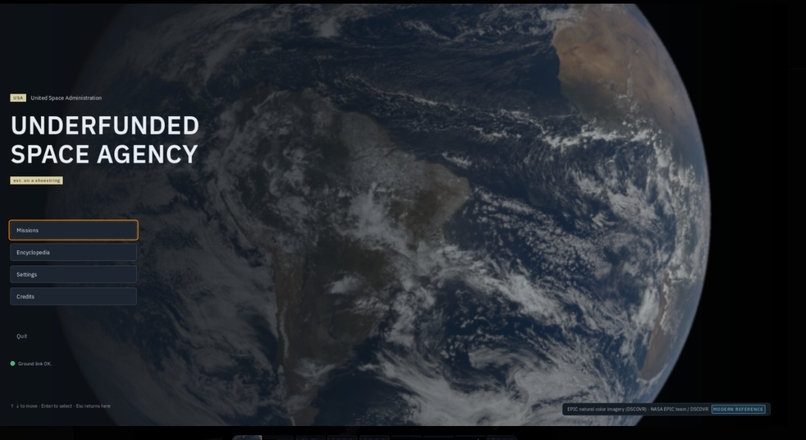
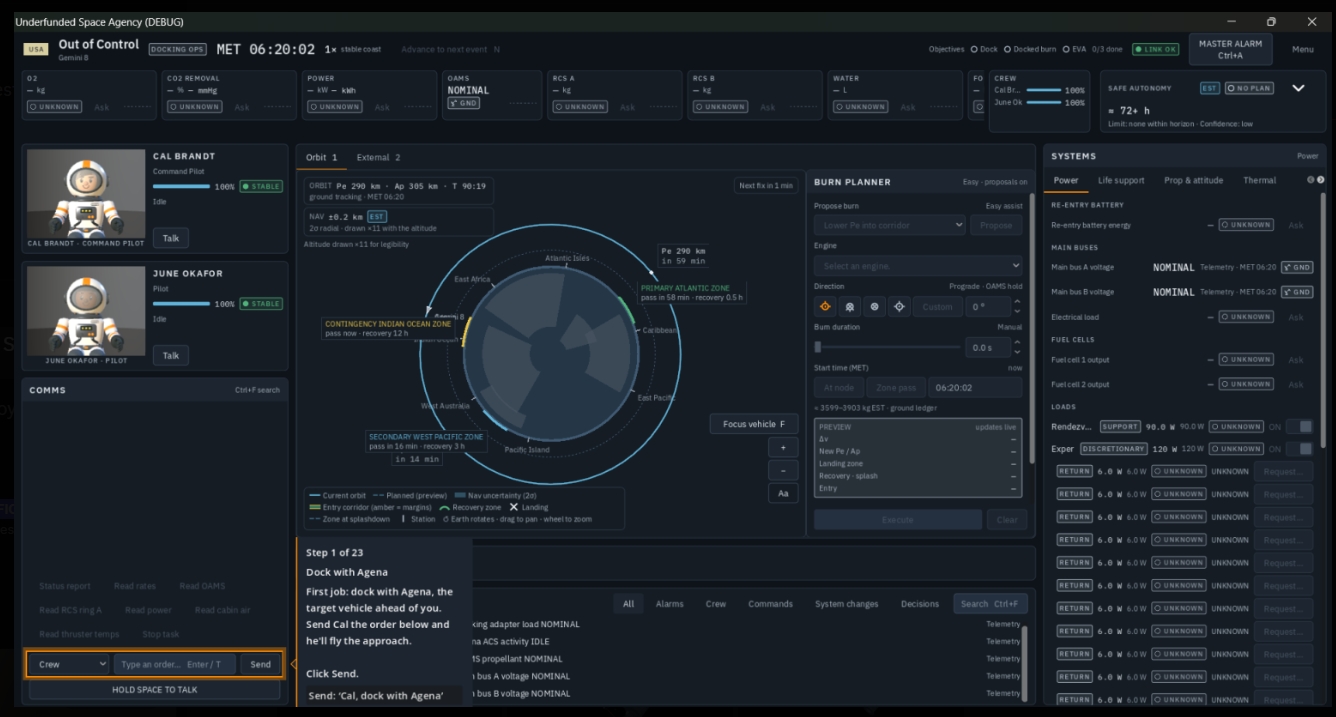
Start page
-
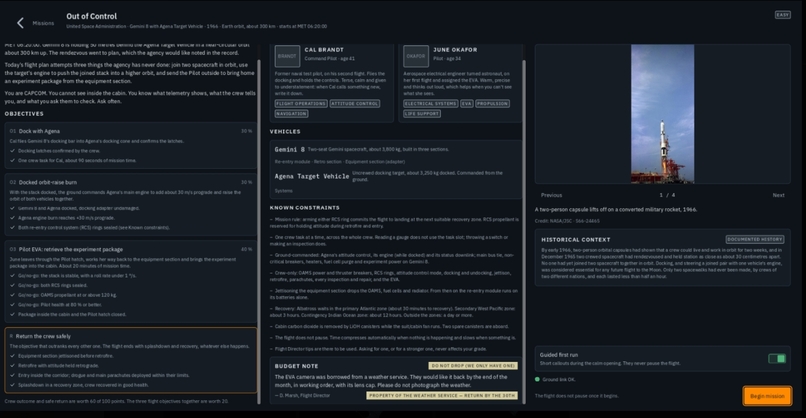
Pre-flight info & History
-
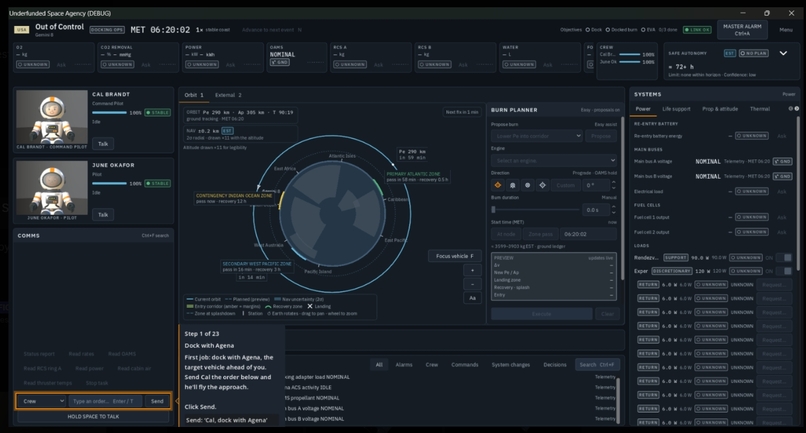
Interactive display
-
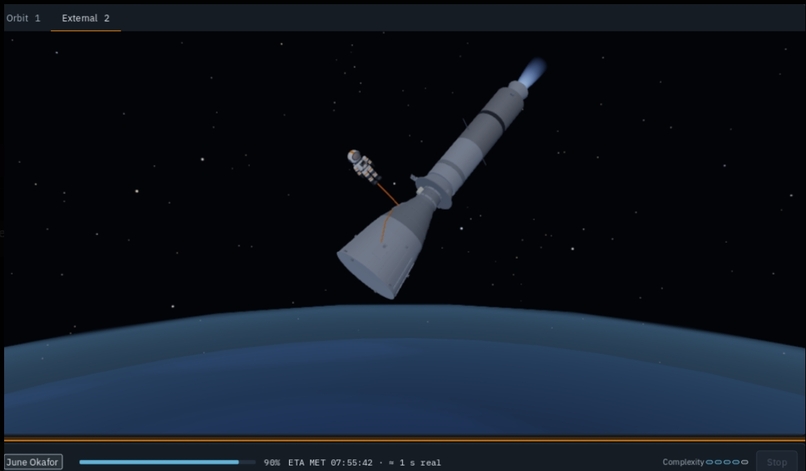
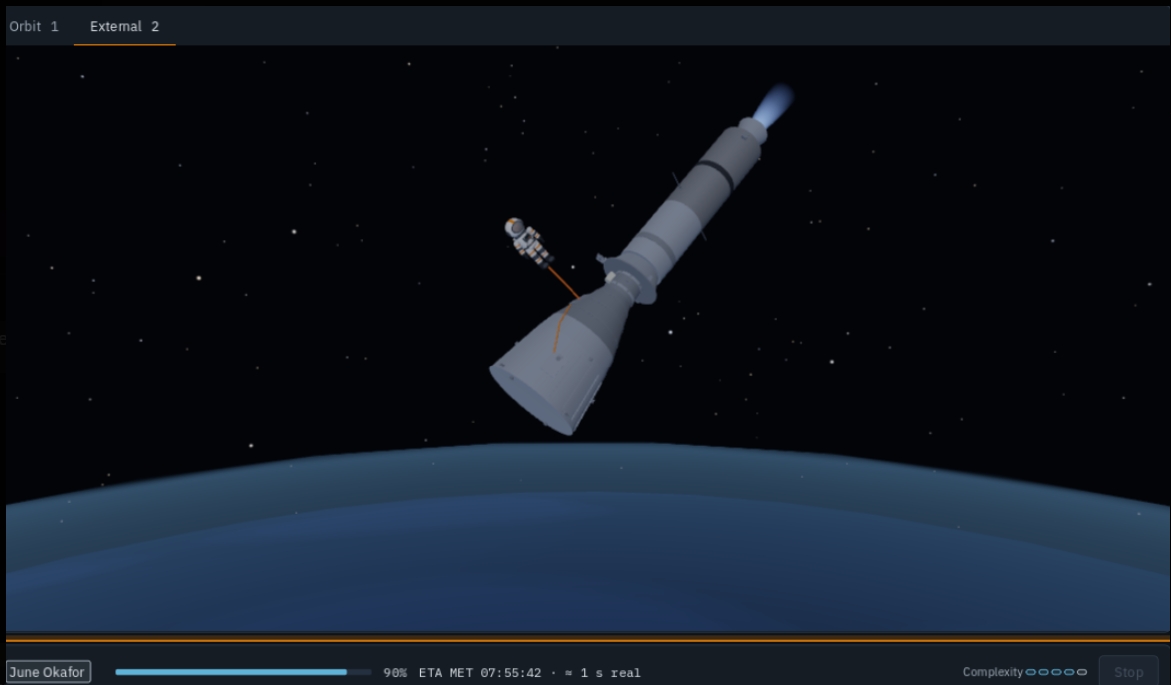
Rocket play
-
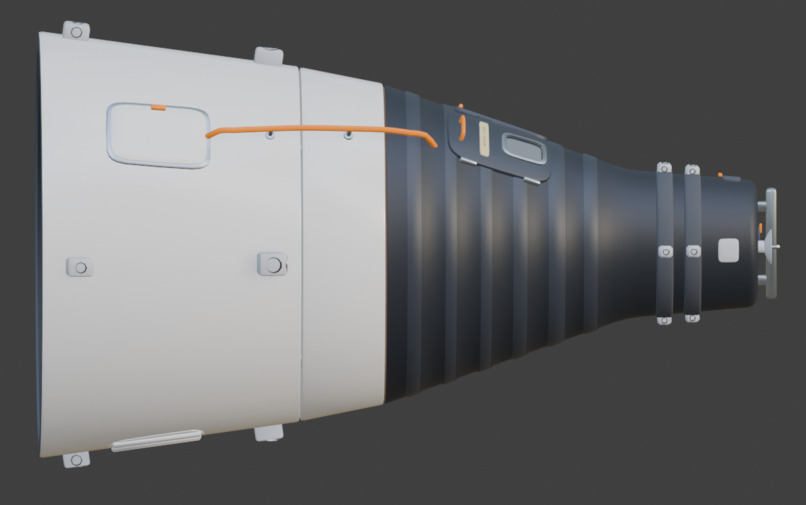
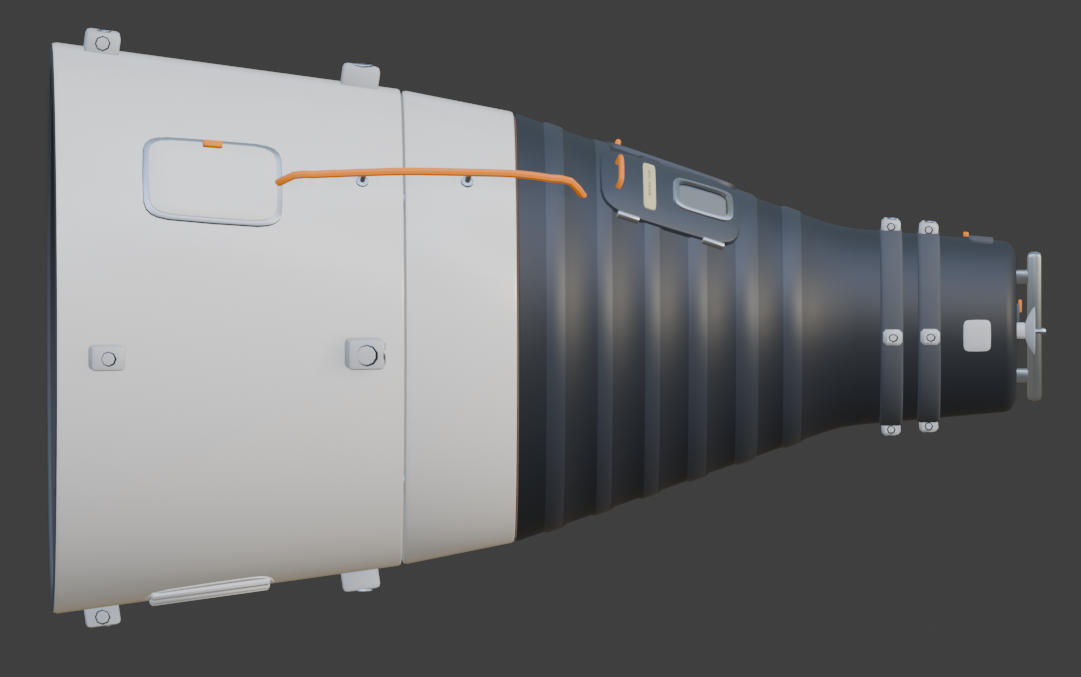
The Tandem 8 Rocket
-
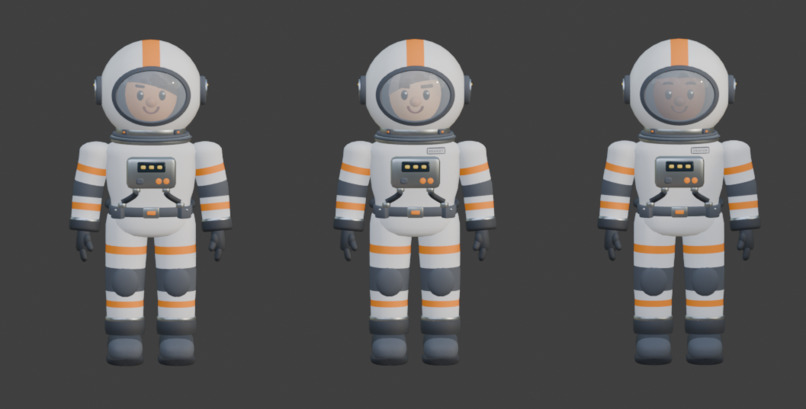
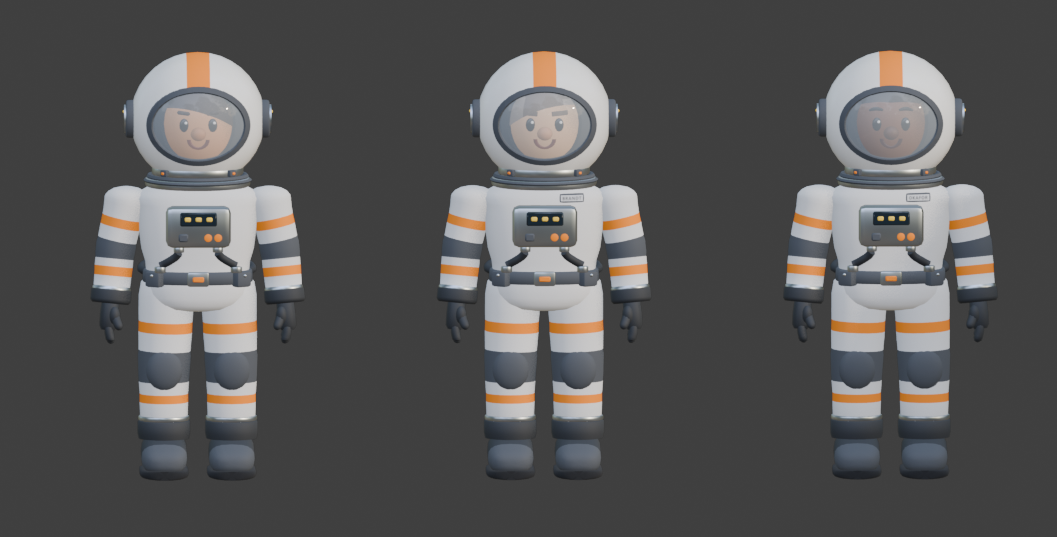
3 Different Crew Members
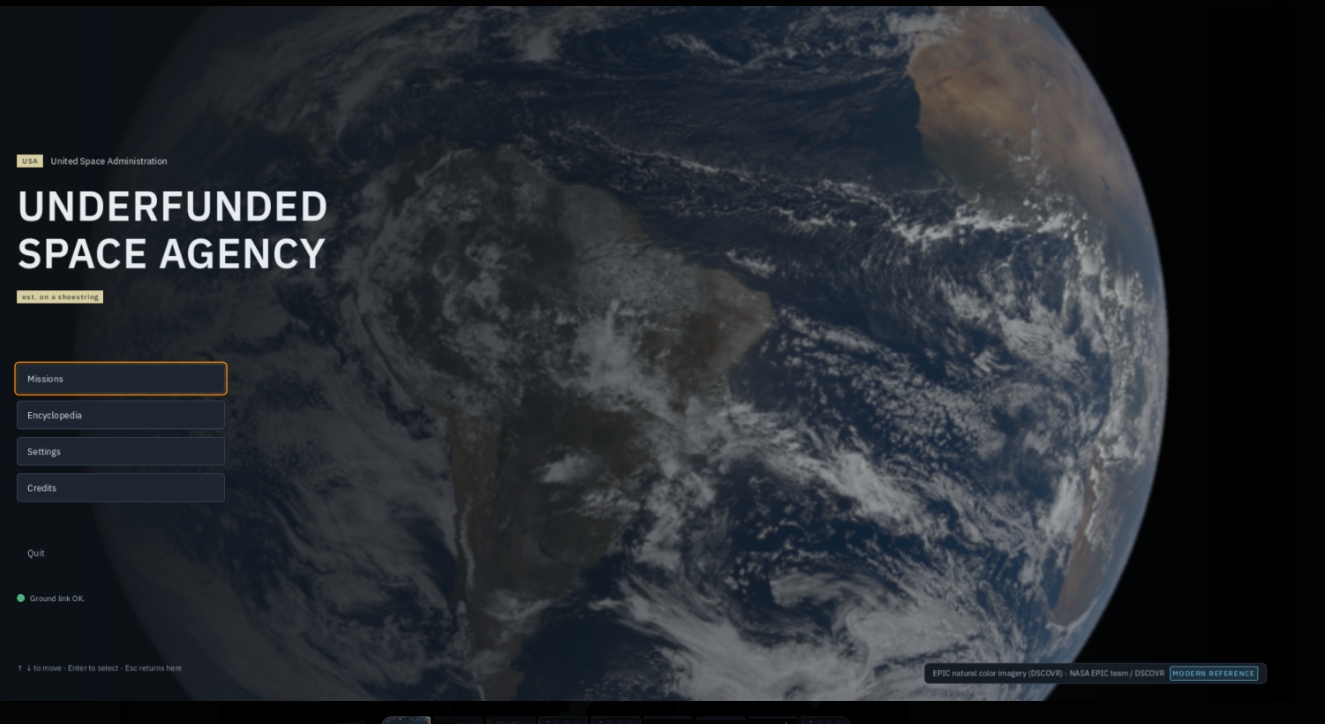
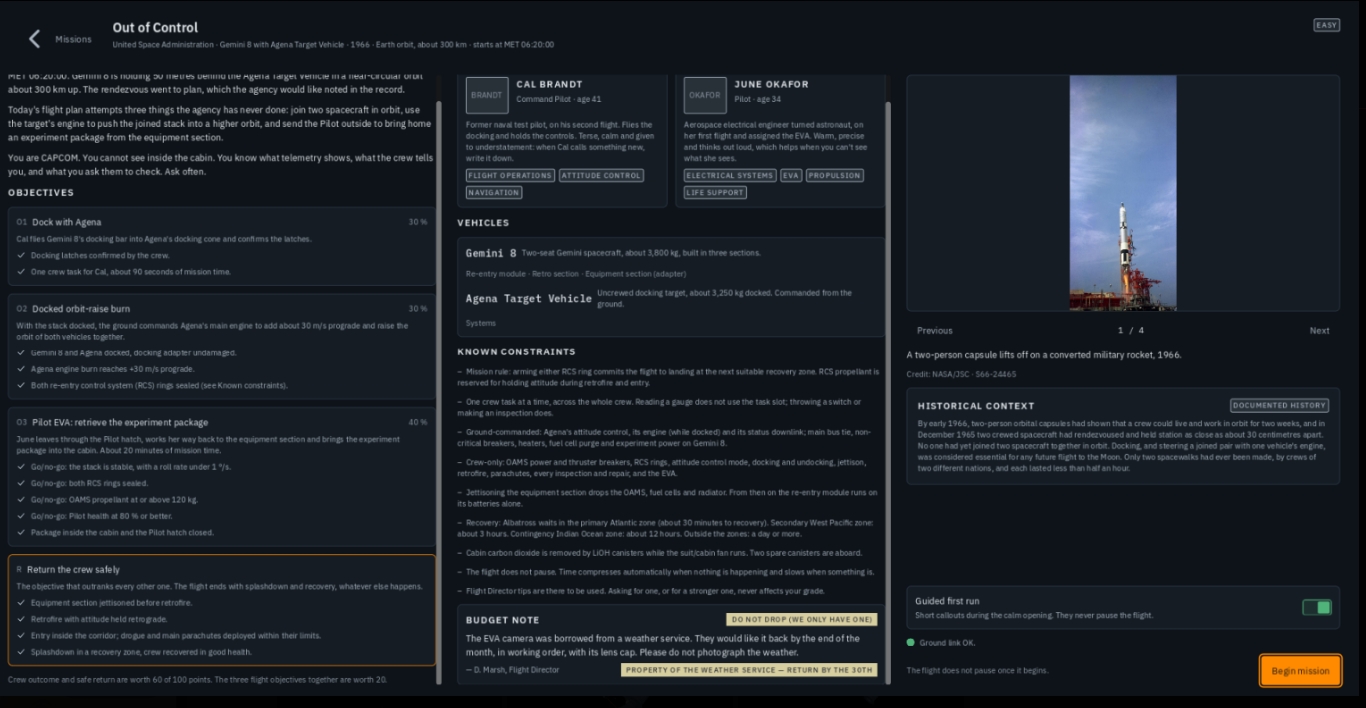
🚀 Underfunded Space Agency
Space is unforgiving. Budget cuts make it worse.
Houston, we have a budget problem. 💸
An AI-powered space mission crisis simulator that combines natural-language interactions, dynamic gameplay, real-world NASA data, and historically inspired space disasters into an unpredictable, immersive, and hilariously chaotic gaming experience.
Your mission? Save the crew. Complete the objective. Try to fix the problems other people made.
💡 Inspiration
Space exploration represents one of humanity's greatest engineering achievements. Behind every successful space mission is a team of engineers, scientists, and astronauts working together to solve incredibly complex problems, often under extreme pressure and with limited resources.
Our inspiration came from a shared fascination with space exploration, technology, artificial intelligence, and the history of human spaceflight. With NASA being an official sponsor of the hackathon and one of our team members being a lifelong game developer, we saw an opportunity to combine our technical backgrounds and creative interests into something both entertaining and educational.
🌕 We were particularly inspired by historical events such as Apollo 13, where ingenuity, communication, resource management, and unconventional problem-solving were essential to bringing astronauts home safely.
We wanted to recreate that sense of urgency and accomplishment while introducing a comedic twist:
More importantly, we wanted to explore how artificial intelligence could move beyond traditional NPC dialogue and become an integral part of a game's decision-making process, mechanics, storytelling, and player experience.
What it does
Underfunded Space Agency is an AI-powered spaceflight crisis and mayhem simulator in which players assume the role of a mission controller working for a severely underfunded, questionably competent space agency.
Unfortunately, almost every mission goes wrong. 🔥
As seemingly the only competent employee, your responsibility is to communicate with astronauts, troubleshoot spacecraft failures, manage emergencies, make difficult decisions, and ultimately bring your crew home alive.
Key Gameplay Features
🧑🚀 AI-powered crew members: Astronauts dynamically respond to player instructions and evolving mission circumstances.
🎙️ Natural-language mission control: Players communicate with their crew using spoken instructions rather than relying exclusively on traditional game controls.
🧠 Voice-driven gameplay: Player commands are interpreted and translated into actionable in-game events.
💥 Dynamic consequences: Decisions can directly influence mission conditions, creating both successful outcomes and potentially catastrophic situations.
🛰️ Historically inspired scenarios: Missions draw inspiration from real-world spaceflight incidents and engineering challenges, including Apollo 13.
🎯 Adaptive difficulty: Different difficulty settings provide varying levels of guidance, making the experience accessible to beginners while challenging more experienced players.
🌌 NASA-powered educational content: Real-world space imagery and astronomical information help ground the fictional experience in actual space exploration.
🔄 Infinite possibilities: Generative AI enables different conversations, approaches, and outcomes across multiple playthroughs.
😂 Spaceflight comedy: Experience the chaos of managing a space agency where ambition significantly exceeds funding and competence.
Completing the original mission objective is an added bonus—assuming everything hasn't already caught fire.
Unlike traditional video games that rely on predefined dialogue trees, scripted interactions, and predetermined responses, our game allows players to communicate naturally with their crew through voice-based interactions powered by generative AI.
Players can formulate their own solutions, issue instructions, ask questions, and respond to unexpected situations without being restricted to a predetermined set of dialogue options. That idea became Underfunded Space Agency. 🚀
Our goal was to create a game where players are encouraged to think critically, experiment with unconventional solutions, and experience the consequences of their own decisions rather than simply discover the correct dialogue option.
Every decision matters. Every mission is different. Every astronaut is probably underpaid.
🤖 AI-Powered Game Development Pipeline
To develop a functional game within the 24-hour hackathon timeframe, we established a development pipeline utilizing Claude and the Model Context Protocol (MCP).
MCP allowed our AI-assisted development environment to interact with external creative tools, reducing the amount of manual work required to generate, modify, and iterate on game assets.
Our pipeline incorporated:
🧠 Claude: AI-assisted programming, development, debugging, problem-solving, and asset creation workflows.
🧊 Blender MCP: Creation and modification of 3D models and environmental assets.
🎨 Figma MCP: Development and iteration of user interface designs and visual components.
🎮 Game engine integration: Implementation of game mechanics, assets, interfaces, and external API interactions within a unified playable experience.
⚙️ Multi-agent orchestration: Parallel execution of independent development tasks to maximize productivity and available computing resources.
🧠 Natural-Language Processing and AI-Driven Gameplay
One of the most technically significant components of our project is the integration of large language models into the game's core gameplay loop.
We utilized Google's Gemini API and Google AI Studio to interpret player instructions, generate contextually relevant character responses, and translate natural-language interactions into events that affect the game.
The AI serves two primary purposes:
💬 1. Narrative and Conversational Intelligence
Gemini generates responses that reflect the current mission circumstances, allowing players to communicate with their astronauts in a conversational and context-sensitive manner.
Instead of selecting a predefined response from a dialogue menu, players can formulate their own instructions and engage in dynamic conversations with the crew.
⚙️ 2. Gameplay Action Interpretation
Gemini also processes player instructions and generated responses to identify actions that can be translated into changes within the game environment.
This creates a connection between an unstructured natural-language conversation and actionable game mechanics.
Rather than simply generating dialogue, the AI becomes an interactive component of the simulation. What the player says can influence what happens next, creating a dynamic relationship between conversation, decision-making, and gameplay.
The AI isn't just talking about the game. It's actively participating in it.
🎙️ Real-Time Voice Communication
To make the experience more immersive, we integrated ElevenLabs into our communication pipeline.
Our voice interaction system follows a multi-stage process:
🎤 The player communicates with the spacecraft crew through voice input.
📝 Speech recognition converts the player's spoken instructions into text.
🧠 The text is processed through the Gemini API alongside relevant mission context.
⚙️ Gemini generates a contextually appropriate response and interprets potential gameplay actions.
🔊 The generated dialogue is passed to ElevenLabs for text-to-speech synthesis.
🎮 The resulting audio is played back to the player while relevant actions affect the game environment.
🔄 The updated mission conditions influence subsequent interactions.
This creates a continuous interaction loop between the player, the AI-powered crew, and the underlying simulation.
By combining speech recognition, large language model inference, voice synthesis, and gameplay state management, we created an experience that more closely resembles communicating with an actual spacecraft crew than interacting with a conventional video game NPC.
🌎 NASA API Integration and Scientific Authenticity
We wanted the game to be entertaining without completely sacrificing scientific and historical authenticity.
To accomplish this, we incorporated NASA resources and API-provided information into our experience, including:
🪐 Planetary position and orbital information.
🌌 Authentic space imagery.
🛰️ Photographs of spacecraft and space exploration technology.
🌕 Historically inspired space missions.
🔬 Scientific and engineering concepts.
Drawing inspiration from real-world space missions also allowed us to introduce players to the types of engineering challenges that astronauts and mission control personnel have historically encountered.
By combining authentic space exploration content with fictional scenarios and AI-generated interactions, we aim to make learning an organic part of the gameplay experience.
Players are not simply reading about space exploration—they are actively participating in a fictionalized version of the decision-making processes that make space exploration possible.
Real science. Artificial intelligence. Questionable management.
🚧 Challenges we ran into
Developing an entire video game within a 24-hour period presented significant technical, logistical, and creative challenges.
Unlike a traditional application, a video game requires numerous interconnected systems to function cohesively. These include storytelling, game mechanics, user interfaces, 3D environments, audio, character development, API integration, and player interaction.
Our most significant challenges included:
🧩 Integrating Generative AI with Game Mechanics
Large language models naturally produce conversational and unstructured outputs, while game engines require actionable instructions and consistent state changes.
Bridging this gap required us to develop a system that could interpret conversational interactions and translate them into meaningful gameplay consequences.
The challenge was not simply getting an AI character to respond to the player, but making those responses relevant to the actual simulation.
🔌 Coordinating Multiple External Services
Our project relied on several interconnected tools and APIs, each serving a different purpose.
Coordinating speech recognition, AI inference, audio synthesis, asset generation, and game engine functionality introduced additional complexity.
We had to consider API communication, response latency, dependencies between services, and how each component contributed to the overall gameplay experience.
⚖️ Balancing Player Freedom with Gameplay Consistency
Giving players the ability to communicate freely creates significantly more possibilities than a traditional scripted game.
However, that flexibility also introduces challenges. Players may provide unexpected instructions, attempt unconventional solutions, or interact with the crew in ways we did not anticipate.
We needed to balance the unpredictability of generative AI with the consistency necessary to maintain a coherent and enjoyable simulation.
After all, telling an astronaut to fix a spacecraft with duct tape should only work when it actually makes sense. 🛠️
⏰ Developing Under Extreme Time Constraints
Perhaps our greatest challenge was the limited development window.
Creating a coherent storyline, building 3D and 2D assets, implementing gameplay mechanics, integrating multiple APIs, and troubleshooting everything within 24 hours required careful prioritization and collaboration.
Our AI-assisted development pipeline and multi-agent workflow became essential to overcoming these limitations. By accelerating repetitive tasks and enabling rapid iteration, we were able to dedicate more time to improving the overall experience rather than settling for the first functional implementation.
In many ways, our development experience mirrored the premise of our game:
Limited resources. Unexpected problems. Questionable amounts of sleep. And a team determined to make the mission succeed anyway. ☕🚀
🏆 Accomplishments that we're proud of
We are particularly proud of our ability to transform an ambitious concept into an interactive game prototype within a single hackathon.
Rather than using artificial intelligence exclusively as a programming assistant or a conversational interface, we leveraged it across multiple layers of our project.
Some of our greatest accomplishments include:
✅ Integrating generative AI directly into gameplay mechanics and decision-making.
✅ Creating a voice-based interaction system that connects players with AI-powered astronauts.
✅ Connecting multiple independent AI services and development tools into a cohesive technical architecture.
✅ Utilizing the Model Context Protocol to accelerate 3D asset creation and user interface development.
✅ Developing a multi-agent workflow that enabled parallel development and rapid iteration.
✅ Combining NASA resources and historically inspired scenarios with fictional storytelling.
✅ Creating a gameplay experience that encourages creativity, critical thinking, and problem-solving.
✅ Successfully collaborating across different technical skill sets under a demanding 24-hour deadline.
We are especially proud that our project demonstrates how artificial intelligence can amplify existing technical expertise rather than simply replace traditional development processes.
Our programming, software engineering, game development, and problem-solving skills allowed us to use these technologies intentionally, creating a more ambitious project than would have otherwise been possible within the available timeframe.
From an initial idea to a playable space crisis simulator in just 24 hours, we pushed ourselves to explore what is possible when human creativity meets artificial intelligence. 🚀
📚 What we learned
This hackathon provided us with an opportunity to expand our understanding of software engineering, artificial intelligence, game development, and collaborative problem-solving.
Throughout development, we gained practical experience in:
🧠 Large language model integration and prompt engineering.
💬 Natural-language interpretation and context-aware response generation.
⚙️ Translating AI-generated outputs into application-level actions.
🎙️ Speech recognition and text-to-speech integration.
🔌 API orchestration across multiple independent services.
🔗 Model Context Protocol integration.
🤖 Multi-agent development workflows and parallel task execution.
🎮 Game engine integration and rapid prototyping.
🐛 Debugging interconnected systems under significant time constraints.
🏗️ Software architecture, task delegation, and collaborative development.
Beyond the technical experience, we learned the importance of effective communication, prioritization, and leveraging the individual strengths of each team member.
Each member brought a different perspective and area of expertise to the project, allowing us to mentor one another while simultaneously contributing to development.
One of our most important takeaways was that the effectiveness of AI-assisted development depends heavily on the architecture, instructions, workflows, and technical understanding of the people implementing it.
AI can significantly accelerate development, but building a cohesive and meaningful product still requires human creativity, engineering judgment, collaboration, and accountability.
We also learned that developing a game about a dysfunctional space agency while surviving on limited time and resources is a surprisingly immersive development experience. ☕
🔭 What's next for Underfunded Space Agency
This is only the beginning of our mission.
We believe Underfunded Space Agency has significant potential beyond the scope of this hackathon.
Our long-term goal is to evolve the prototype into a fully developed, commercially viable video game that combines artificial intelligence, space exploration, engineering challenges, education, and comedy.
Following the hackathon, we would like to evaluate alternative game engines and improve the underlying architecture to support a larger, more scalable, and more immersive simulation.
Built With
- blender
- c#
- claude
- elevenlabs
- figma
- game-development
- gemini-api
- godot
- google-gemini
- model-context-protocol
- nasa-api
- natural-language-processing
- openai
- python
- speech-recognition
- text-to-speech


