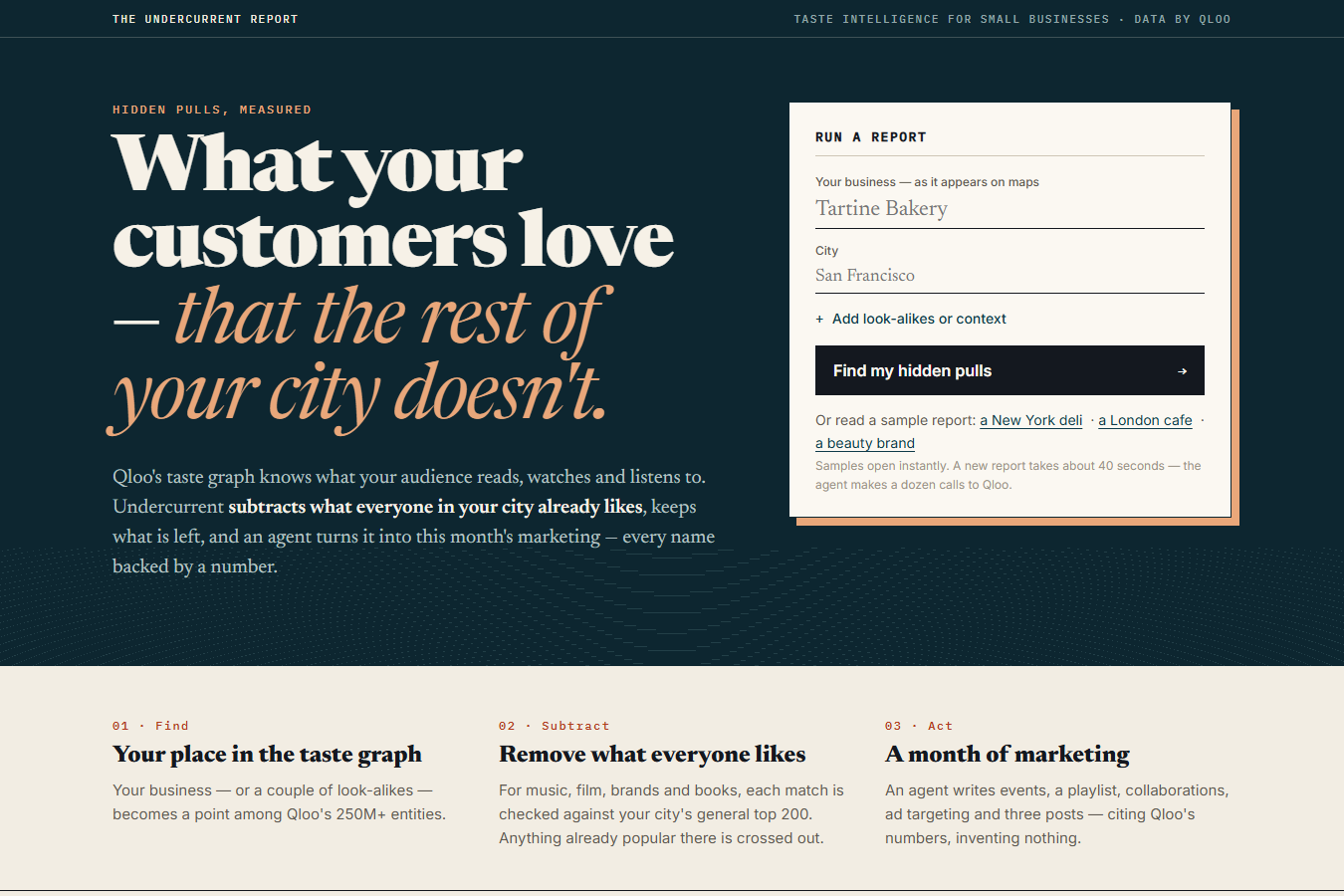
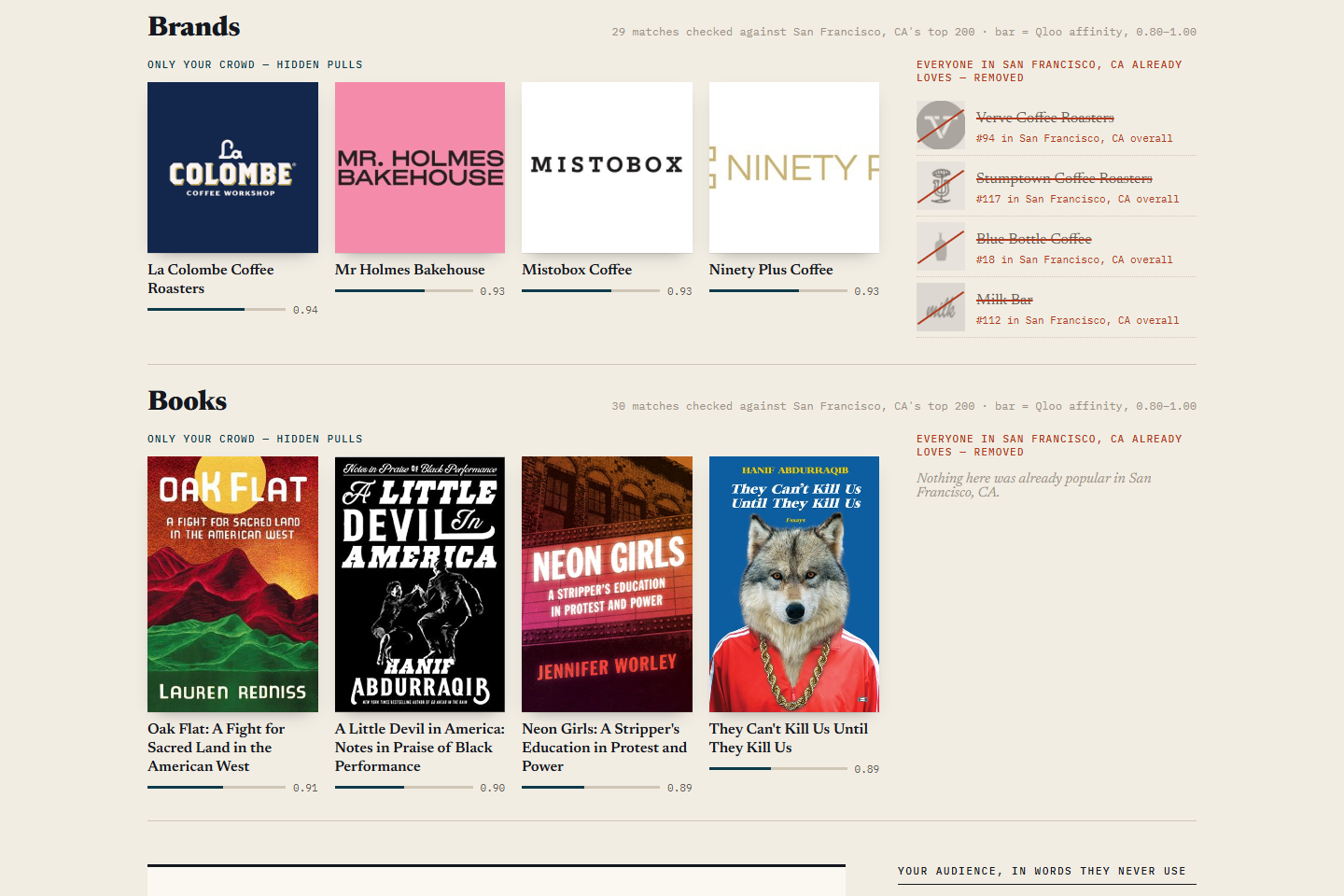
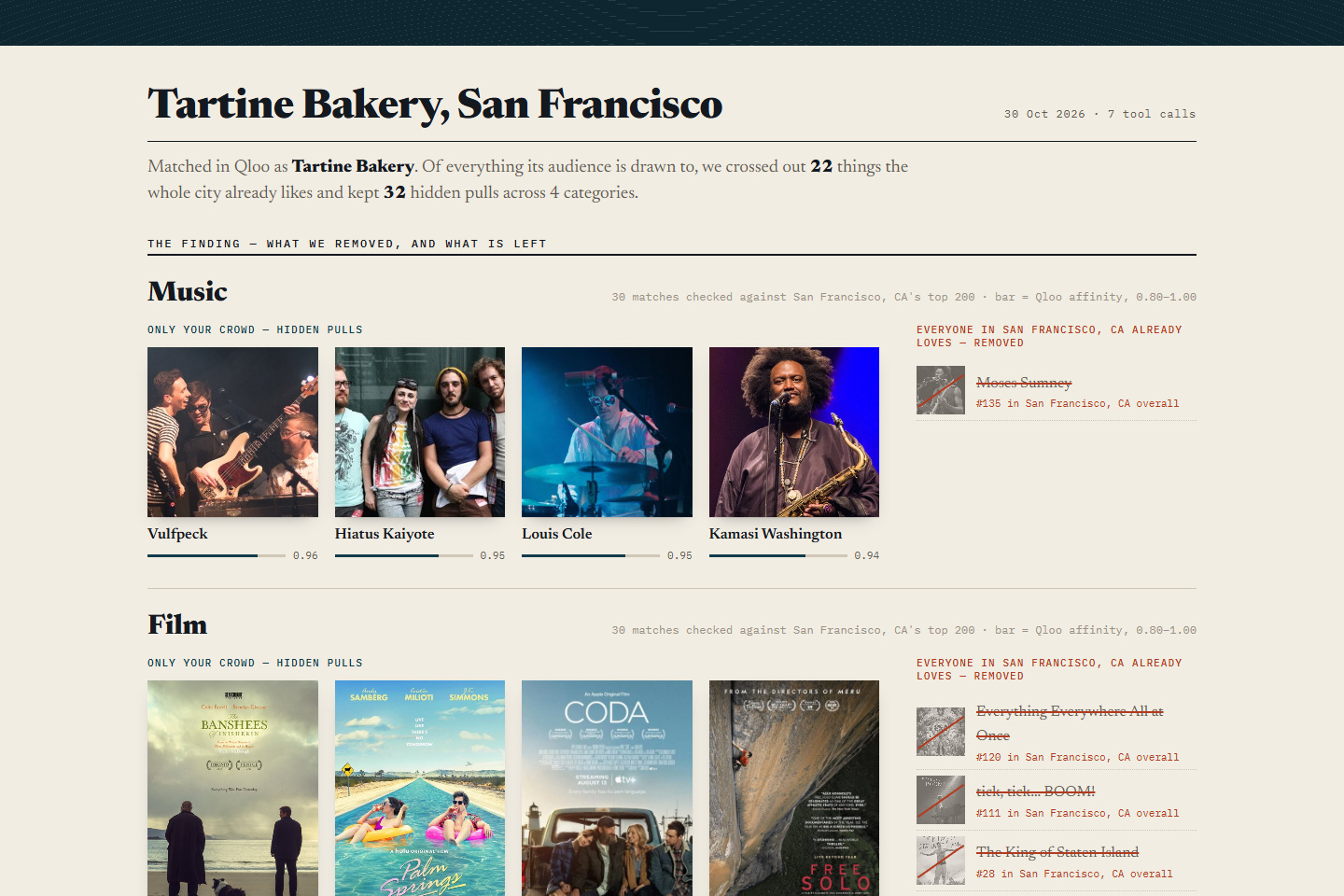
In 30 seconds. Type Tartine Bakery, San Francisco. Qloo says its audience matches Blue Bottle and La Colombe. But Blue Bottle is #18 for all of San Francisco — everyone there likes it — so Undercurrent drops it. La Colombe is not in the city's top 200: that is a hidden pull the bakery can actually use (a guest roast, a co-branded morning). An LLM alone can't tell those two apart; it takes Qloo's taste graph and a local baseline. Try it: https://undercurrent-ai.pages.dev (the three examples load instantly).
Inspiration
Small businesses market on what customers say: "the coffee is good", "the staff are nice". Every competitor says the same thing, so everyone markets the same way. The reasons people actually keep coming back usually sit outside the business's own category — the films, music, books and brands its customers love. Customers can't put that into words, a survey won't surface it, and an LLM on its own can only guess. Qloo's taste graph doesn't have to guess.
What it does
You type your business name (and optionally a city and one or two look-alikes). The agent:
- Finds you in Qloo's graph (
/search). If you are too small to be in it, it uses your look-alikes and tells you so. - Describes your customers with taste keywords (
/v2/insights,urn:tag). - Finds hidden pulls — for music, film, TV, brands, books and podcasts, what Qloo associates with your audience (
signal.interests.entities+ explainability). - Subtracts the obvious. Qloo's affinity is normalised per query, so a top result can just be something everybody likes. Undercurrent pulls the general top 200 for the same category in your city and checks every match against it. Not in that top 200 = hidden (a pull your audience has that the city at large doesn't). In it = removed as "everyone likes this", and the page lists what was removed with its local rank. We report only that comparison — no made-up score — and if the baseline call fails, nothing is called hidden.
- Finds neighbours — nearby places whose audience overlaps yours, for collaborations (
urn:entity:place+filter.location.query). - Writes the playbook — an event, a product or menu idea, a playlist, local collaborations, ad-targeting interests and three ready-to-post captions, each citing the Qloo numbers behind it.
Example from a recorded test run (Russ & Daughters, New York): 4 categories measured against New York's top 200; 25 matches removed as popular with everyone there (e.g. The Infatuation #9, Sorry to Bother You #17); hidden pulls that remained include Ariel Pink and Don't Think Twice; 10 neighbouring places for collaborations. Full log of three industries plus two inputs that must be refused: E2E_TESTS.md in the repo.
How we built it
- A plain HTML page on Cloudflare Pages; a Pages Function runs a Gemini function-calling loop over four Qloo-backed tools:
find_entity,taste_keywords,hidden_pull,neighbor_partners. - The Qloo key stays server-side. Every Qloo call is shown on the page ("How the agent worked"), so judges can see the evidence trail.
- Guard rails: no Qloo evidence → no plan (the agent says it couldn't find you instead of inventing one, including when Qloo only returns unrelated matches); at least four categories are measured before writing, enforced in code; the playbook may only name entities returned by the tools; records with zero popularity in the graph are skipped; per-visitor daily limit and a total spend cap in Cloudflare KV.
Challenges we ran into
- A baseline is harder than it looks. Qloo's insights endpoint needs at least one signal and returns at most 50 results, so "the general public" can't be an empty query. We use the business's city (or the United States) as the neutral signal and read four pages (top 200) — with only the top 50, almost nothing overlapped and everything looked "hidden". The city also turned out to be the better comparison: what your audience loves more than your neighbours do.
- Small independents often aren't in the graph yet; look-alike seeding keeps the tool useful for them, and the agent says when it used them.
What we learned
Affinity alone tells you what's close, not what's distinctive. And these are tastes Qloo associates with a business's audience — useful direction for marketing, not a survey of its actual buyers, so the playbook words them that way. The interesting signal is the difference between a taste profile and its surroundings — that's what a marketer can actually act on.
What's next
- Save a business profile and re-run monthly to see the undercurrent shift.
- Export ad audiences directly to Meta/Pinterest interest targeting.
- Compare two locations of the same business.
Built With
- cloudflare-kv
- cloudflare-pages
- cloudflare-workers
- gemini
- javascript
- qloo


