-
visual-direction-keyframe
Inspiration
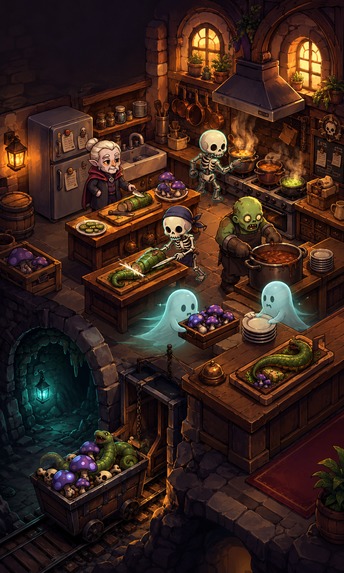
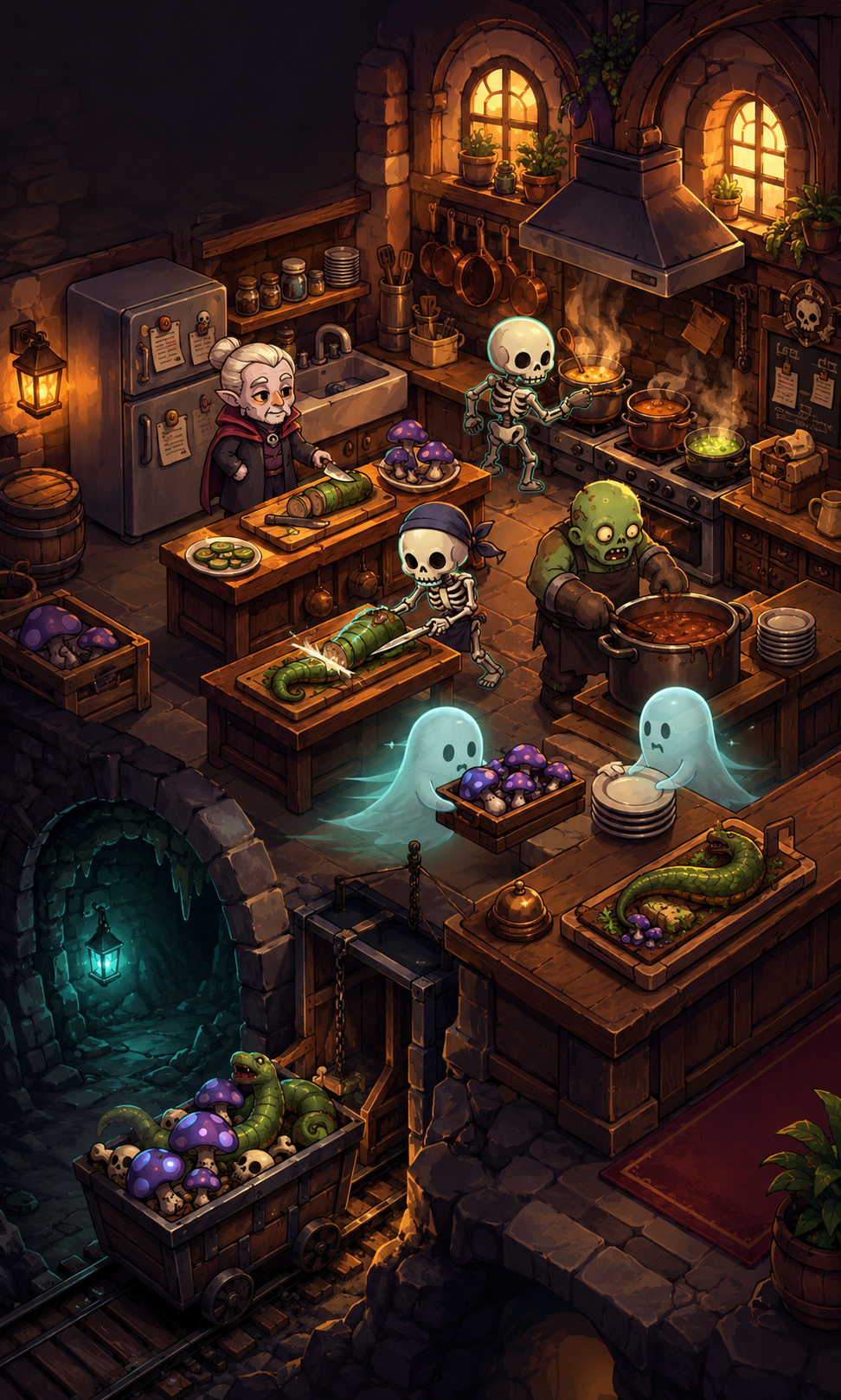
Fantasy necromancers usually command undead armies in battle. Undead Bistro asks what happens after one retires and applies those same unusual management skills to a quieter ambition: running a cozy restaurant beside a dungeon.
What it does
Undead Bistro is a portrait mobile Simulation & Management game. Players send undead crews along automatically resolved dungeon routes to gather dangerous monster ingredients, then create simple Condition -> Action -> Target rules that automate the kitchen.
Skeletons, zombies, and ghosts are not cosmetic workers. Each has practical strengths and limitations that affect poison handling, carrying capacity, movement, and production reliability. When an automation rule fails, the kitchen pauses and presents an actionable Error Trace so the player can understand, revise, and verify the process.
Design approach
The experience is built around high decision density with low input pressure. Every required command stays inside a compact, one-handed Management Console that follows familiar mobile app conventions such as lists, scrolling, back navigation, and explicit confirmation. The upper Performance Stage remains visible for observation and feedback without becoming a precision-control surface.
Dungeon exploration is deliberately treated as supply-chain planning rather than combat. Route risk, Freshness, Weight, staff capabilities, ingredient traits, orders, and Workstations all feed into the same management loop.
Challenges
The main challenge was controlling scope while preserving meaningful system depth. The dungeon needed to create supply decisions without becoming a separate action game, while the portrait interface needed to support automation rules without feeling like a programming tool.
Accomplishments and learning
The resulting pre-production package connects the first 15-minute player journey, visual direction, interaction model, MVP content contract, validation targets, and an eight-week Unity production plan around one testable hypothesis: revising an understandable automated process can be more satisfying than rapid tapping.
What's next
The next step is a 10-15 minute Unity vertical slice that validates rule creation, readable failure diagnosis, one-handed staff assignment, and successful recovery from the authored first-session contamination event.


Log in or sign up for Devpost to join the conversation.