Inspiration
We were brainstorming what to build for this hackathon. I had three ideas, and my teammate had three more. Before we had written any code, we already had a problem to solve: how do we choose?
We could explain why we liked our own ideas, but we needed more than opinions. What had other people already built? Were we solving a real problem? What would make one direction worth pursuing over another?
That conversation became our idea. We built Golden Egg to help teams work through the same decision we were facing.
Choosing a project shapes everything that follows, yet teams often make that choice with scattered searches, incomplete information, and whoever makes the most convincing argument. We wanted a shared place to explore possibilities, find evidence, and reach a decision everyone had helped make.
What it does
Golden Egg helps teams take an early idea through research, criticism, revision, and a final decision.
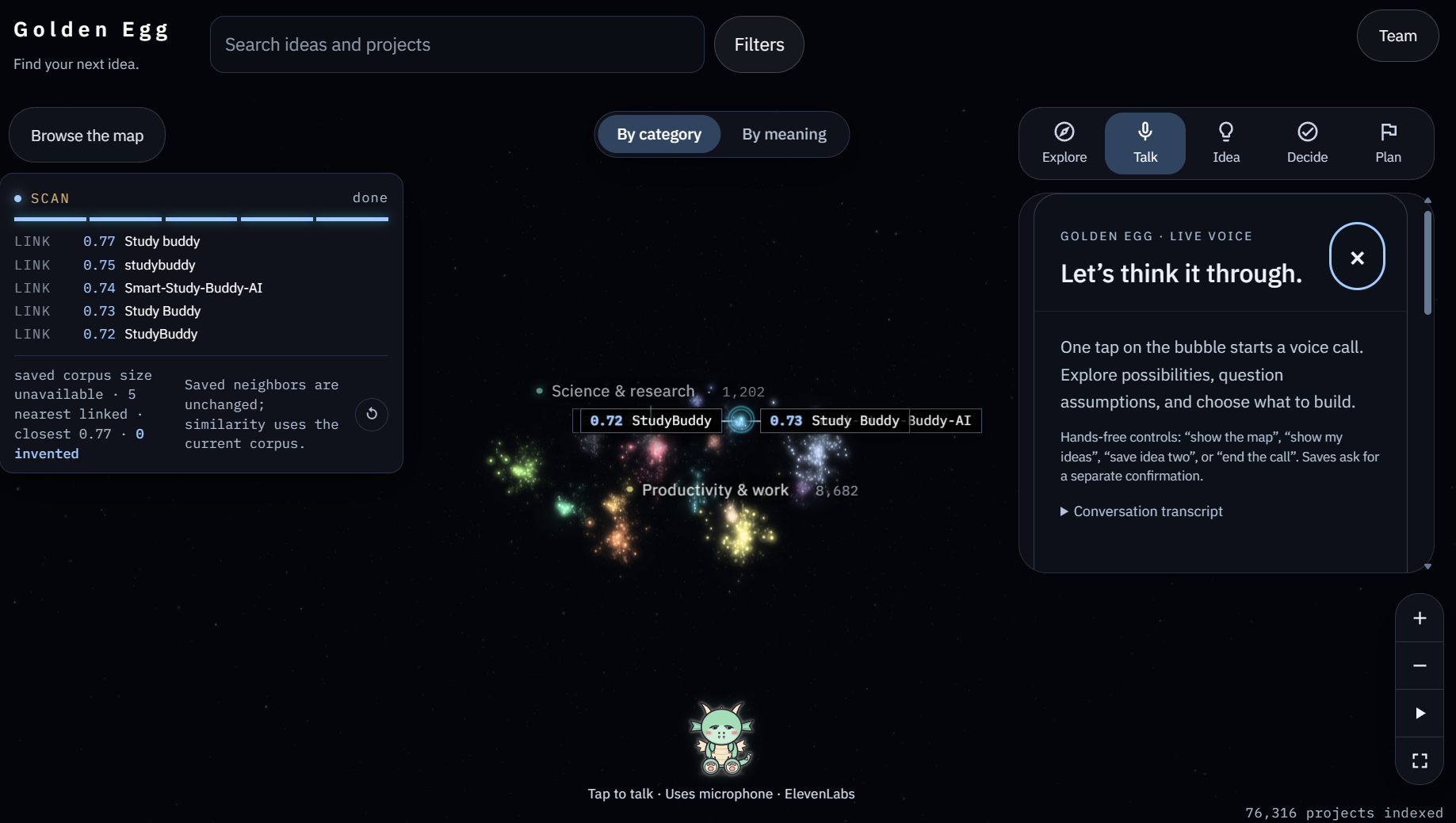
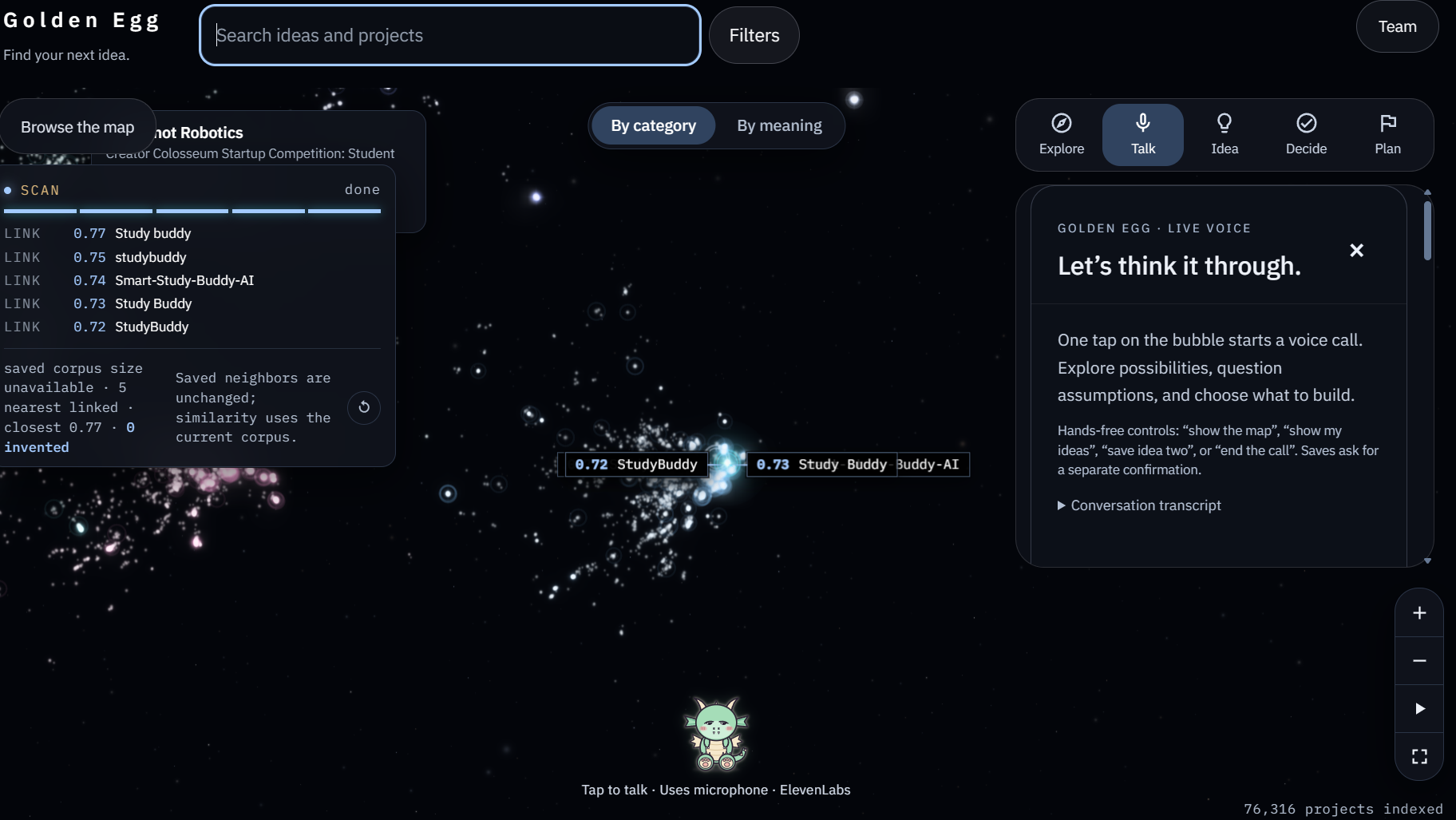
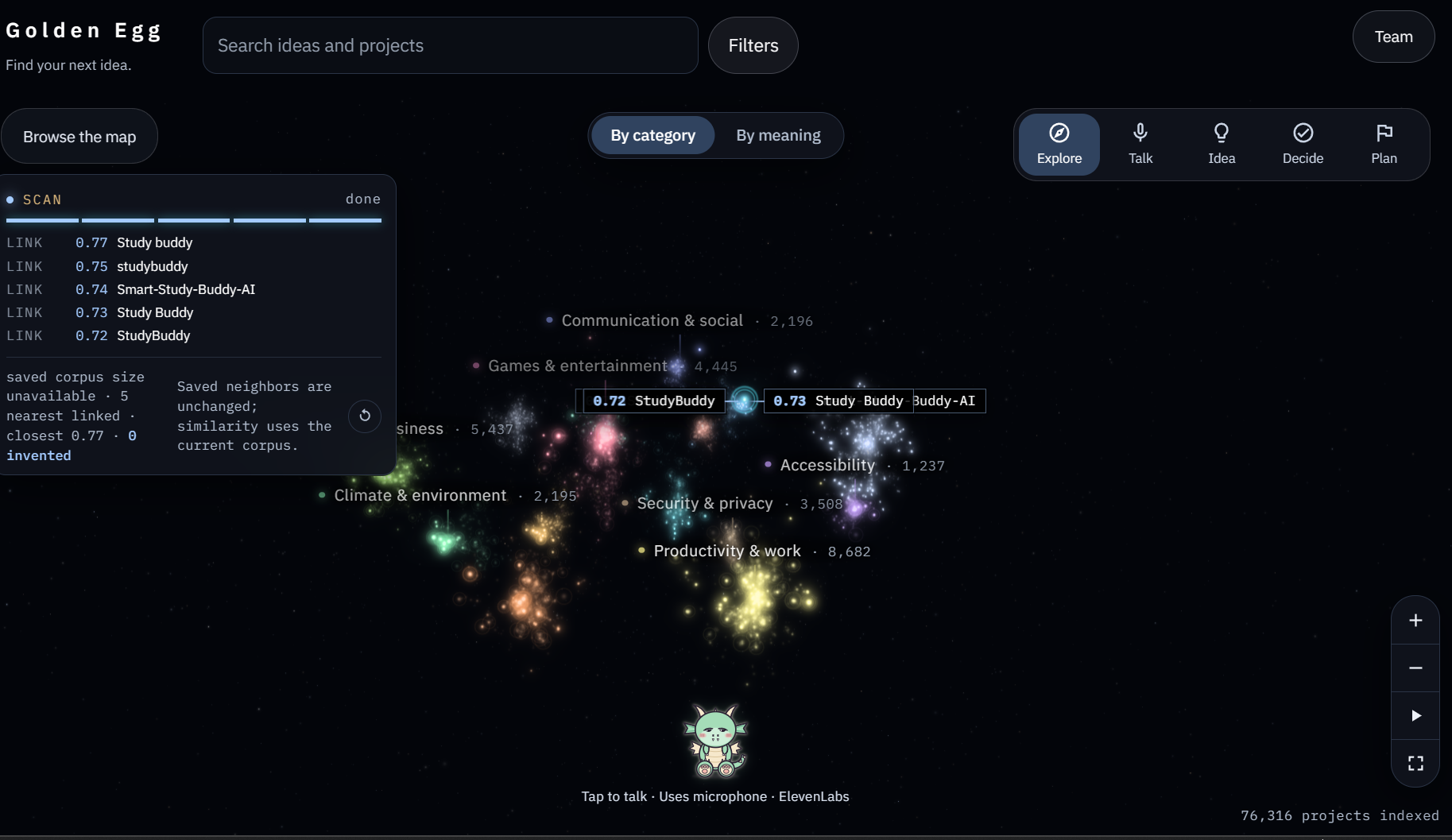
It starts with an interactive 3D map of more than 57,000 real hackathon projects. Each star represents a project and links back to its source. Teams can explore what people have built, discover related work, and find inspiration.
Type an idea or speak it aloud, and Golden Egg finds projects with similar meaning. Comparison cards explain what overlaps, what differs, and which existing project presents the strongest alternative. The map helps you explore, while the underlying search determines which projects are actually relevant.
Teams can then investigate the questions that matter before committing:
- Does evidence suggest this problem exists?
- What related tools are already available on GitHub or Hugging Face?
- Which assumption would a judge, potential user, or engineer challenge?
The critic asks one question at a time, giving the team room to respond and rethink. Teams can accept a revision, keep their original idea, or branch into several directions.
When it is time to choose, both teammates vote privately. Their choices remain hidden until both have voted. The selected version becomes a fixed decision snapshot, with a read-only link and QR code for sharing.
Finding a similar project does not have to end an idea. It can help a team identify a more specific user, a missing capability, or a better approach.
How we built it
The foundation is a searchable collection of real projects. Our Python pipeline collects public Devpost pages, removes duplicate and near-empty records, and converts project descriptions into numerical representations of their meaning using BAAI/bge-m3. We store those vectors in Neon Postgres with pgvector.
New ideas use the same embedding model. We compare them against the stored projects using cosine similarity. Separately, UMAP projects the collection into three dimensions for visualization. Keeping these calculations separate matters: a star's position on the screen is not a reliable measure of how similar two ideas are.
We built the app with Next.js and TypeScript. React Three Fiber and Three.js render the galaxy, with the stars stored in a single GPU point buffer.
Gemini generates comparisons, critiques, revisions, and branches, while Google Search grounding supports problem research. Model responses must pass schema validation before reaching the interface. Claims carry labels distinguishing source-supported information, inference, and unverified statements.
ElevenLabs provides live speech transcription. The server issues a single-use session token so the API key stays out of the browser.
The engineering extends beyond asking a model for feedback. Golden Egg maintains a searchable project collection, retrieves relevant evidence, tracks idea versions, coordinates two participants, enforces private voting on the server, and preserves the final decision as a fixed snapshot. Those behaviors require application state, database logic, and verification alongside the model.
Challenges we ran into
Expanding the collection from 8,409 projects to more than 57,000 initially made our search worse.
Near-empty project pages were appearing as matches for unrelated ideas. Their vague descriptions placed them close to many short queries in the embedding space. We filtered out 187 low-information records and checked the results against known queries. That experience taught us that collecting more data only helps when the data is useful.
The larger collection also increased exact similarity search time from roughly 36 milliseconds to about 0.8 seconds. We kept exact search for this version because relevant results were worth the extra wait.
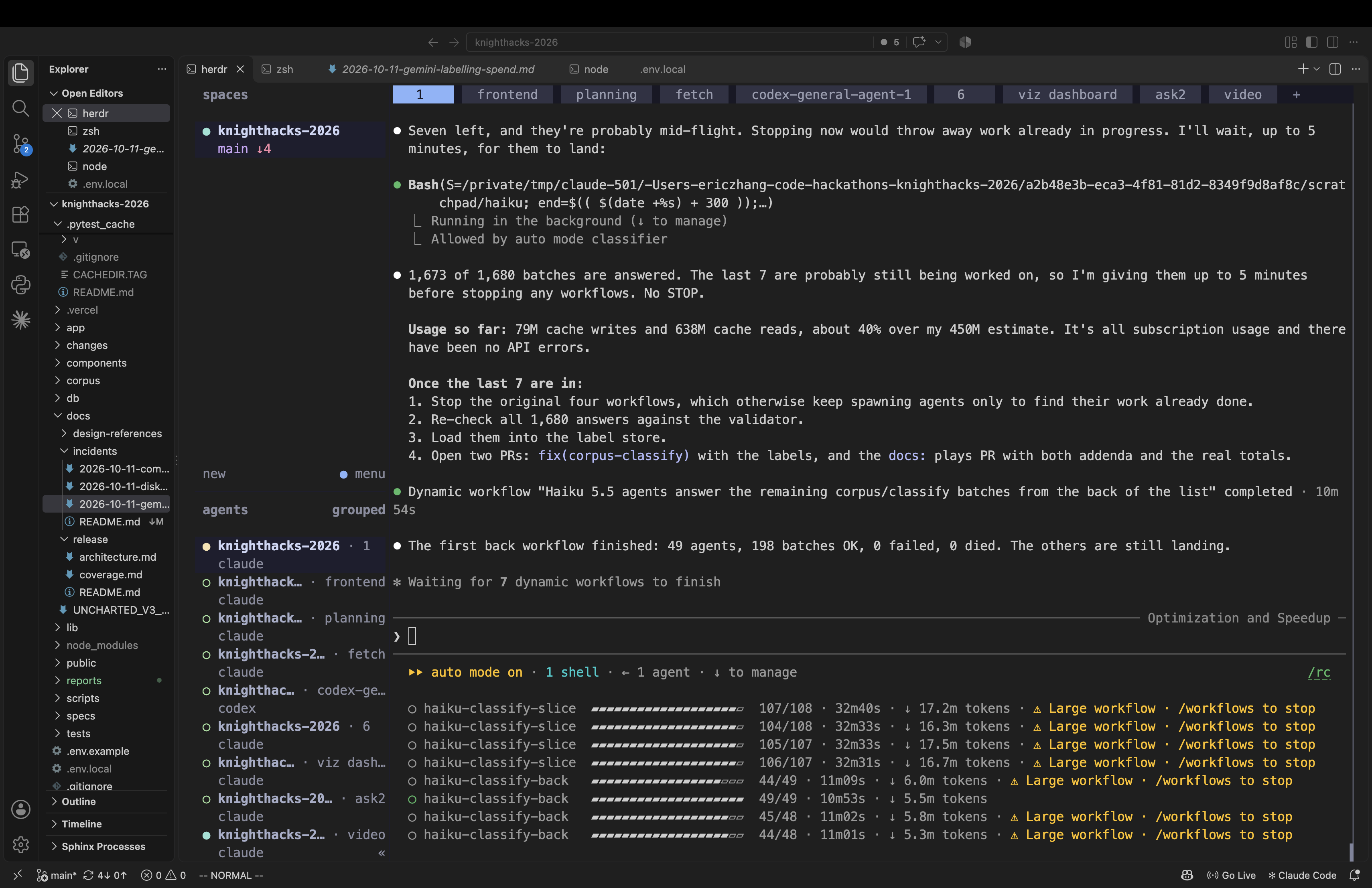
Coordinating coding agents across two laptops presented another challenge. We used written specifications, pull requests, ownership checks, CI, and verification before merging. When two agents attempted competing production updates, a safety check caught the changed state and prevented the second write. We learned why release coordination needs one clear source of truth.
Accomplishments that we're proud of
We built a working path from an uncertain idea to a shared decision. A two-browser verification run with live Gemini covered idea entry, evidence, criticism, revision, branching, private voting, and the final shareable snapshot.
We also made important promises enforceable. Vote privacy is checked at the API response level. Later edits cannot change a shared decision snapshot. Missing evidence remains visible, and empty space on the map is never presented as proof that an idea is original.
What we learned
Useful feedback needs evidence and a clear next step. A question about one specific assumption gives a team something to investigate or change.
We also learned to distinguish passing automated tests, successful live API calls, and verified production behavior. Each answers a different question about whether the app works.
What's next for Golden Egg
We want to expand the project collection while keeping search accurate and responsive, add current event projects alongside past submissions, and let teams compare ideas against sponsor challenge requirements.
The goal stays close to the conversation that started this project: help a team with six possible ideas understand which one they want to spend their weekend building, and why.
Built With
- bge-m3
- drizzle
- elevenlabs
- gemini
- hugging-face
- neon
- next.js
- pgvector
- playwright
- postgresql
- python
- react
- react-three-fiber
- three.js
- typescript
- umap
- vercel
- vitest


Log in or sign up for Devpost to join the conversation.