Inspiration
Onchain products usually serve one of two crowds: traders who optimize for return, or gamers who chase progression and status. They rarely overlap. But strategy games already fuse both instincts in one person — every decision is a cost/risk/payoff calculation (a trader's mindset), while players also pour resources in for status and pride. We bet that this overlap is where onchain gaming finds its product-market fit.
What it does
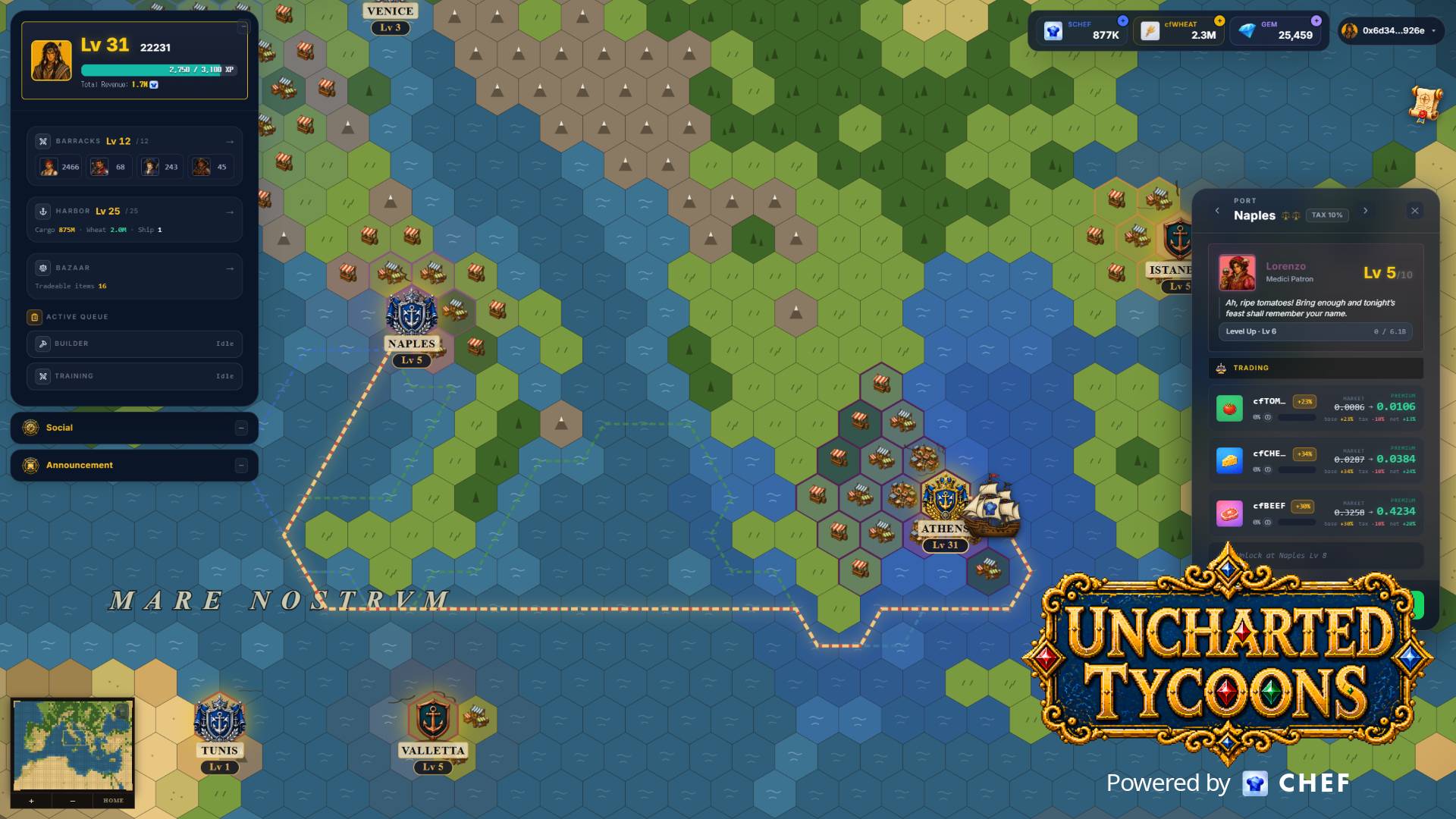
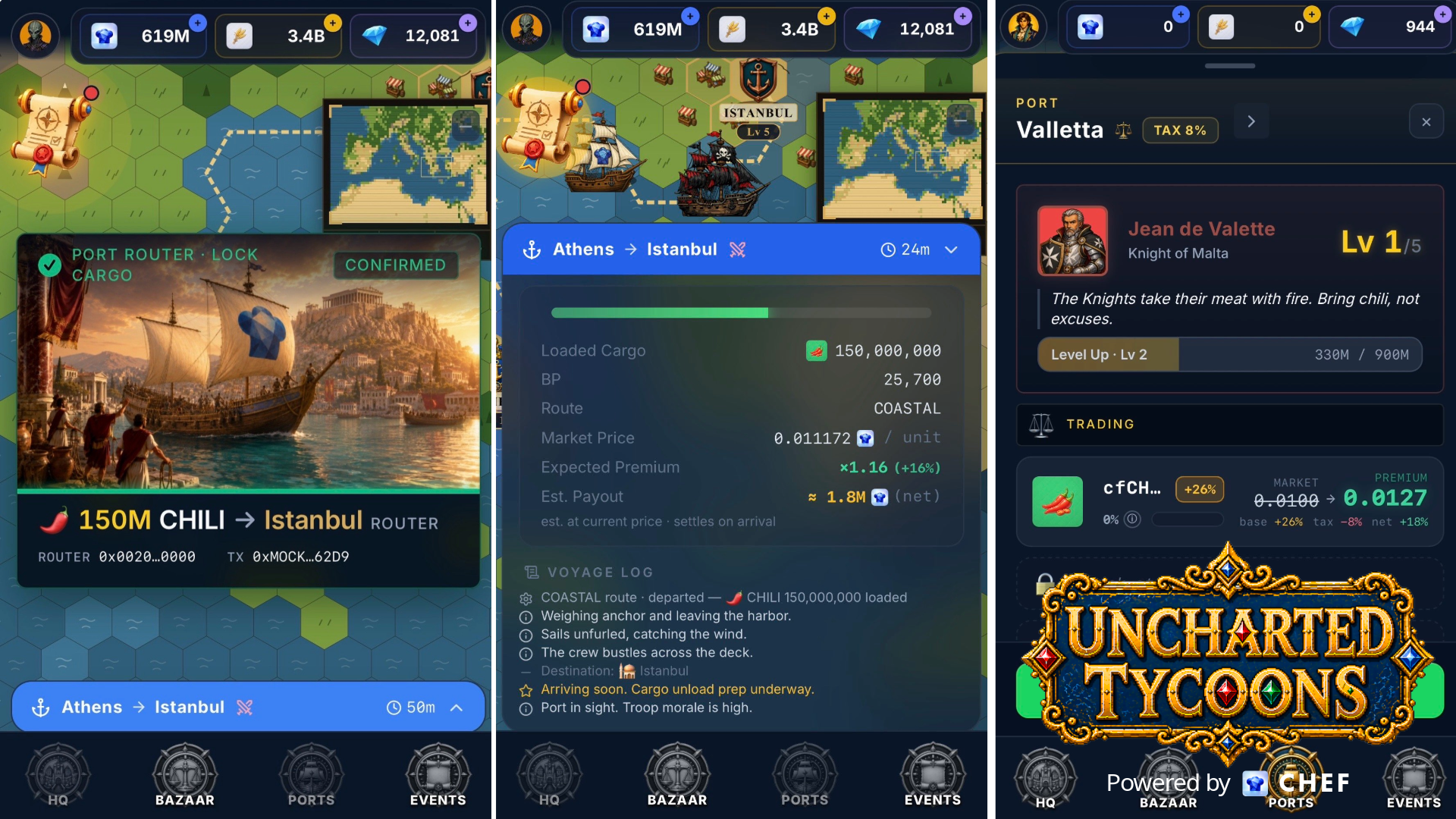
Uncharted Tycoons is a 4X-style maritime trading strategy game on Base. You sail from Athens across 13 Mediterranean ports, buy cargo (Ingredient Tokens) on a Mint Club bonding curve, and trade across ports whose demand and pricing shift dynamically. You build and upgrade ports, train crews, manage fleets, choose routes with different risk levels, and fight pirate encounters — all settled onchain, with a server-authoritative ledger keeping the economy fair.
How we built it
A React 19 + TypeScript frontend (Vite, Tailwind, Zustand) talks to Base via Wagmi/viem. Contracts are written in Solidity with Foundry; the token economy runs on Mint Club V2 bonding curves with $CHEF as the reserve. Auth is Sign-In with Ethereum; balances, rewards, and progression live in a server-authoritative ledger on Neon Postgres via Vercel serverless functions. A merchant AI agent ("Marco Polo") operates the live market.
Challenges we ran into
The hardest part wasn't the blockchain — it was the economy. Early on it was static and exploitable: prices didn't react to activity, so players could farm one optimal route forever, and hand-balancing one port's pricing quietly broke the equilibrium elsewhere days later. AI can write code in seconds, but figuring out why an economy quietly destabilizes days later is a different problem. We solved it by introducing an agent layer: a merchant AI ("Marco Polo") that reads onchain activity and adjusts port pricing weights and virtual inventory in real time — within strict permissions (it can shape the market but never sell, withdraw, or transfer). Market saturation is enforced server-side, and the agent's interventions surface to players as live market events. The result is a market that self-adjusts instead of a spreadsheet we patch by hand.
What's next
Expanding the live economy, seasonal events, and deeper agent-driven market dynamics as we head toward launch.
Built With
- base
- chatgpt
- claudecode
- foundry
- mint-club
- neon
- openclaw
- postgresql
- react
- siwe
- solidity
- tailwind
- typescript
- uniswap
- vercel
- viem
- vite
- wagmi
- zustand

Log in or sign up for Devpost to join the conversation.