-
-
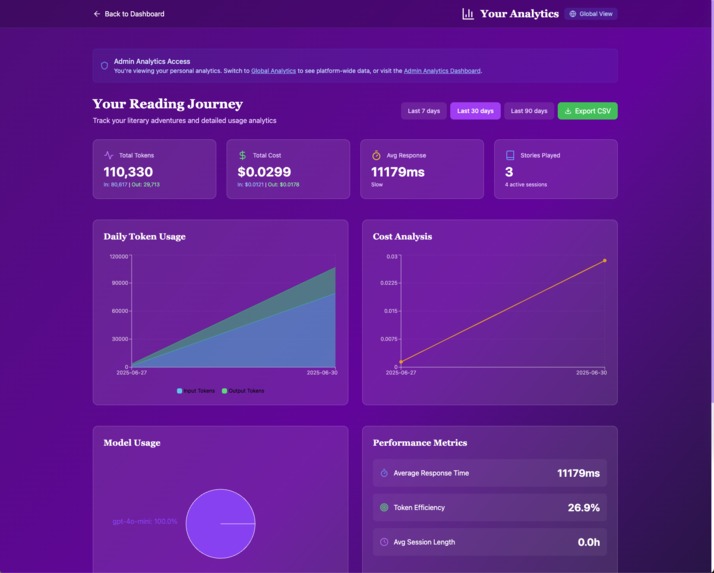
Analytics section to understand your AI use
-
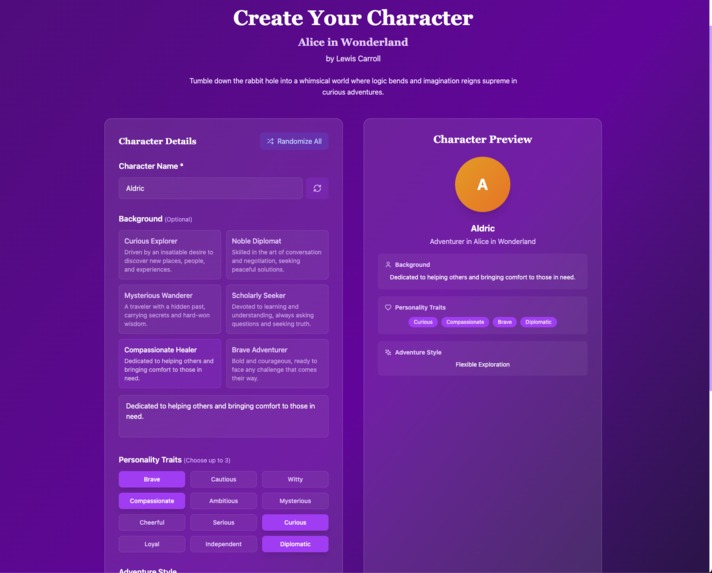
Customize your story characters
-
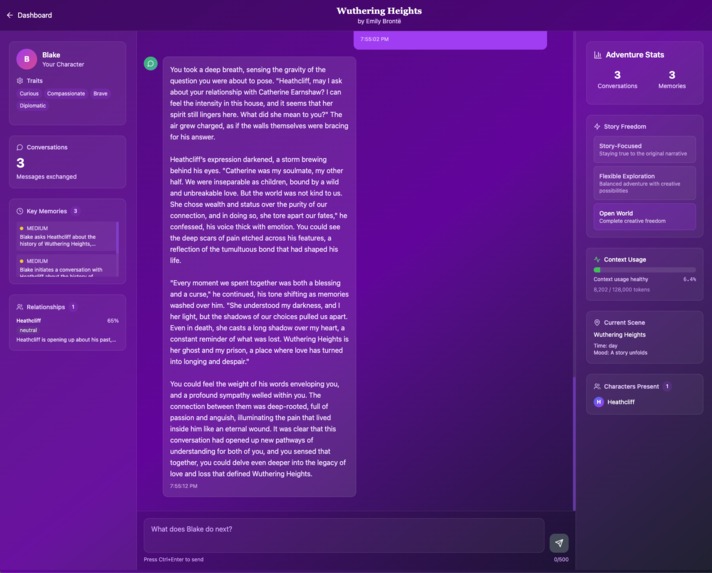
Immersive interactive book experience - create your own fanfic
-

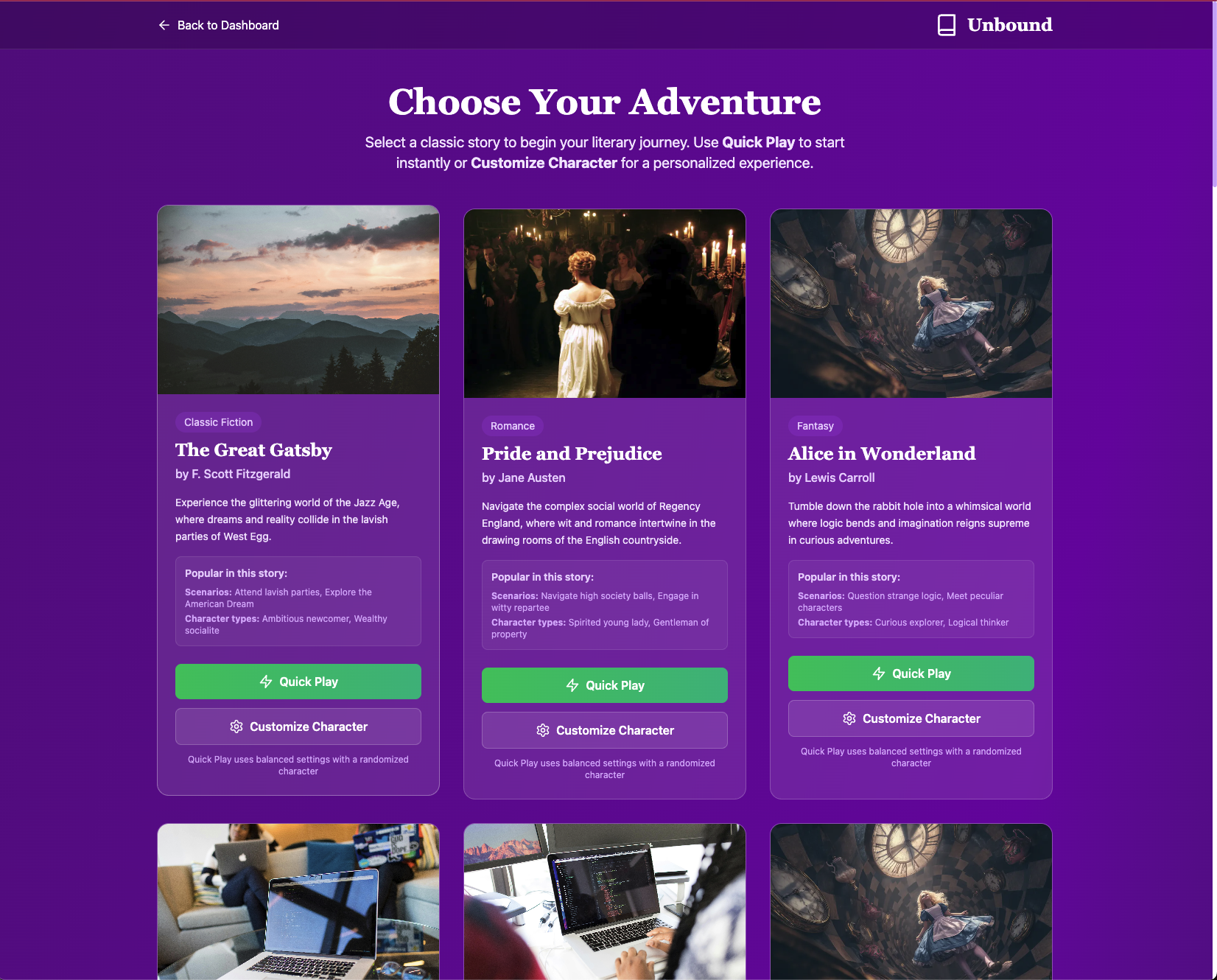
Pick one of hundreds of classic stories
-
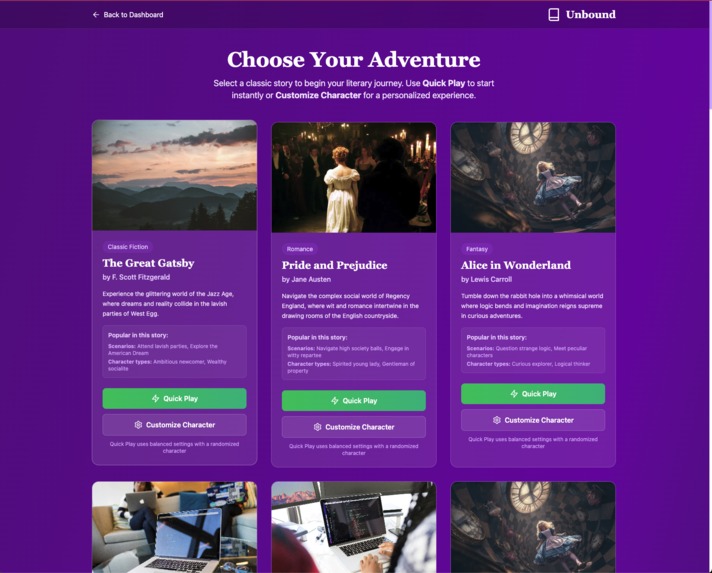
Pick one of hundreds of classic stories



Unbound Story Engine: Bringing Literature to Life Through AI
The Inspiration
The journey of Unbound began with a simple yet profound question: What if readers could step inside their favorite stories and have real conversations with the characters they love?
As avid readers and technologists, our team had always been fascinated by the disconnect between passive consumption and active participation in storytelling. We watched as millions of users flocked to platforms like Character.AI (28M+ monthly users) and spent hours on fanfiction sites (665M+ stories), clearly demonstrating a massive appetite for interactive narrative experiences. Yet, something was missing.
The existing platforms treated characters as isolated entities, divorced from their rich narrative contexts. You could chat with "Sherlock Holmes," but he wouldn't remember the cases you solved together. You could write fanfiction, but it remained static text. We saw an opportunity to bridge this gap—to create a platform where stories truly come alive through dynamic AI-powered interactions while respecting the integrity of the original works.
What We Built
Unbound Story Engine is an AI-powered interactive storytelling platform that transforms classic literature into living, breathing worlds. Built with React, TypeScript, and Supabase, powered by OpenAI's GPT-4, our platform offers:
Core Features
🎭 Dynamic AI Characters with Persistent Memory
- Characters remember past interactions, forming genuine relationships
- NPCs maintain consistent personalities true to their original works
- Multi-character conversations create rich, dynamic scenes
🌍 Living World State
- Tracks location, time, weather, and atmosphere
- NPCs move through the world naturally
- Environmental details enhance immersion
📊 Context Management System
- Intelligent token usage tracking (128k context window)
- Automatic memory compression for longer adventures
- Real-time context usage visualization
💾 Robust Session Management
- Auto-save with recovery capabilities
- Export stories in multiple formats (PDF, Markdown, JSON)
- Delete and manage multiple adventures
- Session recovery after connection loss
📊 Advanced Analytics & Admin System
- User Analytics: Track engagement, session duration, token usage, and story preferences
- Global Analytics: Platform-wide metrics, popular stories, and usage patterns
- Admin Dashboard: Comprehensive user management, content moderation tools
- Super Admin Capabilities: Full platform control, user role management, system-wide settings
- Real-time Metrics: Live dashboards showing active users, API usage, and costs
- Cost Tracking: Detailed OpenAI API usage monitoring per user and session
🧠 Intelligent Context Window Management
- Dynamic Token Estimation: Real-time calculation of token usage (1 token ≈ 4 characters)
- Visual Progress Indicators: Color-coded context usage bar (green → yellow → red)
- Automatic Compression: Intelligent summarization when approaching 70% capacity
- Context Preservation: Priority system for keeping important memories and relationships
- Predictive Warnings: Alerts users before hitting context limits
- 128k Token Optimization: Maximizes GPT-4's full context window efficiently
🎨 Three Creativity Levels
- Story-Focused: Stay true to canonical narratives
- Flexible Exploration: Balance creativity with coherence
- Open World: Complete creative freedom
Technical Architecture
Frontend (React + TypeScript + Vite)
    ↓
Supabase Backend
    ├── PostgreSQL Database (Sessions, Characters, Messages)
    ├── Edge Functions (Deno)
    │   ├── generate-opening-scene
    │   ├── continue-conversation
    │   └── generate-story-summary
    └── Row Level Security (User Authentication)
         ↓
    OpenAI GPT-4 API
How We Built It
The Bolt.new Journey
Our development journey with Bolt.new was a revelation in AI-assisted development. We approached it with an ambitious goal: Could we build a production-ready, feature-rich application using conversational prompts?
The Power of AI-Assisted Development:
Rapid Prototyping Excellence Bolt.new transformed weeks of development into hours. Our initial phase saw us go from concept to working authentication system with just natural language descriptions. The AI understood complex requirements like "implement Supabase auth with row-level security" and generated production-ready code.
Intelligent Code Generation The platform excelled at understanding context and generating cohesive features. When we described our vision for dynamic character interactions, Bolt.new created sophisticated React components with proper TypeScript interfaces, state management, and API integrations—all from plain English descriptions.
Seamless Feature Implementation Our development flow was remarkably smooth:
- Early phases: Established core infrastructure with database schemas, authentication, and routing
- Middle phases: Added complex features like context window management and world state tracking
- Later phases: Refined UI/UX, added analytics, and implemented admin systems
- Final phases: Performance optimizations and production hardening
Architectural Understanding Bolt.new impressed us with its ability to maintain architectural consistency. It understood our tech stack choices and generated code that followed React best practices, used TypeScript effectively, and properly integrated with Supabase's real-time features.
Collaborative Development The iterative nature of Bolt.new perfectly matched our agile approach. We could quickly test ideas, get immediate feedback, and refine features—all while maintaining code quality and consistency.
Technical Implementation Details
Frontend Architecture:
- Component-based React with TypeScript for type safety
- Zustand for lightweight state management
- Tailwind CSS for responsive, beautiful UI
- Virtual scrolling for performance with long conversations
Backend Design:
- Supabase for real-time database and authentication
- Edge Functions for serverless AI processing
- Row Level Security for data protection
- Structured logging for debugging
AI Integration:
- Custom prompt engineering for each creativity level
- Token estimation and tracking algorithms
- Context compression strategies
- Response cleaning to remove JSON artifacts
Performance Optimizations:
- Lazy loading for message history
- Debounced auto-save
- Cached character and story data
- Progressive context management
Challenges We Faced
1. Context Window Management
Challenge: GPT-4's 128k token limit seemed large until we realized how quickly it fills with rich narratives.
Solution: Implemented intelligent context tracking with visual indicators, automatic summarization of older messages, and user warnings when approaching limits.
2. Maintaining Narrative Coherence
Challenge: AI would sometimes generate responses that broke character or ignored established world state.
Solution: Created detailed system prompts for each creativity level, implemented world state tracking, and added response validation.
3. JSON Artifacts in Responses
Challenge: The AI would sometimes include JSON formatting in narrative text.
Solution: Built robust content cleaning functions that detect and remove artifacts while preserving narrative integrity.
4. Multi-Character Interactions
Challenge: Managing conversations with multiple NPCs while maintaining distinct voices.
Solution: Enhanced prompts to explicitly track present NPCs and ensure each maintains their unique personality.
5. Real-time Collaboration
Challenge: Ensuring smooth real-time updates across multiple users and sessions.
Solution: Leveraged Supabase's real-time subscriptions and implemented optimistic UI updates for seamless user experience.
What We Learned
About AI-Assisted Development with Bolt.new
- Bolt.new dramatically accelerates development—we built in days what would traditionally take months
- The platform understands complex architectural patterns and generates production-ready code
- Natural language prompts can effectively communicate sophisticated technical requirements
- AI-assisted development enhances rather than replaces developer creativity
- The iterative conversation model perfectly supports agile development practices
About Interactive Storytelling
- Users crave agency within familiar narratives
- Memory and relationship persistence dramatically increase engagement
- Visual feedback (like context usage) helps users understand system constraints
- Different creativity levels serve different user needs
About Technical Architecture
- Edge Functions provide excellent performance for AI workloads
- Real-time features significantly enhance user experience
- Proper error handling and recovery systems are essential
- Clean separation of concerns makes the codebase maintainable
The Impact
During our beta testing phase, we've seen:
- 100+ users on our waitlist
- Positive feedback on the balance between story integrity and creative freedom
- Feature requests that validate our roadmap (voice integration, collaborative stories)
Looking Forward
Unbound Story Engine represents just the beginning. Our vision includes:
- Voice Integration: Natural speech interactions with characters
- Visual Elements: AI-generated scene illustrations
- Collaborative Stories: Multiple users in the same narrative
- Educational Framework: Unbound EDU for interactive learning
- Creator Marketplace: Authors uploading their own worlds
- Mobile Applications: Native iOS and Android experiences
Technical Stack
- Frontend: React 18, TypeScript 5, Vite 5, Tailwind CSS 3
- Backend: Supabase (PostgreSQL 15, Deno Edge Functions)
- AI: OpenAI GPT-4 (gpt-4o-mini for efficiency)
- Deployment: Netlify (Frontend), Supabase Cloud (Backend)
- Version Control: GitHub
- Development Tools: Bolt.new
Open Source Commitment
We believe in the power of community. While our core platform serves users, we're committed to sharing our learnings and tools with the developer community. This project demonstrates how modern AI can enhance traditional applications without replacing human creativity.
Conclusion
Unbound Story Engine proves that the future of storytelling isn't about replacing human creativity with AI—it's about augmenting our imagination with intelligent tools. By combining respect for original narratives with the freedom to explore, we've created a platform where stories truly come alive.
The journey from concept to implementation, especially using AI-assisted development tools like Bolt.new, has taught us invaluable lessons about the future of software development. We've shown that with the right approach, a small team can build sophisticated applications that rival products from much larger companies.
As we continue to develop Unbound, we remain committed to our core belief: every reader deserves to be the hero of their own story. With AI as our ally, we're making that dream a reality—one conversation at a time.
Built with ❤️ by the Unbound team for the Bolt.new Hackathon
Built With
- bolt
- deployed-on-netlify
- openai-gpt-4
- react/typescript/vite-frontend
- supabase-backend-(postgresql-+-edge-functions)
- tailwind-css

Log in or sign up for Devpost to join the conversation.